Skip to content

AI-Augmented Development

What Happens When an AI Submits a PR and Another AI Reviews It

Recursive Refinement

We submitted a pull request to CrewAI adding a KCP manifest and TL;DR summary files. The goal was straightforward: contribute the same efficiency improvement that cut agent tool calls by 76% in our benchmark. Open it up, share the result, see if the maintainers want it.

What happened next was not what I expected.

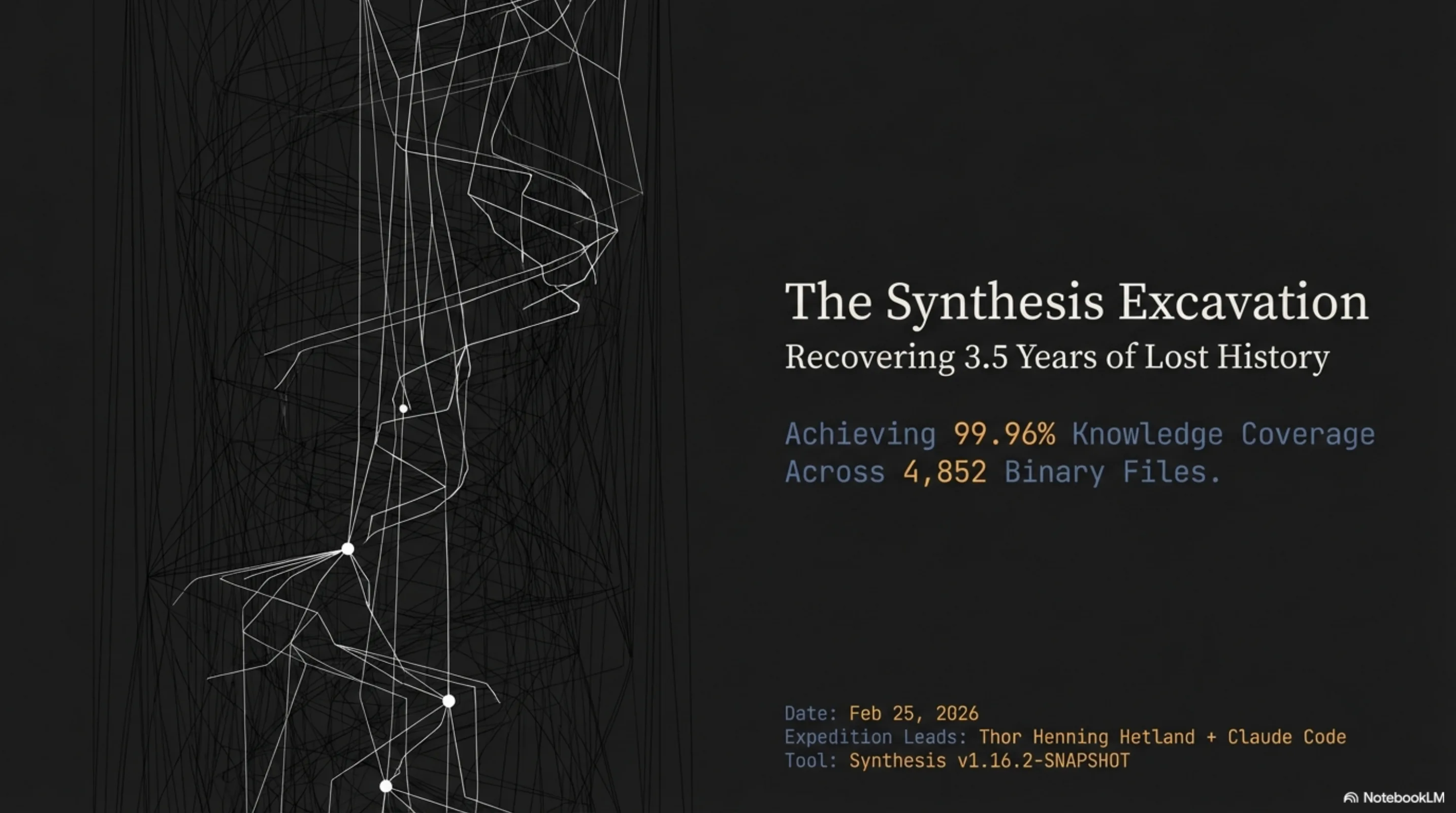
The Synthesis Excavation: Recovering 3.5 Years of Lost History

Title slide: The Synthesis Excavation — Recovering 3.5 Years of Lost History, achieving 99.96% knowledge coverage across 4,852 binary files

We build Synthesis — a knowledge indexing tool whose purpose is to make everything in a workspace searchable. We had been running it on our own workspace for months and the coverage number looked excellent: 99.6%. Nearly perfect.

That number was a vanity metric. It told us exactly what we wanted to hear while hiding what we needed to know. The real asset coverage was 15.2%.

I Wrote About Cloud Computing in 2009. Seventeen Years Later, I Have the Same Feeling.

In February 2009, I wrote a blog post called "Clouded Vision." The central argument was straightforward: "developers have fundamentally misunderstood how cloud computing delivers its benefits." They saw cheaper prices but never stopped to consider where the savings came from. They expected to move existing applications, full of what I called "enterprise DNA" -- static configuration, vertical clusters, high administration costs -- onto cloud platforms with minimal change. Then they complained when it proved difficult. I wrote nineteen posts about cloud computing that year. Most of them circled the same frustration: the industry was adopting a new technology while completely misunderstanding the structural shift it required.

I'm Scared of AI. That's Why It Works.

I need to confess something that most developers won't admit: I'm scared of AI. Not in the "Terminator will take over" way. In the very practical, keeps-me-up-at-night way: scared the AI is hallucinating and I can't tell the difference between correct code and plausible-looking garbage. Scared something will break in production because I trusted it too much. Scared I'm losing my edge as a developer because I'm delegating too much.

Building Together: An 11-Day Human-AI Collaboration Story

This is the full story of lib-pcb -- a production-grade PCB manufacturing library built in 11 days through human-AI collaboration. It started as a weekend experiment in an unfamiliar domain and became the most compelling evidence I have for what disciplined AI-augmented development can achieve.

It Started as a Weekend Experiment

"I wanted to see how far I could push Claude Code in a weekend," Thor Henning Hetland (Totto) explains. A software engineer with 40 years of experience, he'd watched the AI coding assistant landscape evolve from GitHub Copilot's autocomplete to full agentic systems. The domain he chose -- PCB manufacturing automation -- was deliberate: he had almost no knowledge of it. Could you actually build something production-ready in an unfamiliar domain? Could you maintain velocity as the codebase grew? Could the human's expertise grow alongside the AI, rather than atrophy?

Software Entropy at Speed

Fast development with AI doesn't just generate features. It generates disorder at the same velocity.

That's the part nobody talks about. The productivity numbers are real — 53,000 lines, 42 features, five phases of code analysis built in a weekend sprint. But every line you write is also a line you haven't reviewed, a boundary you haven't enforced, a vector you haven't considered.

The entropy compounds with the output.