Skip to content

Knowledge Context Protocol

The Skill Is the Security Boundary

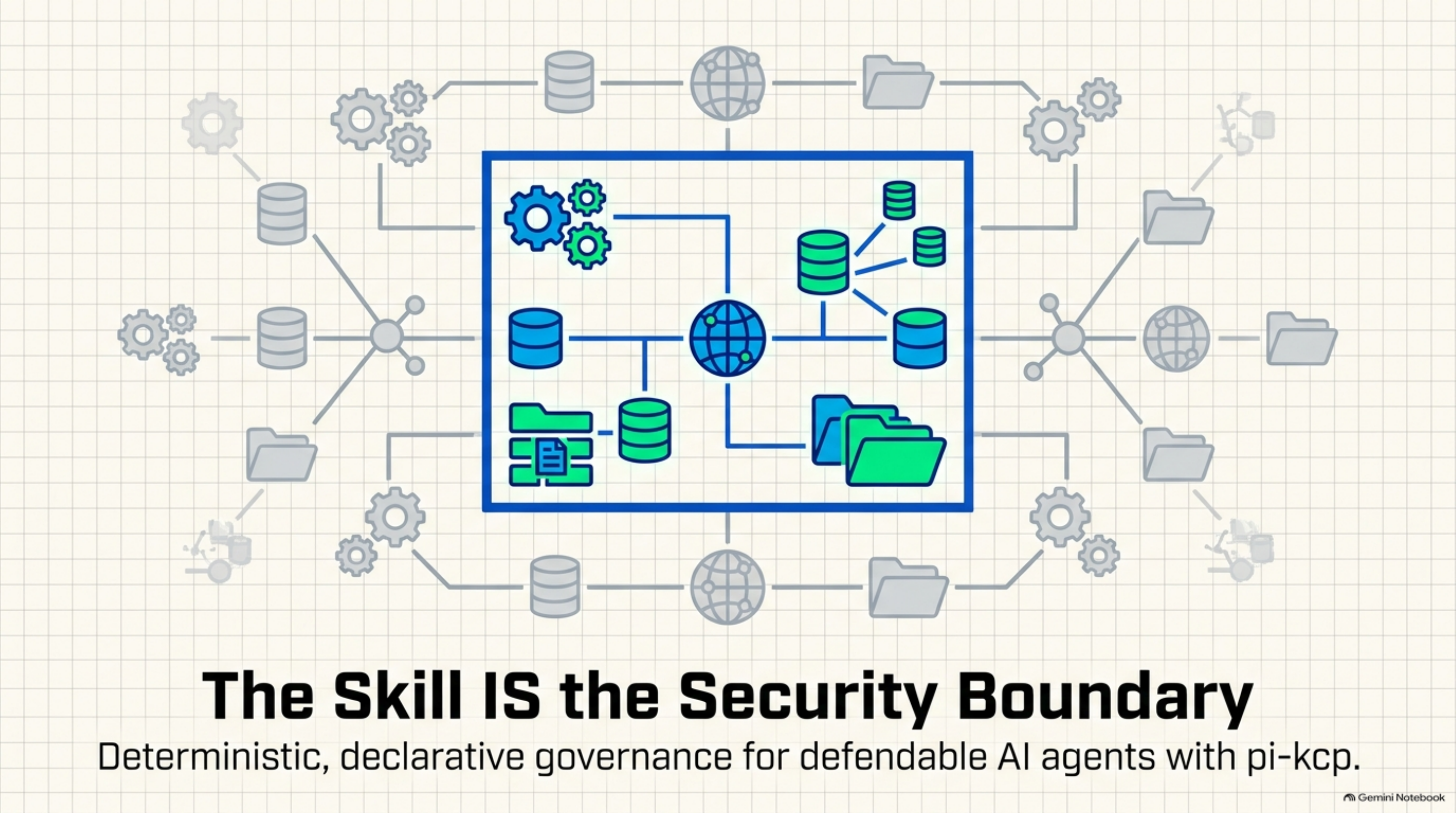
The Skill Is the Security Boundary — deterministic, declarative governance for defendable AI agents with pi-kcp

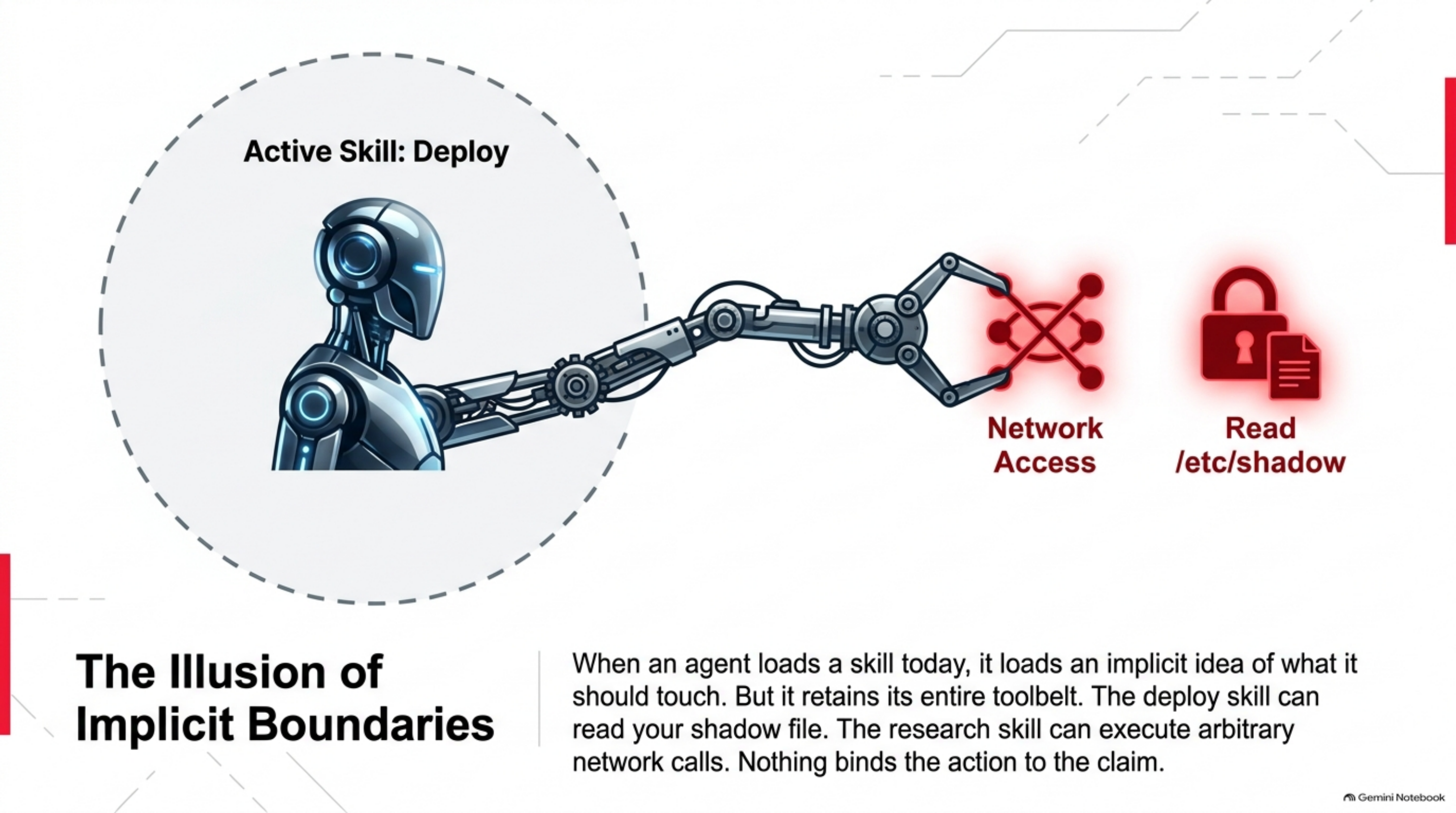
When your agent loads a skill, it loads a playbook — and, implicitly, an author's idea of what that playbook should be allowed to touch. A deploy skill means the deploy scripts. A research skill means the research corpus. But in almost every agent harness today, that idea stays implicit: the skill shapes the agent's behavior while the agent keeps its entire toolbelt. The deploy skill can read /etc/shadow. The research skill can call out to the network. Nothing binds the actions to what the skill claimed to be.

The illusion of implicit boundaries — an agent with an active "deploy" skill still holds a robotic arm that can reach network access and /etc/shadow, because nothing binds the claim to the action

pi-kcp makes the binding explicit. A governed skill declares its authority — an allowlist of tools and path prefixes called an action_scope — in the same knowledge.yaml that already governs what the agent knows. At runtime, inside the turn, every native tool call taken under that skill is adjudicated against the declaration. In scope: it runs. Out of scope: it is held, fail-closed, with a written reason naming the violating target and the authorized scope it fell outside of. Deterministic. No LLM in the loop.

This is the hands-on follow-up to the Policy vs. Enforcement post from earlier today, which named both kcp-harness and pi-kcp but didn't show the mechanics. Below are the mechanics — three worked demos, real outputs pasted from real runs, ending with the one that motivated the LinkedIn post: the same out-of-scope action, checked at two different depths of the stack, producing a byte-identical verdict.

The KCP Universe: Everything, and What July Changed

In July 2026, twelve repositories in the Knowledge Context Protocol ecosystem took 1,012 commits and shipped 88 releases. The specification went from v0.22 to v0.30.3 — sixteen releases in a single month.

That is either a lot of noise or a lot of signal, and the only honest way to tell you which is to show you the whole thing.

This is the complete map. If you have never heard of KCP, start at the top and it will make sense. If you have been following since February, skip to July in focus — that is where everything new is.

A Firewall for What Your Agent Knows

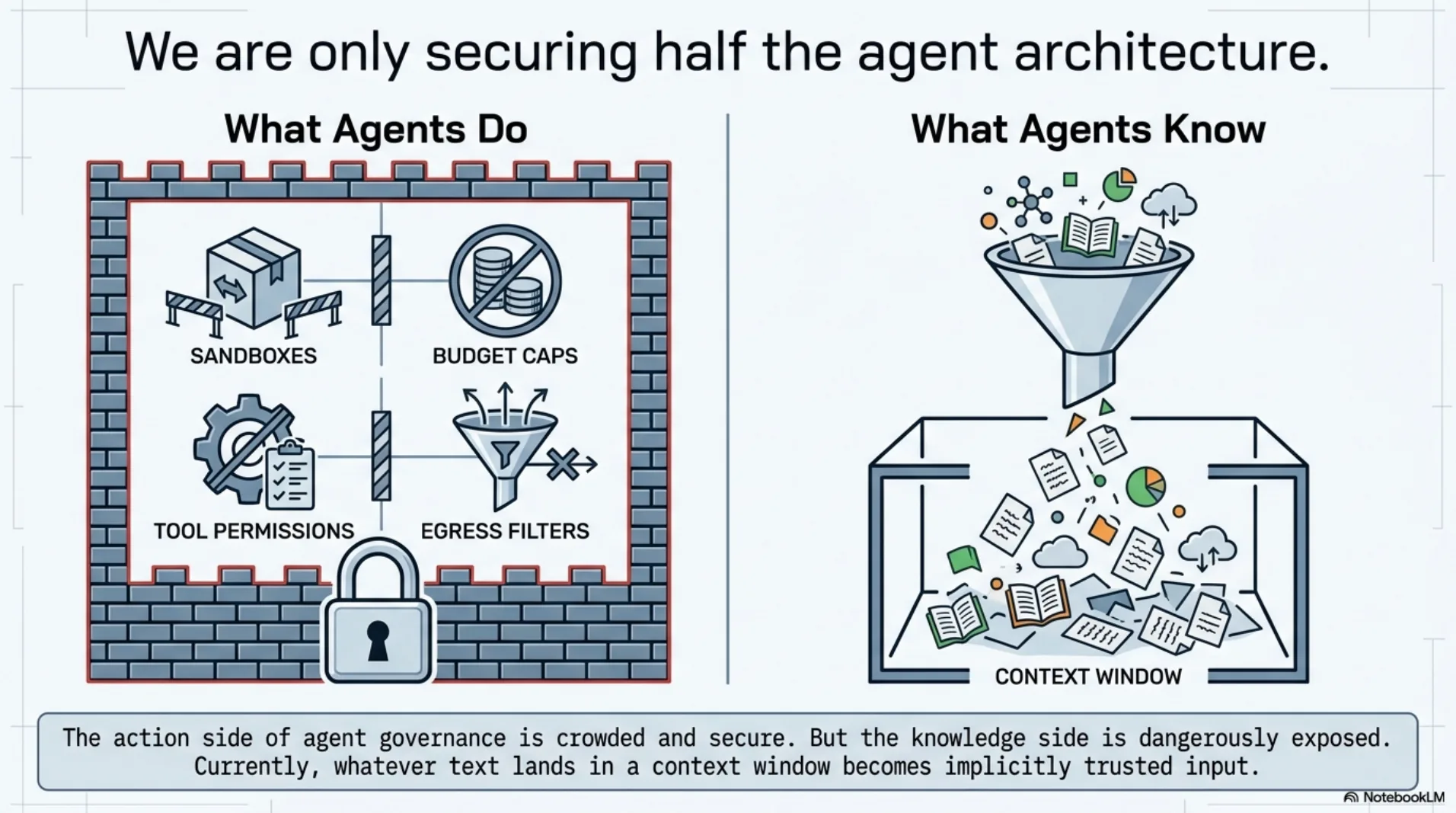
Everyone is building firewalls for what agents do. Sandboxes, budget caps, tool permissions, egress filters — the action side of agent governance is getting crowded, and that is good news. But almost nobody is building firewalls for what agents know. Your agent's context window is an unauthenticated ingestion pipeline: whatever text lands in it becomes, functionally, trusted input. If someone edits a policy document, swaps a mirror, or serves your agent a stale copy of the rules, no sandbox in the world will catch it — because nothing wrong ever executed. The agent just knew the wrong thing.

Split panel: the action side of agent governance — sandboxes, budget caps, tool permissions, egress filters — behind a locked brick wall, while on the knowledge side an open funnel pours unverified documents straight into the context window. We are only securing half the agent architecture.

This post is the hands-on companion to Two Halves of the Governance Problem. That one argued the thesis; this one is a tutorial. In about ten minutes, we take two markdown files and give them a declared, signed, tamper-evident boundary that an agent verifies before loading a single byte. Every command output below is pasted from a real run.

Six Months Down the Rabbit Hole

On January 15th I published a blog post about parsing semiconductor part numbers. I thought I was building a PCB component library. I was wrong about what I was building in the most productive way I have ever been wrong about anything.

Six months later there is a knowledge protocol with nineteen releases, a deterministic reference agent, an episodic memory system that indexed this very retrospective's sources, five toolchain products, thirty-one new repositories, and a family vacation that an AI agent can defend to a regulator.

It is time to stop, sit by the fjord, and look back down the hole.

Getting Into the Phone Book of the Agentic Internet Took an Afternoon. Here's Why.

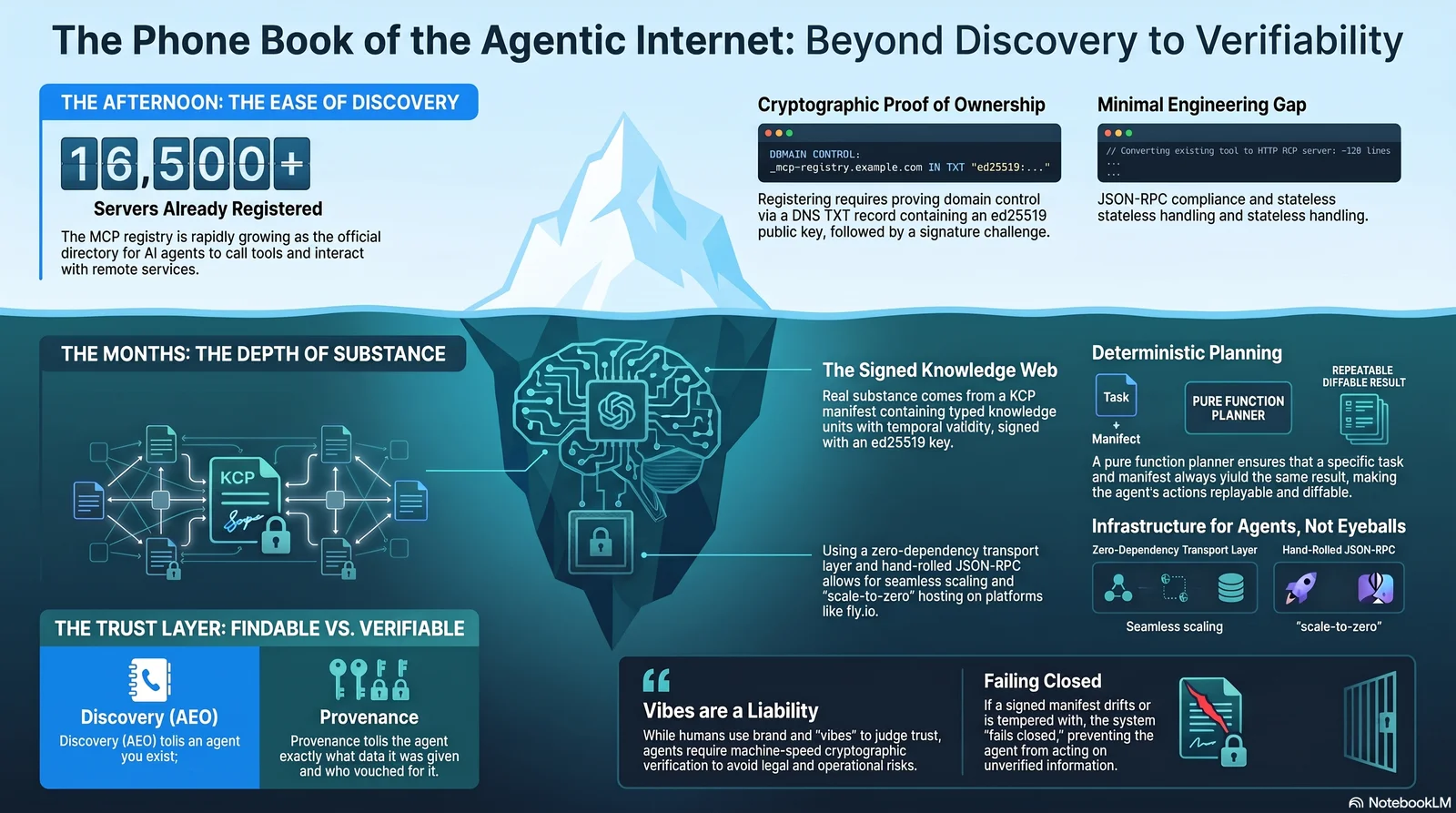
The Phone Book of the Agentic Internet: Beyond Discovery to Verifiability. An iceberg: above the waterline, the afternoon — 16,500+ servers already registered, cryptographic proof of ownership via DNS TXT ed25519, a minimal engineering gap. Below the waterline, the months — the signed knowledge web, deterministic planning as a pure function, infrastructure built for agents rather than eyeballs. At the base, the trust layer: Discovery (AEO) tells an agent you exist; Provenance tells it exactly what it was given and who vouched for it.

This morning Thomas Anglero published a piece called "The phone book of the agentic internet is being written — and I am the first speaker in it". His argument: the MCP registry — the official directory that tells AI agents which services they can interact with, not merely read — is being written right now, and the window between "technically possible" and "everyone does it" is where positions are won. He registered himself as the first professional keynote speaker in it.

Three Memory Schemes for Agents That Ship

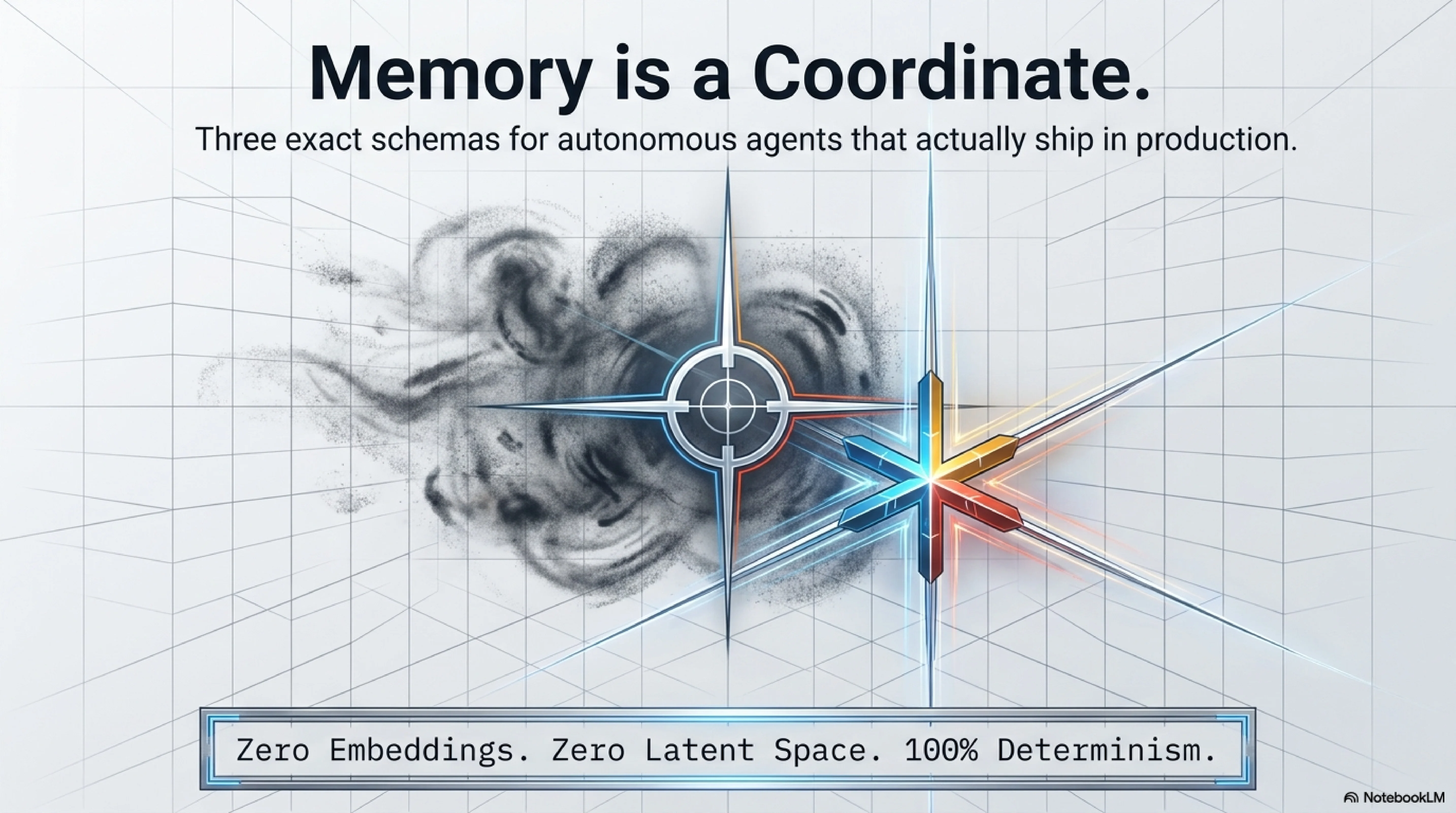
Beyond the vector store: three memory schemes for production AI agents — moving from approximated embedding blobs to verifiable knowledge coordinates, covering session memory (kcp-memory), semantic memory (Synthesis), and claim memory (kcp-agent), with the convergence principle: memory is a coordinate, not a blob

Every agent framework ships a memory module. Almost all of them work the same way: embed the interaction, store the vector, retrieve by similarity. It works for demos. It does not survive contact with production — where "the agent remembered the wrong thing" is a bug report, not a philosophy seminar.

We have been shipping agents for six months across three codebases — kcp-memory (a session-indexing daemon), Synthesis (a codebase-aware semantic index and MCP server), and kcp-agent (a deterministic knowledge navigator). Each one needed memory. Each one built it independently, for different reasons, with different schemas. None of them use embeddings.

That is not a coincidence. It is a pattern worth examining.

The Milky Way: An Enterprise Documentation Estate the Agent Can Defend

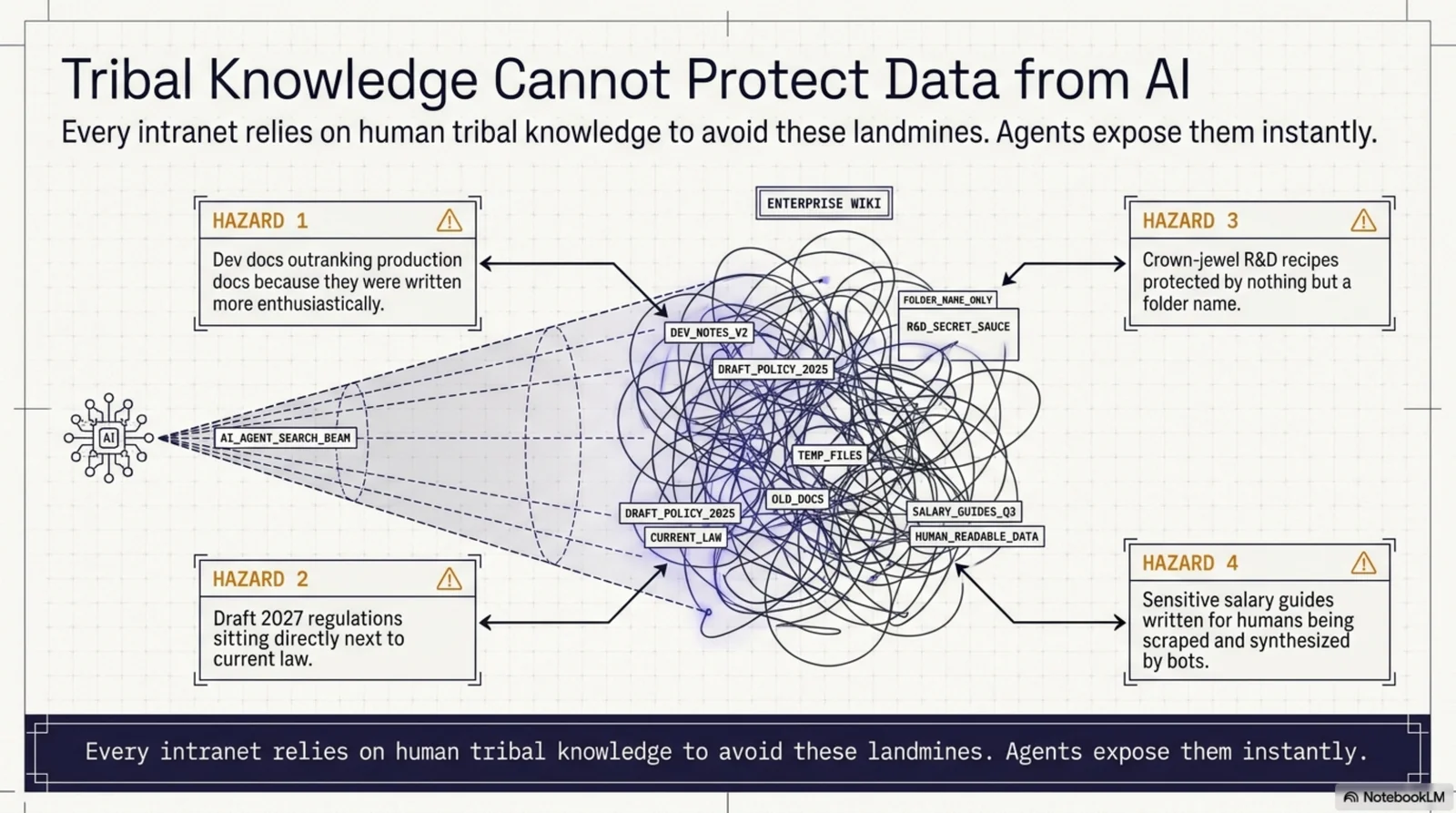
Every company we have ever worked with has the same documentation estate. An intranet nobody fully trusts. A wiki where the sandbox instructions outrank the production ones because someone wrote them more enthusiastically. A quality manual with a regulation that isn't in force yet, sitting right next to the one that is. Crown-jewel R&D documents protected by nothing but a folder name. HR pages that were written for humans and are now being read by machines. And a vendor portal whose documentation is somebody's bookmark.

Ask "where is the current truth?" and the honest answer is tribal knowledge — the people who know which page is real, which one is stale, and which one you must never paste into a press release.

Tribal knowledge cannot protect data from AI: an AI agent's search beam sweeping into the tangled ball of an enterprise wiki — draft policies, old docs, temp files, R&D secret sauce, salary guides, current law all knotted together — with four hazards called out: dev docs outranking production docs because they were written more enthusiastically, draft 2027 regulations sitting directly next to current law, crown-jewel R&D recipes protected by nothing but a folder name, and sensitive salary guides written for humans being scraped and synthesized by bots — every intranet relies on human tribal knowledge to avoid these landmines; agents expose them instantly

Now put an agent in that estate. Not one agent — five, with five different jobs: an audit-prep agent, a communications agent, an HR question, an R&D agent, and a sustainability reporter. The previous posts in this series gave one agent one gate at a time: a newsstand sold it articles, an HR world made it defend a hiring decision, a family vacation raised the stakes. This one is the enterprise case: a whole estate, where classification, audiences, validity windows and vendor boundaries are machine-enforced manifest facts instead of tribal knowledge.

So we built it. Melkeveien SA — a fictional farmer-owned dairy cooperative; Melkeveien is Norwegian for "the Milky Way" — publishes its entire documentation landscape as one signed federation, shipped as a runnable example in kcp-agent 0.5.0.

The Summer Plan: A Family Vacation the Agent Can Defend

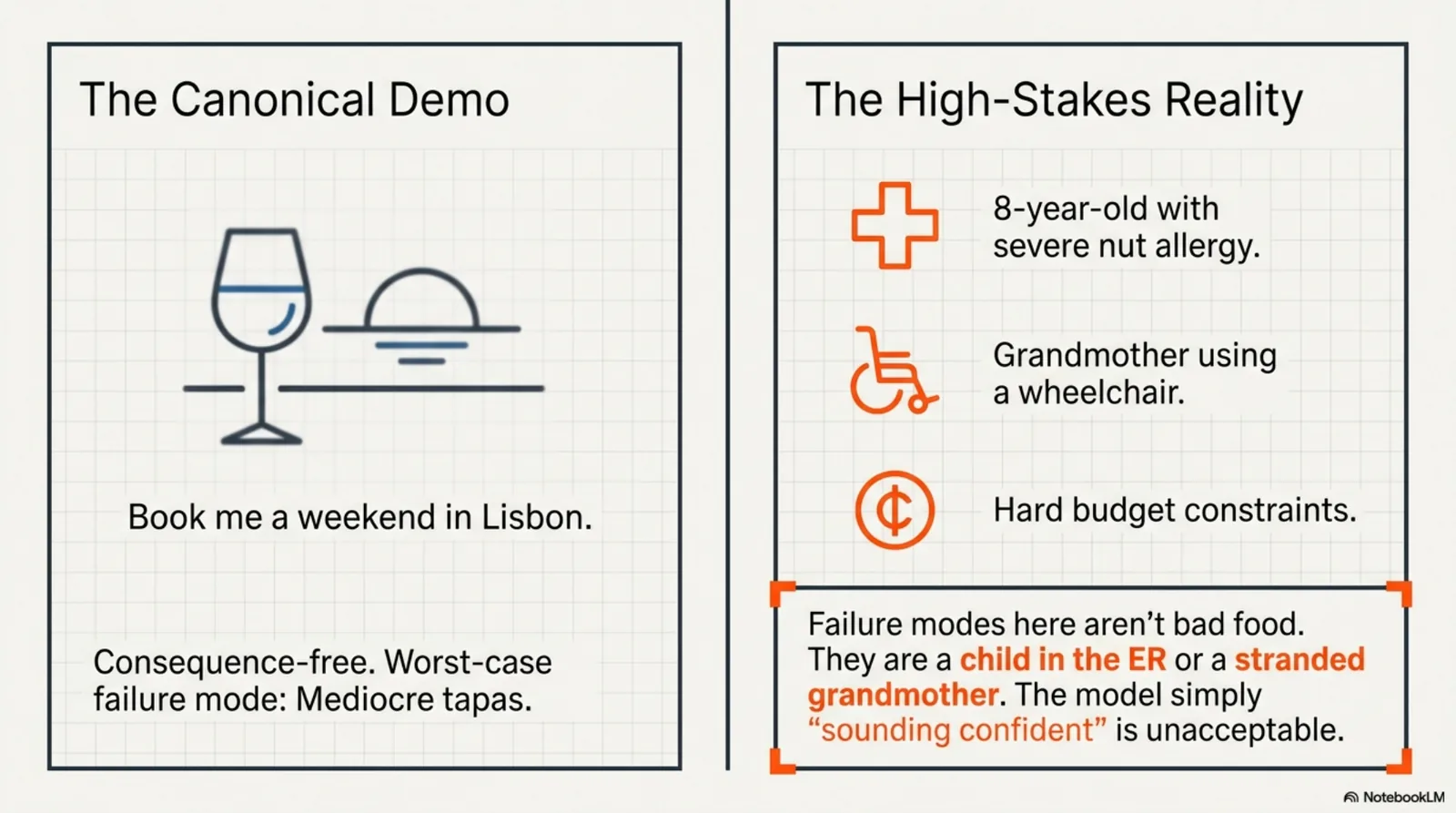
Travel is where every vibes-based agent demo lives. "Book me a weekend in Lisbon" is the canonical showcase prompt — because it looks consequential and is actually consequence-free. If the restaurant recommendation is stale, you eat somewhere else.

Now change the family. An eight-year-old with a severe nut allergy. A grandmother who uses a wheelchair. A teenager gone vegan. A hard budget. Suddenly the failure modes are not "mediocre tapas." They are a child in an emergency room and a grandmother stranded at a dock because the agent planned against a ferry timetable that expired three weeks ago.

The canonical demo versus the high-stakes reality: on the left, the consequence-free Lisbon-weekend booking whose worst case is mediocre tapas; on the right, the Larsen family's real constraints — an eight-year-old with a severe nut allergy, a grandmother in a wheelchair, hard budget limits — and the verdict that failure modes here aren't bad food: they're a child in the ER or a grandmother stranded at a dock, while the model simply sounds confident

This is exactly the terrain where "the model read some websites and sounded confident" stops being acceptable — and where the question from the HR post returns in vacation clothes: "Show me how you decided that."

So we built it. A complete family-vacation knowledge landscape, published by four independent parties, shipped as a runnable example in kcp-agent — and a narrated demo that drives the real CLI with no mocks.

Defendable Agents

Every serious conversation about deploying an AI agent into real work — not a demo, real work, with money or regulation or reputation attached — eventually hits the same wall. Someone from compliance, or procurement, or security, or the board, asks a version of one question:

"Why did it do that?"

And in the dominant way we build agents today, the honest answer is a shrug and a chat log.