Skip to content

May 2026

From Policy to Practice: How KCP Makes Regulations Machine-Readable for AI Agents

A presentation version of this post is available as slides.

Your agent reads customer data. It makes a decision. It writes something to a database.

Somewhere in your system prompt, there is a line that says: "You must comply with GDPR data minimization principles when accessing customer data."

That line does nothing. It is not verifiable. It is not testable. It is not auditable. It is a string that your model may or may not attend to, depending on context length, prompt position, and the phase of the moon.
The Beginning

How a PCB library, a knowledge system, and a naming conversation became a brand.

eXOReaction has been around for a while. This is not a story about starting a company. It is a story about what happens when a practice inside an existing company grows distinct enough that it needs its own identity.

Ægis is that practice. ægis.no went live last week. This is the origin story — not the polished version, the one with dates and git logs.

The Harness Before the Service

In May 2026, Anthropic shipped Managed Agents. I read through the docs, the API spec, the beta header (managed-agents-2026-04-01), and felt something I can only describe as architectural recognition.

Not surprise. Recognition. The way you recognize your own design decisions in someone else's implementation — because the problem space, if you take it seriously, produces the same structural answers.

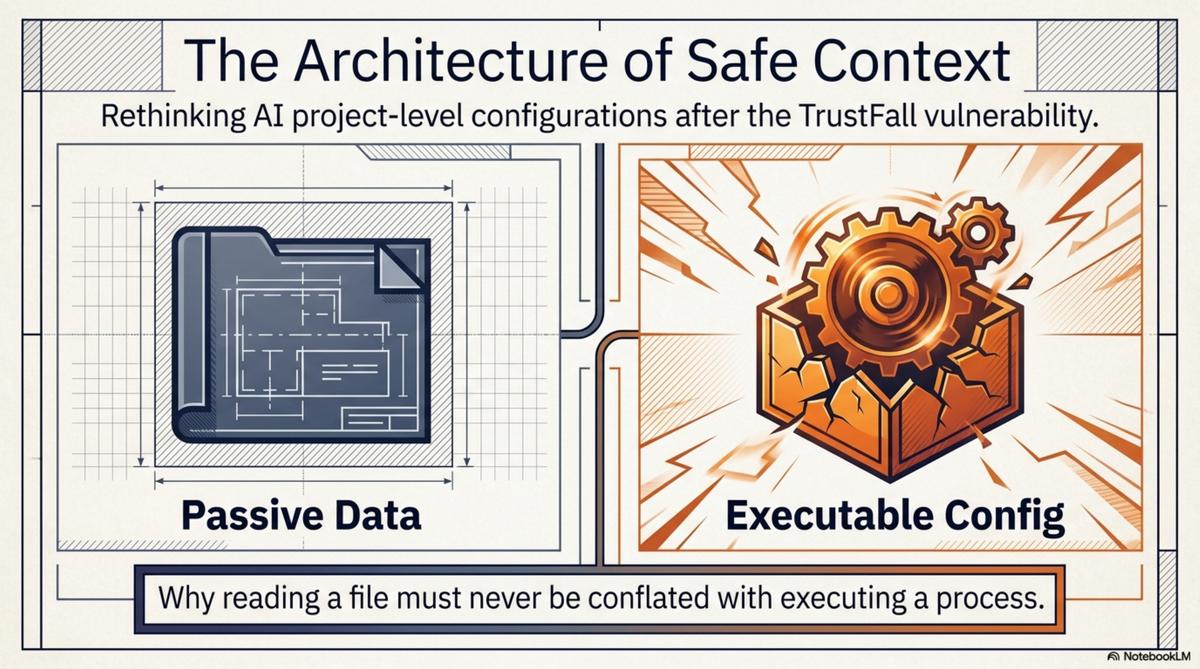
Why KCP Is Passive Data, Not Executable Config — And Why That Matters Now

The Architecture of Safe Context — passive data vs executable config

Yesterday, Adversa AI disclosed a vulnerability they call TrustFall. The mechanic is straightforward: a .mcp.json or .claude/settings.json file checked into a repository can silently configure and launch arbitrary MCP servers when a developer opens the project. The developer sees a trust dialog — "Trust this folder?" — clicks yes, and processes spawn with their full user privileges. Claude Code, Gemini CLI, Cursor CLI, and Copilot CLI are all affected. In CI/CD pipelines, where there is no human to click, the execution is zero-click.

Making Ægis Machine-Readable in One Session

An AI-era consulting company that isn't machine-readable is a contradiction. Clients evaluating you will use AI to do it. Agents will look up your services, your methodology, your pricing model. If the only thing they find is a wall of HTML, you're invisible to half the evaluation pipeline before the first conversation starts.

So I spent a session making ægis.no properly machine-readable. Not just an LLM-friendly page — actually structured, federated, and cryptographically signed. Here's what I did and what I learned.