Making Ægis Machine-Readable in One Session
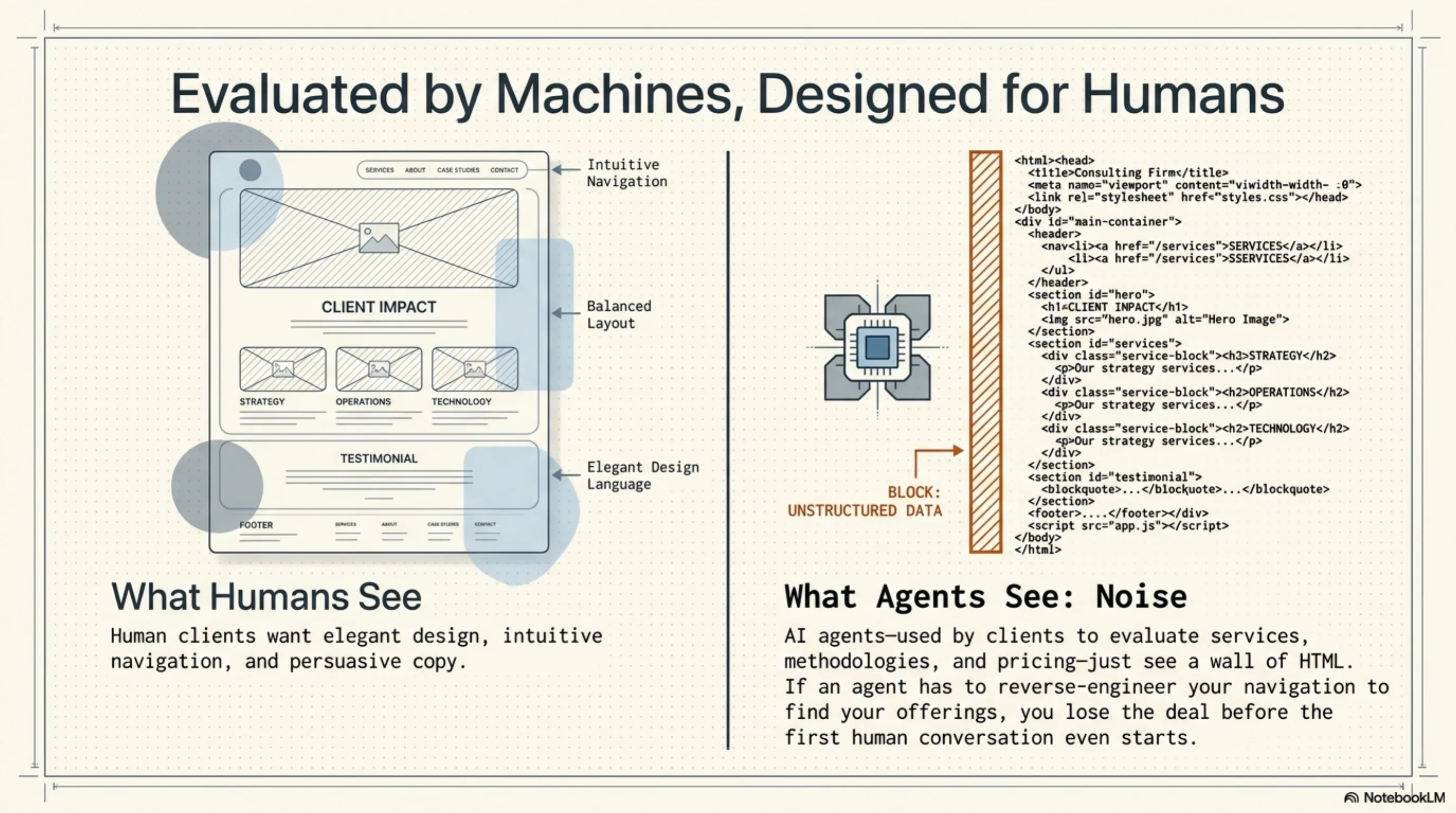
An AI-era consulting company that isn't machine-readable is a contradiction. Clients evaluating you will use AI to do it. Agents will look up your services, your methodology, your pricing model. If the only thing they find is a wall of HTML, you're invisible to half the evaluation pipeline before the first conversation starts.
So I spent a session making ægis.no properly machine-readable. Not just an LLM-friendly page — actually structured, federated, and cryptographically signed. Here's what I did and what I learned.
Start with the obvious: /llms.txt
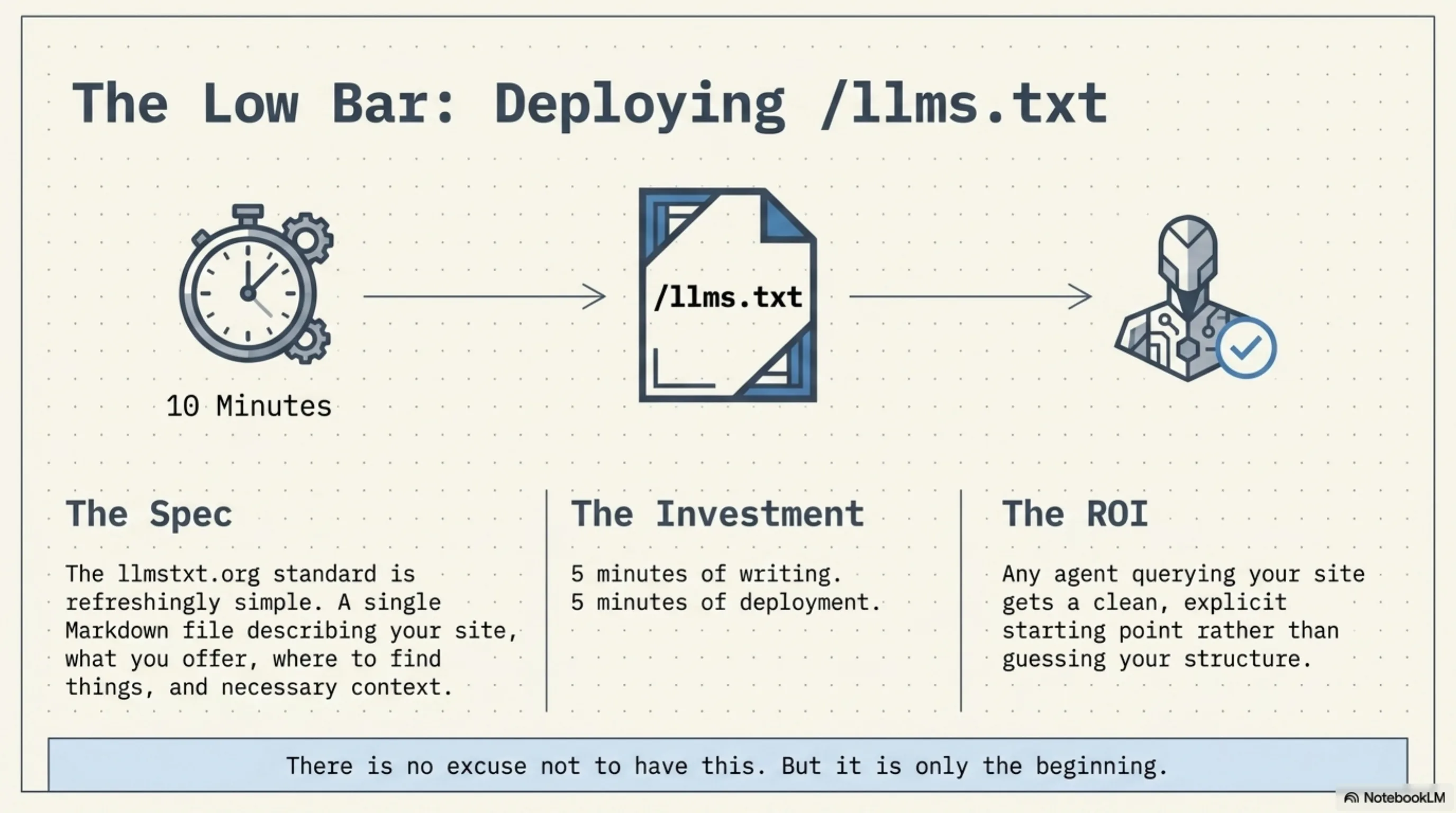
The llmstxt.org spec is refreshingly simple. One
Markdown file at /llms.txt describing your site for language models: what you
offer, where to find things, what context matters. Five minutes of writing, five
minutes of deployment. Done.
There's no reason not to have this. If your company has a website, it should
have an llms.txt. The bar is extremely low and the upside is that any agent
querying your site gets a clean starting point instead of reverse-engineering
your navigation structure.
That was the easy part.
There are three levels, not two
Before going further it's worth naming the progression explicitly.
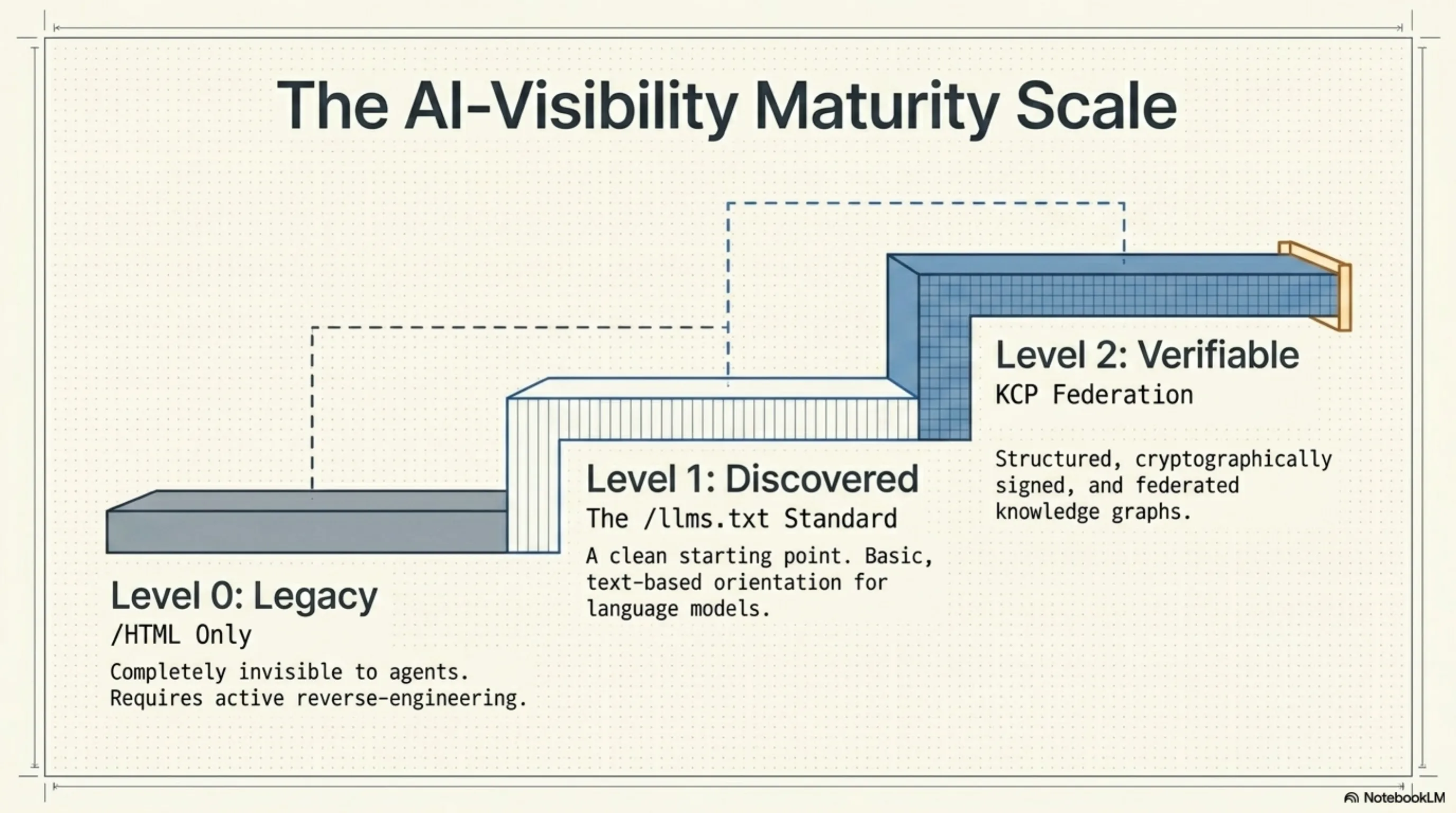
Most people stop at Level 1 and call it done. Level 2 is where the interesting properties emerge: structured, federated, verifiable. That's what the rest of this post is about.
KCP federation: the interesting part
KCP (Knowledge Context Protocol) is a YAML-based protocol for publishing structured knowledge as a machine-readable graph. Think of it as a sitemap, but for concepts and capabilities rather than pages — with authority, provenance, and signing baked in.
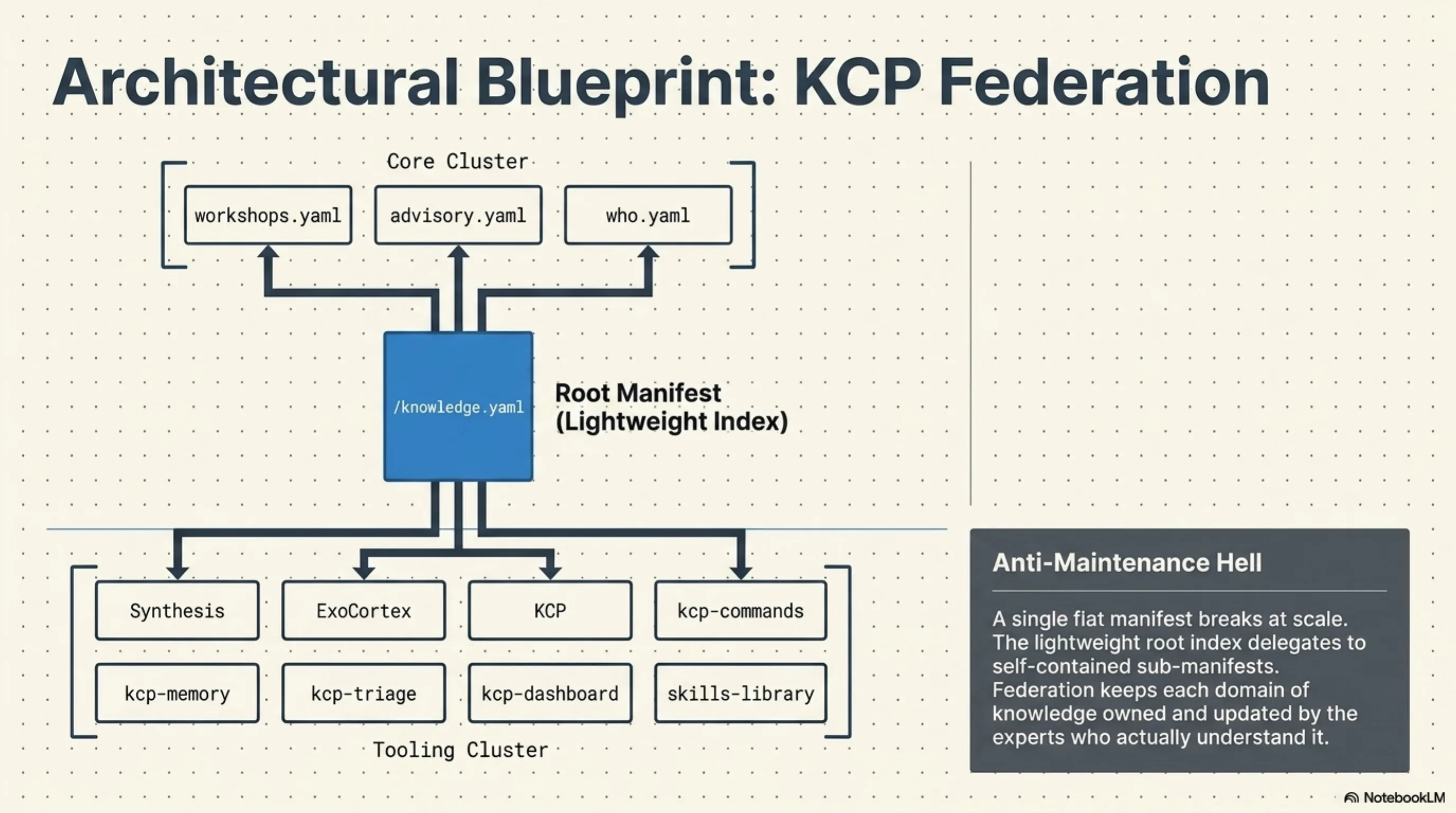
The root manifest at /knowledge.yaml is deliberately lightweight. It's an
index that federates to eleven sub-manifests in /knowledge/:
workshops.yaml,advisory.yaml,who.yaml— core offerings and context- Seven tooling manifests under
knowledge/tooling/— Synthesis, ExoCortex, KCP itself, kcp-commands, kcp-memory, kcp-triage, kcp-dashboard, skills-library
Each sub-manifest is self-contained. It has its own discovery block, its own
authority block, its own signing block. The root just knows where to find
them.
The design rationale: a flat single manifest becomes maintenance hell as a site
grows. Federation keeps each domain of knowledge owned by the people who
understand it. An agent that only needs workshop pricing loads
knowledge/workshops.yaml directly — it doesn't need to parse the whole graph.
Option A signing: per-manifest, independent
KCP supports several signing models. I went with Option A: each sub-manifest is independently signed.
The implication is that different manifests can eventually be signed by different keys. A partner contributing a sub-manifest could sign it with their own key. The root manifest trusts the federation structure; signing anchors the provenance of each piece. You can verify who vouches for what.
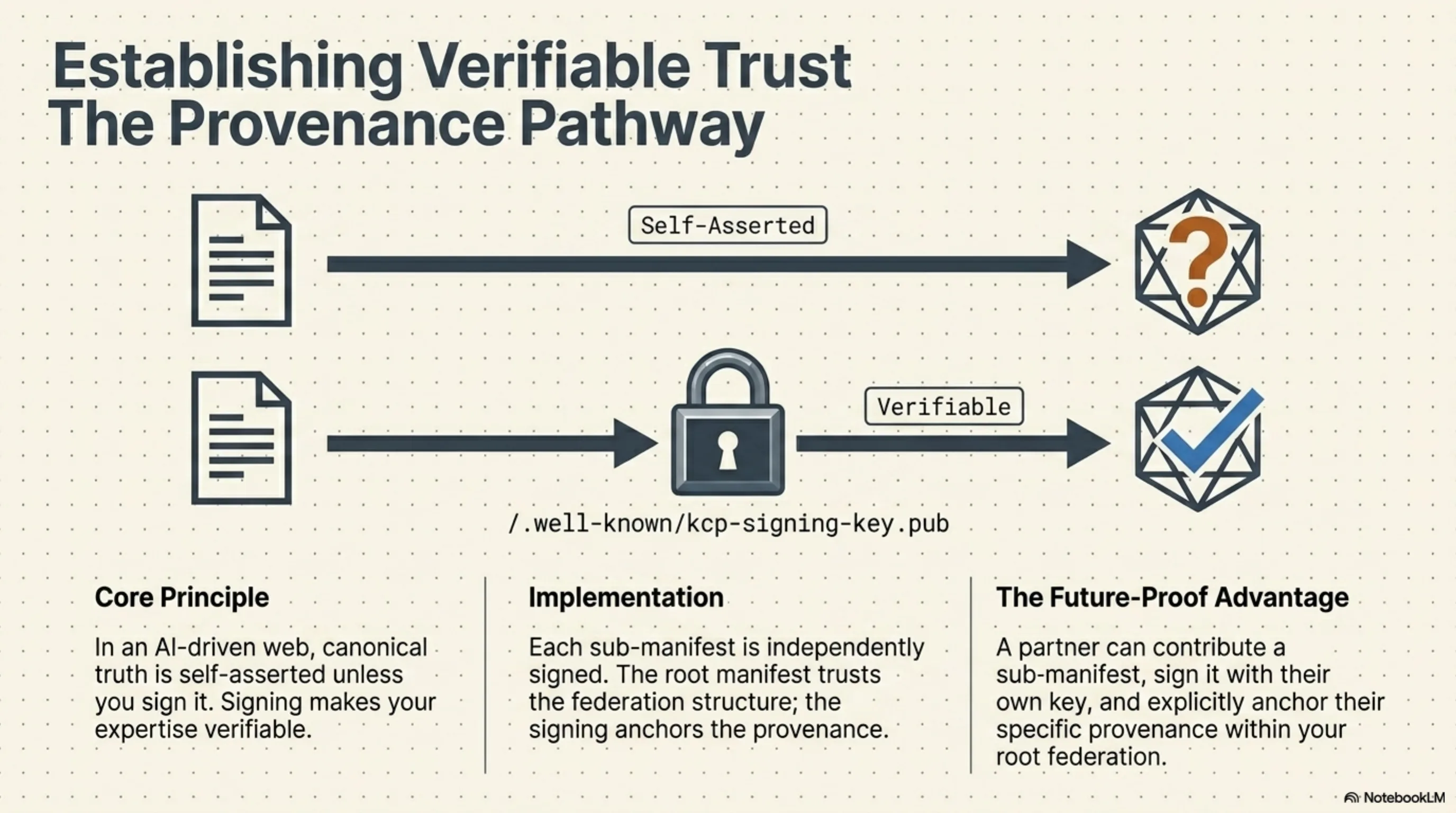
For now, all eleven manifests are signed by the same key — a GitHub Actions
workflow that triggers on any push touching knowledge.yaml or knowledge/**.
The public key lives at /.well-known/kcp-signing-key.pub. The workflow signs
each manifest and commits the .sig files back with [skip-sign] in the
commit message to avoid triggering itself in a loop.
This matters because provenance: canonical in a KCP manifest is
self-asserted unless you sign it. Signing makes it verifiable.
The -rawin gotcha
The first run of the signing action failed with:
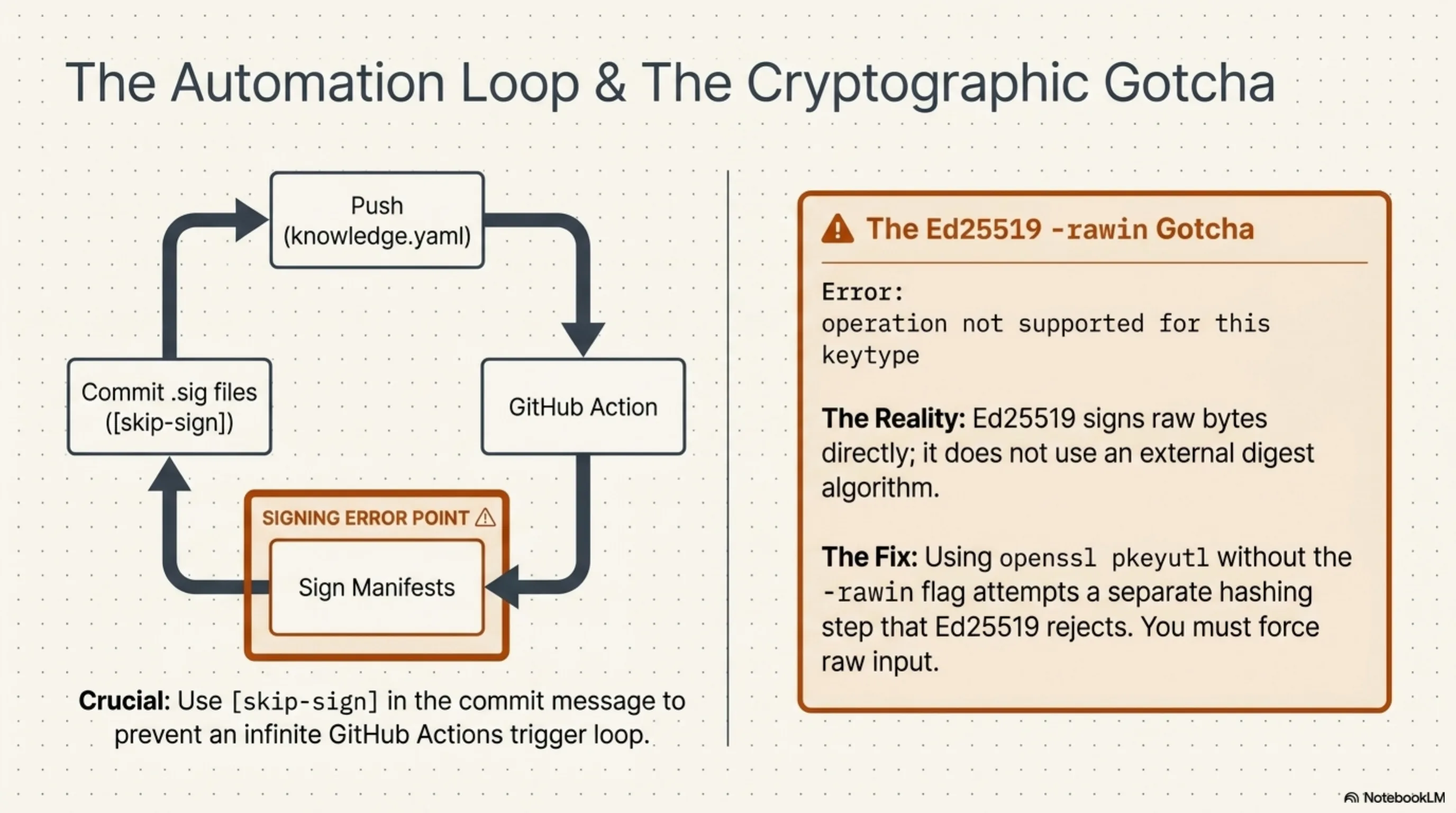
The issue: Ed25519 doesn't use an external digest algorithm. The hash is
internal to the algorithm — you sign the raw bytes directly. openssl pkeyutl
without -rawin tries to do a separate hashing step that Ed25519 simply
doesn't support.
The fix:
openssl pkeyutl -sign -inkey private.pem -rawin -in manifest.yaml \
  | base64 -w0 > manifest.yaml.sig
One flag, problem solved — but it's the kind of thing you only discover by hitting it.
What this actually means
ægis.no is now a live reference implementation of KCP federation with
independent per-manifest signing. Any agent that understands KCP can traverse
the graph, verify provenance, and understand what Ægis offers —
programmatically, without scraping HTML.
Is this transformative? No. It's one session of work. The hard part isn't the implementation — it's knowing what to build and why. Most companies don't do this not because it's difficult, but because nobody has made it a priority.
In an AI-first world, that's a choice worth revisiting.
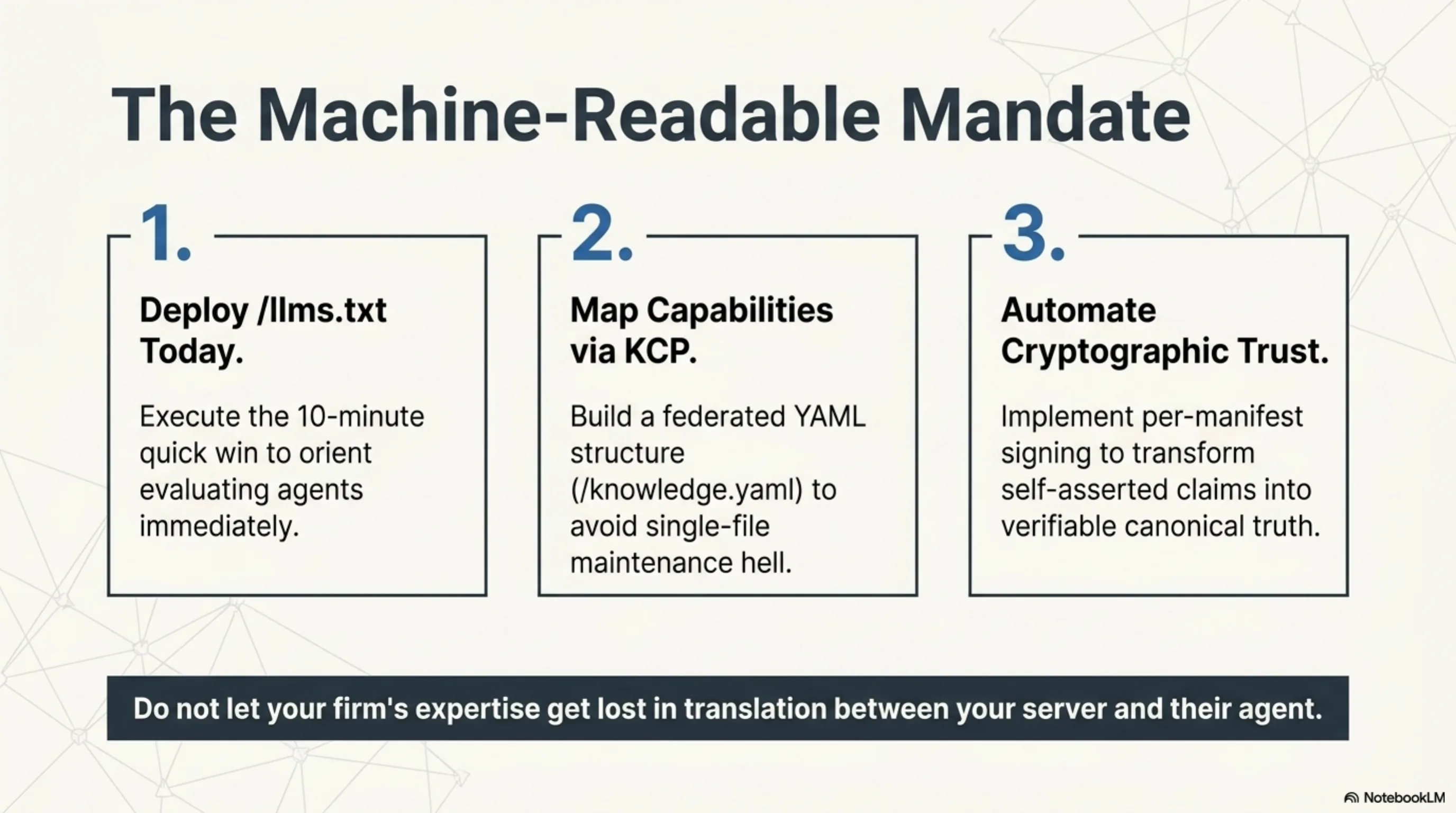
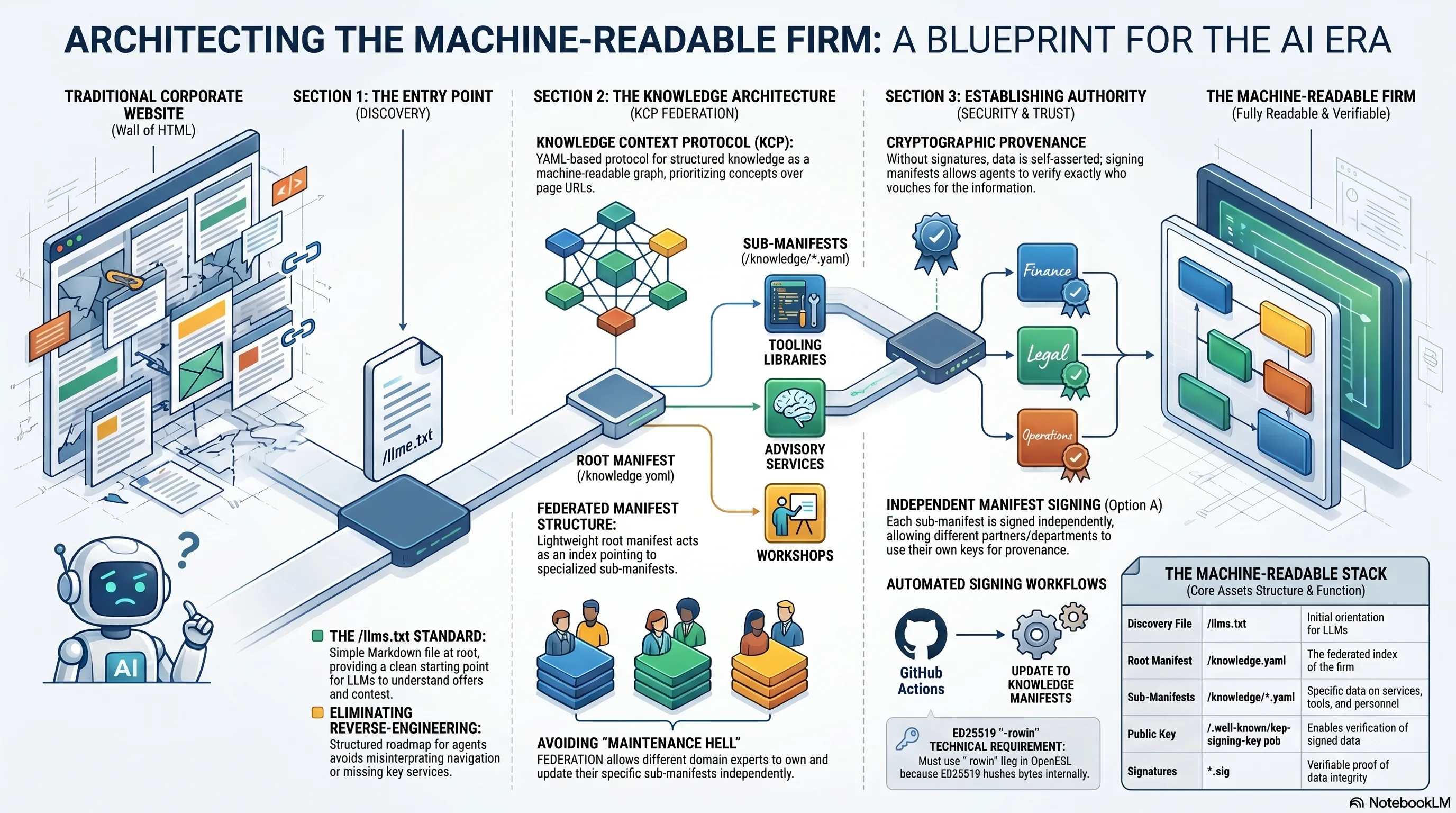
Slide decks
Both NotebookLM presentations used to develop this post are available to browse: