Skip to content

Security

The Agentic Web Has No Login Page

Think about what makes the human web economically viable. Not the browser. Not HTML. It's the login page — and everything it implies. Paywalls, licenses, subscriptions, terms of access. The mundane machinery that lets someone publish valuable knowledge without giving it away. Remove that machinery and the web would contain only what people are willing to publish for free.

Now look at the agentic web. Agents consume knowledge from manifests, MCP servers, and context files across organisational boundaries — and there is no equivalent machinery. A knowledge source is either open to every agent that finds it, or it's locked behind a bespoke API that no standard agent can negotiate. Nothing in between. No standard way for a publisher to say "this knowledge is for certified consumers only — prove who you are."

The consequence is quiet but enormous: the knowledge layer of the agentic web contains only what publishers are willing to give away. Authoritative sources — legal data providers, regulatory interpreters, standards bodies, paid research — stay off it entirely. So agents answer compliance questions from scraped blog posts instead of authoritative guidance, because the authoritative guidance has no way to come online on terms its publisher can accept.

KCP v0.22 and v0.23, both shipping today, are the missing machinery.

Why KCP Is Passive Data, Not Executable Config — And Why That Matters Now

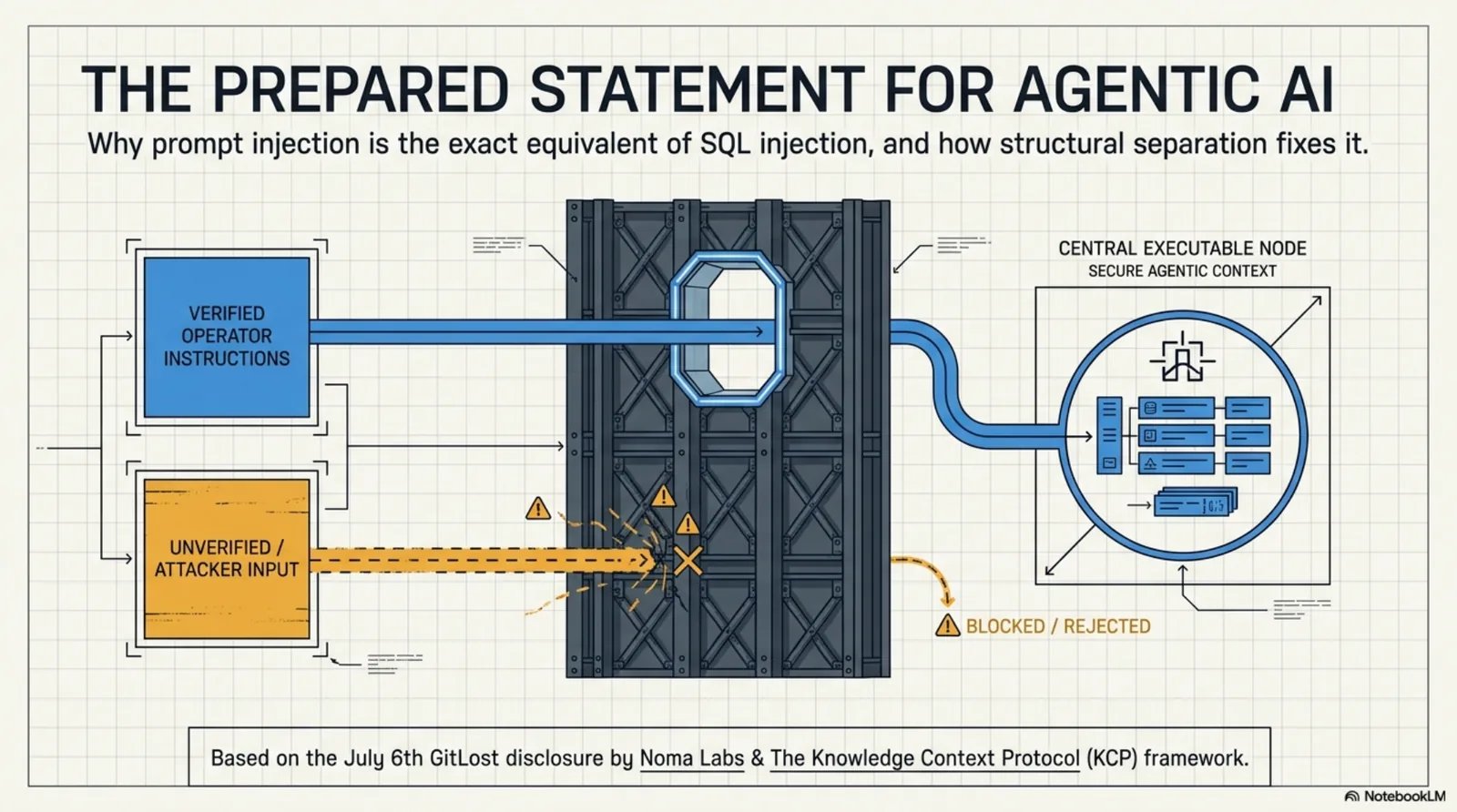
The Architecture of Safe Context — passive data vs executable config

Yesterday, Adversa AI disclosed a vulnerability they call TrustFall. The mechanic is straightforward: a .mcp.json or .claude/settings.json file checked into a repository can silently configure and launch arbitrary MCP servers when a developer opens the project. The developer sees a trust dialog — "Trust this folder?" — clicks yes, and processes spawn with their full user privileges. Claude Code, Gemini CLI, Cursor CLI, and Copilot CLI are all affected. In CI/CD pipelines, where there is no human to click, the execution is zero-click.