Selling News to Robots¶
Yesterday's tour of the whole protocol ended with a loose thread: "A knowledge economy ends with a payment — and RFC-0005 is still sitting at the RFC stage, waiting."
It didn't wait long. v0.25 landed on main the same day: Economic Metadata, the full promotion of RFC-0005. payment.methods[] — free, x402 micropayments, metered billing, subscriptions — plus per-tier rate_limits, all at manifest and unit level. Nothing of RFC-0005 remains RFC-only.
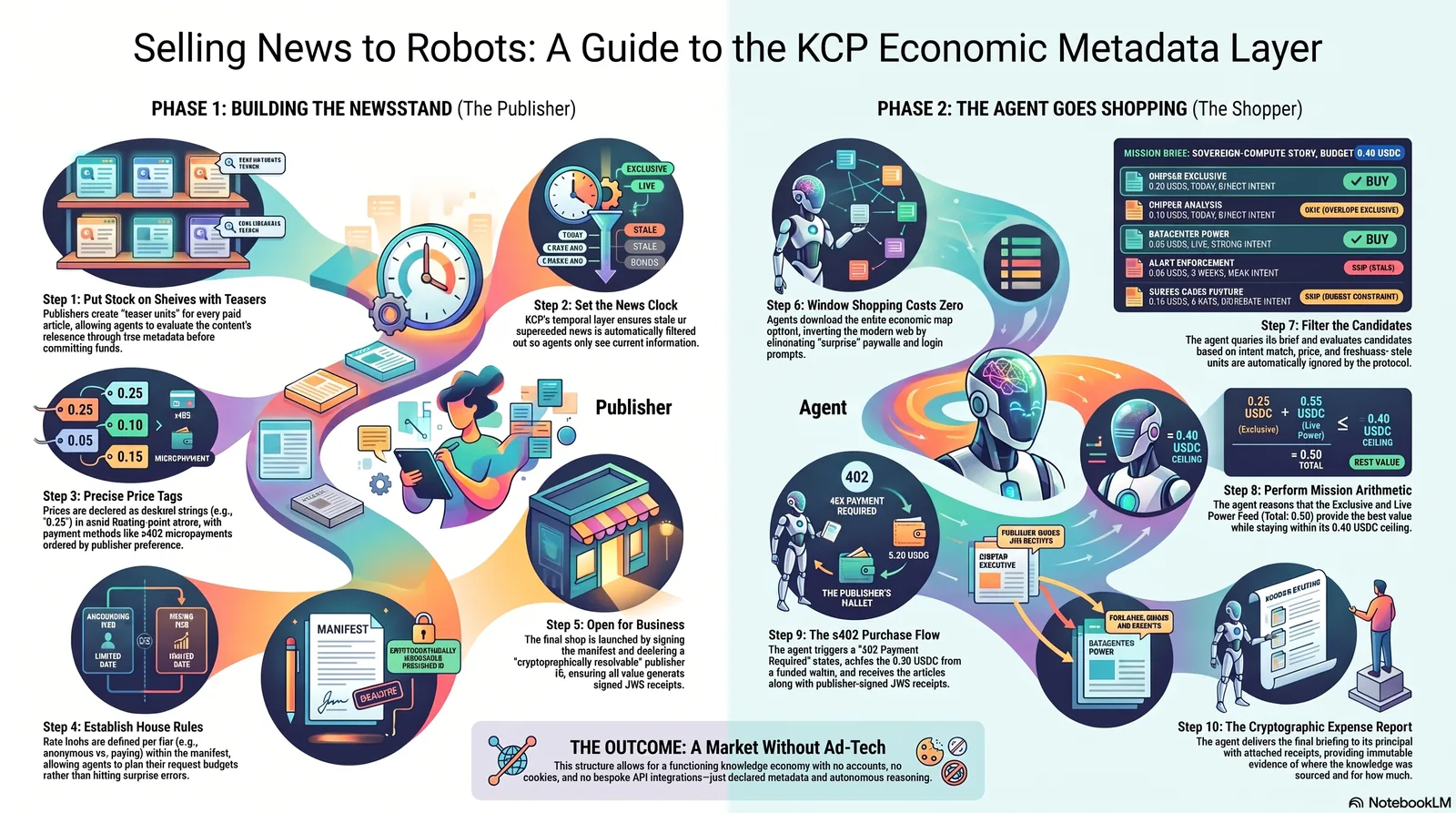
Which means something new is possible on the agentic web this weekend that wasn't possible last weekend: you can open a shop. So let's open one — a newswire that sells to agents — and then play the customer: an agent with a funded wallet, a briefing to write, and a budget. Step by step, both sides of the counter.
The shop and the shopper¶
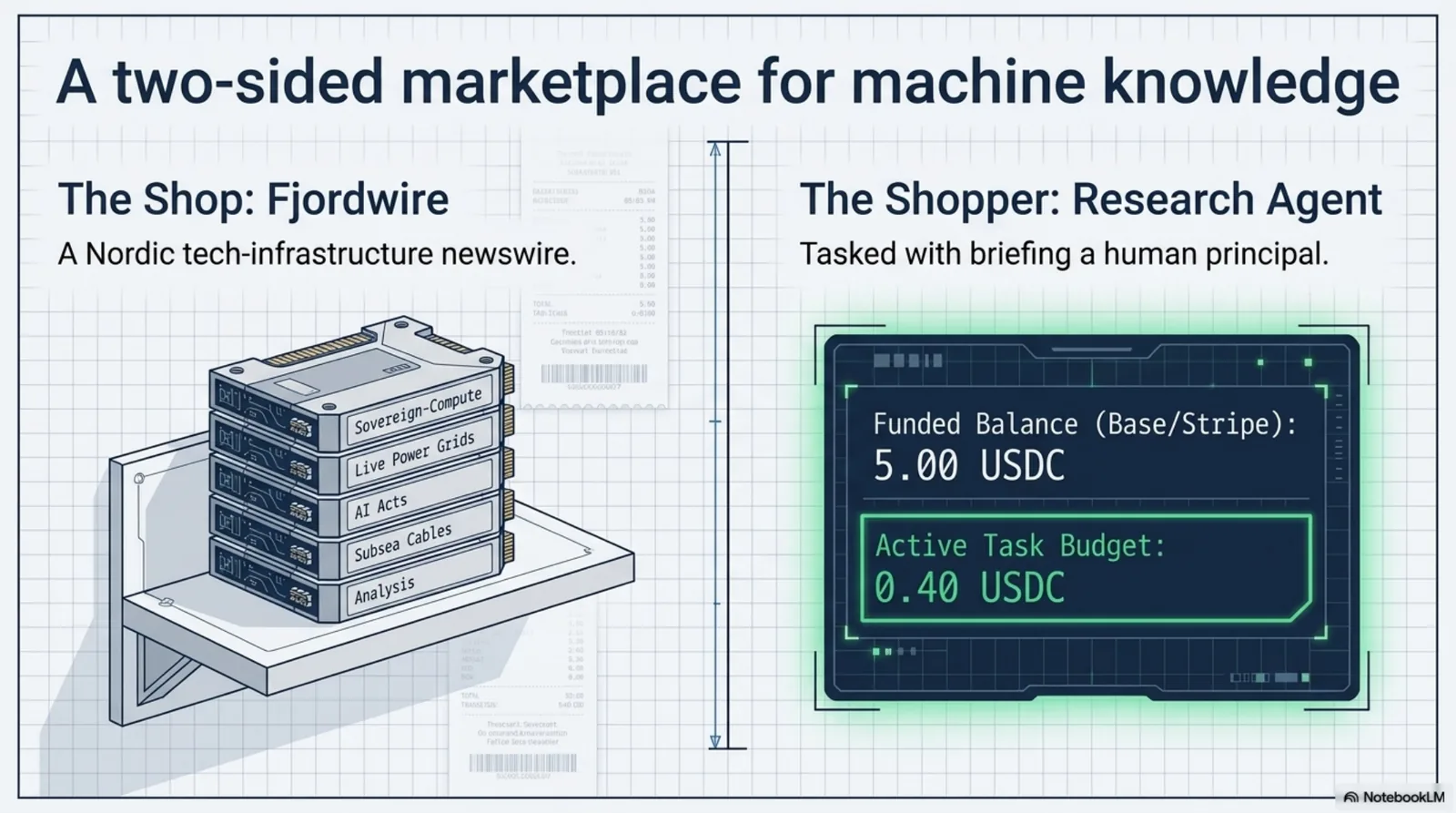
The shop: Fjordwire, a fictional Nordic tech-infrastructure newswire. Its stock this weekend: an exclusive on an EU sovereign-compute award, an analysis desk piece on the same story, a live datacenter power-grid feed, a three-week-old AI Act enforcement piece, and a subsea-cable feature. Teasers are free. Full articles cost money.
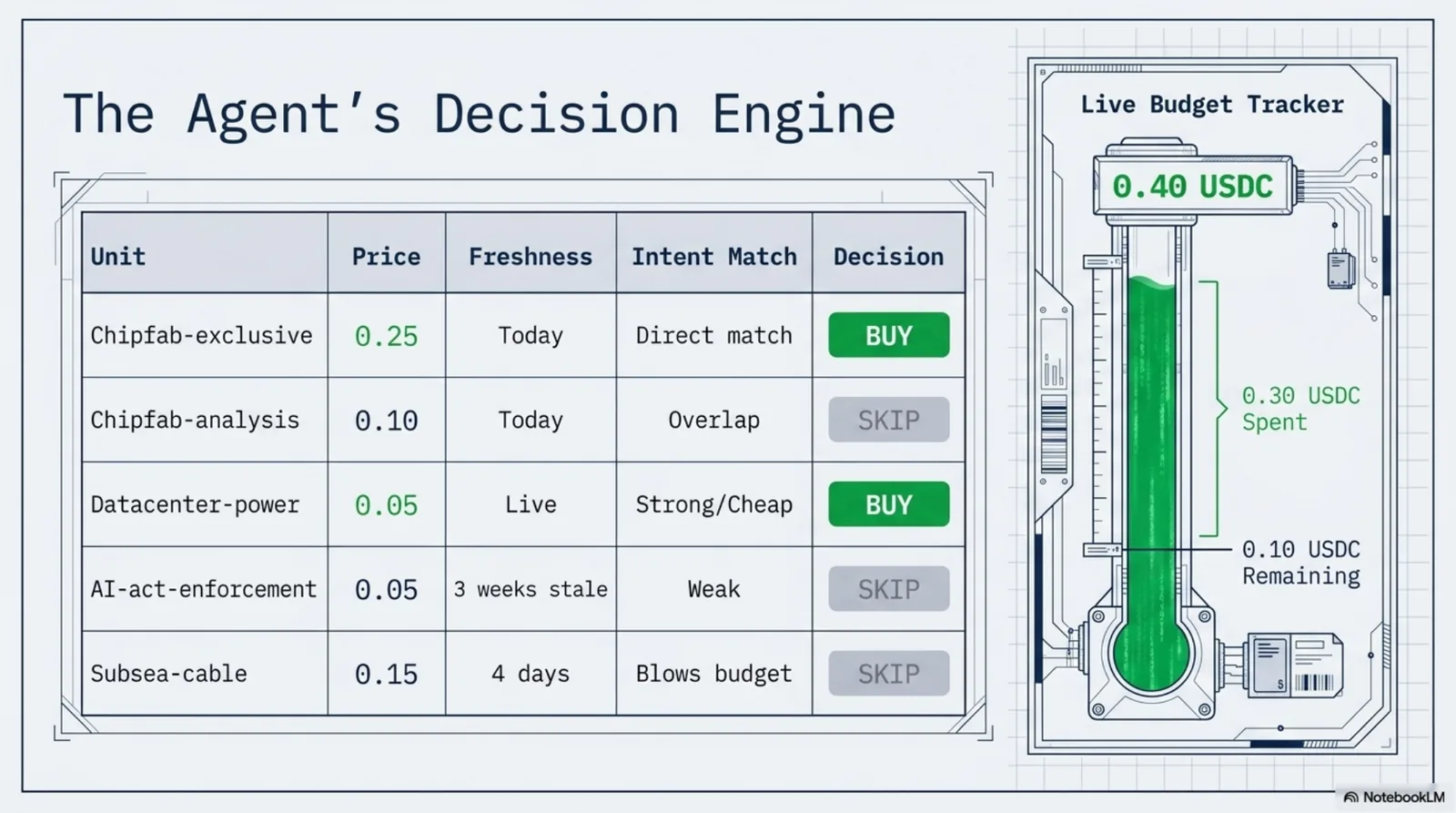
The shopper: a research agent tasked with briefing its principal on the sovereign-compute story and its infrastructure implications. Its operator funded a wallet through their Stripe account: 5 USDC on Base. The task budget: 0.40 USDC.
No accounts. No login page — or rather, the login page we built yesterday, now with a cash register next to it.
Part 1: Building the newsstand¶
Step 1 — Put the stock on shelves¶
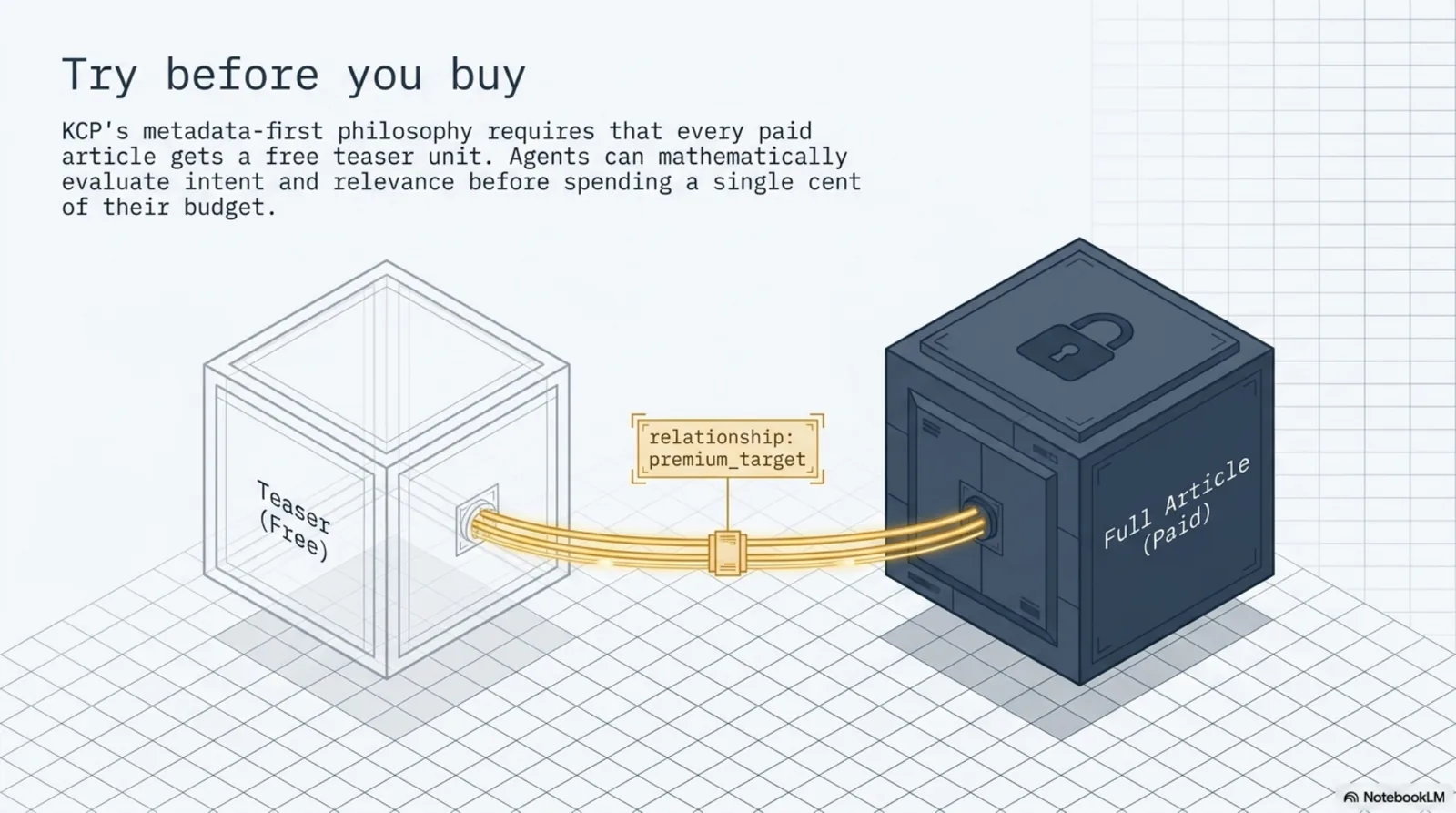
Every article is a knowledge unit with an intent, triggers, and an audience. The one structural decision that matters: each paid article gets a free teaser unit, linked by a relationship. This is KCP's metadata-first philosophy becoming try before you buy — the agent can evaluate what an article is about, and whether it's worth the price, without spending anything.
units:
  - id: chipfab-exclusive-teaser
    path: stories/chipfab-exclusive-teaser.md
    intent: "Summary: which Norwegian chip fab won the EU sovereign-compute contract?"
    audience: [agent]          # free — inherits the root payment block

  - id: chipfab-exclusive
    path: stories/chipfab-exclusive.md
    intent: "Full exclusive: the EU sovereign-compute award, the term sheet, and who lost"
    audience: [agent]
    # no access gate — payment, not auth, guards this one (see step 3).
    # An anonymous-paid unit stays access: public; `access` declares the
    # authentication axis only (spec §4.11, clarified in v0.25.1).

relationships:
  - from: chipfab-exclusive-teaser
    to: chipfab-exclusive
    type: context
Step 2 — News has a clock¶
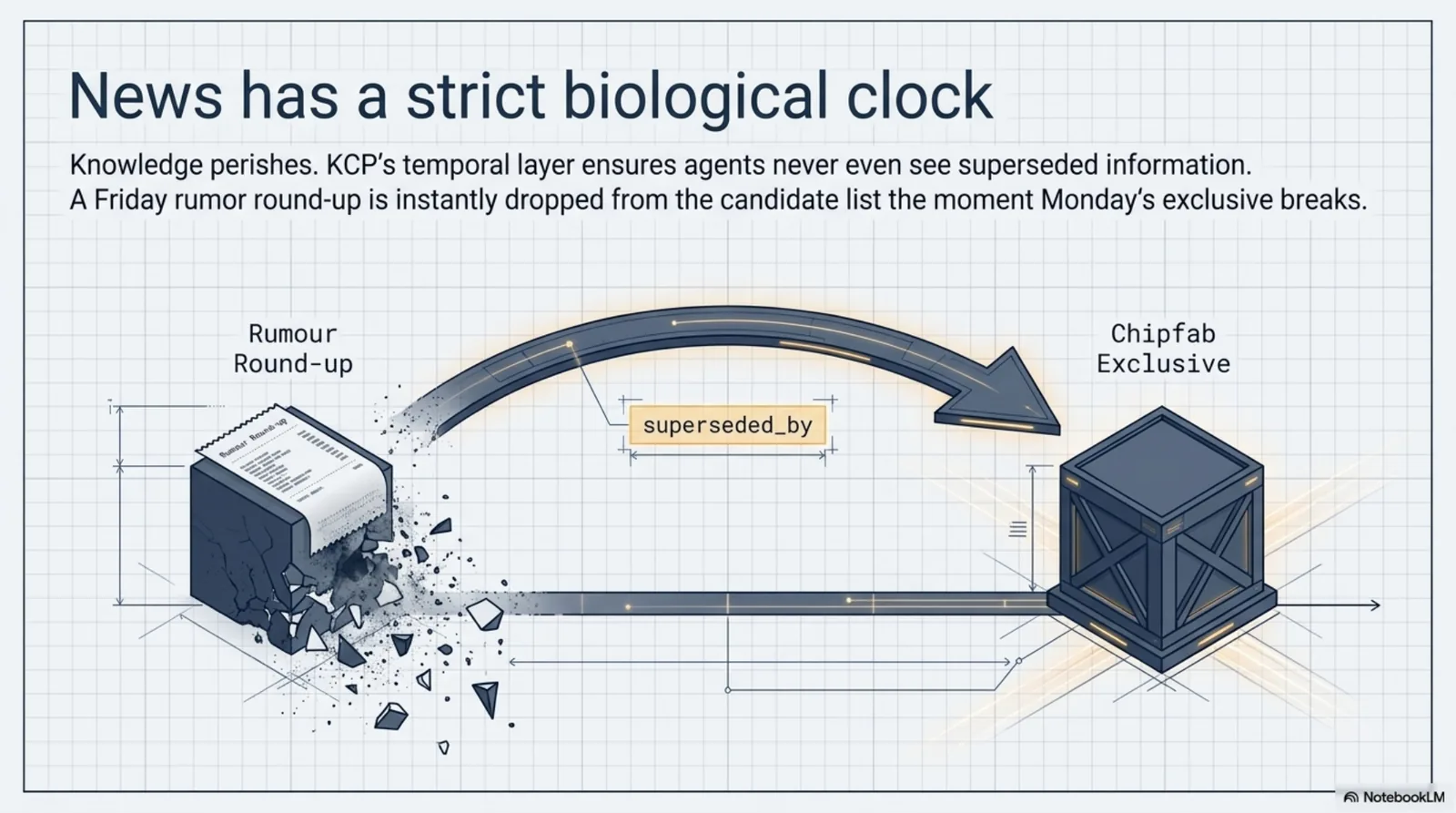
News is the most perishable knowledge there is, and KCP's temporal layer (v0.19–v0.21) was built for exactly this. Last week's rumour round-up was superseded the moment the exclusive broke:
  - id: chipfab-rumour
    path: stories/chipfab-rumour.md
    intent: "Rumour round-up: who is favourite for the EU sovereign-compute award?"
    temporal:
      valid_from: "2026-06-28"
      valid_until: "2026-07-05"
      superseded_by: chipfab-exclusive
Remember this unit. It's about to not appear in the story.
Step 3 — Price tags¶
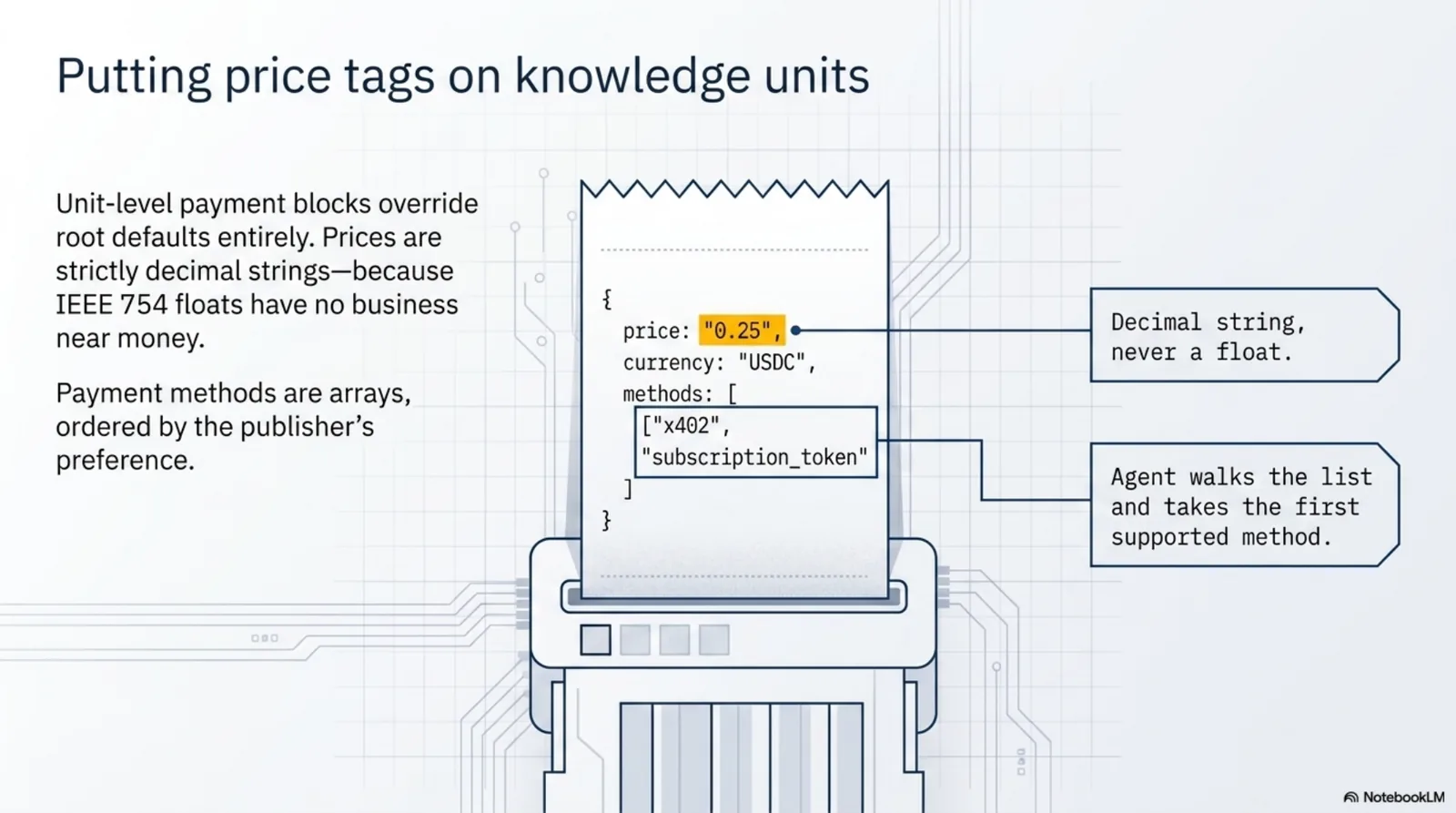
The root payment block declares the house default: free to read, with a subscription offer for regulars. Then each premium article overrides it — a unit-level payment block replaces the root entirely (no merge, no ambiguity):
payment:                        # root: the house default
  default_tier: free
  methods:
    - type: free
    - type: subscription
      plans_url: "https://fjordwire.example/plans"
      free_tier: true
      free_requests_per_day: 50
  billing_contact: "billing@fjordwire.example"
  - id: chipfab-exclusive       # the exclusive: 0.25 USDC per read
    payment:
      default_tier: metered
      methods:
        - type: x402
          currency: USDC
          price_per_request: "0.25"
          networks: [base]
          wallet: "0xF10RDW1RE0000000000000000000000000000000"
        - type: subscription
          plans_url: "https://fjordwire.example/plans"
Two details carry weight. Prices are decimal strings — "0.25", never a float, because IEEE 754 has no business near money. And methods are ordered by publisher preference: Fjordwire would rather take the low-overhead micropayment, but a subscriber's token works too. An agent walks the list and takes the first method it supports.
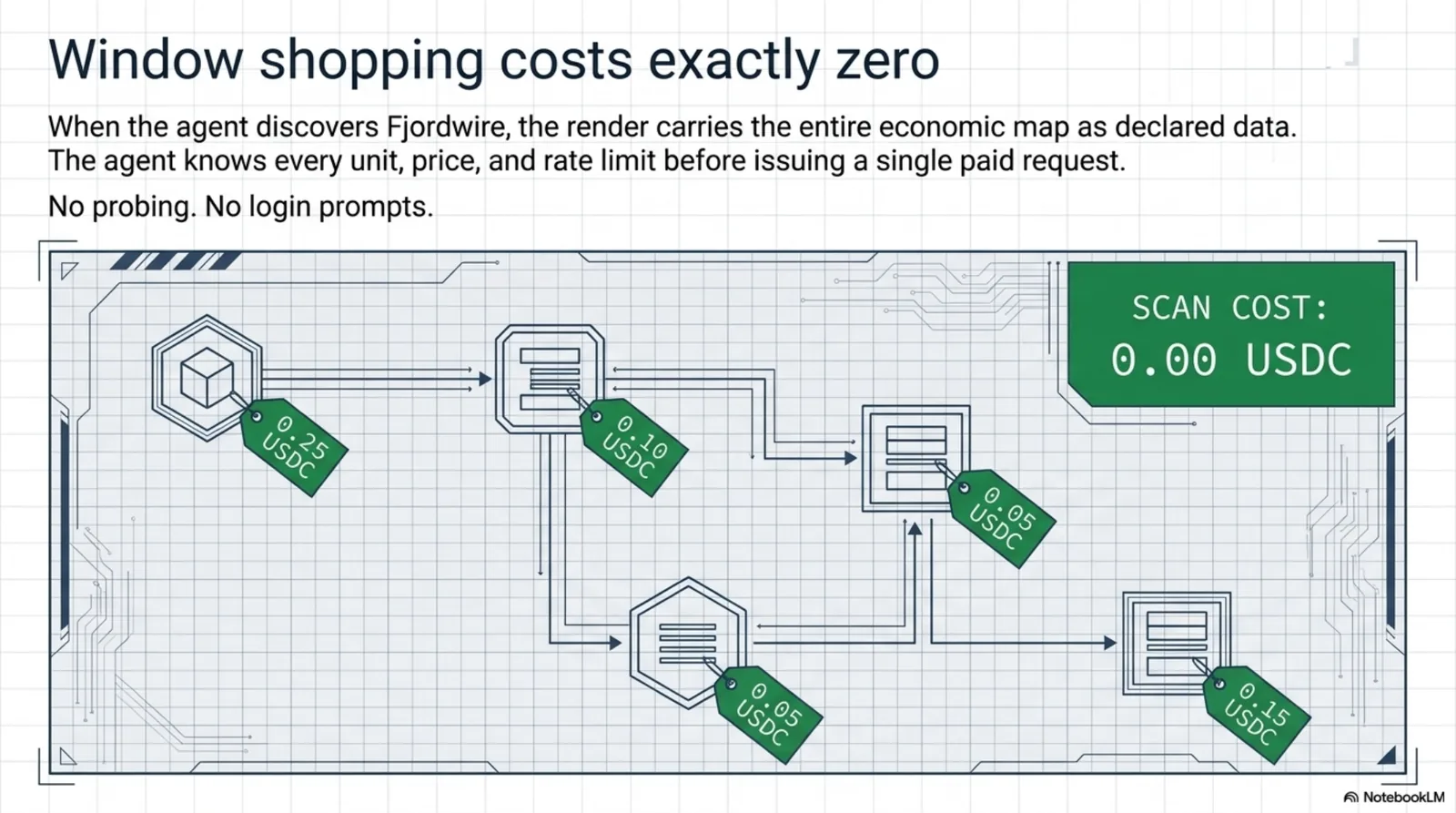
The five articles get five price tags: the exclusive at 0.25, the analysis at 0.10, the live power feed at 0.05, the AI Act piece at 0.05, the cable feature at 0.15.
Step 4 — House rules¶
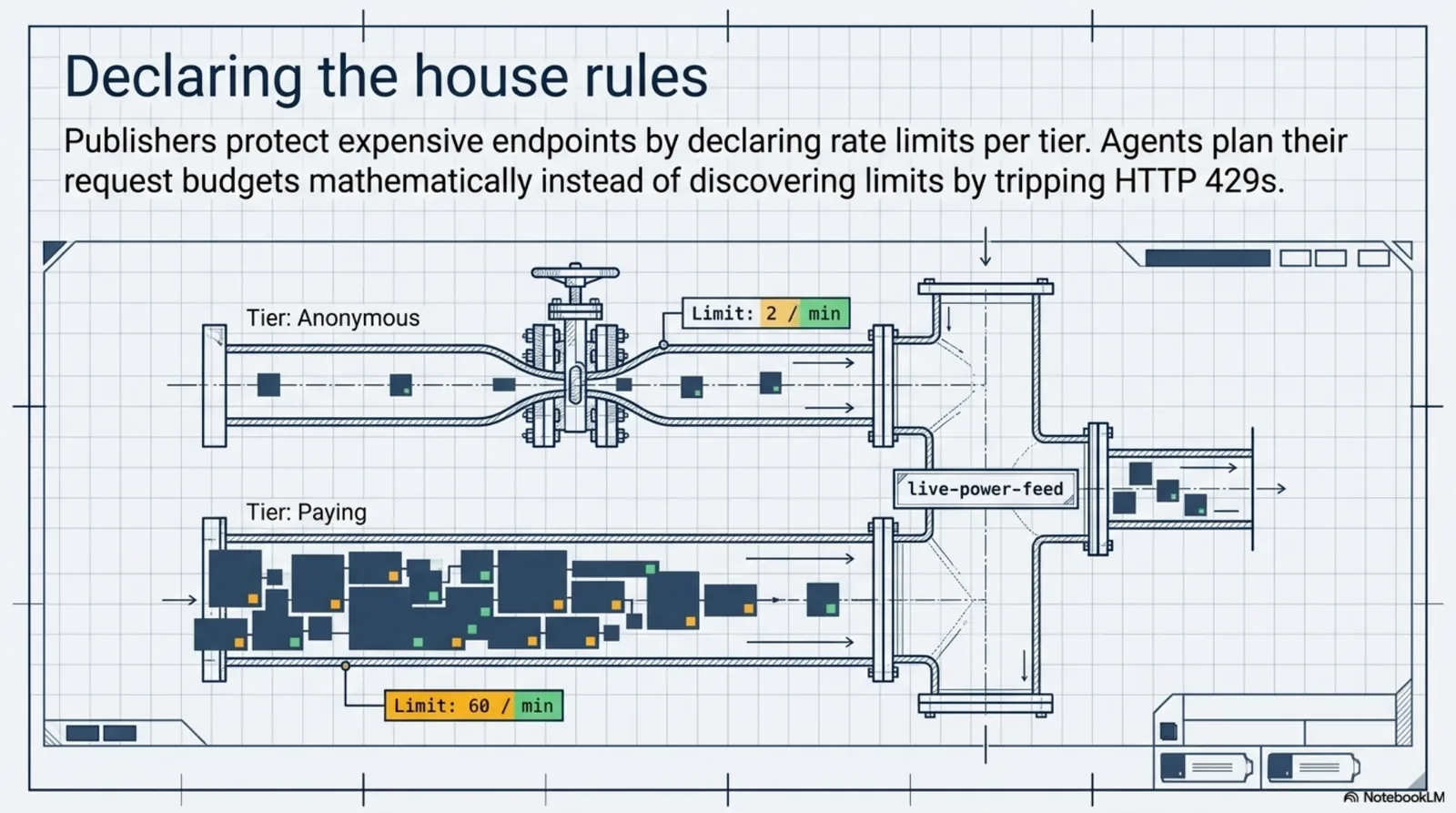
rate_limits tells agents how much they can consume per tier, before the first 429:
rate_limits:
  default:      { requests_per_minute: 10, requests_per_day: 200 }
  premium:      { requests_per_minute: 120, requests_per_day: unlimited }
  headers:
    remaining: "X-RateLimit-Remaining"
    reset: "X-RateLimit-Reset"
  backoff: exponential
The hourly power feed adds its own override — anonymous agents get 2 requests a minute, paying ones get 60. Publishers protect the expensive endpoints; agents plan request budgets instead of discovering limits by tripping them.
Step 5 — Open the shop¶
The rest is yesterday's machinery, unchanged: sign the manifest (v0.16), publish .well-known/kcp.json and the llms.txt pointer (v0.1/v0.10), declare trust.provenance.publisher_did so the byline is cryptographically resolvable, and declare trust.audit.provides_access_receipts: jws — every sale will come with a signed receipt (v0.23).
The full manifest — 8 units, 3 economic models — passes kcp validate with zero warnings. The v0.25 validators check the economics too: an x402 method missing its price, a non-decimal amount, a metered tier whose only method is free — all caught at publish time, not at the till.
Part 2: The agent goes shopping¶
Step 6 — Window shopping costs nothing¶
The agent discovers Fjordwire the standard way — domain, .well-known, manifest — and renders it. The render is free, and it carries the entire economic map: every unit, every price, every rate limit, as declared data. The agent knows what everything costs before issuing a single paid request.
This inverts how the web works for agents today: no probing, no surprise 402s, no "please sign in to continue reading."
Step 7 — Five candidates¶
The agent queries with its brief: sovereign-compute award, infrastructure implications. Five units come back:
| Candidate | Price | Fresh? | Intent match |
|---|---|---|---|
chipfab-exclusive |
0.25 | today | direct — the story itself |
chipfab-analysis |
0.10 | today | direct — same story, analysis desk |
datacenter-power |
0.05 | live (hourly) | strong — the infrastructure angle |
ai-act-enforcement |
0.05 | 3 weeks old | weak — regulatory, not compute |
subsea-cable-feature |
0.15 | 4 days | moderate — adjacent infrastructure |
Notice who's missing: the rumour round-up. Its validity window closed and its superseded_by points at the exclusive, so temporal evaluation dropped it before it ever reached the candidate list. The agent never had to detect that last week's speculation was stale — the protocol never showed it.
Step 8 — Buying 2 of 5¶
The agent reads the free teasers, then does arithmetic no scraper has ever done:
chipfab-exclusive— buy. It's the brief. 0.25 is most of the budget, but a summary of a summary won't do for the principal.chipfab-analysis— skip. Same story, and the exclusive already carries the term sheet. Marginal value doesn't survive the overlap.datacenter-power— buy. The infrastructure angle, live data, 0.05. The cheapest strong match on the board.ai-act-enforcement— skip. Weak intent match and three weeks stale against a breaking brief.subsea-cable-feature— skip. Relevant-adjacent, but 0.25 + 0.15 leaves nothing if the power feed needs a refresh before the briefing lands.
Projected spend: 0.25 + 0.05 = 0.30 USDC, inside the 0.40 ceiling, with headroom for one power-feed refresh. All of this reasoning ran on declared metadata. Total cost of the decision phase: zero.
Step 9 — The purchase¶
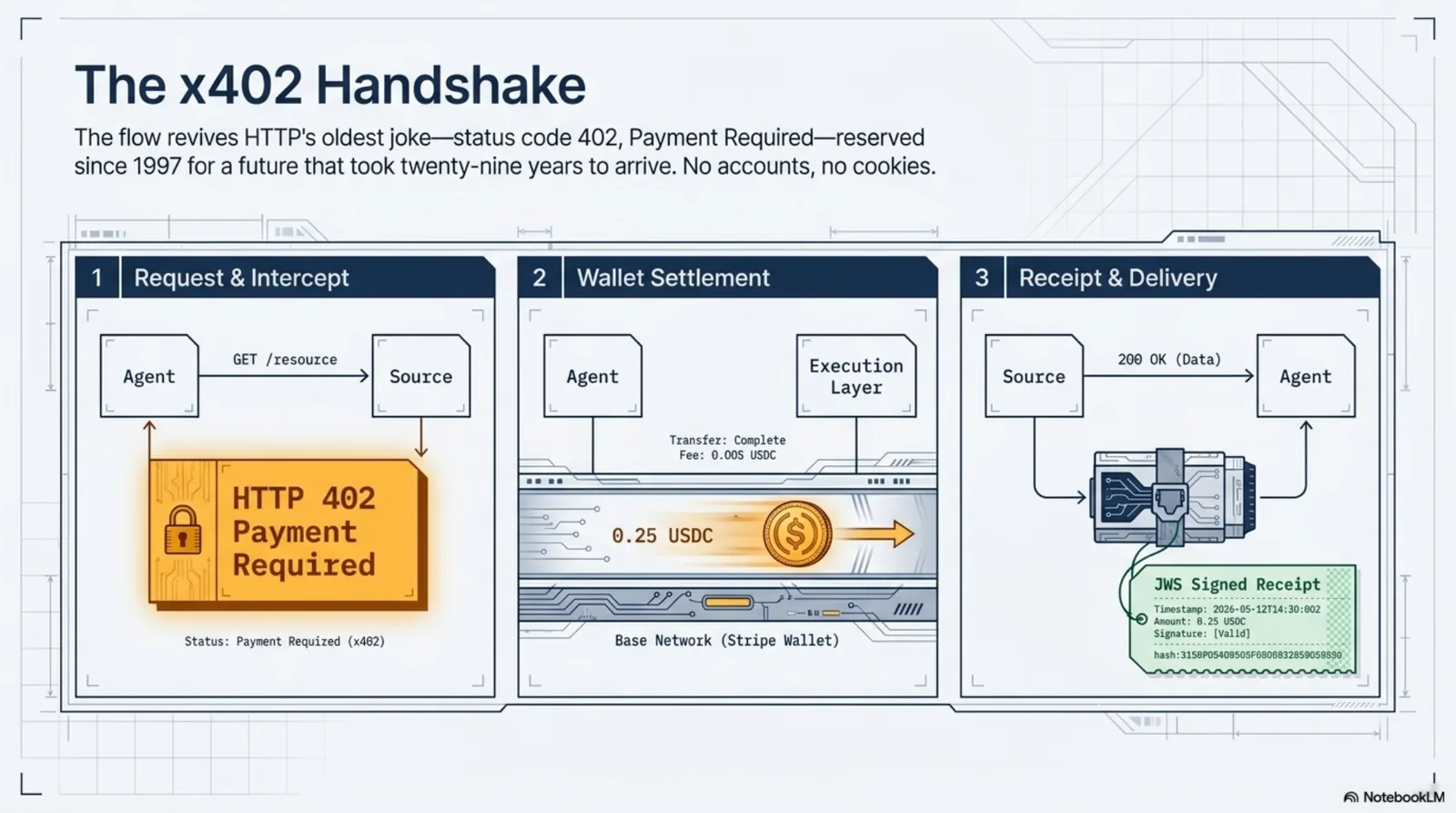
For each buy, the flow is the x402 revival of HTTP's oldest joke — status code 402, Payment Required, reserved since 1997 for a future that took twenty-nine years to arrive:
- The agent requests the unit. The source answers 402 with payment terms matching the declared method.
- The agent's payment stack settles 0.25 USDC on Base — from the Stripe-funded wallet, no account, no session, no cookie banner.
- The source serves the article — and issues a signed JWS receipt: unit id, timestamp, agent identity.
Twice. Total spend: 0.30 USDC. Two articles, two receipts.
Step 10 — The expense report¶
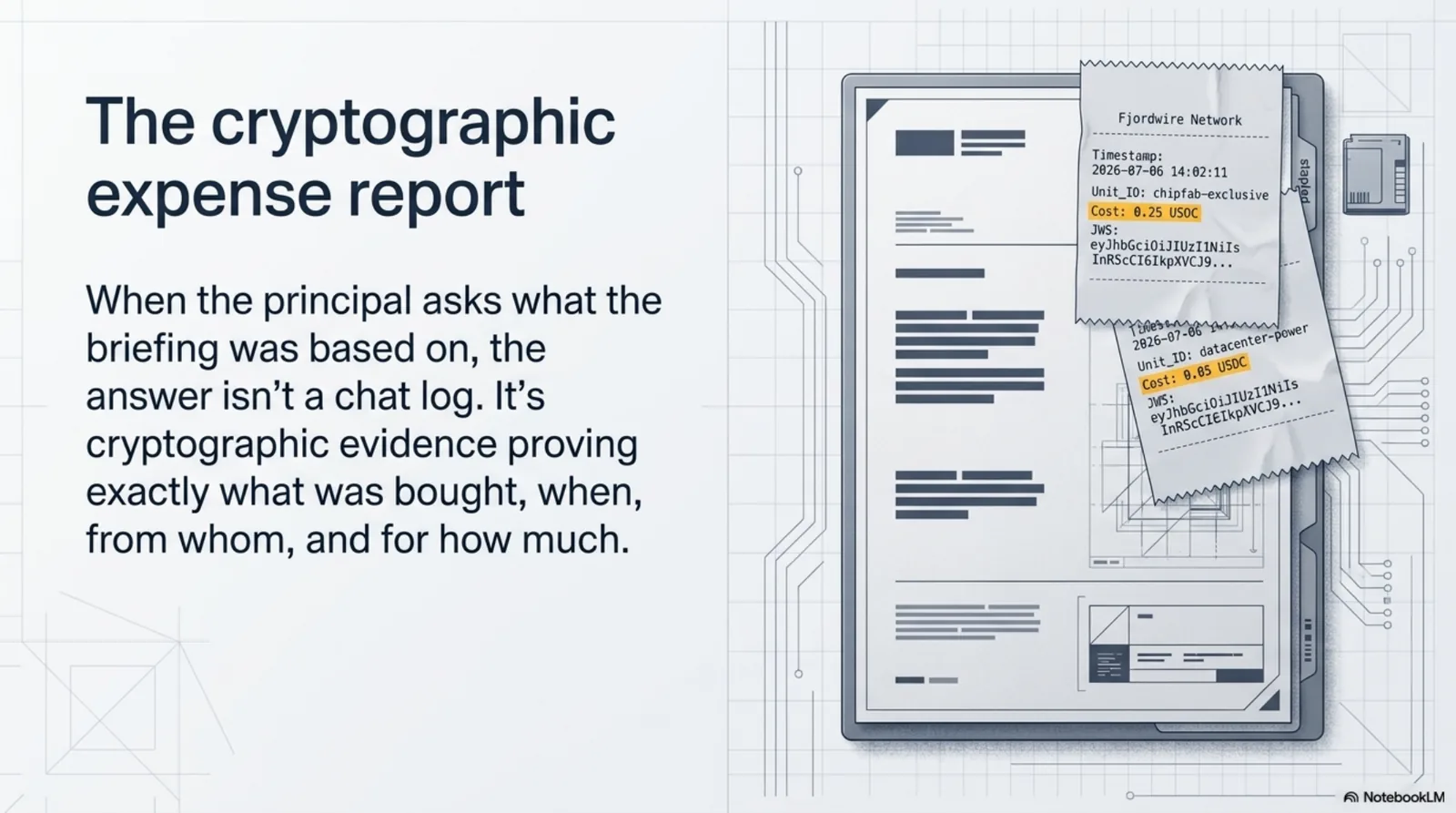
The briefing goes to the principal citing both articles — and attached to it, two publisher-signed receipts proving exactly which knowledge was bought, when, from whom, for how much. The agent's expense report is cryptographic. When someone asks what the sovereign-compute briefing was based on, the answer isn't a chat log. It's evidence.
What just happened¶
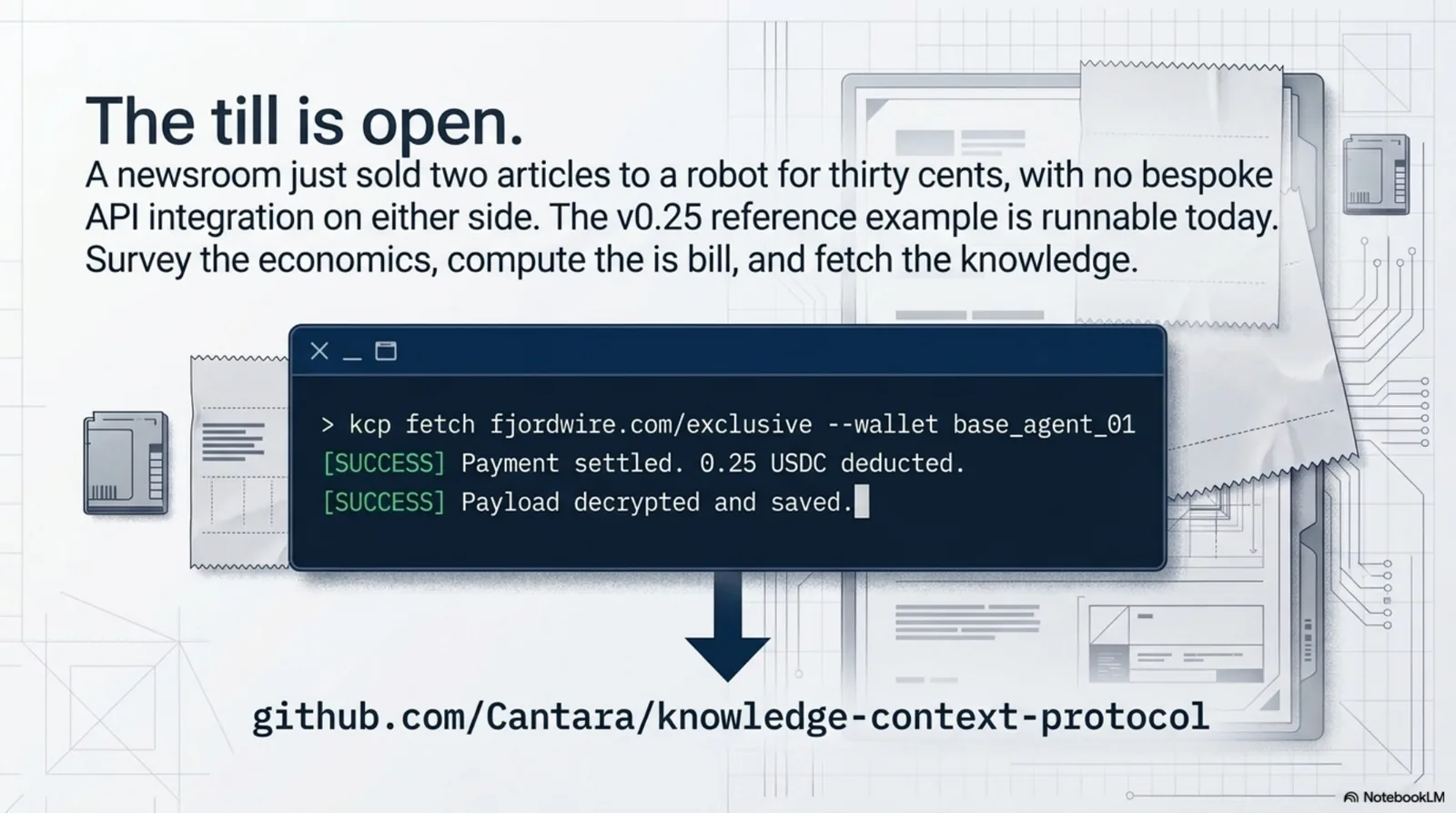
A newsroom sold two articles to a robot for thirty cents, with no account, no login, no ad tech, no bespoke API integration on either side. The publisher declared prices in the same manifest that declares intents and validity windows; the agent comparison-shopped on free metadata and paid only for what survived its own reasoning.
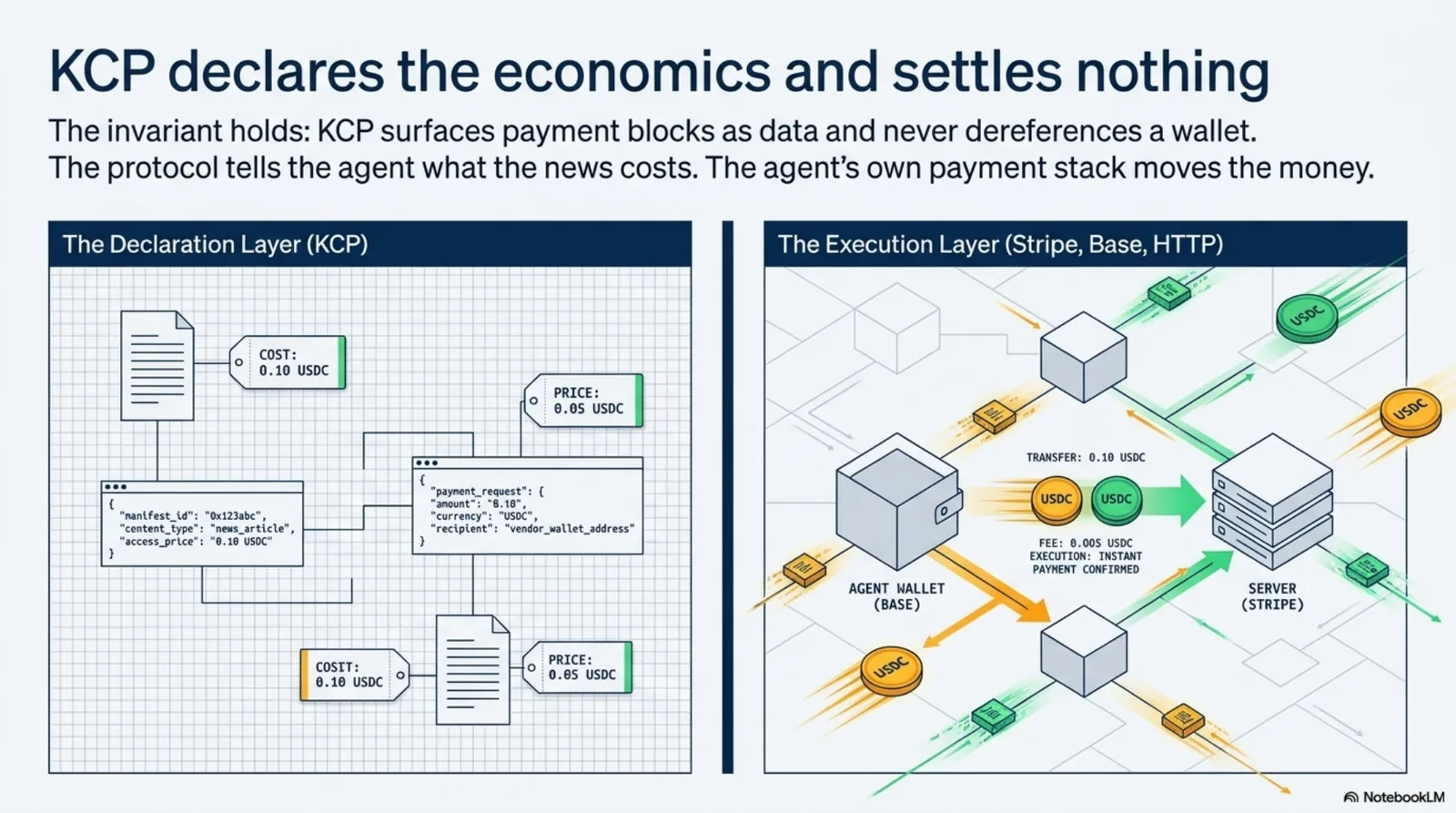
That's a real market structure, and it's worth naming what makes it work — because it's not the payment rail. Rails existed. What was missing was the declaration layer: a standard way to put a price tag on knowledge units where agents already look, next to the freshness data and trust signals they already evaluate. The teaser-unit pattern, the temporal filter that removed the stale rumour, the receipts that made the purchase auditable — every piece was already in the protocol. v0.25 just added the price tag.
And the invariant held, for the twenty-fifth consecutive version: KCP declares the economics and settles nothing. The renderer surfaces payment blocks as data and never dereferences a wallet or a plans_url. The protocol told the agent what the news costs. The agent's own payment stack — its wallet, its operator's Stripe account, its settlement network — moved the money. What does KCP execute? Still nothing. Even now that there's money on the table.
Try it¶
The v0.25 reference example is runnable today — a paid knowledge API with the same three economic models, driven through the real kcp CLI:
git clone https://github.com/Cantara/knowledge-context-protocol
cd knowledge-context-protocol
(cd cli && npm install && npm run build)
node examples/paid-knowledge-api/demo.js
Four narrated scenarios: survey the economics, select a payment method, compute the bill before fetching, read the rate-limit budget. The Fjordwire manifest from this post validates against the same tooling.
- Guide:
guides/monetizing-knowledge-with-payment.md - Example:
examples/paid-knowledge-api/ - Spec §4.14–§4.15: SPEC.md
The trust model got its login page yesterday. Today the agentic web got its first till. What's left is the interesting part: watching what publishers put on the shelves.
→ github.com/Cantara/knowledge-context-protocol
Series: Knowledge Context Protocol
← One Agent's Journey Through the Whole Protocol · Part 36 of 52 · The Vibes-Based Agent Era Deserves to End →