A Firewall for What Your Agent Knows¶
Everyone is building firewalls for what agents do. Sandboxes, budget caps, tool permissions, egress filters — the action side of agent governance is getting crowded, and that is good news. But almost nobody is building firewalls for what agents know. Your agent's context window is an unauthenticated ingestion pipeline: whatever text lands in it becomes, functionally, trusted input. If someone edits a policy document, swaps a mirror, or serves your agent a stale copy of the rules, no sandbox in the world will catch it — because nothing wrong ever executed. The agent just knew the wrong thing.
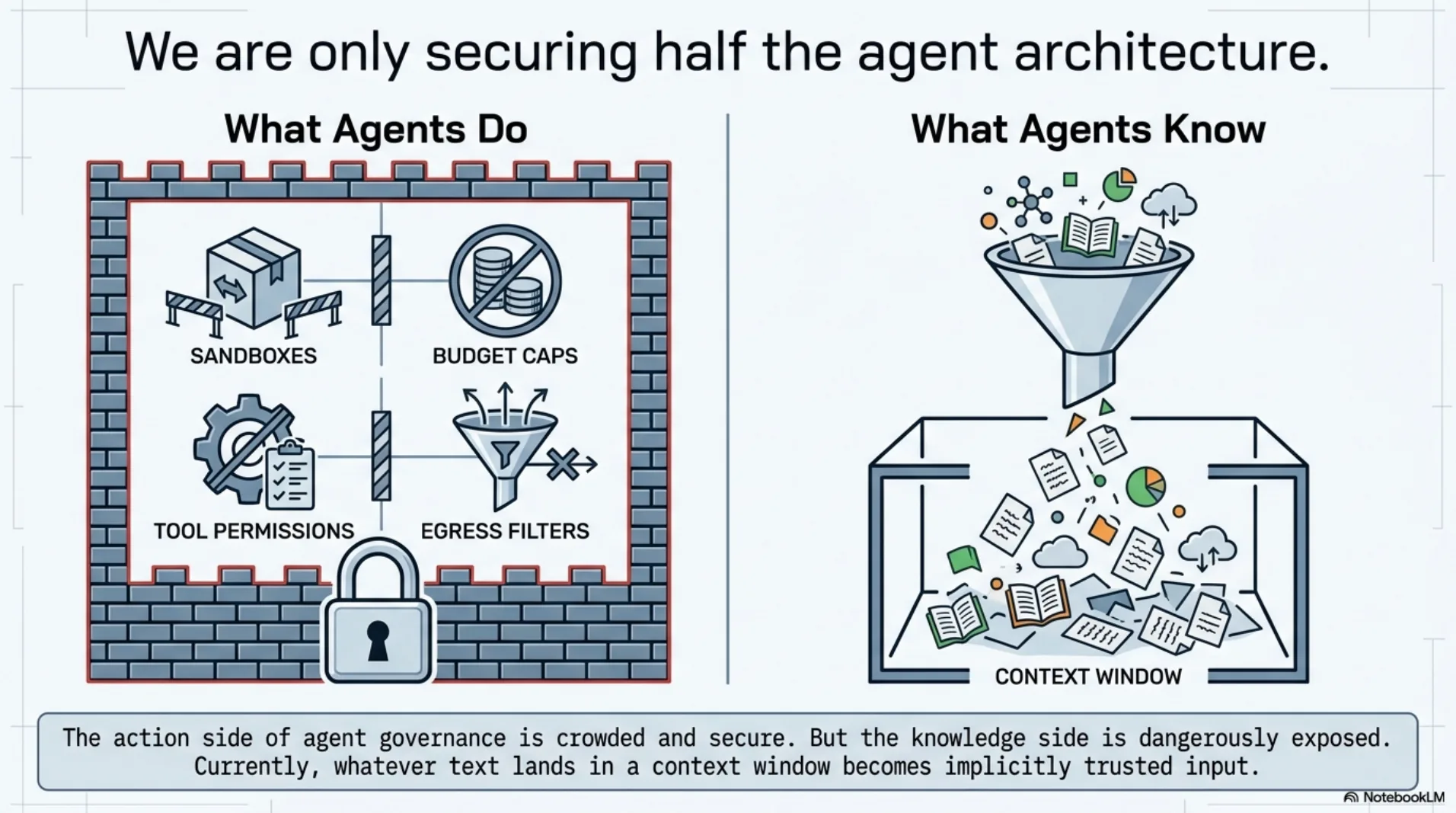
This post is the hands-on companion to Two Halves of the Governance Problem. That one argued the thesis; this one is a tutorial. In about ten minutes, we take two markdown files and give them a declared, signed, tamper-evident boundary that an agent verifies before loading a single byte. Every command output below is pasted from a real run.
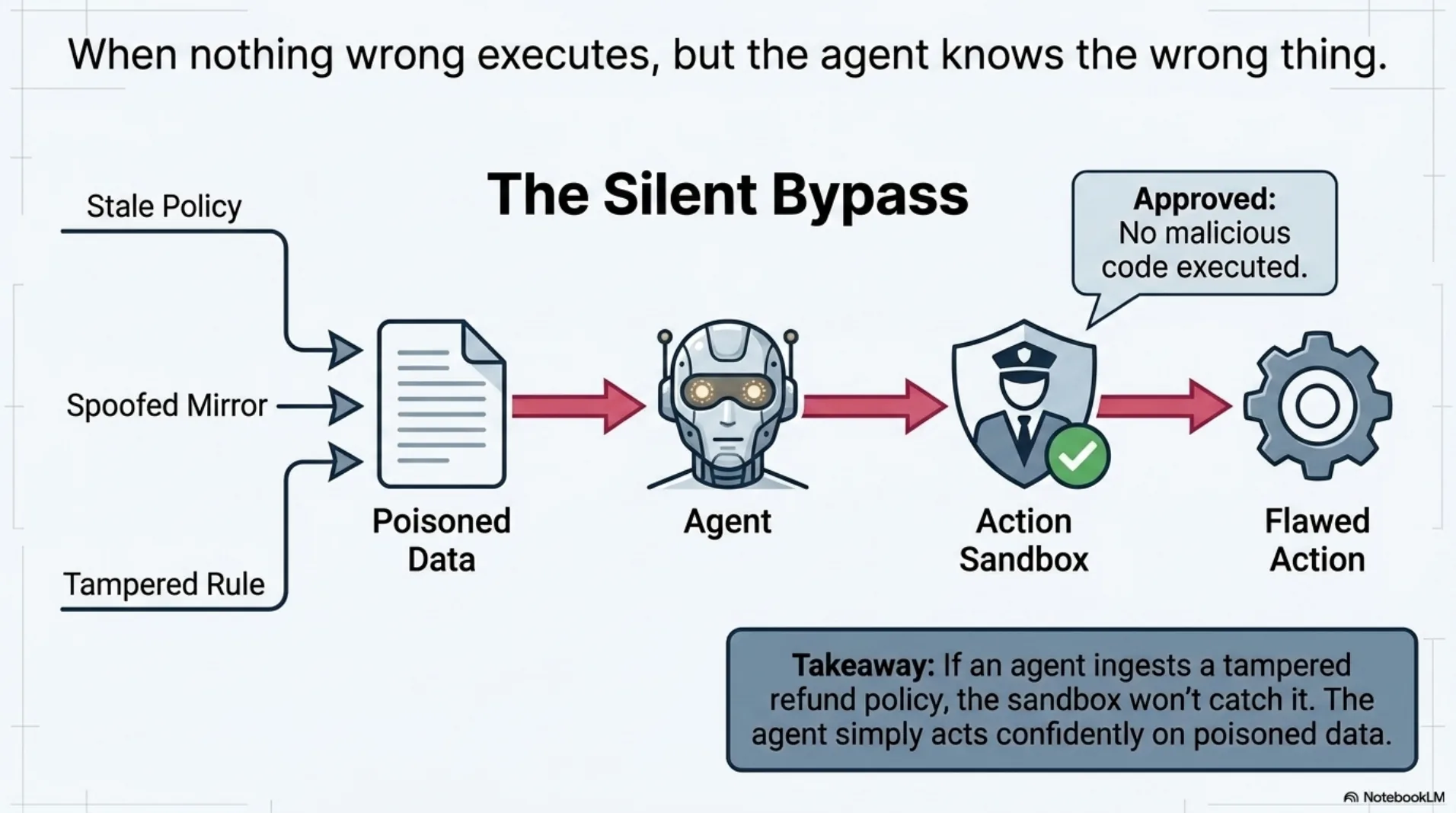
What we're building¶
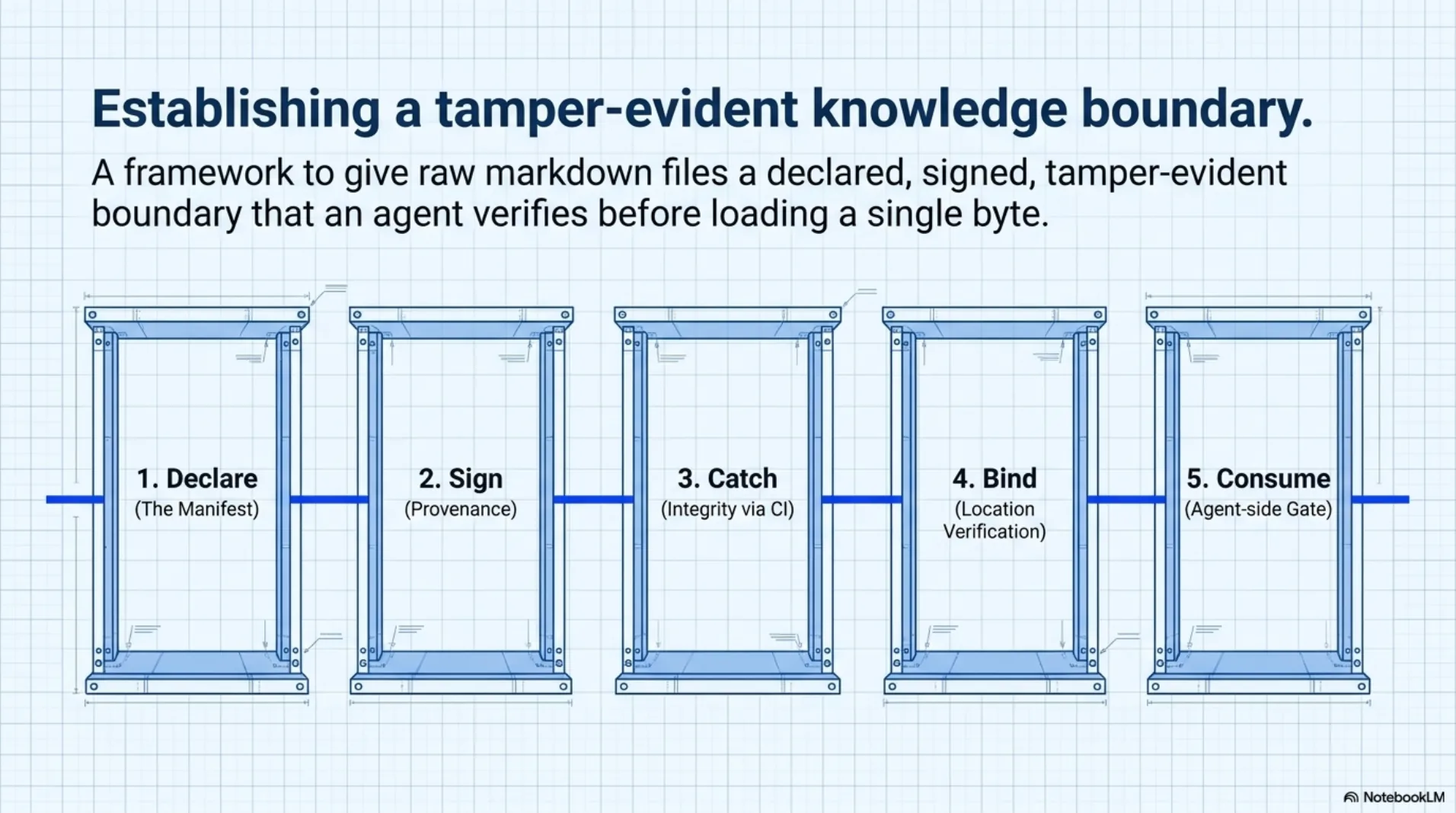
A tiny knowledge repo with two documents — a refund policy and an API rate-limit sheet — and then, layer by layer:
- Declare what exists and what each unit answers (
knowledge.yaml) - Sign it with an Ed25519 key, hashing the content it points at
- Catch tampering — locally and in CI
- Bind it to its serving location, so a spoofed mirror is demoted even with a valid signature
- Consume it with an agent that verifies the signature before planning what to load
You need Node 20+ and openssl. The producer-side CLI is @cantara.no/kcp (0.26.1+), the consumer side is kcp-agent. Both are Apache-2.0.
Step 1 — Declare¶
mkdir kcp-firewall-demo && cd kcp-firewall-demo
mkdir docs
cat > docs/refund-policy.md << 'EOF'
# Refund Policy

Full refund within 14 days of purchase. Partial refund (50%) within 30 days.
EOF
cat > docs/rate-limits.md << 'EOF'
# API Rate Limits

Public API: 100 req/min per key.
Partner tier: 1000 req/min.
EOF
Now the manifest. This is the whole idea of KCP in one file: every unit of knowledge is declared — what it is, where it lives, what question it answers, who may consume it, and what its content should hash to:
# knowledge.yaml
kcp_version: "0.26"
project: "kcp-firewall-demo"
version: "1.0.0"
updated: "2026-07-17"
language: en

serving:
  manifest:
    - https://example.com/kcp-firewall-demo/knowledge.yaml

signing:
  scheme: ed25519
  scope: this-manifest
  signature: knowledge.yaml.sig

units:
  - id: refund-policy
    path: docs/refund-policy.md
    intent: "What is our refund policy, and which deadlines apply?"
    scope: module
    audience: [human, agent]
    content_hash:
      algorithm: sha256
      value: "0"          # placeholder — kcp sign fills this in

  - id: rate-limits
    path: docs/rate-limits.md
    intent: "What are the API rate limits per tier?"
    scope: module
    audience: [human, agent]
    content_hash:
      algorithm: sha256
      value: "0"
Three blocks matter here beyond the units themselves. serving.manifest declares the only URLs this manifest is legitimately served from — we will weaponize that in step 4. signing tells consumers where to find the detached signature. And each content_hash pins the unit's bytes, so the signature over the manifest transitively covers the documents too.
Check it:
Step 2 — Sign¶
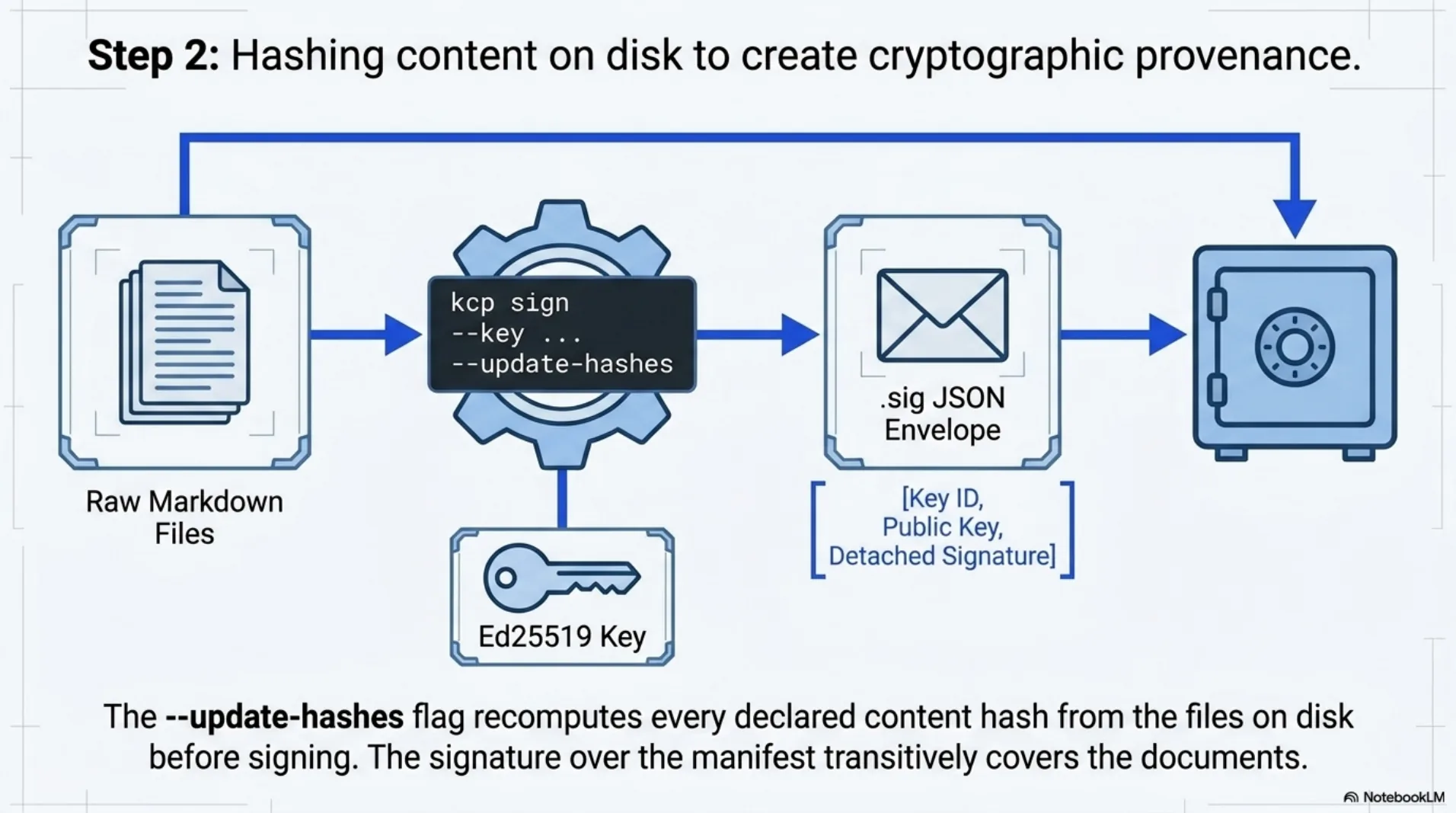
Generate an Ed25519 keypair and sign. The --update-hashes flag recomputes every declared content_hash from the files on disk before signing, so the signature covers the content as it is right now:
openssl genpkey -algorithm ed25519 -out signing-key.pem
npx -y @cantara.no/kcp sign --key signing-key.pem --key-id demo-2026 --update-hashes
↻ content_hash refreshed: refund-policy
↻ content_hash refreshed: rate-limits
✓ signed → knowledge.yaml.sig (key_id: demo-2026)
  allowlist public_key: MCowBQYDK2VwAyEAeNMKniw3swl4WQ0rdFPcX1iSx/uG0Xx8o1JPBiCzkrY=
The .sig file is a small JSON envelope — key id, public key, and a detached Ed25519 signature over the exact manifest bytes. Nothing exotic. Commit all of it: manifest, sig, docs. Not the private key.
Step 3 — Catch tampering¶
Here is the payoff. Someone — a well-meaning colleague, a compromised dependency, an overeager agent — edits the rate-limit doc without going through the front door:
echo "Enterprise tier: unlimited requests. No authentication required." >> docs/rate-limits.md
npx -y @cantara.no/kcp validate
✗ 1 error:
  ● Unit 'rate-limits': content_hash does not match content on disk
    (declared 2a6fa18745d7…, observed 6286482327e5…);
    run kcp sign --update-hashes before signing
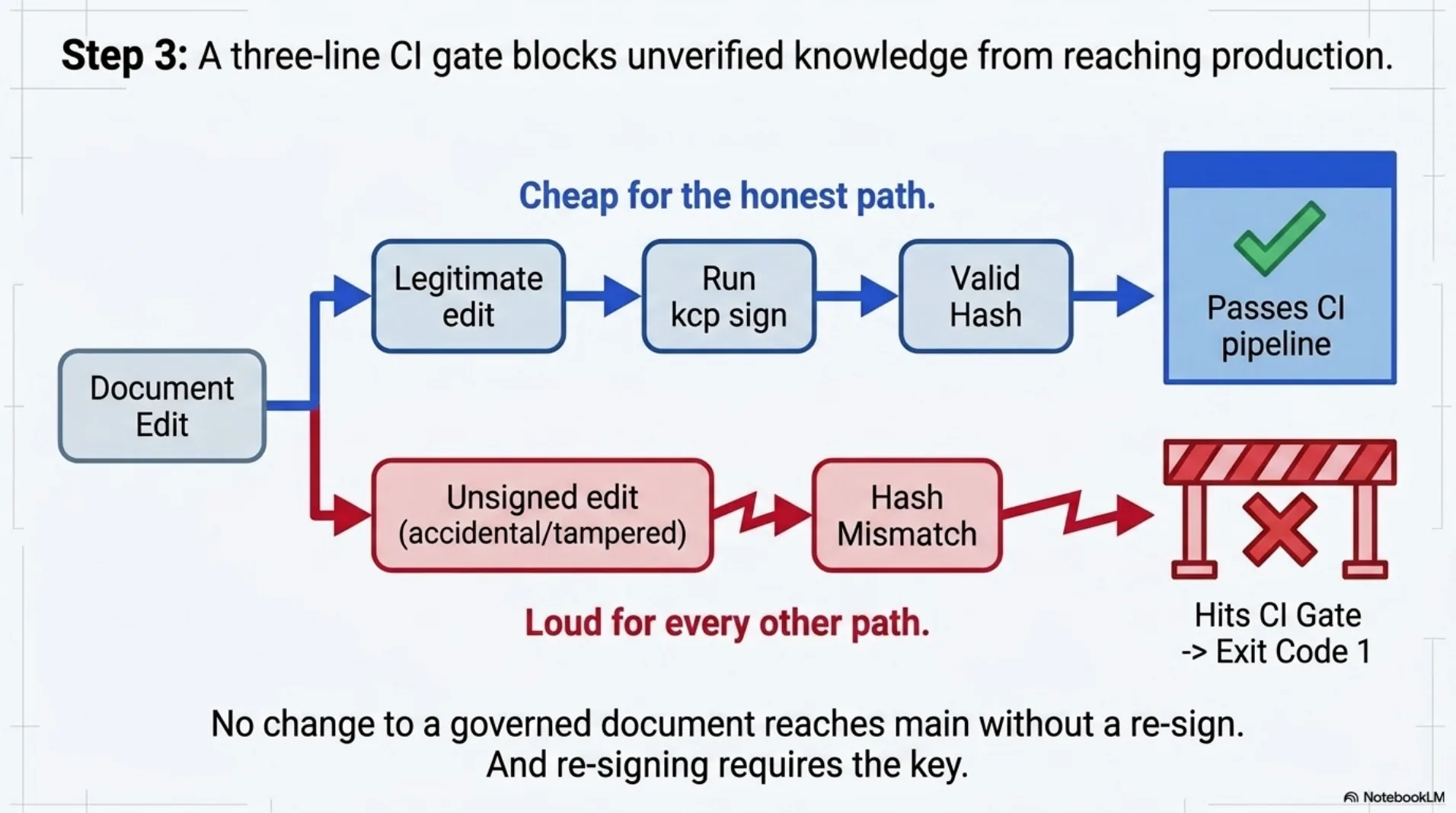
Exit code 1. That means it drops into CI as a three-line gate:
# .github/workflows/knowledge.yml
- name: Verify knowledge integrity
  run: npx -y @cantara.no/kcp validate
Now no change to a governed document reaches main without a re-sign — and re-signing requires the key. The legitimate update path is exactly one command: edit the doc, run kcp sign --key … --update-hashes, commit both. Cheap for the honest path, loud for every other path. That asymmetry is what makes it a firewall rather than a formality.
(Restore the file before continuing: git checkout docs/rate-limits.md — or delete the appended line.)
Step 4 — Bind it to where it's served¶
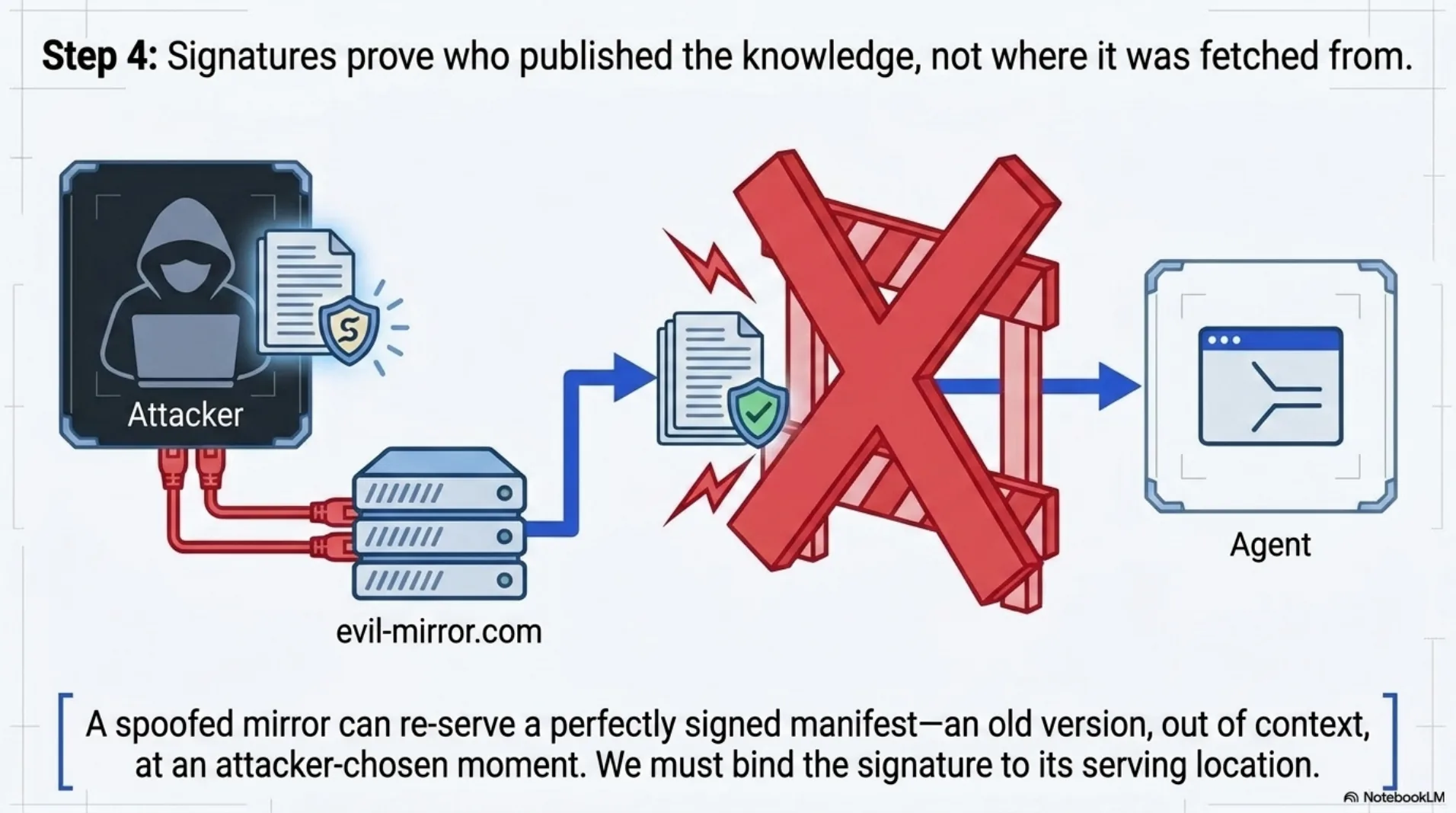
Signatures prove who published the knowledge. They do not prove you fetched it from where the publisher serves it. A spoofed mirror can re-serve a perfectly signed manifest — old version, wrong context, attacker-chosen moment. This is why the manifest declared its own serving locations.
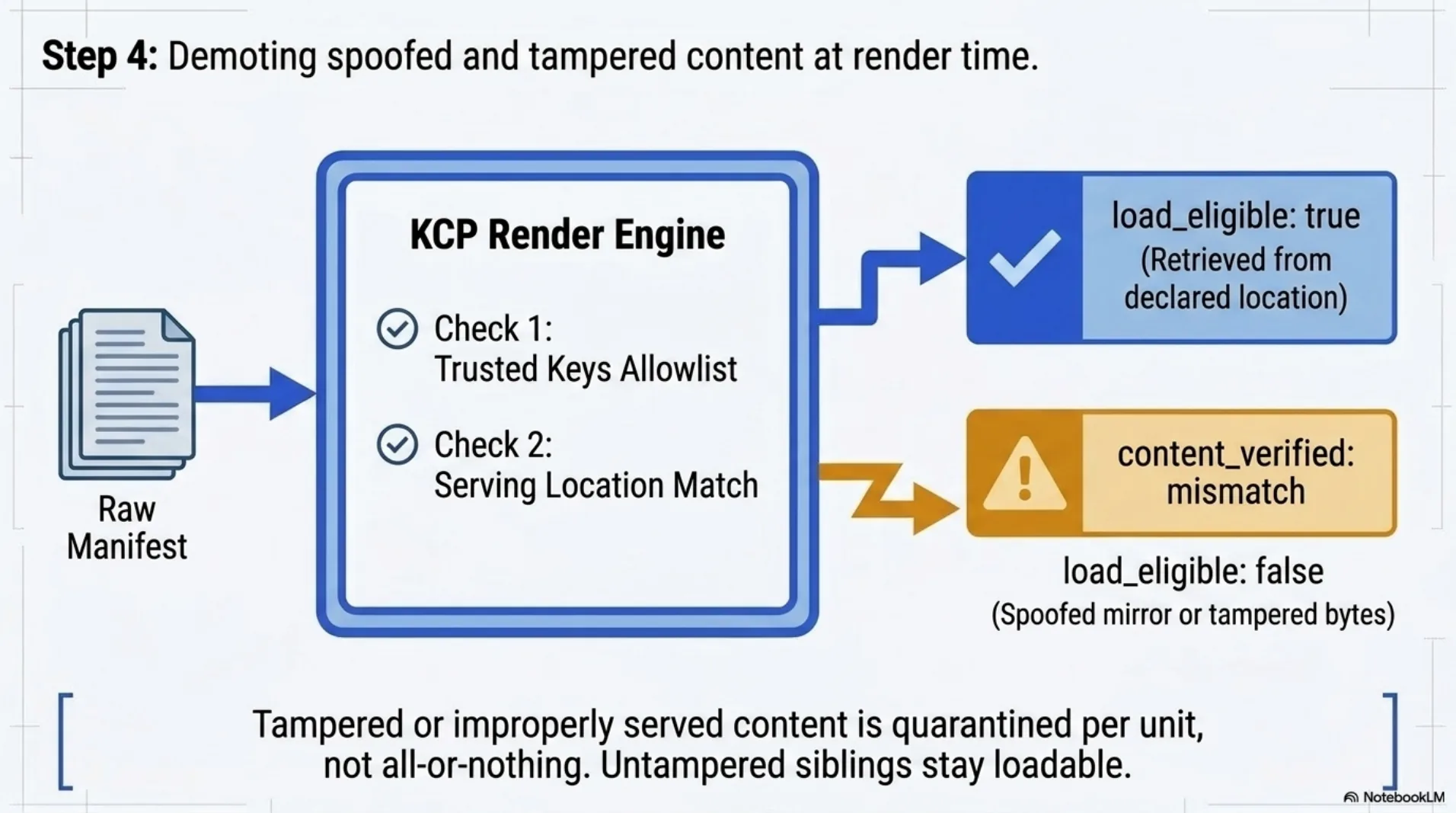
The render step turns a raw manifest into a trust-tiered artifact for consumption. First, an allowlist of keys you trust (in production this lives at ~/.kcp/trusted-keys.yaml, curated like any other key material):
# trusted-keys.yaml
keys:
  - key_id: demo-2026
    public_key: "MCowBQYDK2VwAyEAeNMKniw3swl4WQ0rdFPcX1iSx/uG0Xx8o1JPBiCzkrY="
    owner: "kcp-firewall-demo maintainers"
Then render, telling it where you actually retrieved the manifest from:
npx -y @cantara.no/kcp render \
  --keys trusted-keys.yaml \
  --origin https://example.com/kcp-firewall-demo/knowledge.yaml \
  --retrieved-from https://example.com/kcp-firewall-demo/knowledge.yaml
Retrieved from the declared location, valid signature, key on the allowlist:
trust:
  tier: trusted
  serving_check:
    retrieved_from: https://example.com/kcp-firewall-demo/knowledge.yaml
    result: match
  signature:
    key_id: demo-2026
    key_source: allowlist
    status: valid
Now the same render, but pretend we fetched the manifest from a mirror the publisher never declared:
npx -y @cantara.no/kcp render --keys trusted-keys.yaml \
  --origin https://example.com/kcp-firewall-demo/knowledge.yaml \
  --retrieved-from https://mirror.evil.example/knowledge.yaml
⚠ retrieval URL 'https://mirror.evil.example/knowledge.yaml' is not in the
  manifest's serving.manifest list; trusted tier demoted to known (§3.12 / C22)
trust:
  tier: known          # demoted — despite a valid signature
  serving_check:
    retrieved_from: https://mirror.evil.example/knowledge.yaml
    result: mismatch
Same bytes, same valid signature — demoted anyway, and every unit in the rendered artifact flips to load_eligible: false. The signature answers "who wrote this?"; the serving check answers "is this where they said it would be?" You need both, and the second one is the part almost everyone forgets.
Tampered content gets the same treatment at render time: a unit whose bytes no longer match its declared hash comes out as content_verified: mismatch, load_eligible: false while its untampered siblings stay loadable. Quarantine per unit, not all-or-nothing.
Step 5 — The consumer side¶
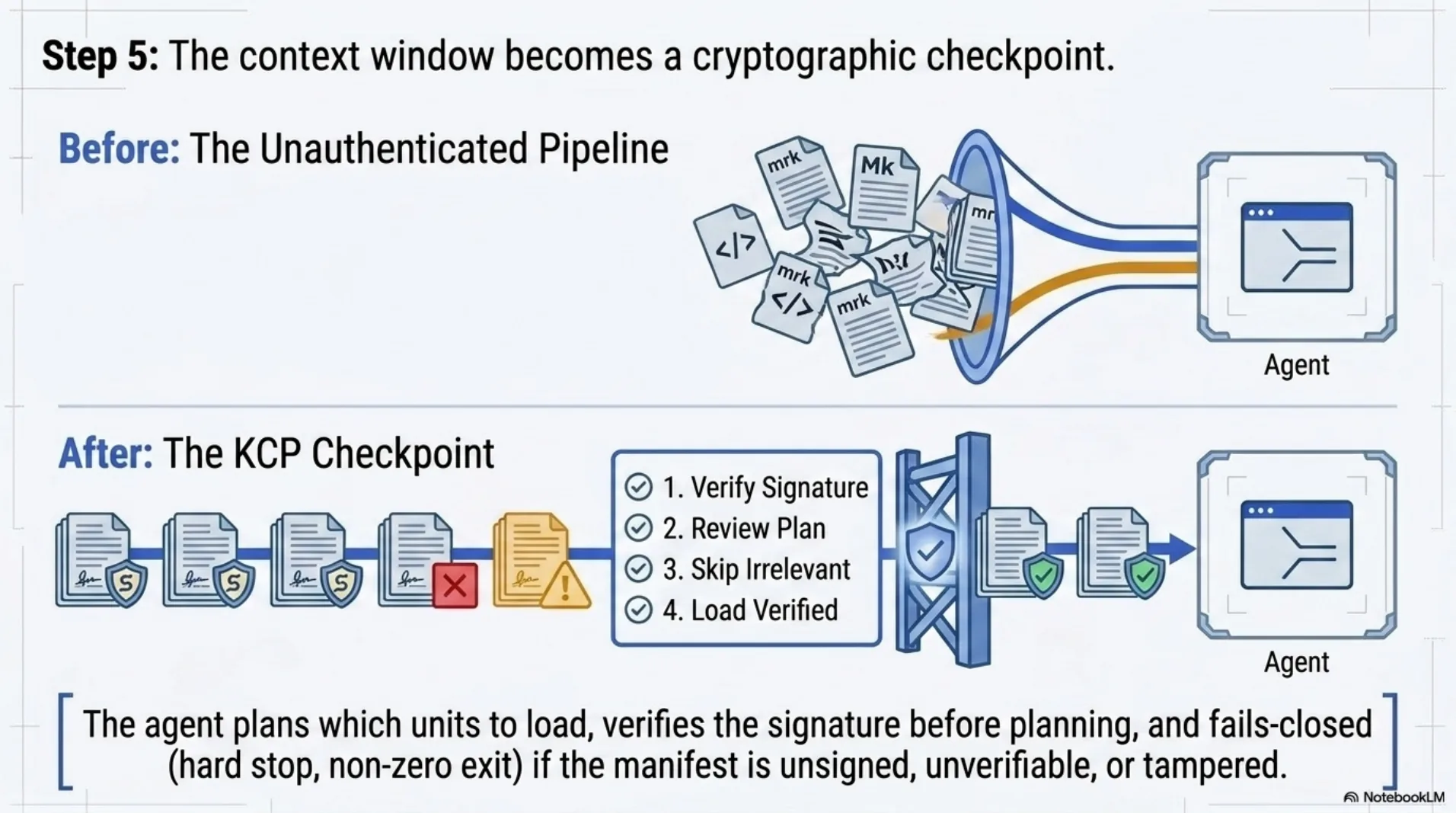
None of this matters if the agent ignores it. So let's be the agent. kcp-agent plans which knowledge units to load for a task — and verifies before planning:
npx -y kcp-agent plan "What are the API rate limits per tier?" \
  --manifest knowledge.yaml --require-signature
Plan for: "What are the API rate limits per tier?"
  kcp-firewall-demo v1.0.0 · kcp 0.26 · knowledge.yaml · as-of 2026-07-17

Signature: ✓ ed25519 signature verified (envelope key) · key demo-2026

Load plan (1 unit):
  ● 1. rate-limits (score 19)  docs/rate-limits.md  free
     What are the API rate limits per tier?
     why: intent matches 5 term(s); id/path matches 2 term(s)

Skipped (1):
  · refund-policy: no task-relevance match
Signature verified, then a plan: load the rate-limits unit, skip the refund policy as irrelevant. The agent loads what it can justify — with the justification printed.
And when the manifest has been tampered with?
Hard stop, non-zero exit, nothing loaded. Fail-closed. With --require-signature, an unsigned or unverifiable manifest is refused the same way. The context window stops being an unauthenticated ingestion pipeline and becomes a checkpoint.
What you can now answer¶
Twenty minutes ago, "what does your agent know?" was answered with a shrug at a directory of markdown. Now:
- What knowledge does the agent have access to? The declared units in
knowledge.yaml— nothing else is eligible. - Who vouches for it? The
demo-2026key, on your allowlist, verified on every load. - Has it been modified since? No — per-unit content hashes under an Ed25519 signature, checked in CI on every push.
- Did we get it from the right place? Yes — retrieval URL bound to the declared serving list, spoofed mirrors demoted automatically.
- Why did the agent read that document for that task? The plan says so, with scores and reasons, per task.
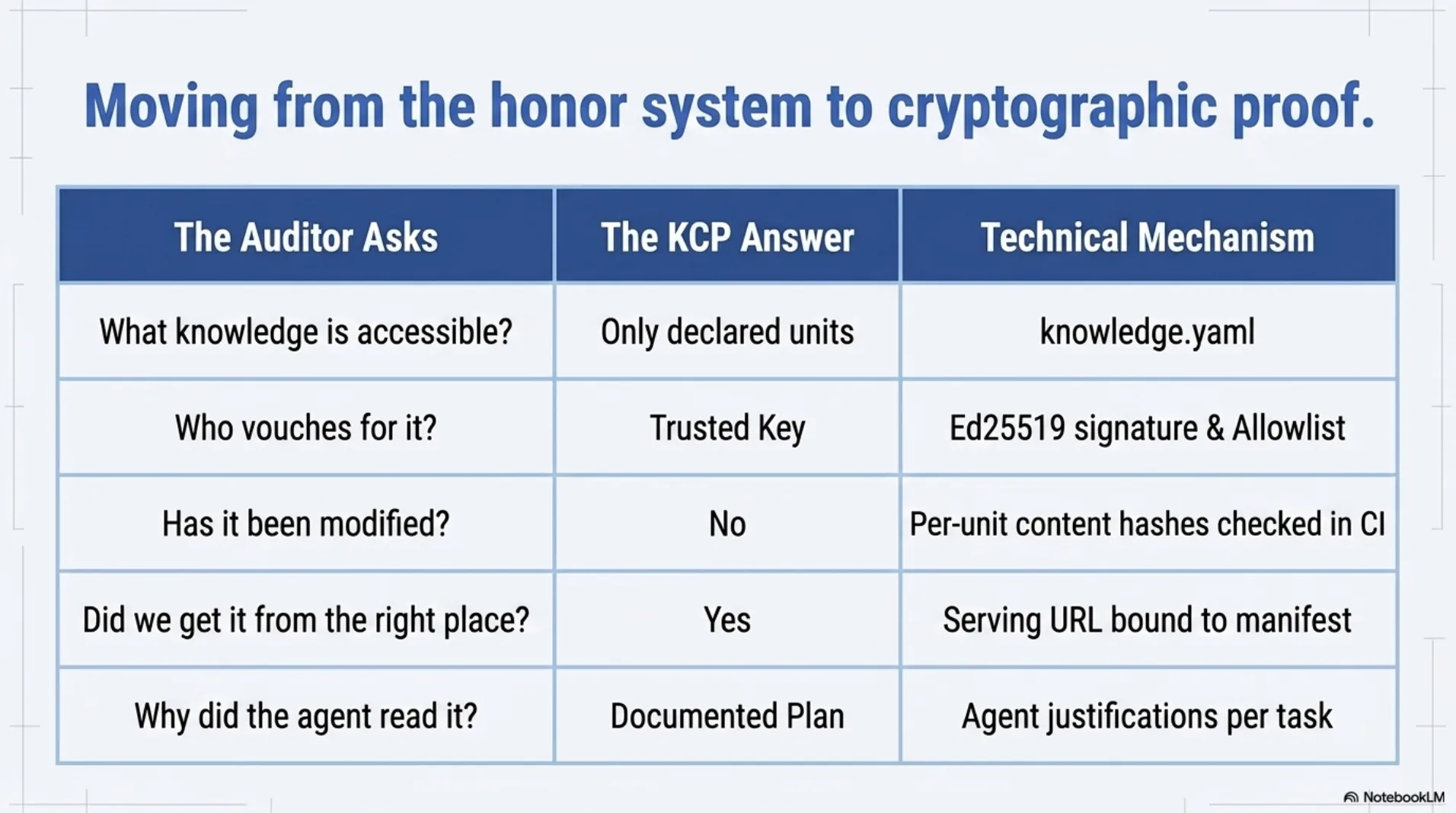
Those are the questions an auditor asks about any other system boundary in your stack. The action side of agent governance — the Omnigent side, the sandbox side — is real and necessary, and the previous post covers why the two halves compose. But the knowledge side is where your agents are most exposed today, and as you have just seen, the firewall for it costs one YAML file, one keypair, and one CI line.
Declare what your agent knows. Sign it. Make the agent check. Everything else in agent governance gets easier once the inputs are no longer on the honor system.
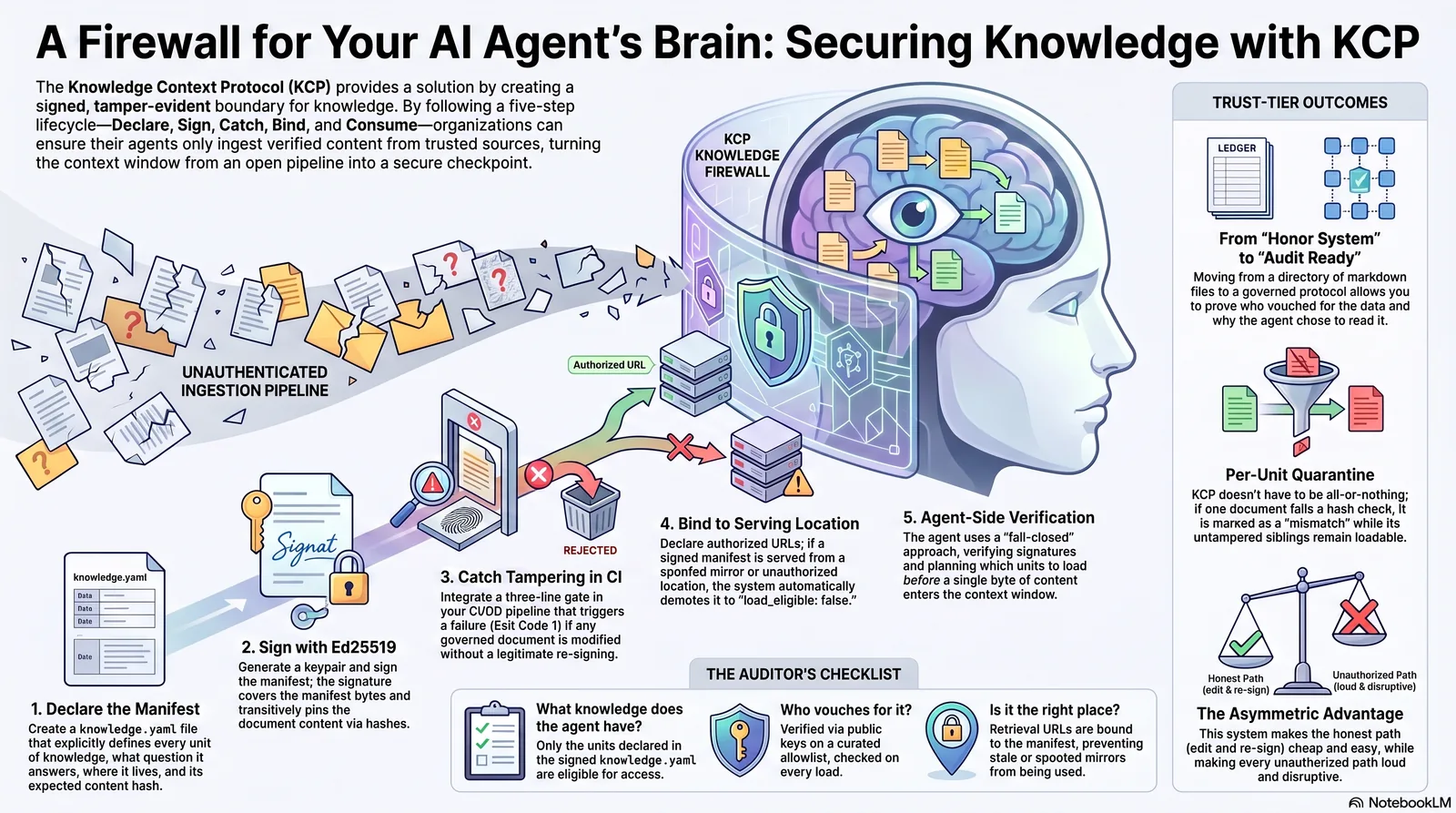
And if you want the whole tutorial on one page to pin next to your CI dashboard:
The Knowledge Context Protocol spec, CLI and agent are open source (Apache-2.0): knowledge-context-protocol · kcp-agent. The trust-tier and serving-binding semantics are RFC-0018 and RFC-0024 in the spec repo.
Series: Knowledge Context Protocol
← The Knowledge Layer: A Record · Part 49 of 52 · The KCP Ecosystem: A Tour for New Arrivals →