Skip to content

Writing

Organized Truths

Practitioner notes on the verification you only do once.

In the previous post I described catching an agent claiming a parser was "fully RFC compliant." I caught it by opening the RFC — four minutes of reading against a parser that handled none of the wildcard support the spec requires.

The tips in that post were about catching such claims. This post is about a better question that took me longer to ask:

Why did the agent never open the RFC?

Not because it couldn't read it. Because the RFC wasn't there. The agent had the parser in its context and the spec in its vibes — a compressed, lossy impression from training data. Asked to compare code against a standard, it compared code against its memory of the genre of that standard. Of course it produced an adjective.

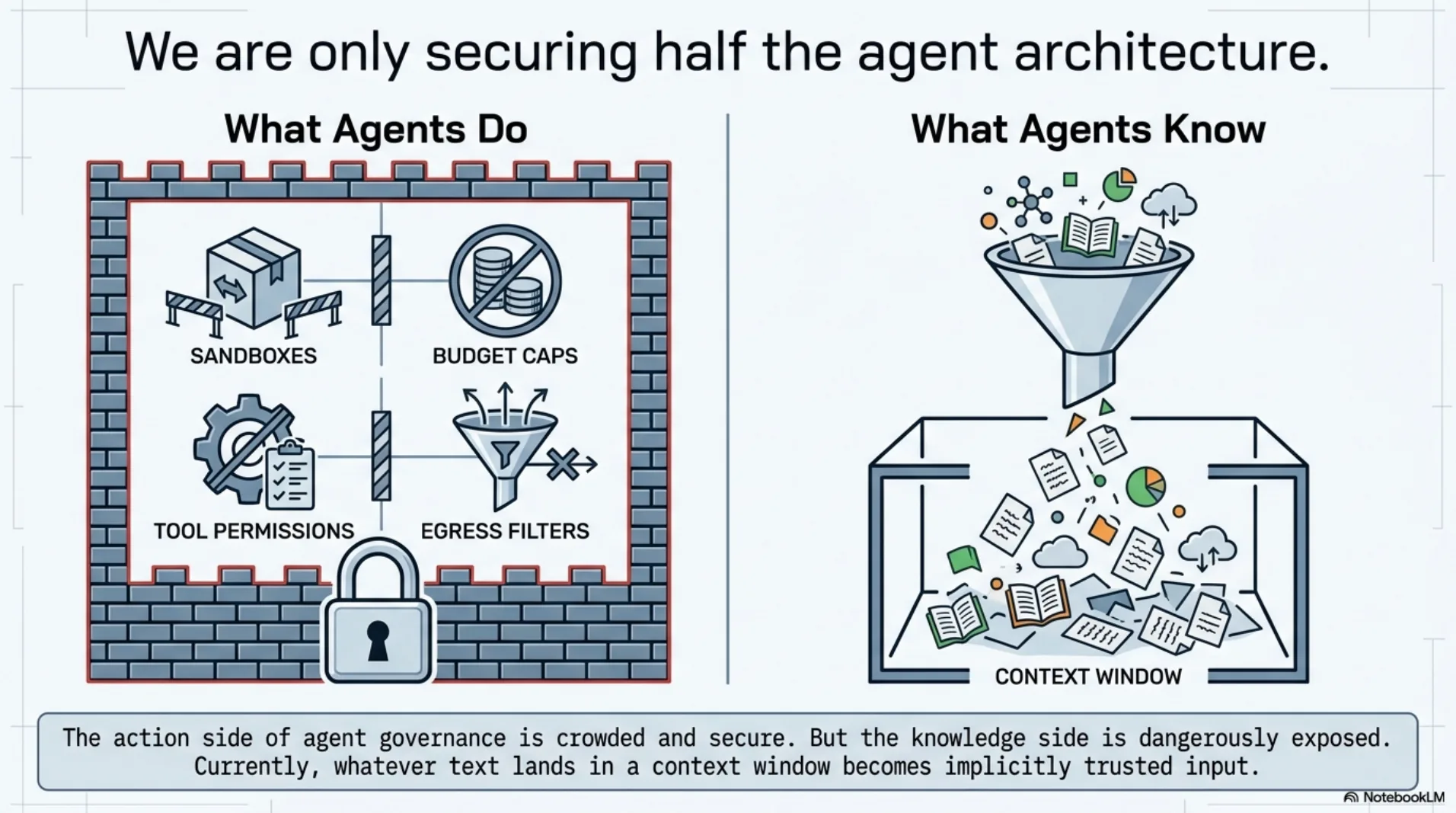
You can audit that failure forever. Or you can change what the agent reasons from.

False Alarms and False Assurances

Practitioner notes on verifying what your agents tell you.

This week an agent told me, confidently, that an API endpoint had no authentication.

It did. The router was mounted twelve lines after the auth middleware. The agent had read the route file — clean, self-contained, no auth code in sight — and reported what it saw. What it saw was true. What it concluded was false.

The same afternoon, two more claims from the same research run didn't survive contact with the source: a parser described as "fully RFC compliant" (it lacked the wildcard support the RFC requires), and a plugin described as "active" (it was active only because of an import side effect in an unrelated legacy file — a load-order accident no test asserted).

Three wrong claims, one afternoon, inside an otherwise excellent piece of agent research that compressed days of code archaeology into hours. This is not a complaint about agents. It is a job description for the human.

The Compound Developer

A developer at their desk, knowledge network nodes glowing through the dark

In the most rigorous study of AI coding tools conducted to date — a randomized controlled trial by METR published in July 2025 — sixteen experienced open-source developers used AI assistance on tasks in their own projects. Projects they had worked on for an average of five years. Before each task, they predicted AI would reduce their completion time by 24%. After each task, they estimated they had been sped up by 20%.

The actual measurement: they were 19% slower.

The METR perception-reality gap: predicted +24%, felt +20%, actual -19%

The perception-reality gap in that study is between 39 and 44 percentage points. The developers were not exaggerating. Working with AI genuinely feels faster. But something in the translation from felt experience to measured outcome goes wrong — and understanding what, exactly, goes wrong is the only path to what actually works.

Everyone Is Auditing the Workflow. Nobody Is Fixing the Knowledge.

Overview: Beyond the Audit Trail — Solving the AI Provenance Problem. The three problem areas, incomplete solutions, and the KCP/composable trust solution.

In February 2024, a Canadian small claims tribunal ruled against Air Canada. Their chatbot had told a passenger he could book a full-fare ticket and claim a bereavement discount retroactively. He couldn't. When he tried, Air Canada's position was: the chatbot said that, not us. The tribunal disagreed. You deployed it, you own what it says.

The ruling was correct. But the more interesting problem was underneath: when the incident happened, nobody could reconstruct what context the chatbot had been given. Nobody could confirm whether a human had ever reviewed the policy the bot was consulting. Nobody could determine whether the specific bereavement policy text had been modified between deployment and the passenger's interaction. The audit trail recorded that the system was deployed. It did not record what the system knew.

That's the provenance problem. And every organization running AI agents at enterprise scale is about to hit a version of it.

The Law Is Also Knowledge. Package It.

Overview: The Law as Code — Solving the AI Compliance Identity Crisis. The problem (shapeless regulations as prose), the KCP solution (typed regulatory packages), and real-world applications across NIS2 and EU AI Act.

In the previous post, I argued that the AI provenance problem is a format problem. The knowledge going into and out of AI systems -- policies, observations, interpretations -- has no stable shape. No type, no version, no cryptographic binding. The audit trail records that something was reviewed. It cannot record what was reviewed, because the thing itself is prose that could have drifted between the moment of review and the moment of use.

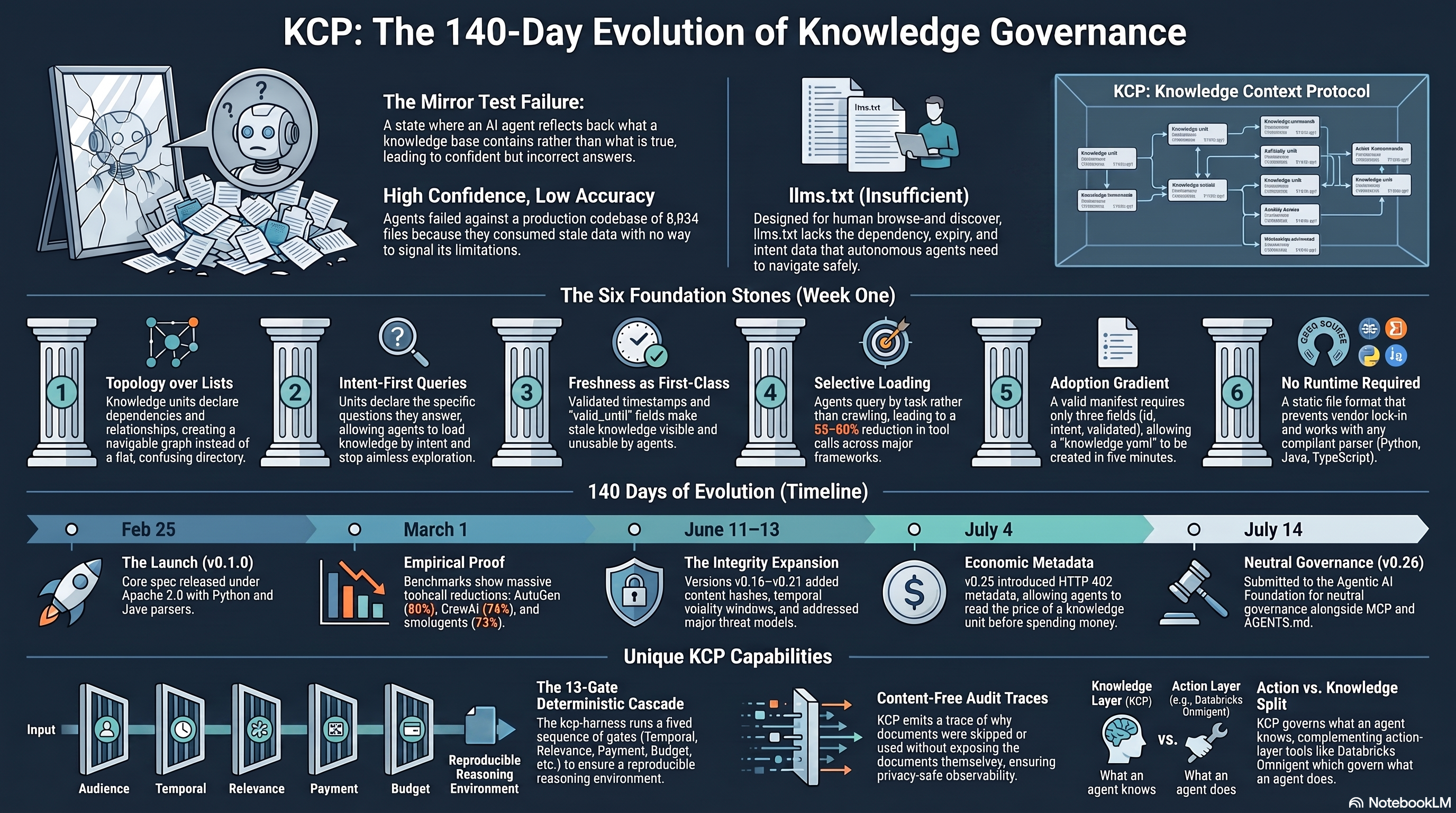
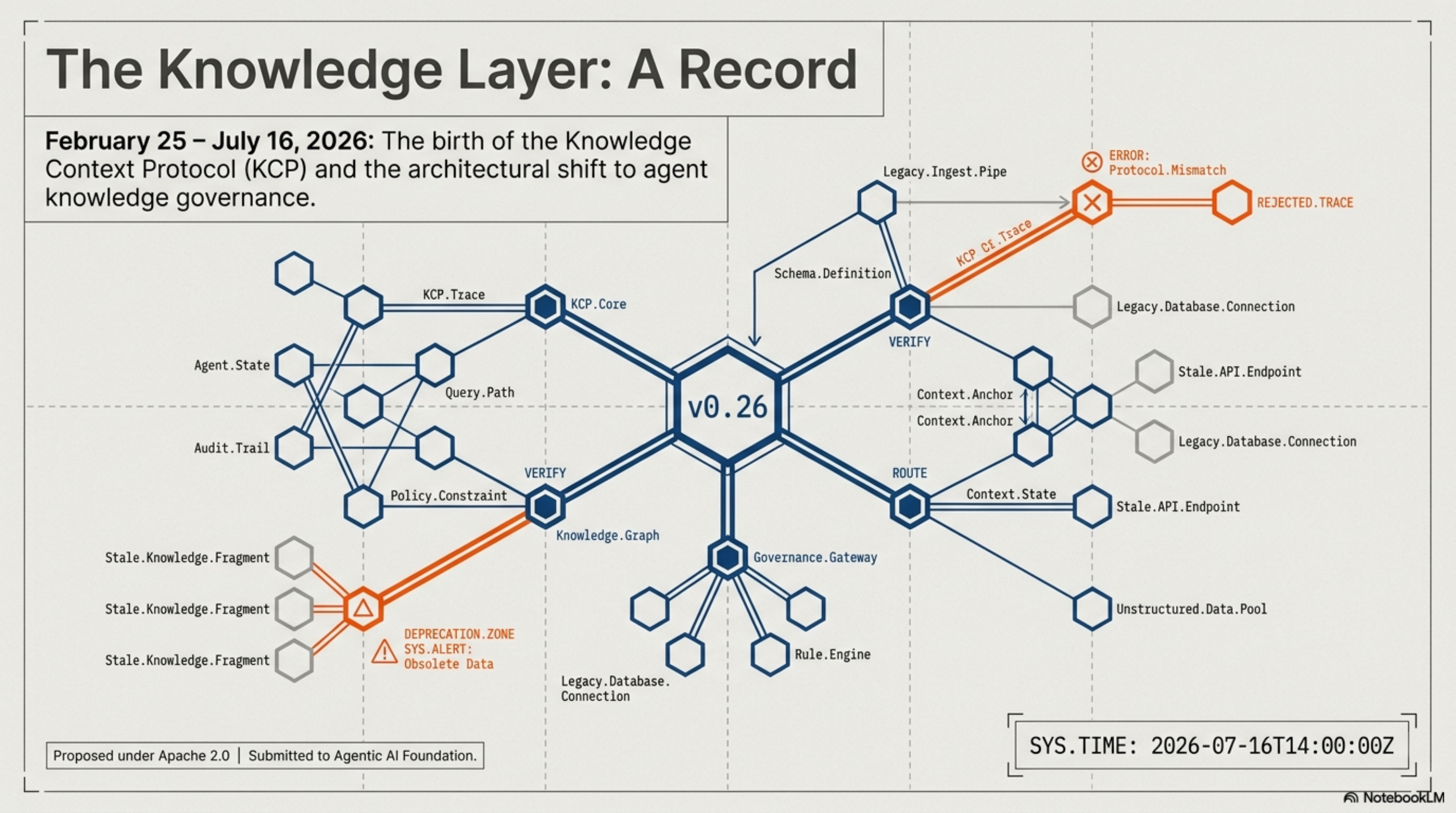
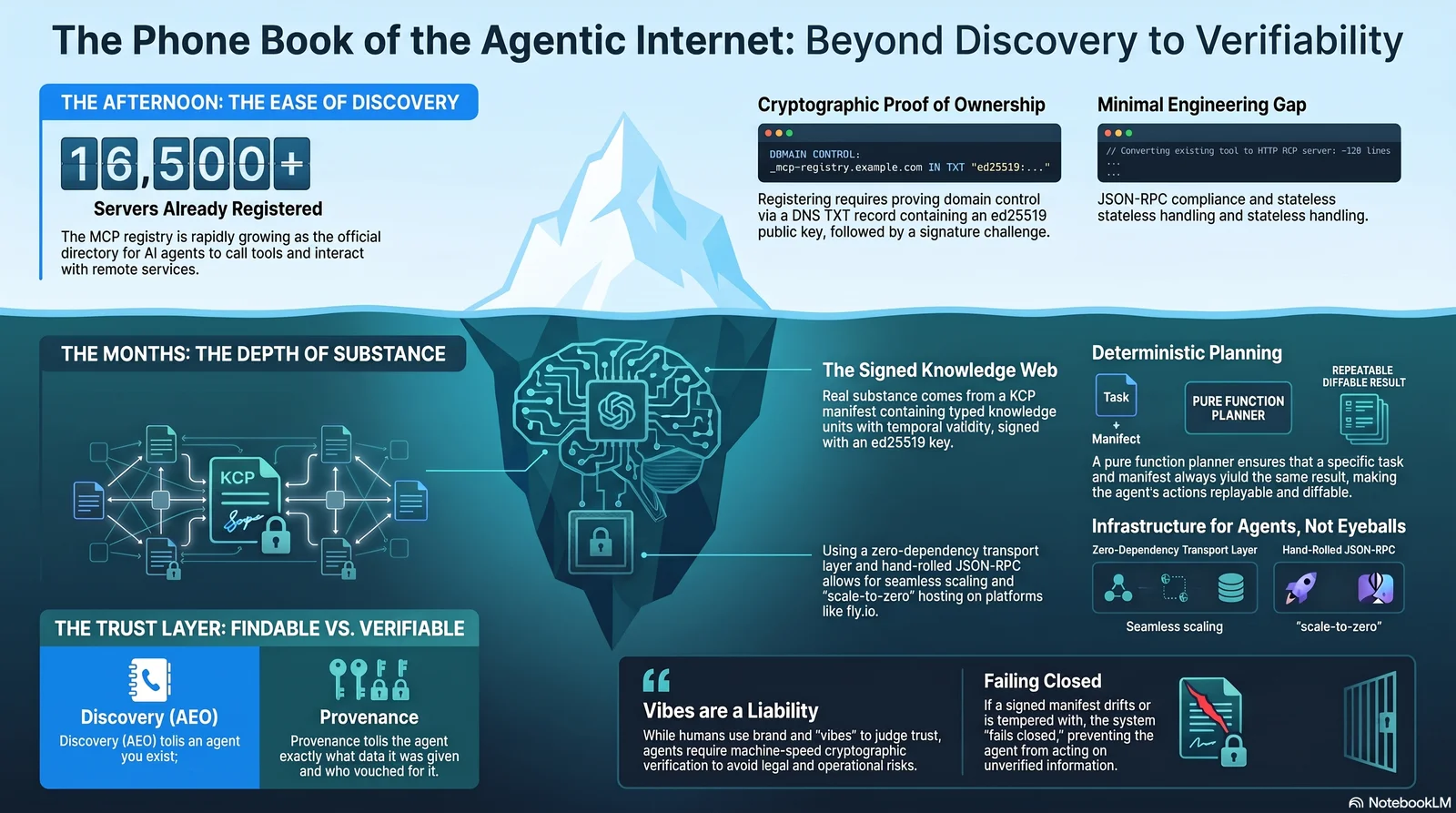
KCP solves this by giving knowledge a shape: typed, versioned, signed packages. A compliance observation becomes a structured declaration with type, version, signed_by, derived_from, review_depth, valid_until. The audit trail becomes precise: "reviewed a cryptographically signed declaration of type evaluation:nis2-art21-supply-chain v1.2.0" -- not "reviewed a document."

But there is a gap I did not address. I gave shape to the outputs -- the policies, the observations, the interpretations. I left the inputs shapeless. The regulations and laws that AI agents evaluate against are still prose in the system prompt.

This post closes that gap.

From Policy to Practice: How KCP Makes Regulations Machine-Readable for AI Agents

A presentation version of this post is available as slides.

Your agent reads customer data. It makes a decision. It writes something to a database.

Somewhere in your system prompt, there is a line that says: "You must comply with GDPR data minimization principles when accessing customer data."

That line does nothing. It is not verifiable. It is not testable. It is not auditable. It is a string that your model may or may not attend to, depending on context length, prompt position, and the phase of the moon.

The Beginning

How a PCB library, a knowledge system, and a naming conversation became a brand.

eXOReaction has been around for a while. This is not a story about starting a company. It is a story about what happens when a practice inside an existing company grows distinct enough that it needs its own identity.

Ægis is that practice. ægis.no went live last week. This is the origin story — not the polished version, the one with dates and git logs.

The Harness Before the Service

In May 2026, Anthropic shipped Managed Agents. I read through the docs, the API spec, the beta header (managed-agents-2026-04-01), and felt something I can only describe as architectural recognition.

Not surprise. Recognition. The way you recognize your own design decisions in someone else's implementation — because the problem space, if you take it seriously, produces the same structural answers.

Why KCP Is Passive Data, Not Executable Config — And Why That Matters Now

The Architecture of Safe Context — passive data vs executable config

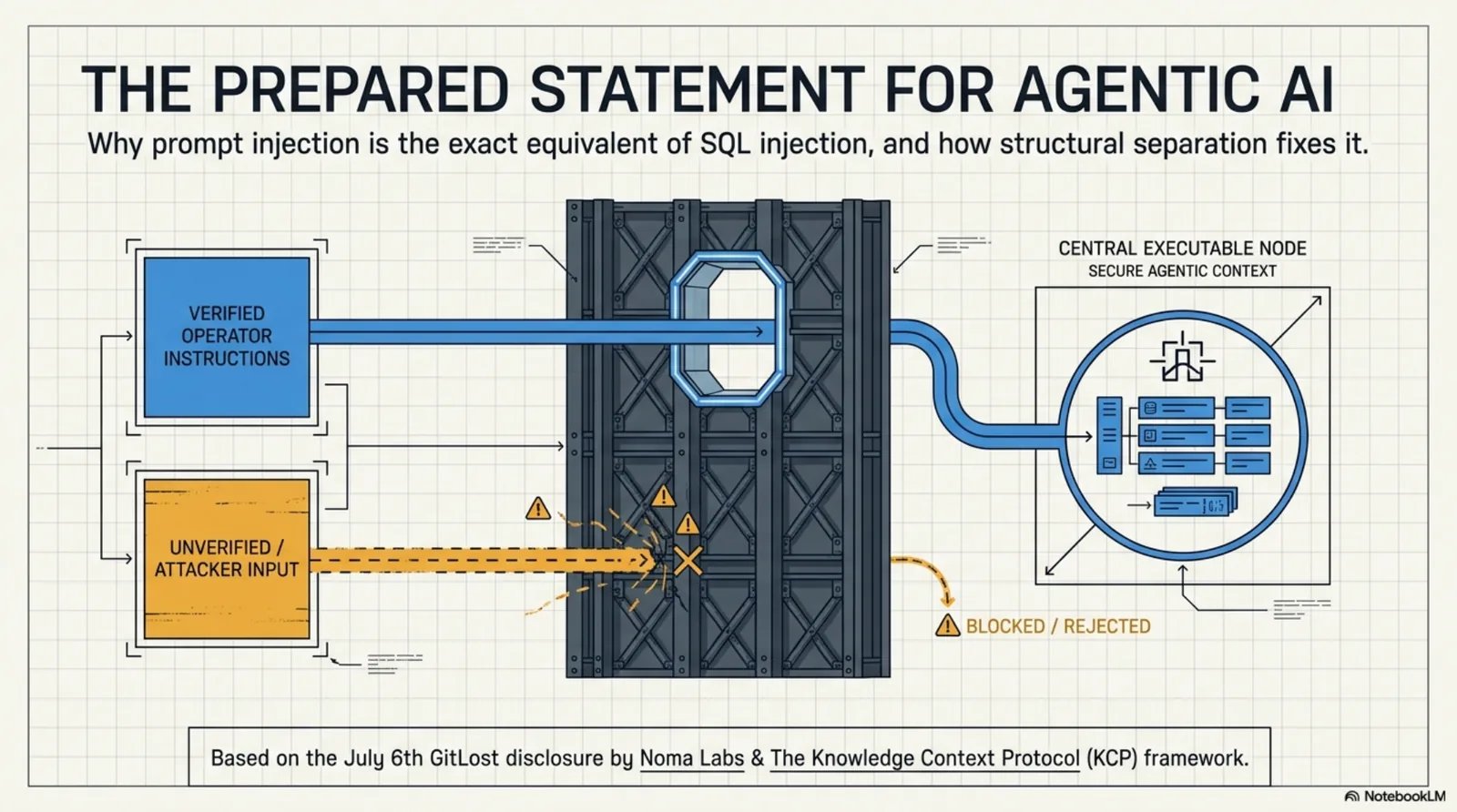
Yesterday, Adversa AI disclosed a vulnerability they call TrustFall. The mechanic is straightforward: a .mcp.json or .claude/settings.json file checked into a repository can silently configure and launch arbitrary MCP servers when a developer opens the project. The developer sees a trust dialog — "Trust this folder?" — clicks yes, and processes spawn with their full user privileges. Claude Code, Gemini CLI, Cursor CLI, and Copilot CLI are all affected. In CI/CD pipelines, where there is no human to click, the execution is zero-click.

Making Ægis Machine-Readable in One Session

An AI-era consulting company that isn't machine-readable is a contradiction. Clients evaluating you will use AI to do it. Agents will look up your services, your methodology, your pricing model. If the only thing they find is a wall of HTML, you're invisible to half the evaluation pipeline before the first conversation starts.

So I spent a session making ægis.no properly machine-readable. Not just an LLM-friendly page — actually structured, federated, and cryptographically signed. Here's what I did and what I learned.