On June 12, 2026, Google Cloud published the Open Knowledge Format (OKF). I read it the same day. My first reaction was: this is good news. My second reaction was: they stopped exactly where it gets hard.
Practitioner notes on shipping a feature that was already a no-op, in two different ways.
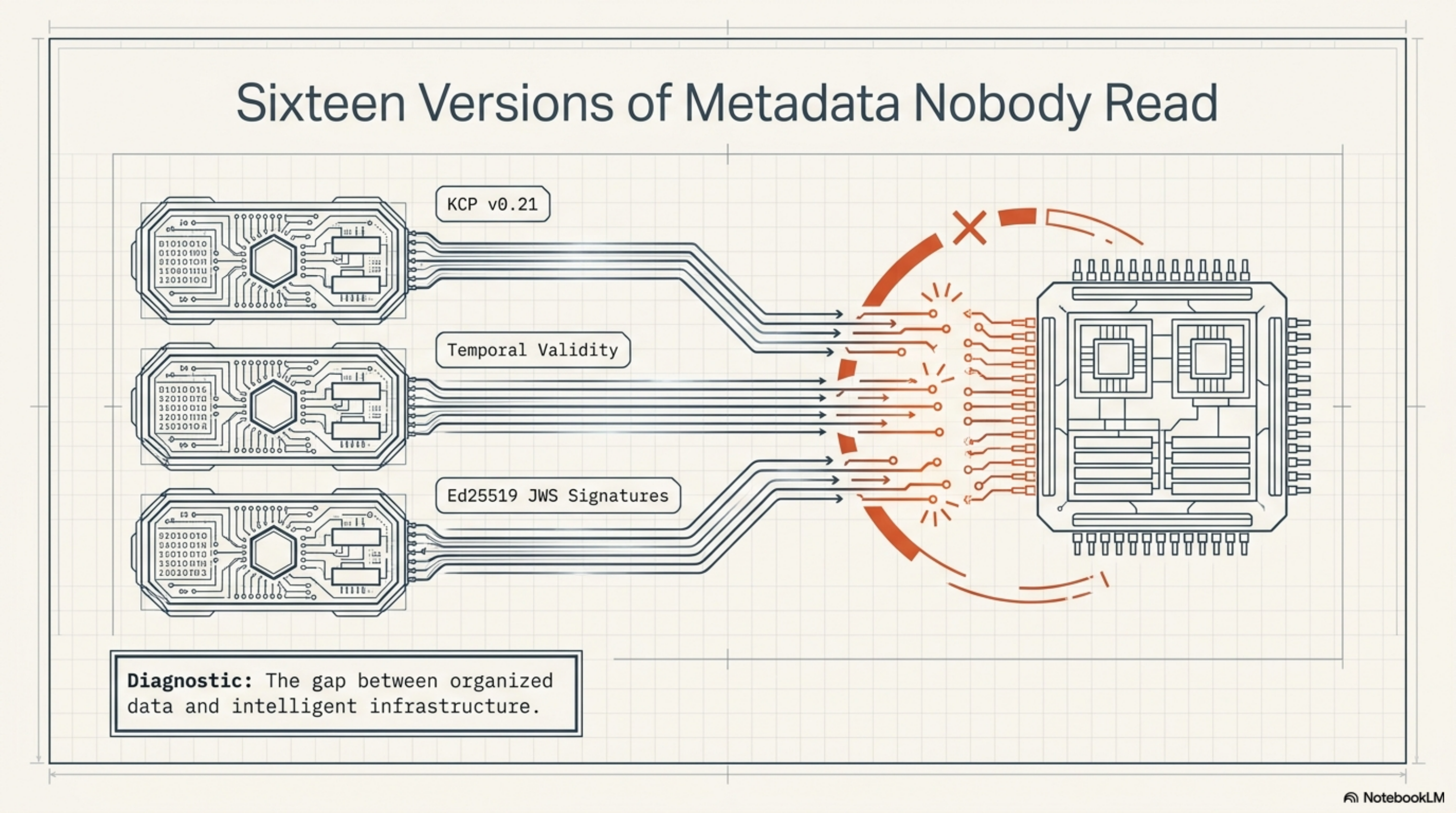
The Mynder regulatory knowledge base has 63 fragment manifests covering 101 units of EU regulation — GDPR, NIS2, the EU AI Act, DORA, Norwegian and Swedish data protection law. Every unit carries temporal validity (valid_from, valid_until, superseded_by), per-unit content hashes (sha256), not_for audience filtering, content structure declarations, and Ed25519 JWS signatures. All of it declared in KCP v0.21.
Synthesis — the workspace intelligence tool that indexes and searches this corpus — was reading it at v0.5 feature level.
Sixteen spec versions of metadata, sitting in the files, being dutifully indexed and completely ignored by the tool whose job was to understand them. The corpus was "searchable" but not "knowledge-aware." You could find GDPR articles by keyword. You could not ask what was in effect in 2022 and get a time-correct answer.
This morning I spent three hours on regulatory knowledge infrastructure. 63 fragment manifests across Arbeidsmiljøloven, GDPR, NIS2, DORA, AI Act, NSM Grunnprinsipper, Dutch financial supervision law. Fixed a scope validation bug across 30+ files. Extracted 38 Dutch obligation units from inline YAML to standalone navigable text. Everything passing kcp validate by lunch.
None of it would normally get published. Too narrow. Too technical. No audience in the traditional sense — a compliance engineer isn't subscribing to this blog, and a developer evaluating KCP isn't refreshing the RSS feed waiting for fragment extraction patterns.
That instinct is correct. If you're writing for humans, ruthless editing is the right move. Cut the scope validation bug. Keep the summary. Optimize for skimmability, because human reading bandwidth is fixed and attention is scarce.
The instinct is right. The assumption about who's reading has become incomplete.
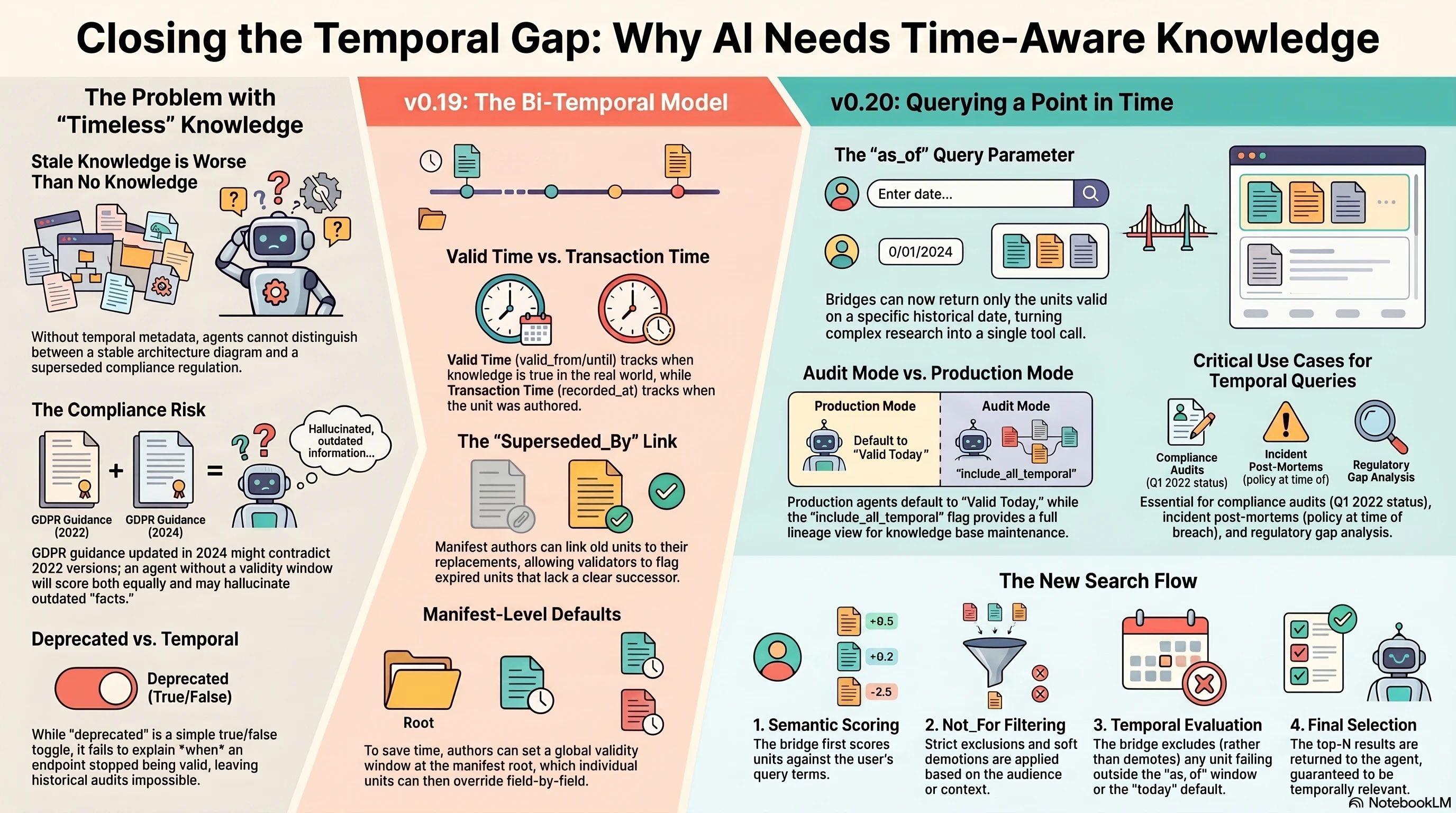
The previous post ended with a list of gaps still visible after v0.18: federated trust delegation, transport integrity, digest cost budgets. The one I left off the list, because it was already in progress, was time.
Not performance. Not latency. Actual calendar time — the question that turns out to matter enormously for knowledge that agents load into context: when is this unit valid?
v0.19 and v0.20 answer that question. v0.19 lets manifest authors declare temporal validity. v0.20 lets agents query against it.
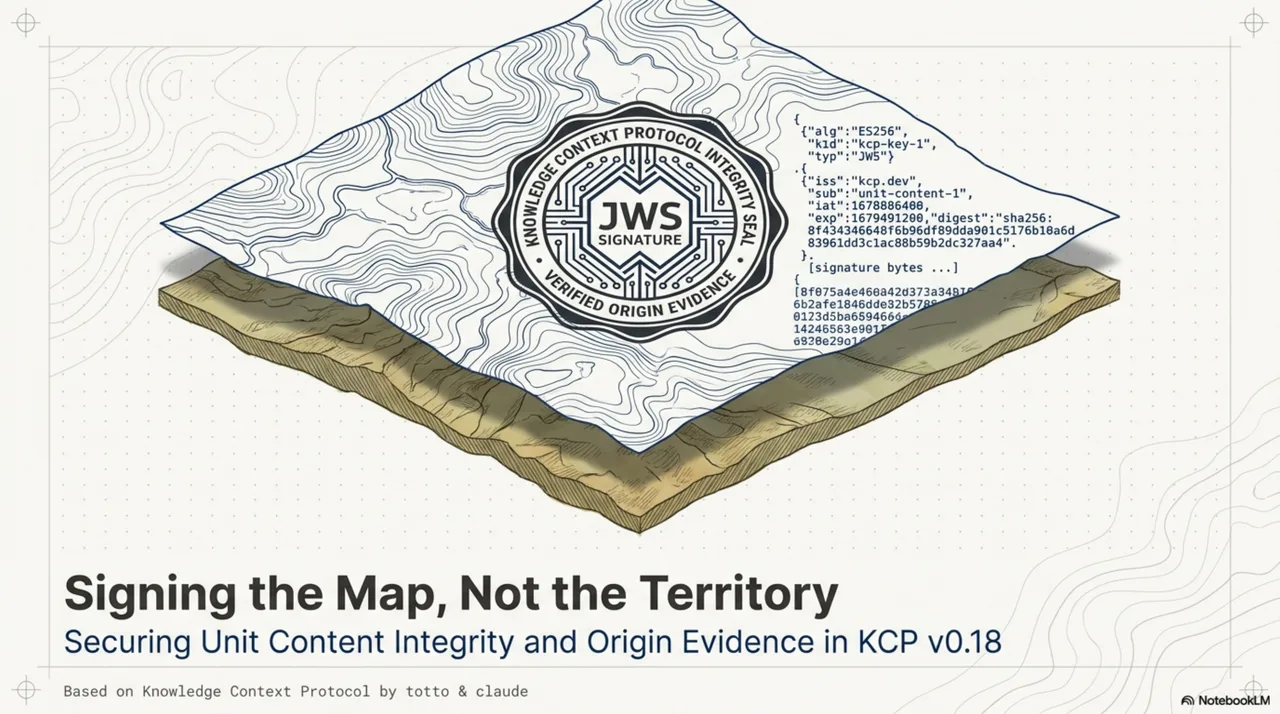
The previous post showed how KCP v0.16 gives manifests a trust model: cryptographic signing, trust tiers, a render pipeline that fails closed. The signature covers the manifest -- the YAML bytes that describe your knowledge units. It does not cover the files those units point to. The signature says "this map is authentic." It says nothing about the territory.
That gap has a name: T9, the manifest relocation attack. v0.18 closes it.
It started with a question no one expected to be hard.
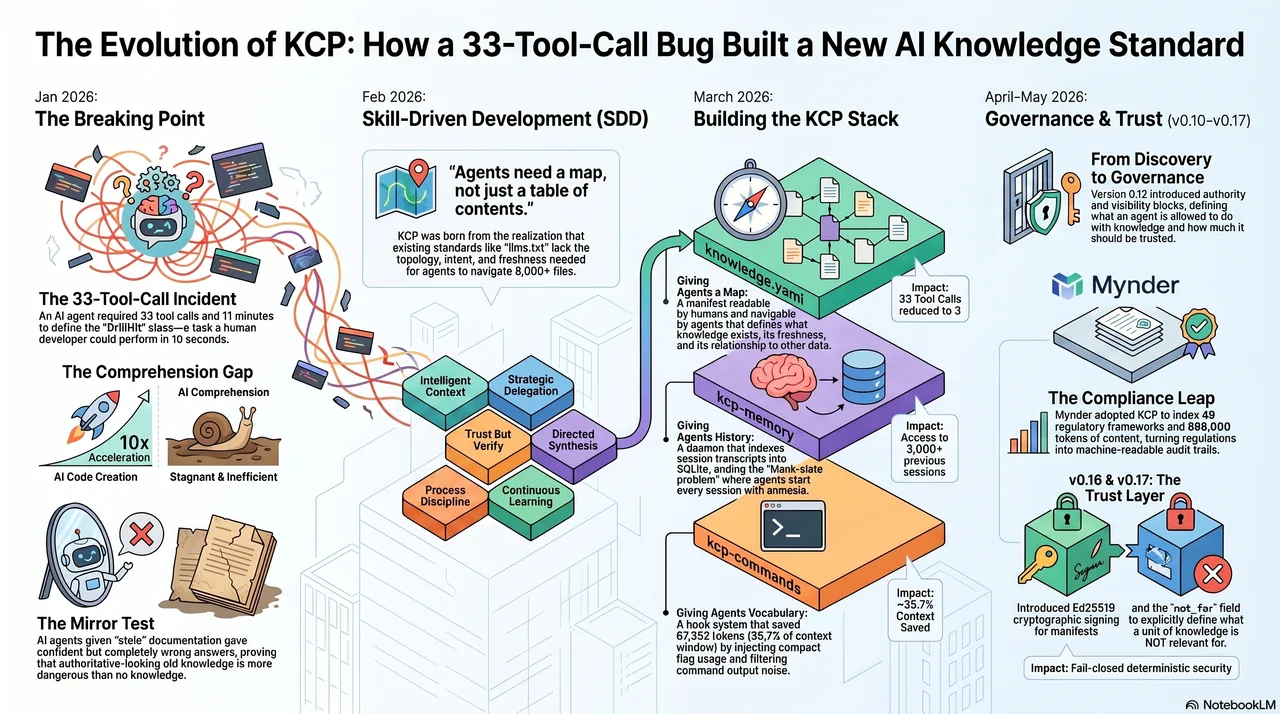
Day seven of the lib-pcb build. January 2026. A single developer, eleven days to produce what the industry does in ten to eighteen months. The AI was generating code at a pace that defied every estimate. Features that should take a week arrived in hours. The skill library -- YAML files encoding project-specific context for Claude Code -- had grown to over forty entries. Everything was working.
And then everything stopped.
"What fields does the DrillHit class have?"
The AI did not know. The class had been written four days earlier. It was central to the entire parsing architecture. It had been discussed in multiple sessions. But the context was gone -- fresh session, blank slate. The AI started searching. Grep for the class name. Read the file. Follow the imports. Check the parent class. Read that file. Check the serializer. Follow another import. Back to grep. Thirty-three tool calls to answer a question that any developer on the project for a week could answer in ten seconds.
Eleven minutes. For one question.
That was the moment something broke open. Not the code -- the assumption underneath it. The assumption that making AI faster at creating code was sufficient. Creation had been accelerated by an order of magnitude. Comprehension had not moved at all.
When a compliance agent evaluates a supplier against NIS2 Article 21, it needs two things: the supplier's security documentation to evaluate, and the regulation to evaluate it against. KCP, as described in the previous post, gives the supplier documentation a shape. The evaluation result gets a shape. But the regulation itself -- the specific requirements of Article 21(2), the interpretive guidance from ENISA, the national implementation notes -- lives where it has always lived: as prose in the system prompt.
That worked when agents consumed knowledge from a single, trusted source. It does not work when your agent pulls context from four federated manifests across two organisations, one of which was generated by an automated crawl three weeks ago. The question is no longer "does this knowledge have a shape?" It is: "can I trust this knowledge, and is it even the right content for what I need?"
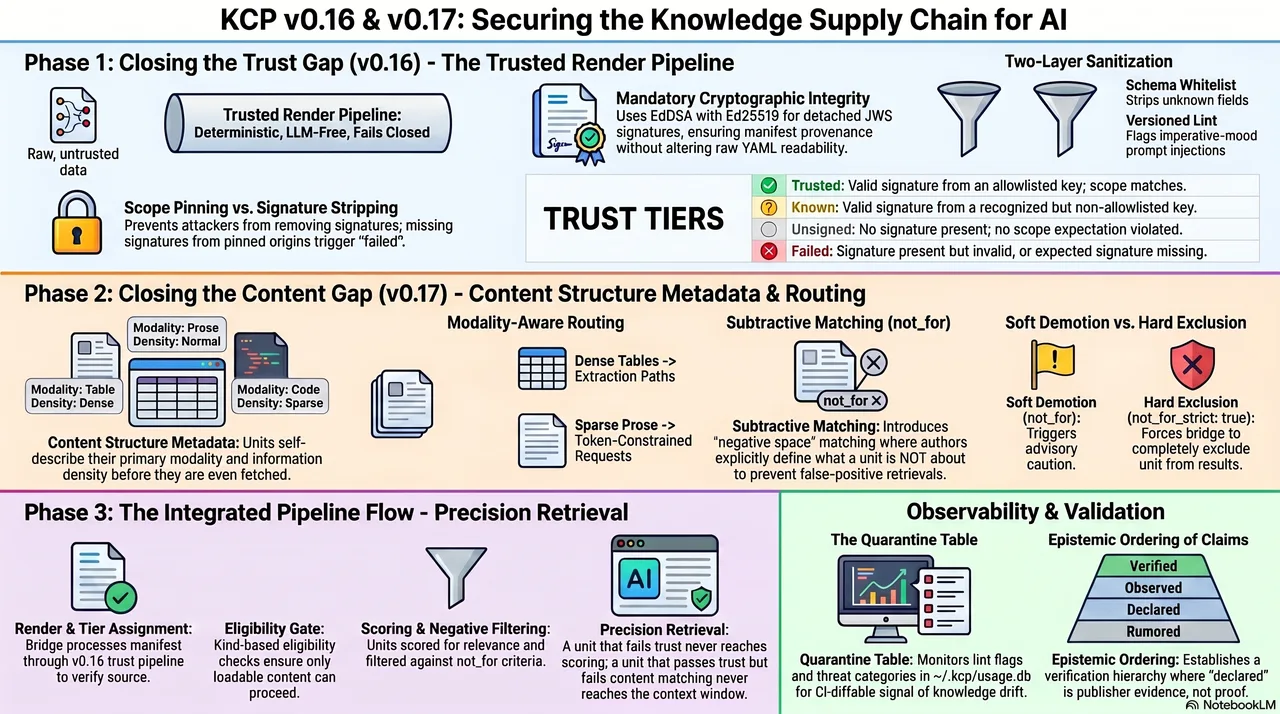
KCP v0.16 and v0.17 answer those two questions. v0.16 introduces a trust model -- cryptographic signing, trust tiers, a render pipeline that fails closed. v0.17 introduces a content model -- structural metadata that tells you what a unit contains before you fetch it, and subtractive matching that tells you what it is explicitly not about. Together, they close two gaps that have been open since the beginning of the series.
This post walks through both releases. The examples are concrete. The threat model is explicit. If you are building systems where agents ingest knowledge from sources you do not fully control, this is the machinery that makes that safe.
Practitioner notes on engineering as a sequence of experiments — and on who does what in the loop.
Before we wrote the production code for a recent platform feature, we ran a fictional organization through two years of using it.
Twenty-four simulated months of compliance life: onboarding, supplier churn, audits, incidents, people leaving with their knowledge. The simulation produced fifteen architectural findings — wrong assumptions and missing pieces, discovered while every fix was still cheap and no customer existed yet. Sibling simulations took the total to twenty-five. A design meeting on the same material would have produced opinions.
That run is the clearest recent example of how I've worked for years, and of what I've started calling the approach out loud: explorative development. An idea becomes a hypothesis. The hypothesis becomes the cheapest implementation or simulation that could prove it wrong. The result gets verified. What survives is kept — and what was learned gets encoded, either way.
It is not a new method. It's the scientific method wearing a hoodie. Two things are new: the price list, and the fact that I no longer run the loop alone.
Practitioner notes on the verification you only do once.
In the previous post I described catching an agent claiming a parser was "fully RFC compliant." I caught it by opening the RFC — four minutes of reading against a parser that handled none of the wildcard support the spec requires.
The tips in that post were about catching such claims. This post is about a better question that took me longer to ask:
Why did the agent never open the RFC?
Not because it couldn't read it. Because the RFC wasn't there. The agent had the parser in its context and the spec in its vibes — a compressed, lossy impression from training data. Asked to compare code against a standard, it compared code against its memory of the genre of that standard. Of course it produced an adjective.
You can audit that failure forever. Or you can change what the agent reasons from.
Practitioner notes on verifying what your agents tell you.
This week an agent told me, confidently, that an API endpoint had no authentication.
It did. The router was mounted twelve lines after the auth middleware. The agent had read the route file — clean, self-contained, no auth code in sight — and reported what it saw. What it saw was true. What it concluded was false.
The same afternoon, two more claims from the same research run didn't survive contact with the source: a parser described as "fully RFC compliant" (it lacked the wildcard support the RFC requires), and a plugin described as "active" (it was active only because of an import side effect in an unrelated legacy file — a load-order accident no test asserted).
Three wrong claims, one afternoon, inside an otherwise excellent piece of agent research that compressed days of code archaeology into hours. This is not a complaint about agents. It is a job description for the human.