Sixteen Versions of Metadata Nobody Read
Practitioner notes on shipping a feature that was already a no-op, in two different ways.
The Mynder regulatory knowledge base has 63 fragment manifests covering 101 units of EU regulation — GDPR, NIS2, the EU AI Act, DORA, Norwegian and Swedish data protection law. Every unit carries temporal validity (valid_from, valid_until, superseded_by), per-unit content hashes (sha256), not_for audience filtering, content structure declarations, and Ed25519 JWS signatures. All of it declared in KCP v0.21.
Synthesis — the workspace intelligence tool that indexes and searches this corpus — was reading it at v0.5 feature level.
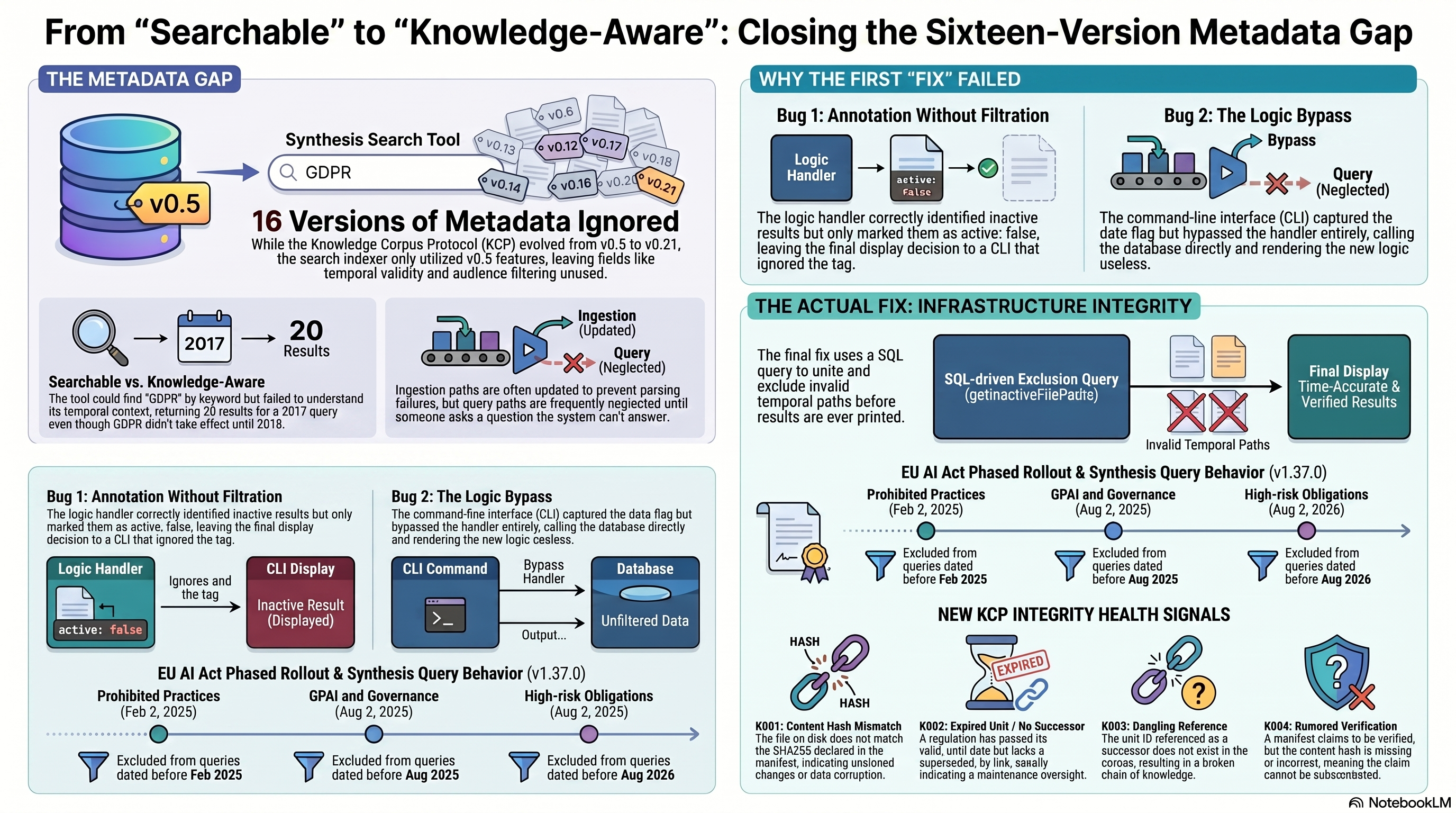
Sixteen spec versions of metadata, sitting in the files, being dutifully indexed and completely ignored by the tool whose job was to understand them. The corpus was "searchable" but not "knowledge-aware." You could find GDPR articles by keyword. You could not ask what was in effect in 2022 and get a time-correct answer.
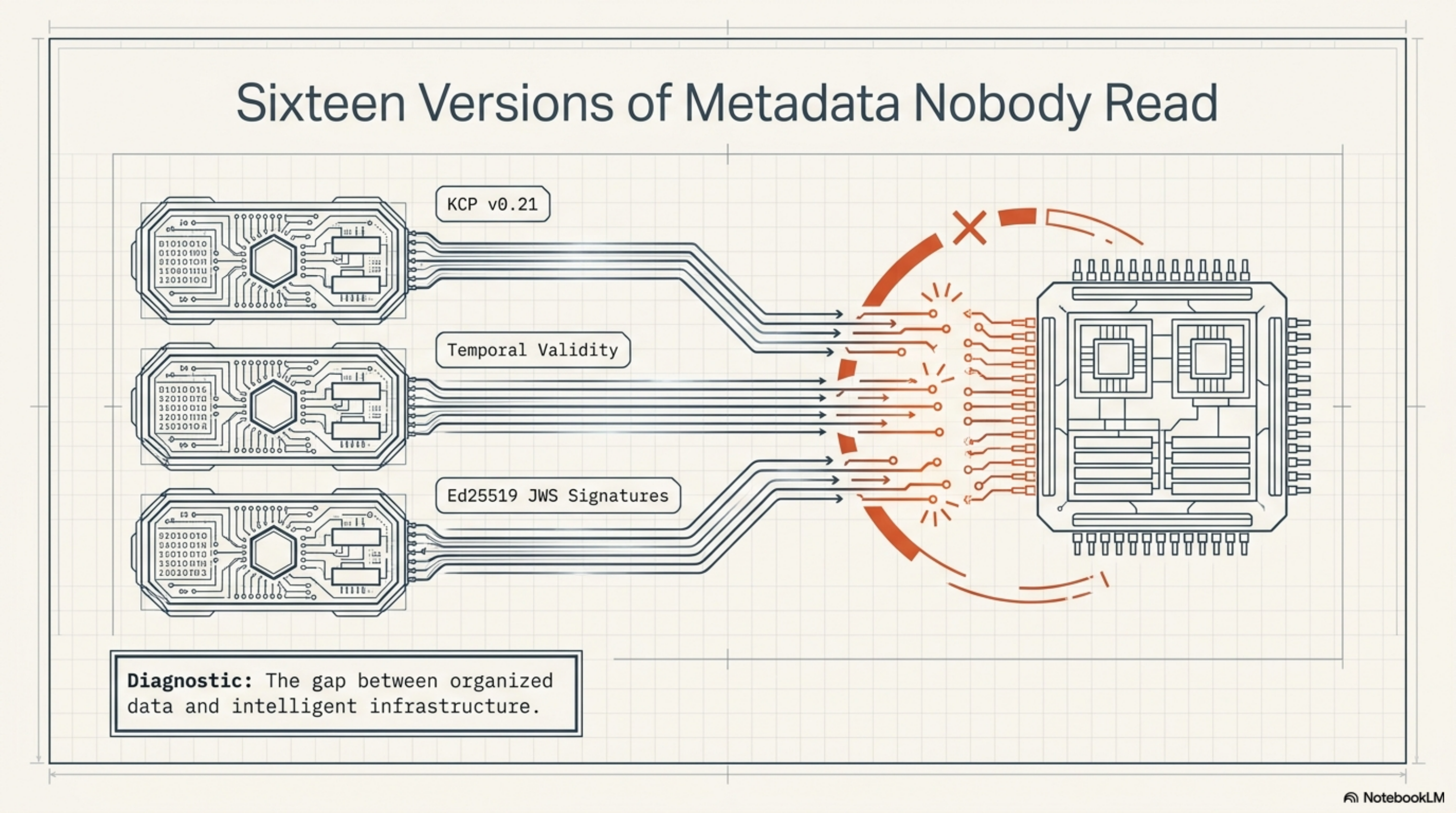
The gap
KCP moved fast this spring. Temporal validity landed in v0.19. Point-in-time queries in v0.20. Content hashes in v0.18. Audience filtering earlier still. Each release was designed, specified, implemented in the bridges, and validated against real manifests.
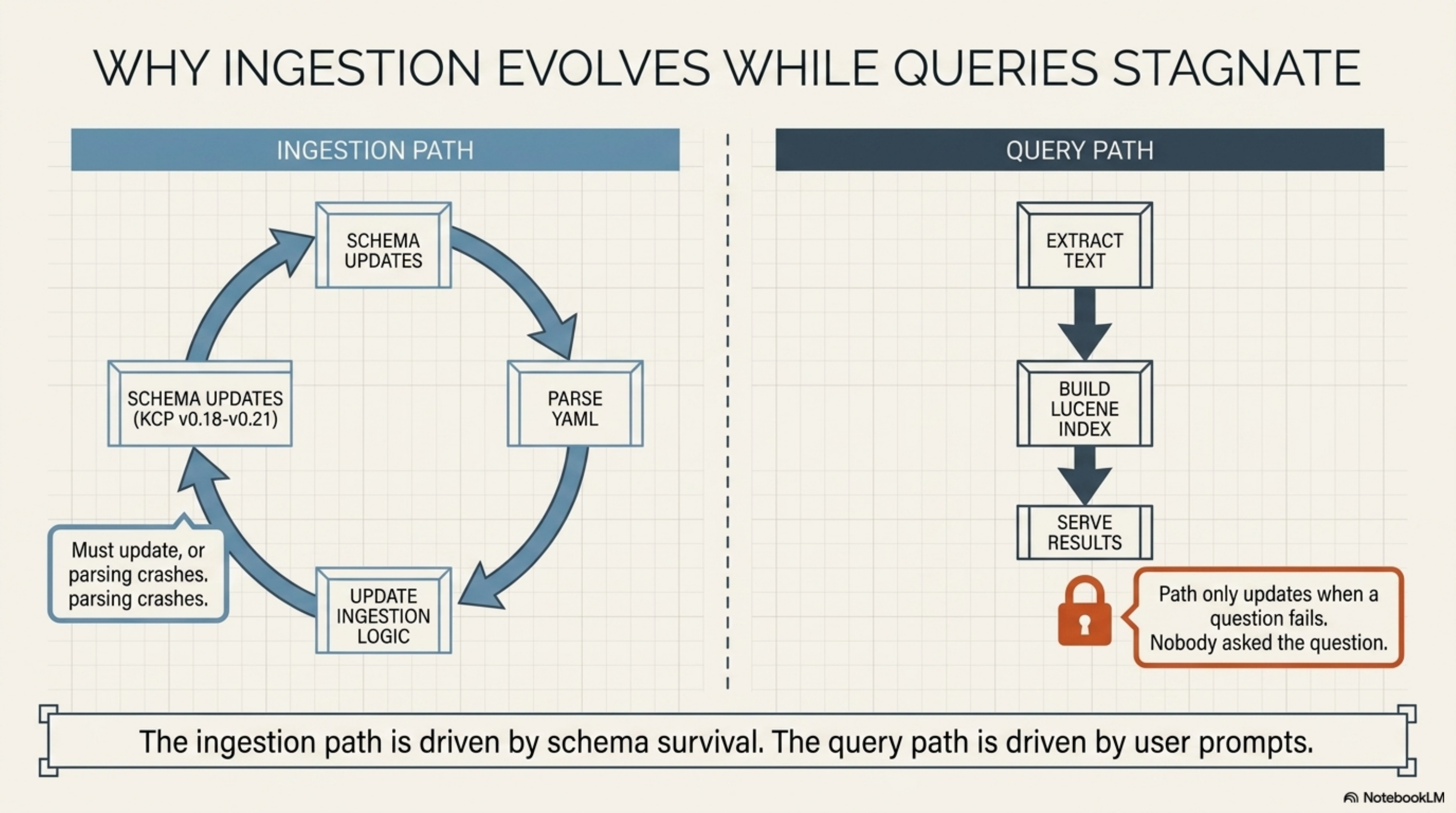
Synthesis consumed those manifests through its own indexer. The indexer read the YAML, extracted the text content, built a Lucene index, and served search results. It did this correctly. It also did this while ignoring every field added after v0.5 — temporal blocks, hash declarations, not_for rules, content_structure, discovery provenance. The metadata was parsed, stored in the database, and never consulted at query time.
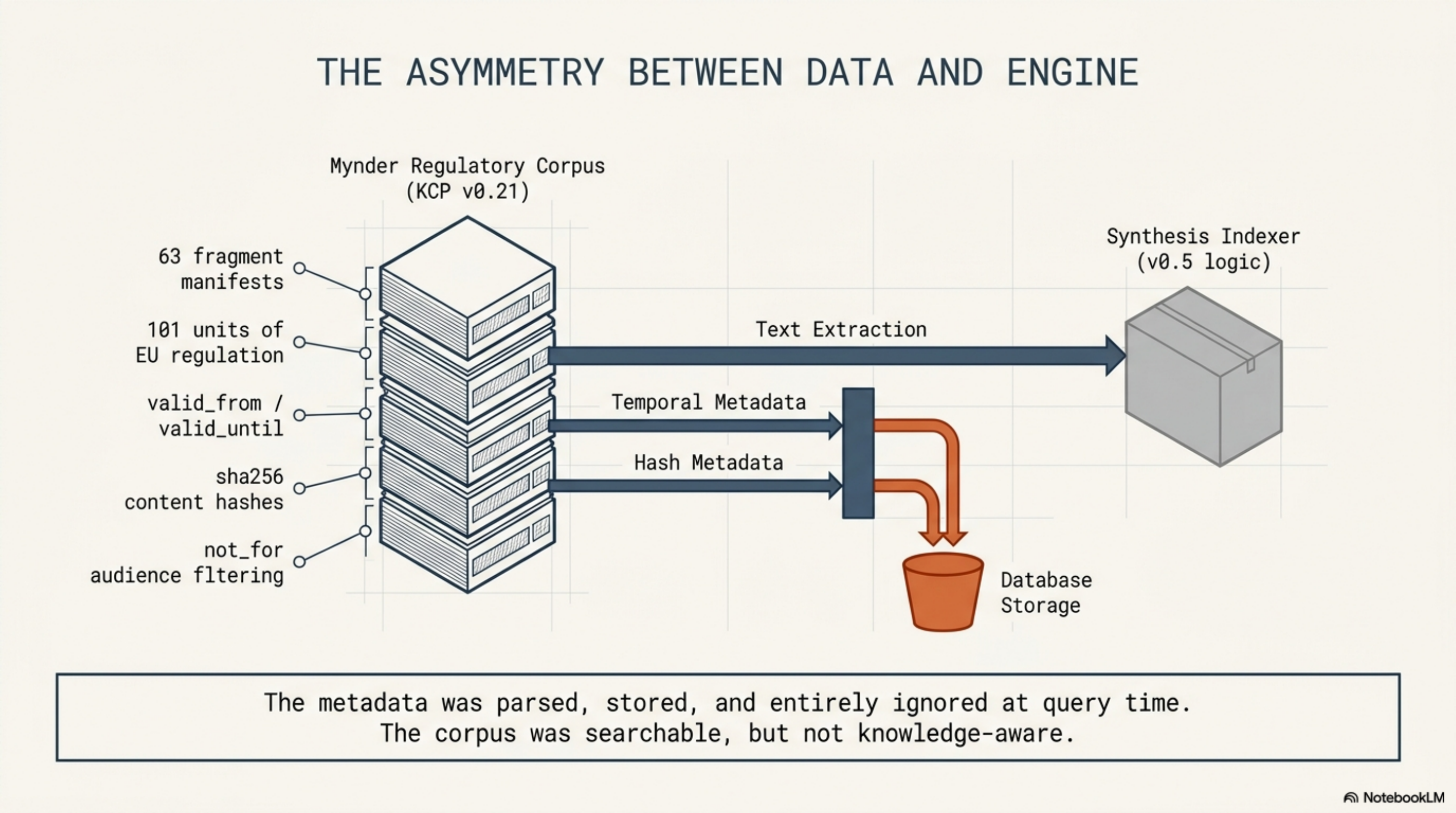
This is not an unusual failure mode. The ingestion path and the query path are different code, maintained at different cadences. The ingestion path gets updated when the schema changes — you have to, or parsing fails. The query path only gets updated when someone asks a question it can't answer. Nobody had asked the question yet.
So we asked it: synthesis search "GDPR" --as-of 2017-01-01.
![The Query That Broke the Illusion: terminal output shows synthesis search GDPR --as-of 2017-01-01 returning [System]: Returning 20 results for GDPR. A timeline below marks 2017-01-01 (Query Date) on the left and 2018-05-25 (GDPR valid_from) on the right — every single result should have been excluded; the temporal data was in the database; the query never checked it.](/assets/images/blog/sixteen-versions-metadata/slide-04.png)
Twenty results. GDPR's valid_from is 2018-05-25. Every one of those results should have been excluded. The temporal metadata was in the database. The query never checked it.
The fix, and why it was a fix twice
PR #345 (Synthesis 1.36.0) added the full v0.21 feature set to the query path: temporal filtering with --as-of, content hash verification, not_for audience exclusion, health signals for integrity problems (hash mismatches, expired units with no successor, dangling superseded_by references). A proper implementation, tested, merged.
Then we ran the same query again.
synthesis search "GDPR" --as-of 2017-01-01 — twenty results.
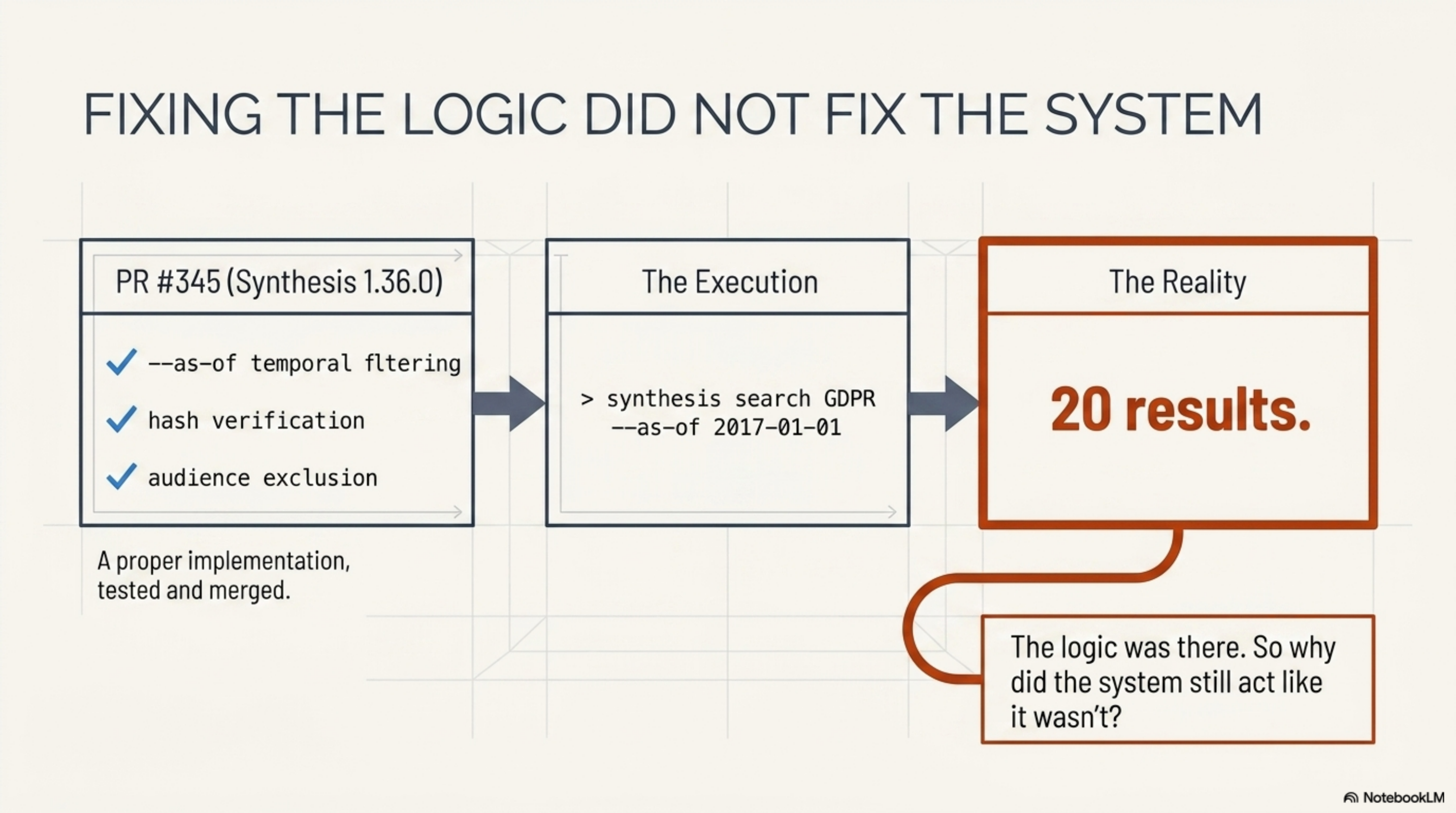
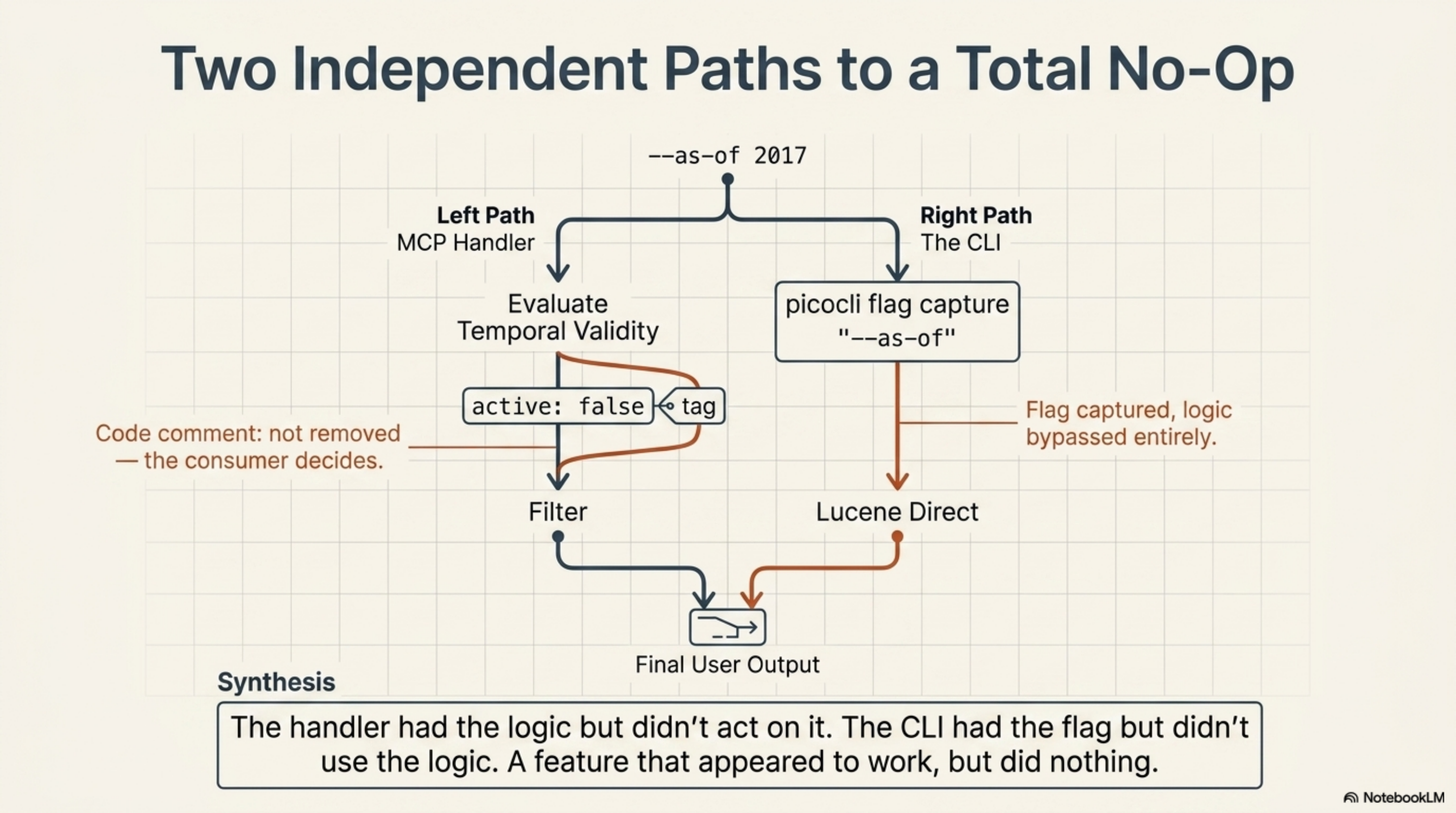
PR #346 (Synthesis 1.37.0) is the more interesting story. The temporal filtering code from #345 worked correctly — in the MCP handler. Two bugs made it a no-op in practice:
Bug 1: Annotate but don't filter. The MCP handler evaluated temporal validity and annotated each result with active: false for units outside the query window. It did not remove them. The code comment — I am not paraphrasing — said: "not removed — the consumer decides." The consumer, in this case, was a CLI that printed every result it received.
Bug 2: The CLI never called the handler. The --as-of flag was declared in picocli, captured from the command line, stored in a field, and never passed anywhere. The CLI search path bypasses the MCP handler entirely — it calls Lucene directly. The flag existed as a user-facing promise with no implementation behind it.
Two independent paths to the same no-op. The MCP handler had the logic but didn't act on it. The CLI had the flag but didn't use the logic. A feature that appeared to work from the code structure, that appeared to work from the CLI help text, and that did nothing.
The actual fix
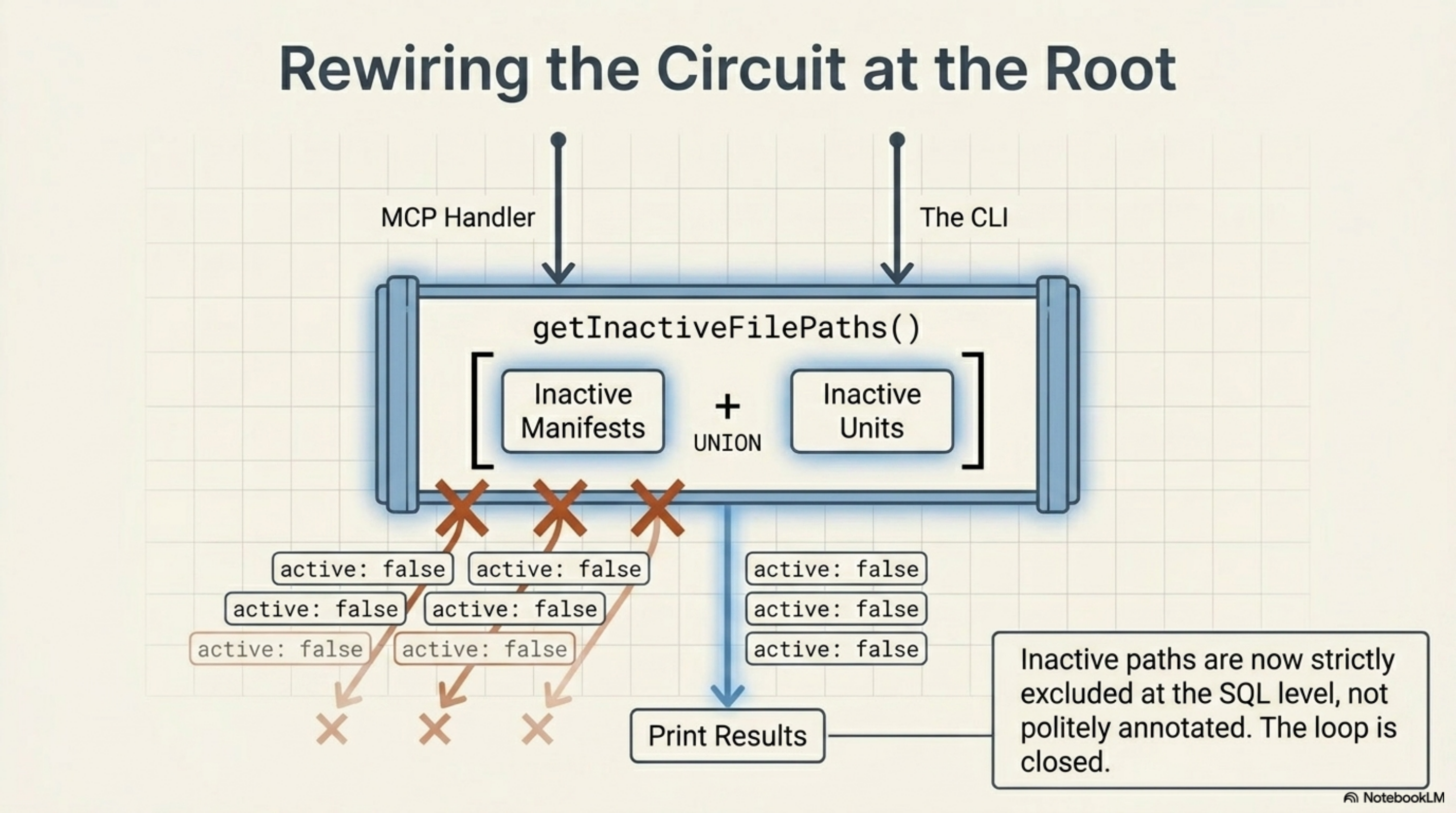
The fix is a SQL query: getInactiveFilePaths(). A UNION of two result sets — file paths from manifests whose temporal window excludes the query date, and content paths from individual units whose temporal window excludes it. Both the CLI and the MCP handler now call this before printing results. Inactive paths are excluded, not annotated.
The validation:
synthesis search "GDPR" --as-of 2017-01-01
# 0 results. GDPR valid_from: 2018-05-25.

synthesis search "GDPR" --as-of 2019-01-01
# Full corpus. All units active.
The EU AI Act test
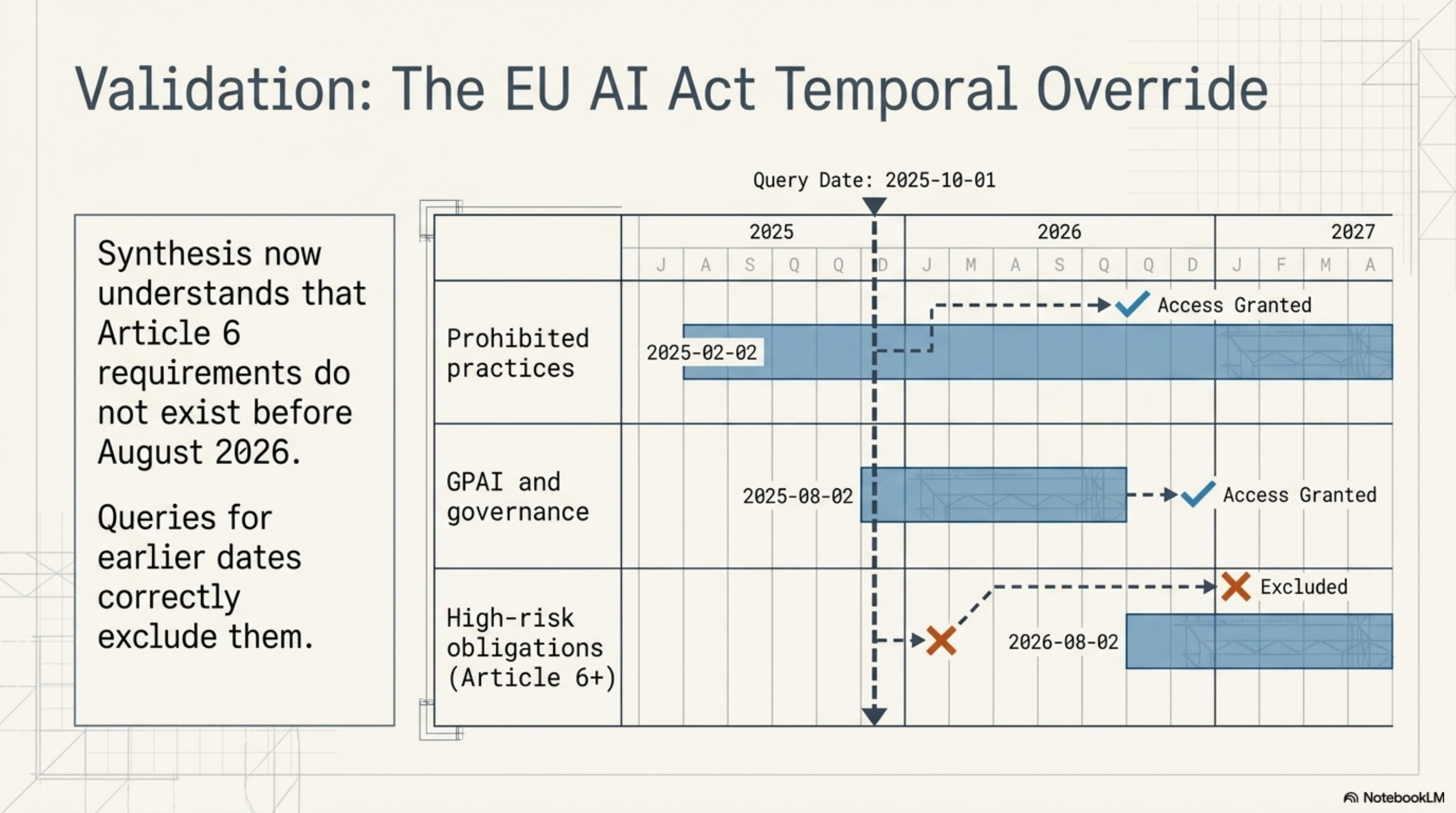
The regulatory corpus already has unit-level temporal overrides for the EU AI Act's phased rollout — three chapters with different effective dates:
- Prohibited practices: 2025-02-02
- GPAI and governance: 2025-08-02
- High-risk obligations (Article 6+): 2026-08-02
This means:
synthesis search "AI Act high-risk" --as-of 2025-07-01
# Returns only the prohibited-practices chapter.
# Article 6 requirements (valid_from: 2026-08-02) excluded.

synthesis search "AI Act high-risk" --as-of 2026-09-01
# Full corpus. All phases active.
Synthesis now understands that Article 6 high-risk classification requirements come into force in August 2026 and correctly excludes them from queries asking about earlier dates. This is not a demo — it is what makes the difference between "an AI searched some files" and "an AI answered from verified, time-correct regulatory knowledge."
New health signals
1.36.0 also added four KCP integrity health checks:
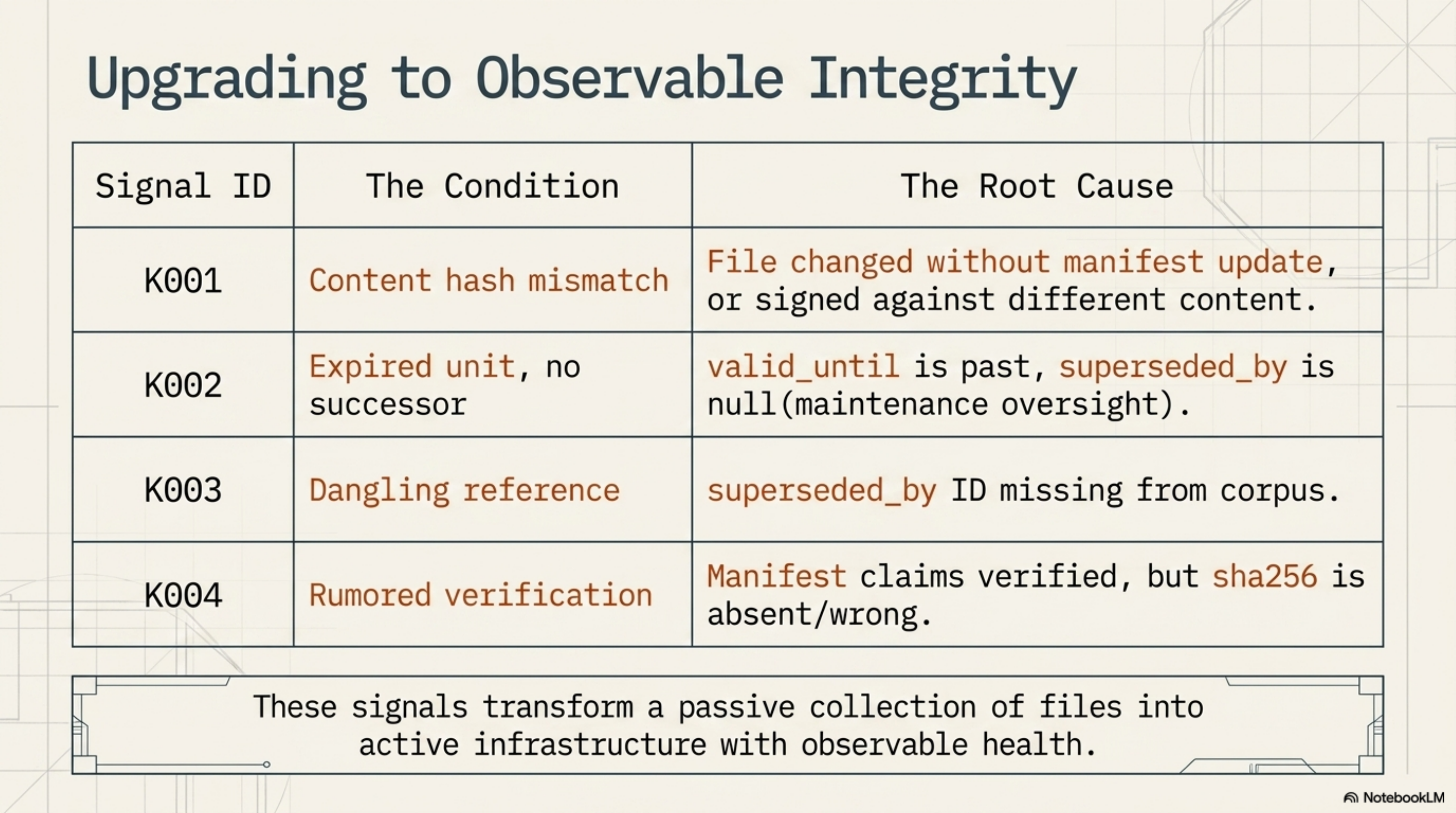
- K001 — Content hash mismatch. The file on disk doesn't match the sha256 declared in the manifest. Either the file changed without updating the manifest, or the manifest was signed against different content.
- K002 — Expired unit with no successor.
valid_untilis in the past andsuperseded_byis null. This is almost always a maintenance oversight — the replacement exists but wasn't linked. - K003 — Dangling
superseded_by. The referenced unit ID doesn't exist in the corpus. Broken chain. - K004 — Rumored verification status. A manifest claims
verifiedbut the content hash is absent or doesn't match. The claim cannot be substantiated.
These surface in synthesis health and in the MCP health tool. They are the kind of signals that turn a knowledge base from "a collection of files" into "infrastructure with observable integrity."
What this is actually about
The Organized Truths post described building a corpus where agents reason from source text instead of training-data vibes. That corpus was already built — 63 manifests, 101 units, full temporal metadata, signed.
But the tool reading it was still in vibes mode. It had the text. It had the metadata. It used the text and ignored the metadata. The organized truth was organized in the files and disorganized in the query engine.
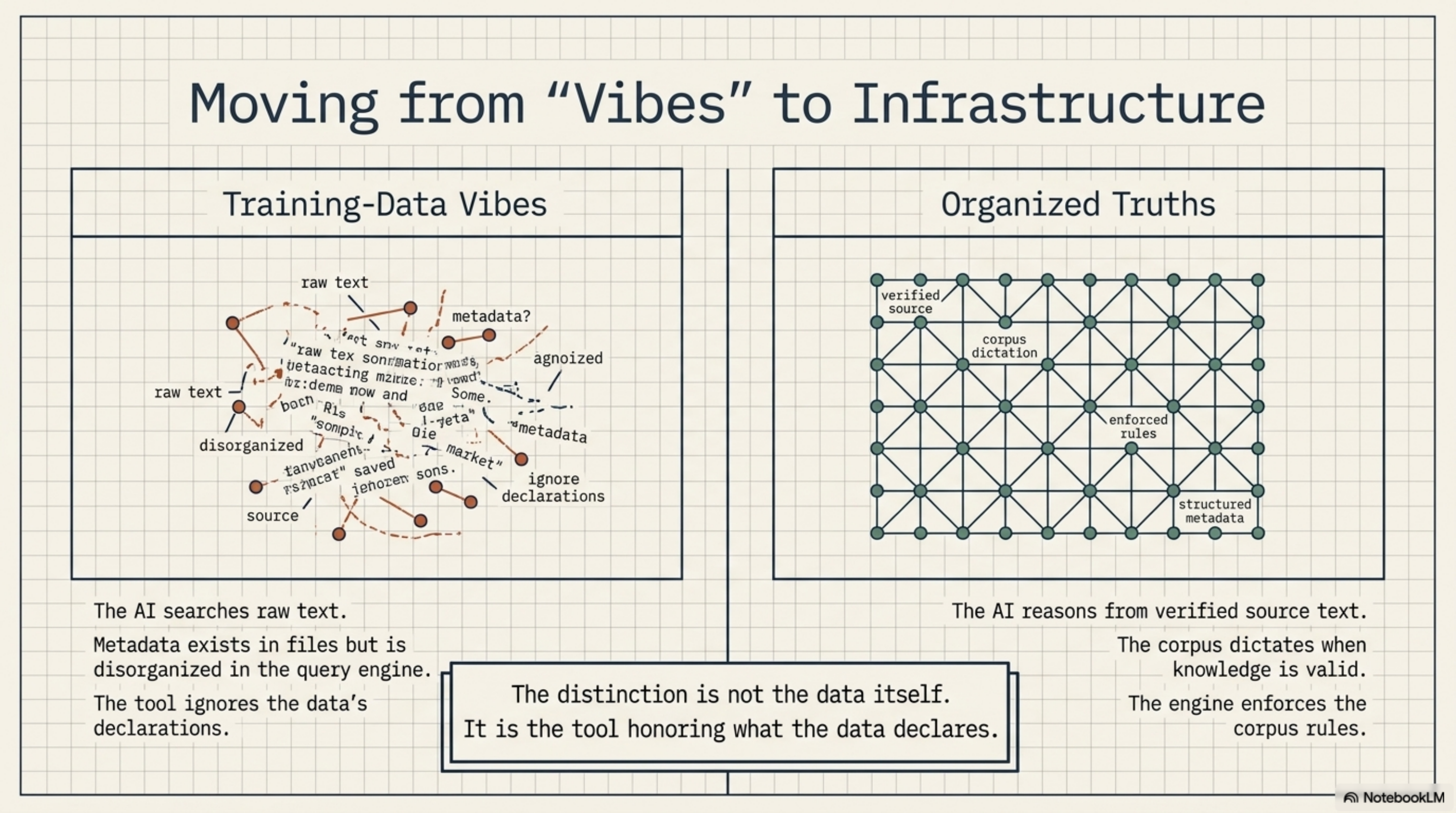
The sixteen-version gap is a reminder: infrastructure is not just the data and not just the tool. It is the tool honoring what the data declares. A temporal validity field that gets parsed but never evaluated is not infrastructure. It is a comment in YAML syntax.
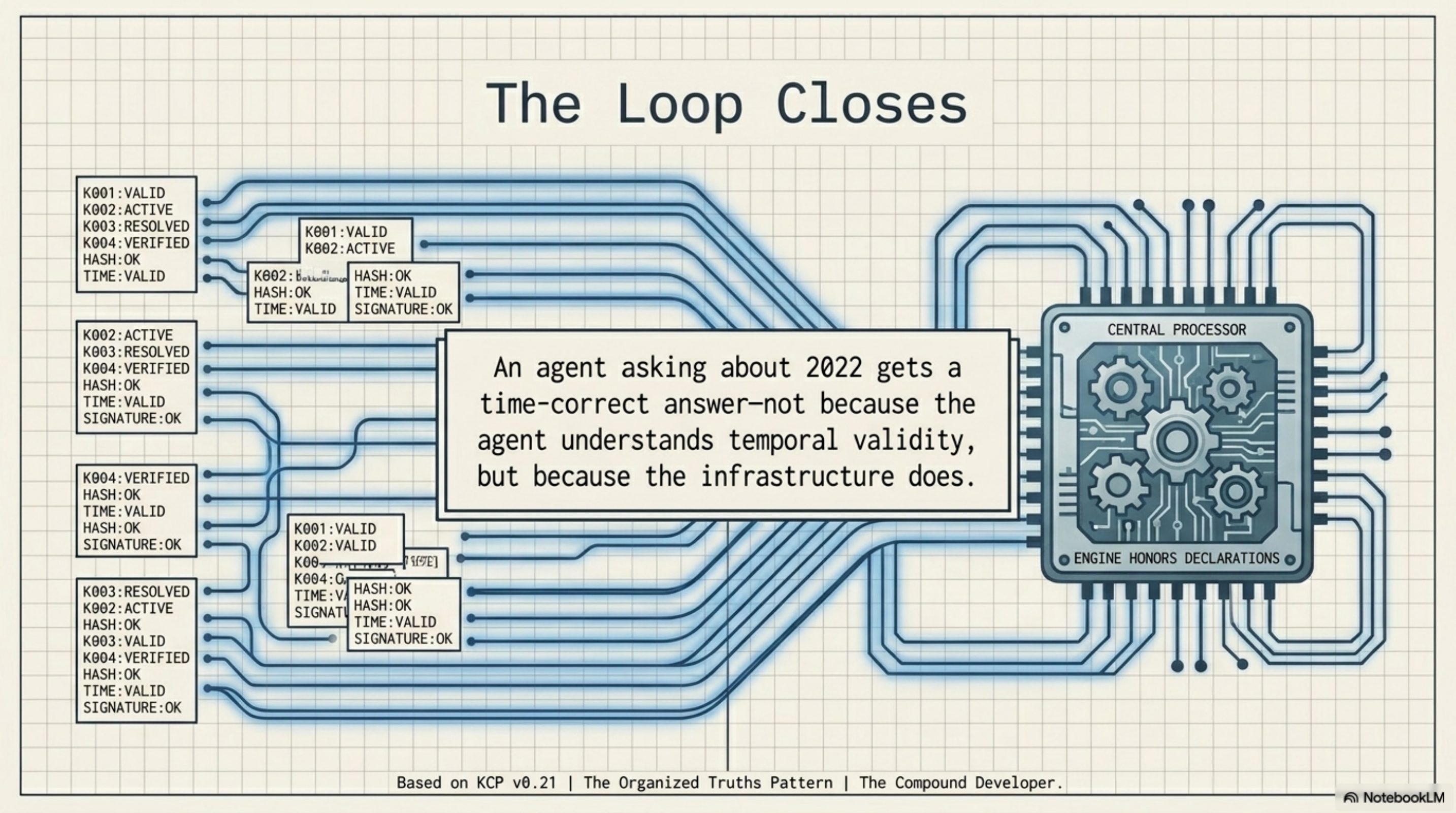
With 1.37.0, the loop closes. The corpus declares when knowledge is valid. The tool respects that declaration at query time. An agent asking "what GDPR rules applied in 2022?" gets a time-correct answer — not because the agent understands temporal validity, but because the infrastructure does.
Synthesis 1.36.0 and 1.37.0 ship KCP v0.21 support and the temporal filtering fix. The KCP temporal model is described in Stale Knowledge Is Worse Than No Knowledge. The corpus design pattern is in Organized Truths. The compound-developer argument for why this maintenance work is the real work: The Compound Developer.
There is also a slide deck version of this post (PDF) if you want to walk a team through the two-bug story.