From Pasted Prompts to Signed Charters: A Short History of the Agentic Skill¶
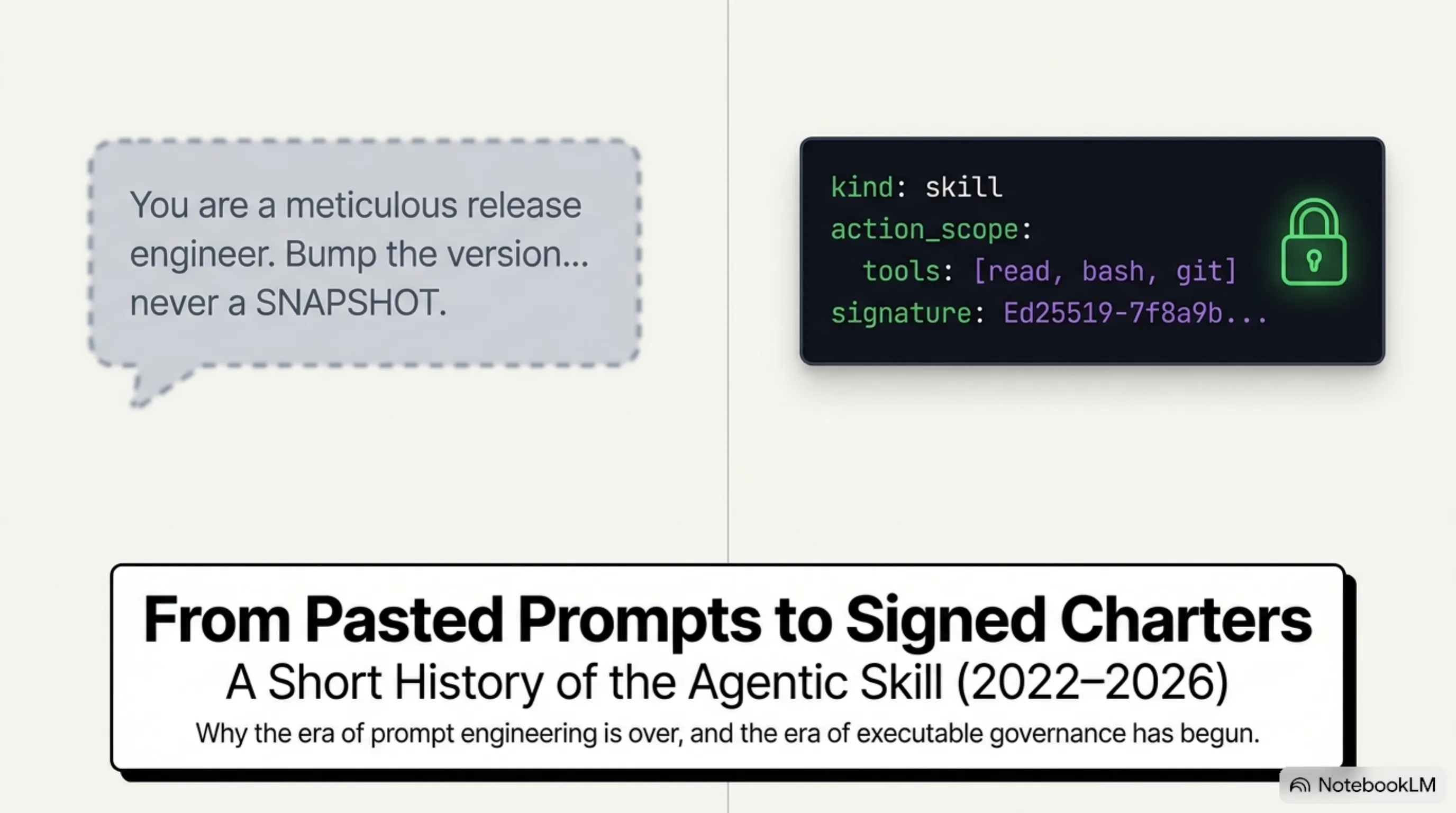
In 2023, if you wanted an AI to help you cut a release, you typed a small prayer into a chat window and pasted the answer into your terminal.
This morning, an agent in my toolchain was offered a release skill by a deterministic planner, which noted — in writing, in a receipt — that the skill was relevant to the task but not eligible to run, because no human had granted it enactment rights. The skill itself declared, in a signed manifest, exactly which tools it may invoke and which files it may touch. A linter had checked that declaration. A different program stood ready to block any tool call that reached outside it.
Same workflow. Same twenty lines of playbook. Completely different kind of object.
The distance between those two moments is about three and a half years, and almost nobody noticed the transitions while they happened — each one looked like a small quality-of-life improvement at the time. Told end to end, they form one story: the agentic skill slowly acquiring the properties of a charter — a scoped, reviewable, revocable grant of authority. This post walks that history with one deliberately boring running example, because boring examples keep us honest: how does the AI help you cut a release?
Era I — The pasted prompt (late 2022–2024)¶
ChatGPT shipped on November 30, 2022, and within weeks every developer had discovered the same thing: the model's usefulness tracked the quality of the instructions you fed it. OpenAI formalised the observation as "custom instructions" in July 2023 and as shareable GPTs that November — but for working developers, the first agentic skills weren't files or features. They were folklore.
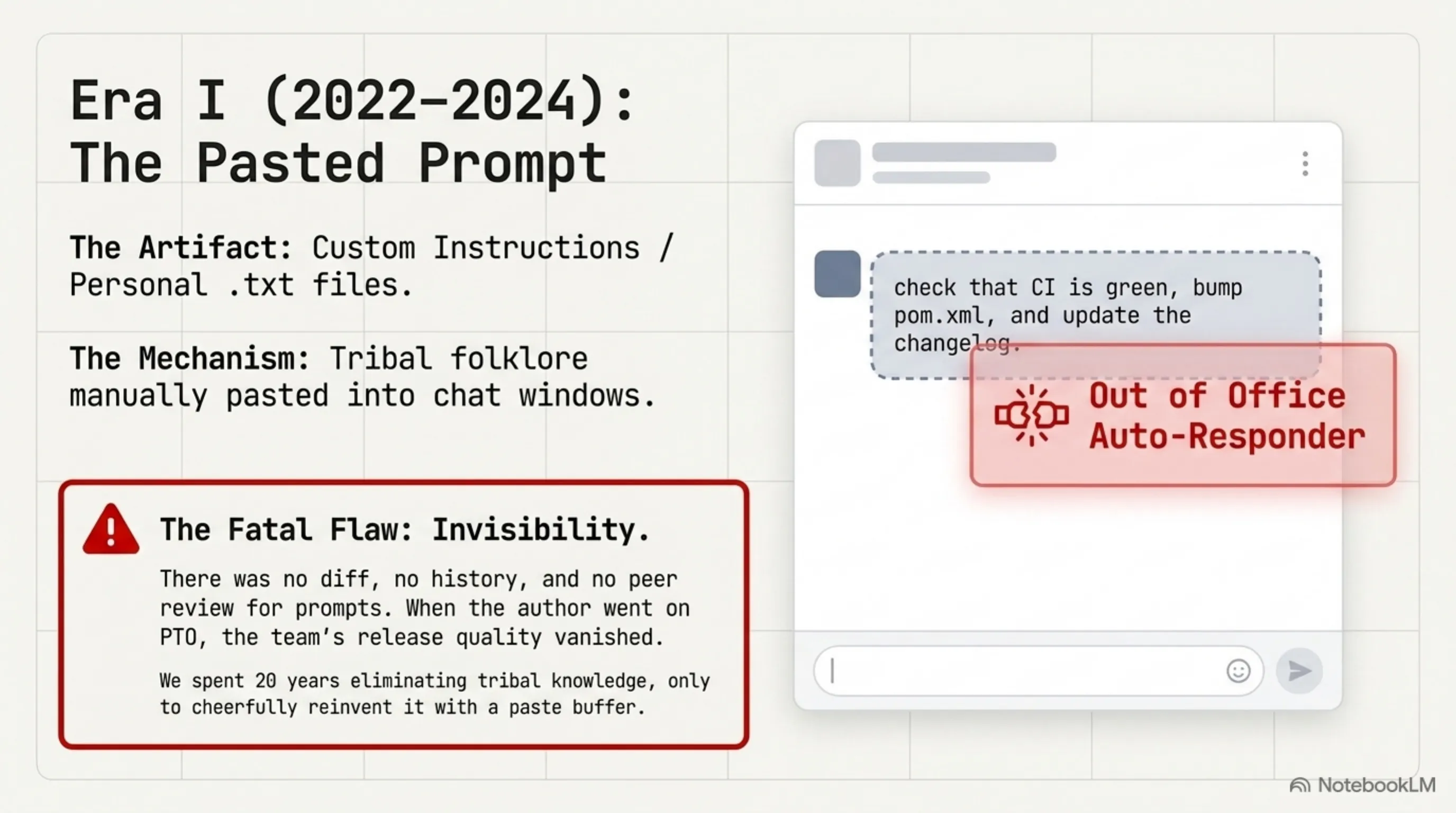
"You are a meticulous release engineer. When I say release, you will: check that CI is green, bump the version in pom.xml — never a SNAPSHOT — update the changelog, tag with a v-prefix, and push the tag. Ask before anything destructive."
Everyone had a text file of these. Some people had good ones, and you could tell, because their sessions went better than yours. The prompt was the skill, and the skill was personal property — it lived in a notes app, it traveled by Slack DM, and when its author went on vacation, the team's release quality went with them.
The era's characteristic failure was invisibility. Nobody could review the prompt that produced a bad release, because nobody else had ever seen it. There was no diff, no history, no way to say "this instruction is wrong" about an artifact that existed only in the space between one person and their chat window. We had spent twenty years learning that tribal knowledge kills teams, built wikis and runbooks to fix it — and then cheerfully reinvented tribal knowledge with a paste buffer.
Era II — The prompt moves into the repo (2024–2025)¶
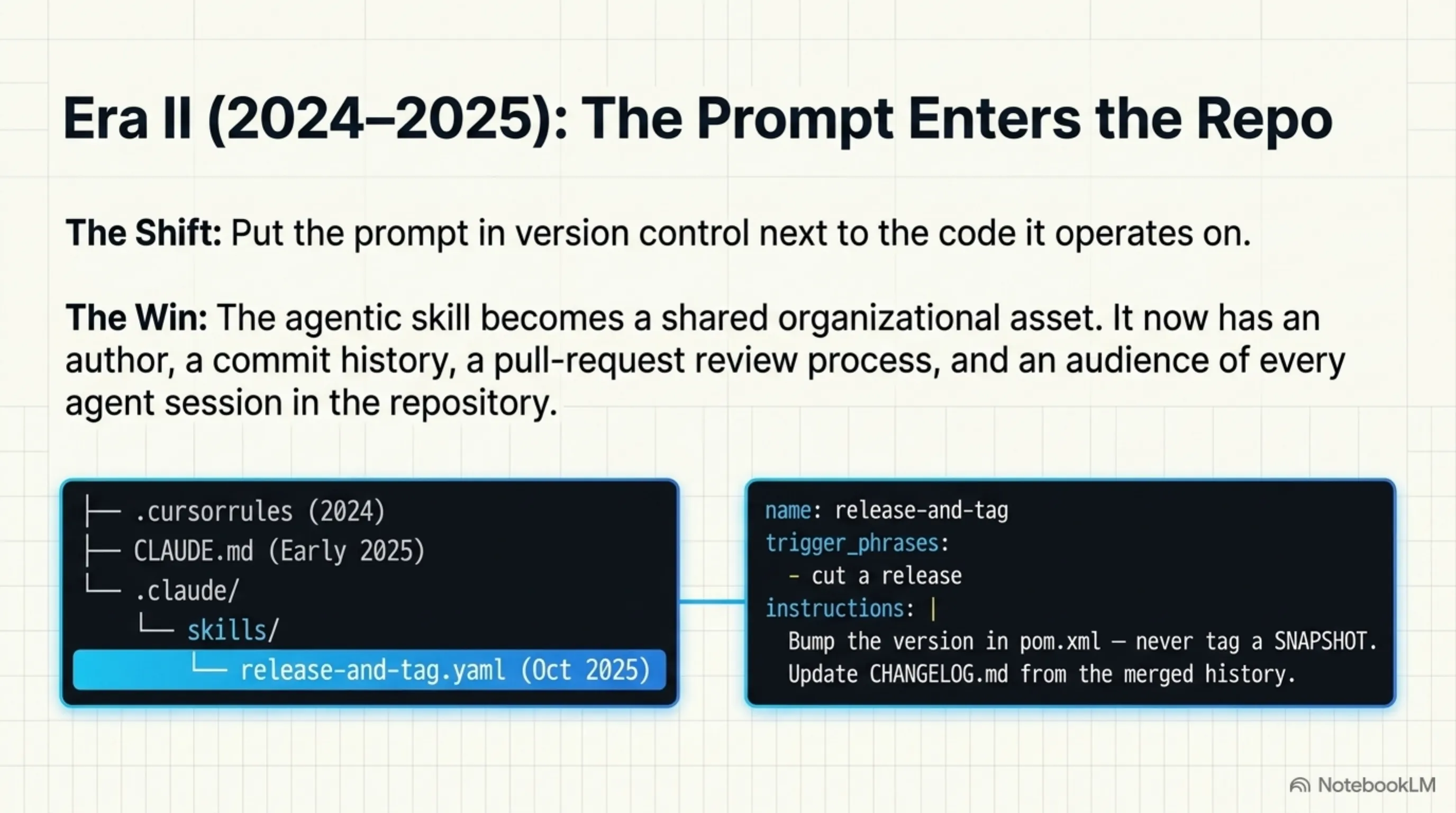
The fix was obvious in hindsight: put the prompt in version control, next to the code it operates on.
The artifacts arrived in a two-year drumbeat. Cursor's .cursorrules and GitHub
Copilot's .github/copilot-instructions.md landed in 2024 — the first mainstream
per-repo instruction files. Claude Code arrived in February 2025 and made CLAUDE.md
a convention; AGENTS.md followed the same year as the tool-neutral umbrella; and in
October 2025, Claude Code's Agent Skills gave the pattern real structure — named
SKILL.md directories, loaded on demand instead of stuffed into every context. The
prompt-folder era, fully assembled. Our release folklore became a file:
# .claude/skills/release-and-tag.yaml
name: release-and-tag
description: |
  How do I cut a release safely? Version bump, changelog, tag.
trigger_phrases:
  - "cut a release"
  - "release and tag"
instructions: |
  Bump the version in pom.xml — never tag a SNAPSHOT.
  Update CHANGELOG.md from the actual merged history.
  git tag vX.Y.Z and push the tag with the commit.
This was a genuine revolution, and I don't want the later eras to diminish it. The skill now had an author, a history, a review process, and an audience of every agent session in the repo instead of one person's. Teams that leaned into this — what I've been calling Skill-Driven Development — got compounding returns: every captured workflow made every future session a little better. The skill had become an asset.
But an asset with three chronic diseases, which I documented at length after running benchmarks against our own skills: skills go stale (the skill says X, the code now does X-and-more), they stay silent (the trickiest patterns never get written down), and they end up ambiguous (the skill states a fact but not its intent — "V7 is missing" reads very differently from "V7 is intentionally reserved"). A prompt folder rots exactly the way a wiki rots, because it is a wiki — just one with an unusually diligent reader.
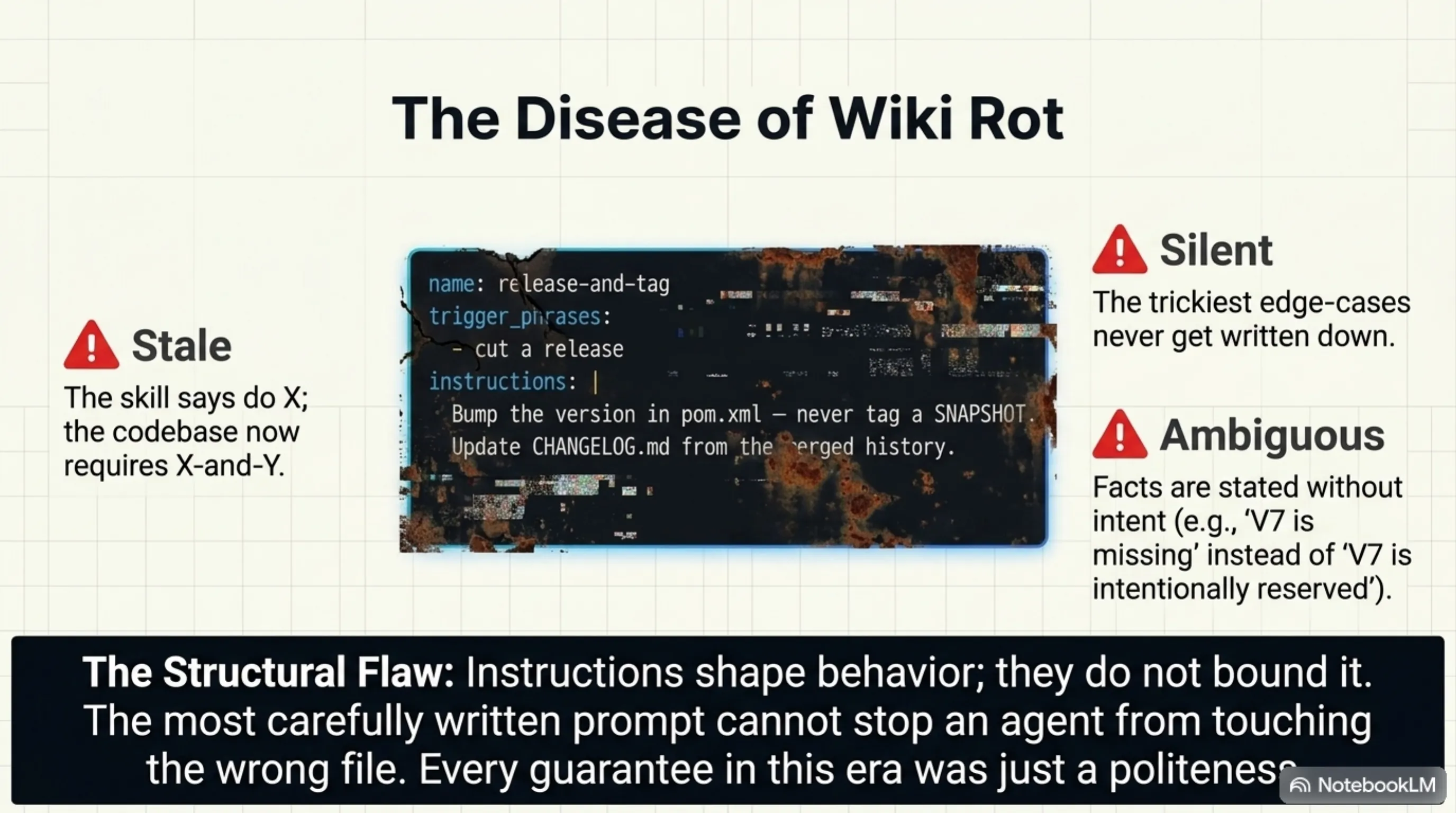
And there was a fourth problem, quieter and more structural: the skill was still advice. The most carefully written release skill in the world could not stop an agent from touching a file the release process should never touch. Instructions shape behavior; they do not bound it. Every guarantee in the prompt-folder era was, at bottom, a politeness.
Era III — The skill becomes knowledge a machine can select (Feb–Jul 2026)¶
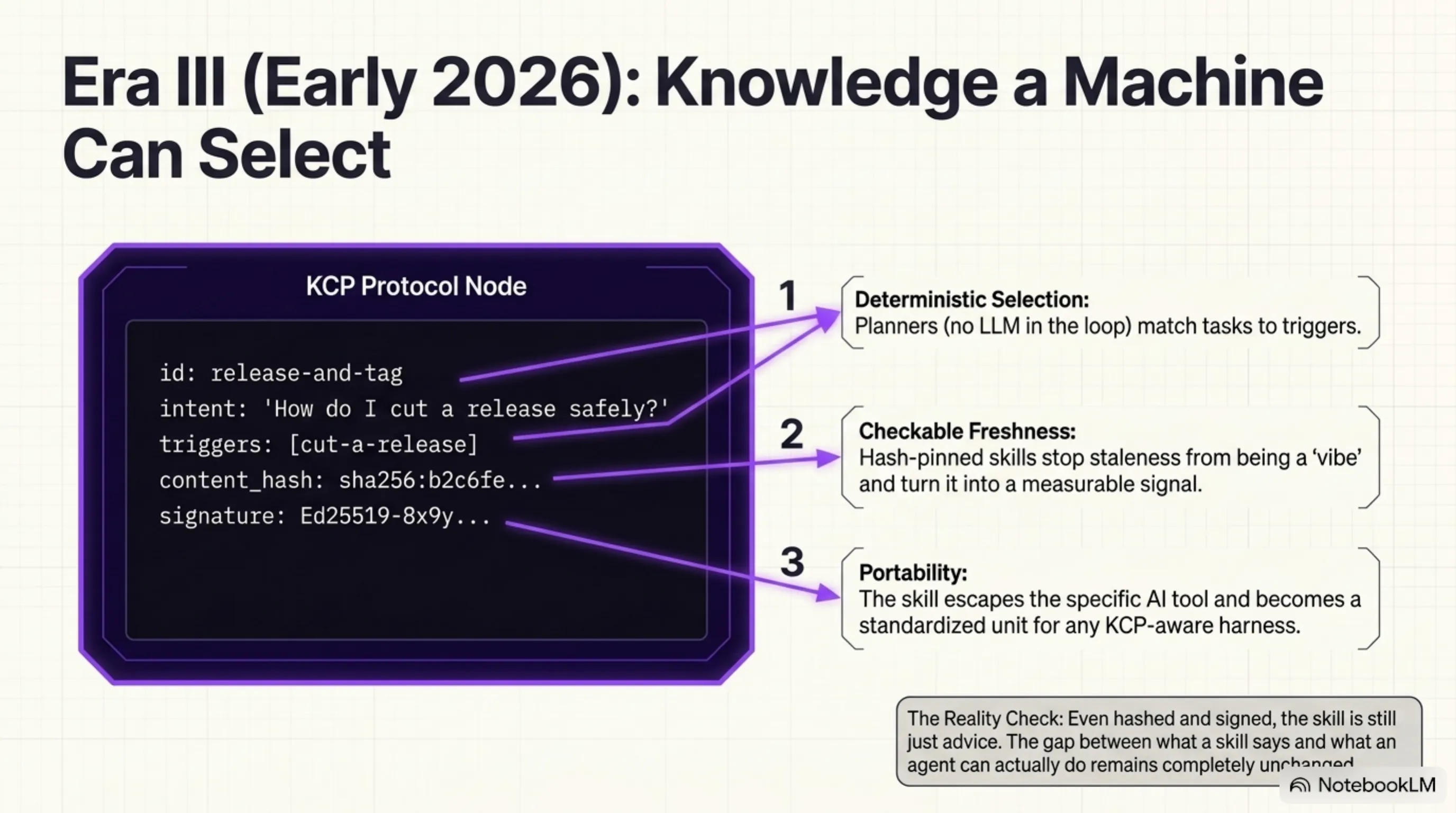
The next shift came from an unexpected direction: not better prompts, but better addressing — and it moved an order of magnitude faster than the first two eras.
The idea had precursors: llms.txt (September 2024) proposed telling agents what a
website contains, and MCP (November 2024) gave agents a protocol for tools. But
knowledge — which files matter, what each is for, in what order to read them — had no
protocol until the Knowledge Context Protocol
published its v0.1 draft on February 25, 2026. Five months and twenty-six minor
versions later it had grown from a table of contents into a full protocol, and along
the way skills started
being described the way any knowledge unit is described — with an intent (the question
this answers), triggers, a content hash (v0.18), temporal validity (v0.19, June 12),
and an Ed25519 signature:
- id: release-and-tag
  path: .claude/skills/release-and-tag.yaml
  intent: "How do I cut a release safely?"
  scope: project
  audience: [agent, operator]
  triggers: [cut-a-release, release-and-tag]
  content_hash:
    algorithm: sha256
    value: "b2c6fe39c32a37f6d603dd0faa..."
Three things changed at once, and each fixed an Era-II disease.
Selection became deterministic. Instead of hoping the model notices the right skill, a planner — kcp-agent, the reference agent that shipped July 5, 2026, no LLM in the loop — matches the task against intents and triggers and produces an inspectable plan: this skill, for this reason, at this score. The silent-skill problem became measurable: if a skill is never selected, the planner's logs tell you, and you can ask why.
Freshness became checkable. A hash-pinned, date-stamped skill can be verified against reality instead of trusted. Staleness stopped being a vibe and became a signal.
The skill became portable. A skill described in protocol terms isn't a Claude Code skill or a Pi skill; it's a unit any KCP-aware harness can consume. The asset escaped its original container — which matters enormously for what comes next, because charters are only worth writing if more than one court will honor them.
But even here — described, hashed, signed, selectable — the skill remained advice. Sharper, fresher, better-routed advice. The gap between what the skill says and what the agent may do had not moved an inch since 2023.
Era IV — The skill becomes a charter (July 14, 2026)¶
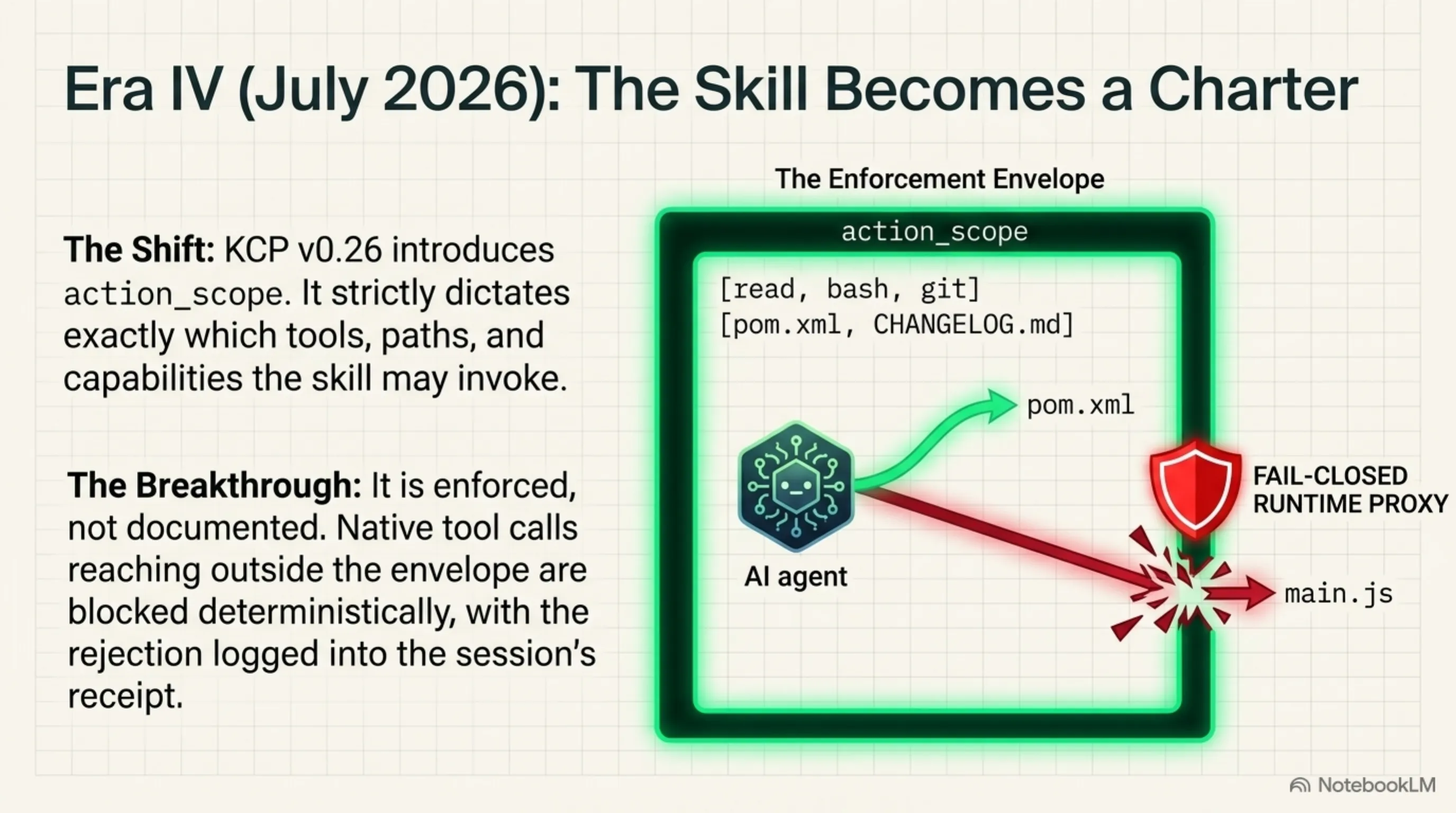
Twelve days ago, the gap finally closed. KCP v0.26 — tagged July 14, 2026 — gave the skill unit one new block in §4.3a, and the block changed what a skill is:
- id: release-and-tag
  path: .claude/skills/release-and-tag.yaml
  kind: skill
  intent: "How do I cut a release safely?"
  audience: [agent, operator]
  triggers: [cut-a-release, release-and-tag]
  action_scope:
    tools: [read, bash, git]
    paths: ["pom.xml", "CHANGELOG.md"]
    capabilities: [release]
action_scope is the envelope: the tools this procedure may invoke, the paths it may
touch, the named capabilities it exercises. And crucially, it is not documentation — it
is enforced. Since July 22, in a
Pi session running pi-kcp, a
native tool call that reaches outside the active skill's envelope is blocked, by the
same deterministic decision function the kcp-harness compliance proxy uses, with the
specific reason (which tool, which path, which capability) written into the turn's
receipt. Every governed turn carries one correlation id, so you can reconstruct
afterwards exactly why the agent read what it read and did what it did.
Look at what quietly happened to the separation of powers. Four distinct authorities now touch one skill, and no two of them live in the same place:
- Declaration — the manifest states the envelope.
-
Selection — the planner decides whether the skill is even offered. Fail-closed: here is a real planner deciding about a real generated skill this morning —
○ 1. release-and-tag (score 9)  .claude/skills/release-and-tag.yaml
     How do I cut a release safely?
     why: intent matches; triggers match;
          kind: skill not invoke-eligible: no explicit eligibility grant
     not load-eligible
Selected on merit. Inert by default. The spec's own words for this default are the whole era in miniature: a skill fails closed — absent an explicit grant it renders as a pointer, never as an action.
-
Enactment — the harness enforces the envelope at tool-call time.
- Grant — a human, and only a human, flips eligibility.
No model holds any of these four powers. The model proposes; a deterministic stack disposes. This is the same argument the Defendable Agents work makes for knowledge and for spending, now landed on procedure: the question "what is this agent allowed to do?" finally has an answer you can print, diff, review, sign, and revoke.
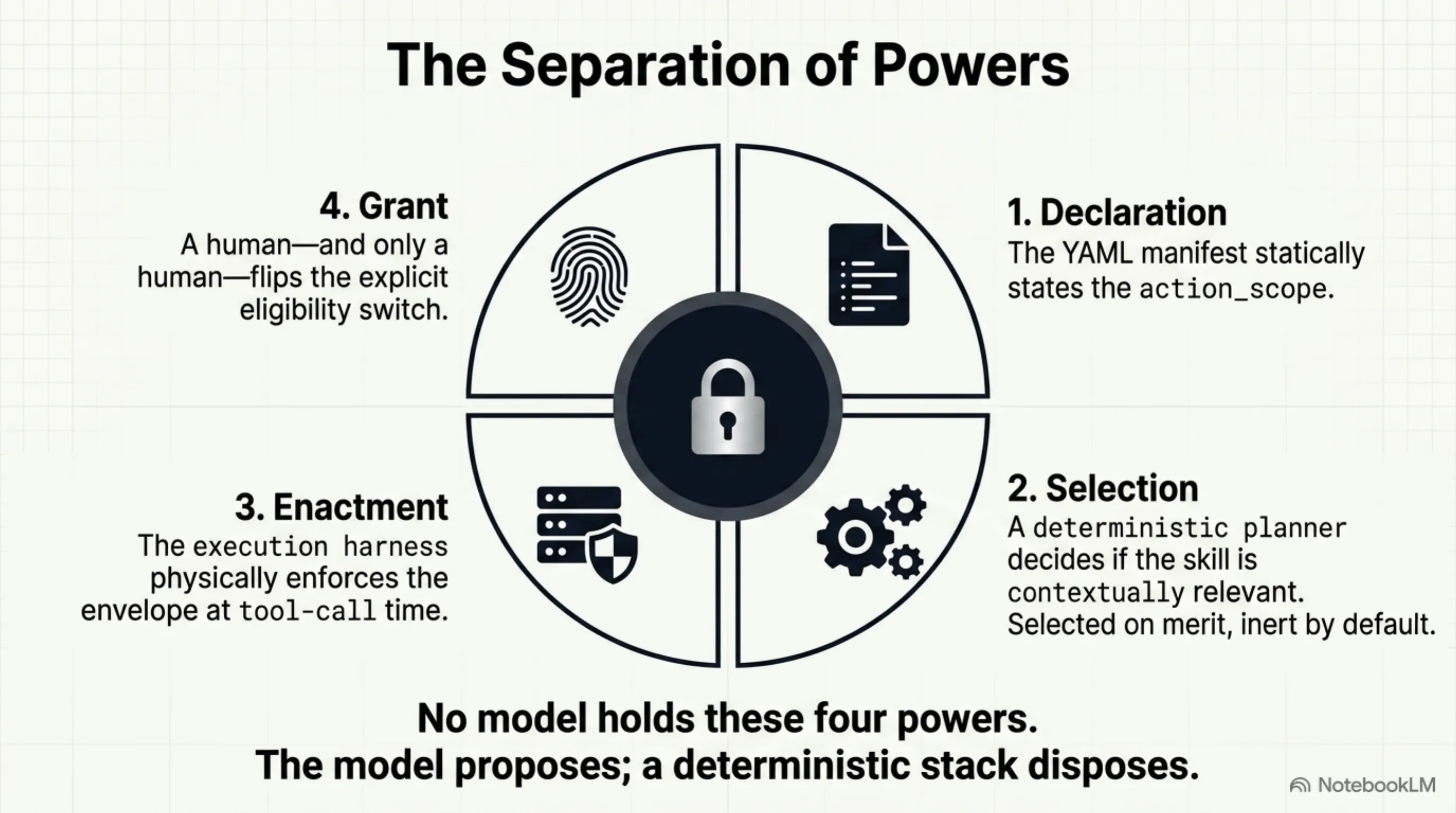
That is a charter. Not a metaphorical one — the actual instrument: a scoped, reviewed, revocable grant of authority, from a principal to an agent, with an audit trail. Organizations have run on these for centuries. They just never had one that a machine could both read and enforce.
Era V — The charter writes itself, from evidence (July 26, 2026)¶
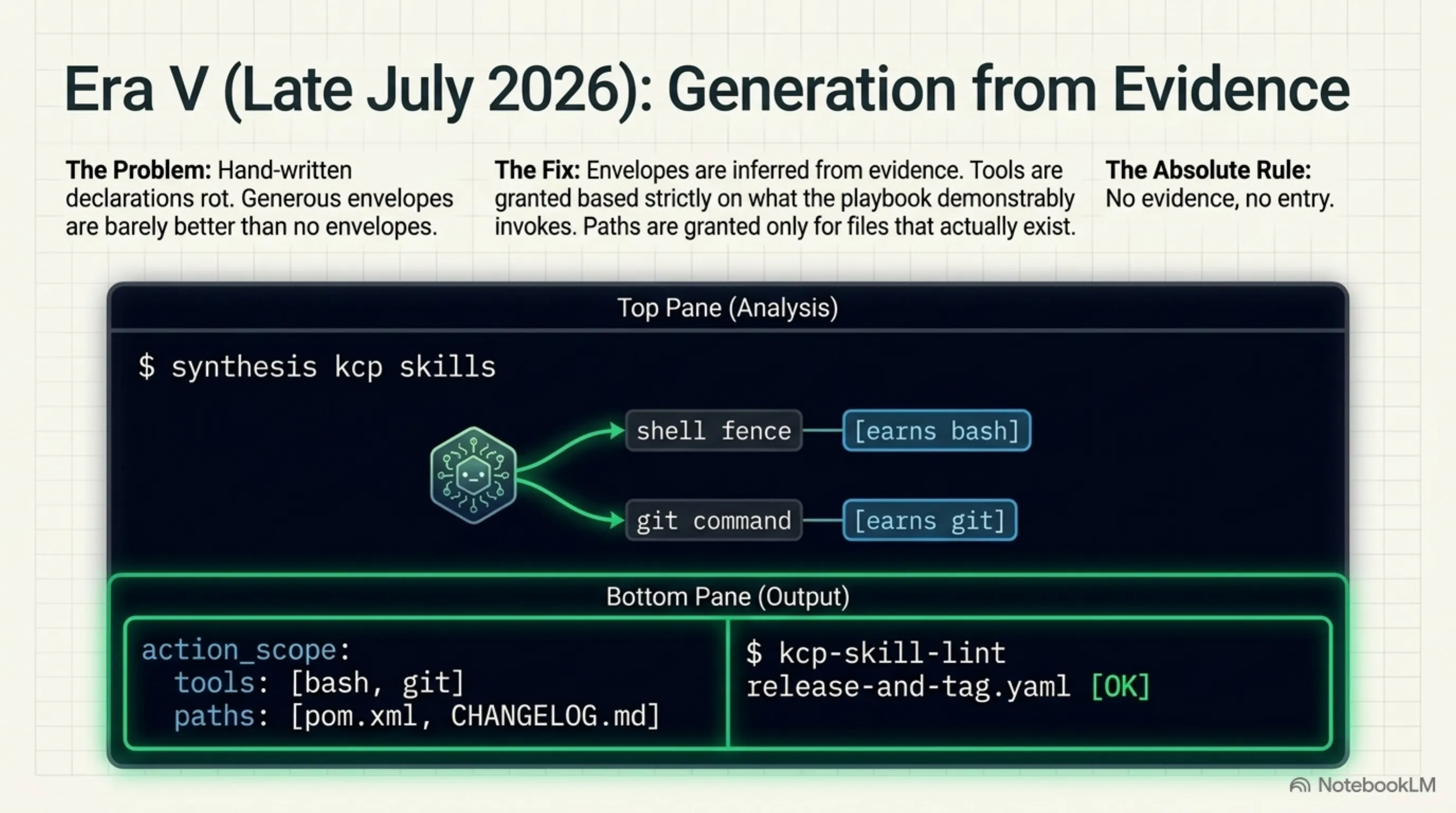
One problem remained, and it was the same problem the prompt-folder era had: hand-written declarations rot. If humans must author every envelope by hand, envelopes will be stale, generous, or absent — and a generous envelope is barely better than no envelope.
So the newest move is generation from evidence.
Synthesis — which already indexes the repo,
holds its code graph, and runs its security analysis — now reads a repo's existing skills
and infers the envelope (synthesis kcp skills): tools from what the playbook
demonstrably invokes (a shell fence earns bash, a git tag earns git); paths only
where the playbook names files that actually exist in the repo; capabilities never
invented at all. No evidence, no entry. The output must pass the shared governed-skill
linter from kcp-skill — conventions, lint rules,
and conformance vectors that both the generator's CI and the enforcing harness's test
suite now run as executable contracts:
$ synthesis kcp skills --write
Governed skills: 1 unit(s) from .claude/skills
  - release-and-tag  (.claude/skills/release-and-tag.yaml)
  [OK] governed-skills block written to knowledge.yaml  (kcp_version: 0.26)

$ npx kcp-skill-lint knowledge.yaml
info  SK007  release-and-tag  capabilities empty/omitted — fail-closed default
0 error(s), 0 warning(s), 1 info
▶ Try it yourself — the kcp-skill playground runs this exact linter in your browser. Load a conformance vector, empty a skill's
capabilitiesand watch it flip to fail-closed, or describe a procedure and have a governed skill drafted and linted live.
The compounding loop this closes is, I think, the actual headline. Watch the shape of it: work happens → sessions leave receipts and episodic memory → recurring workflows get captured as skills → envelopes are inferred from the evidence → linted, signed, granted → enactment produces more receipts → receipts are observed scope, which can confirm or tighten the declared scope. Every cycle, the organization's safely delegable surface grows a little — not because the models got smarter, but because the governance artifacts are generated and verified by the same infrastructure doing the work.
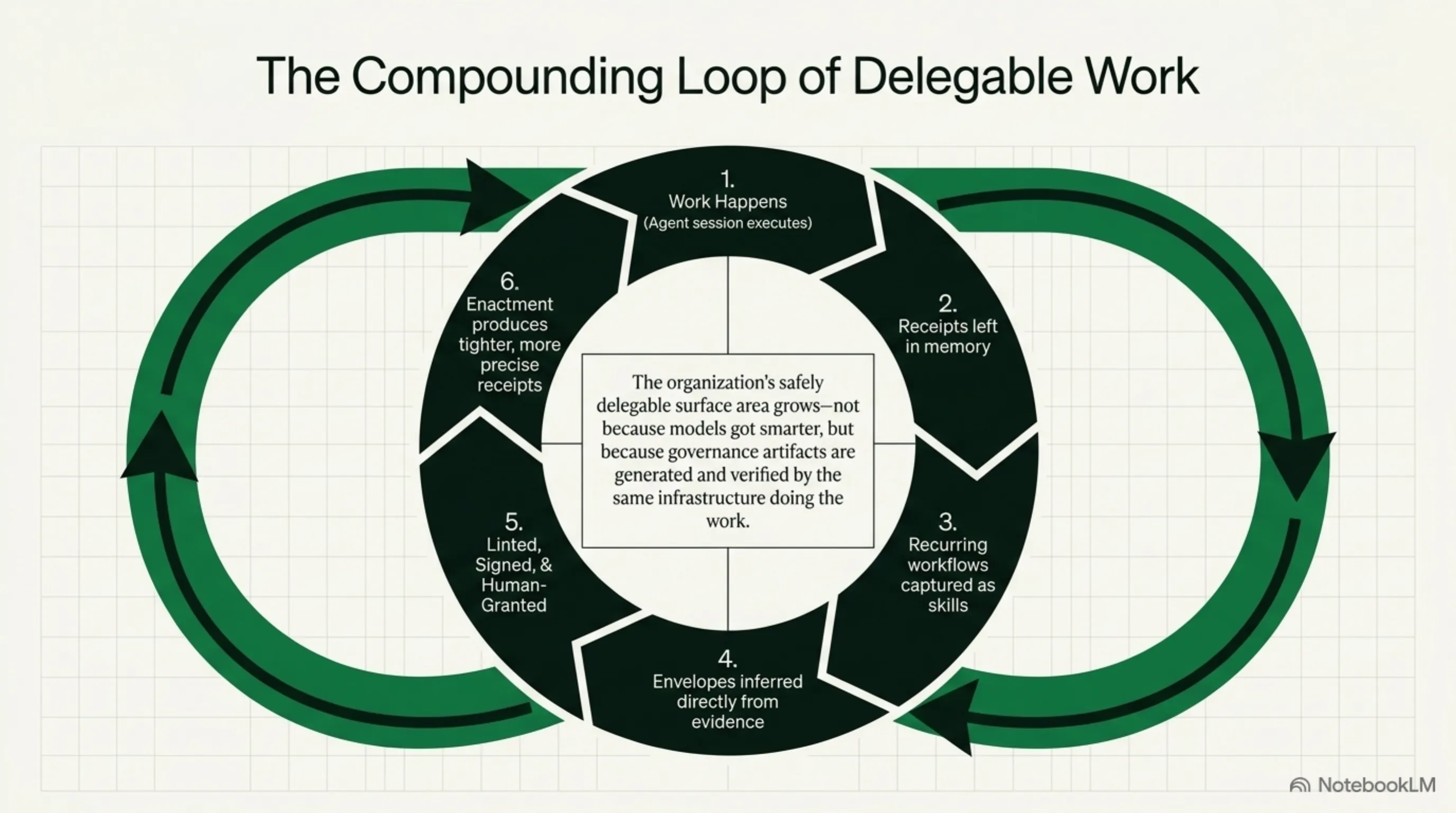
That is what I mean when I say skills are now intra-org charters. Onboarding an agent to a team stops being "paste our conventions into its context" and becomes "grant it these six skills, scoped to these paths" — the same instrument you'd use for a new hire's access, with a better paper trail. Security reviews envelopes without reading playbooks. Authors write playbooks without holding security context. Operations grants and revokes without touching either. One artifact; three jobs; separately auditable. Teams compound because captured procedure compounds. Organizations compound because delegable, governed procedure compounds — and can even cross org boundaries, since a signed skill with a trust tier is something another company's harness can verify before honoring.
What history has not written yet¶
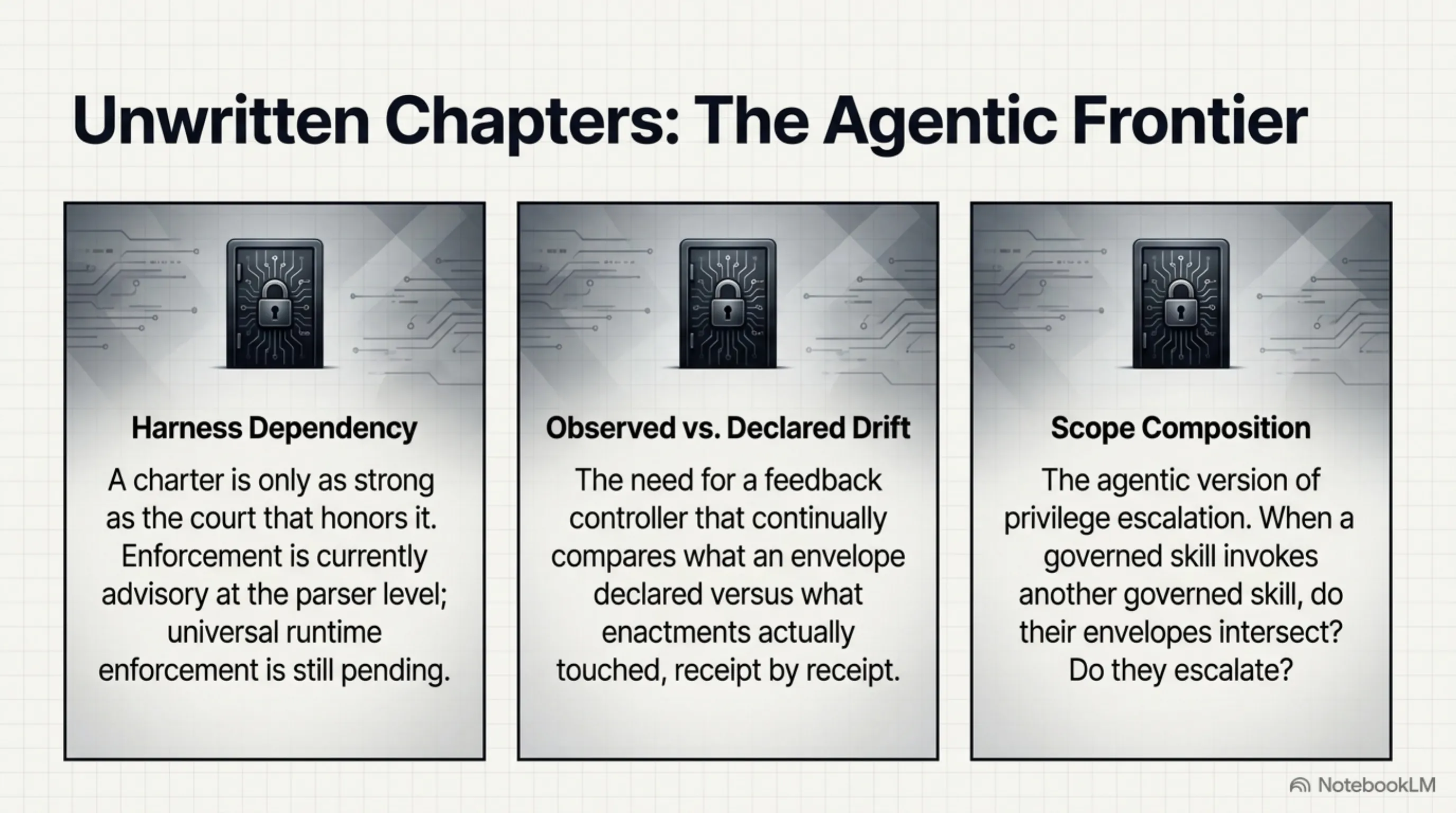
An honest history names its open chapters, and there are three.
Enforcement is only as strong as the harness. action_scope is advisory at the
parser level; today pi-kcp and kcp-harness enforce it, and other harnesses simply don't
yet. A charter honored by one court is a start, not a settlement.
Declared scope needs verification against observed scope. Today we verify that envelopes are well-formed and evidence-based at generation time. The stronger loop — comparing what a skill declared against what its enactments actually touched, receipt by receipt, and flagging the drift — is designed but not built. It is the skills counterpart of verifying knowledge declarations against the codebase, and it turns the audit trail from a record into a feedback controller.
Nobody has defined scope composition. What happens when a governed skill's playbook invokes another governed skill? Intersection of envelopes? Escalation with approval? This is the agentic version of privilege escalation, and it will decide whether compound skills — procedures built from procedures — inherit the safety of their parts or quietly defeat it. It is, in my view, the most consequential open design question in the stack.
The arc, in one line¶
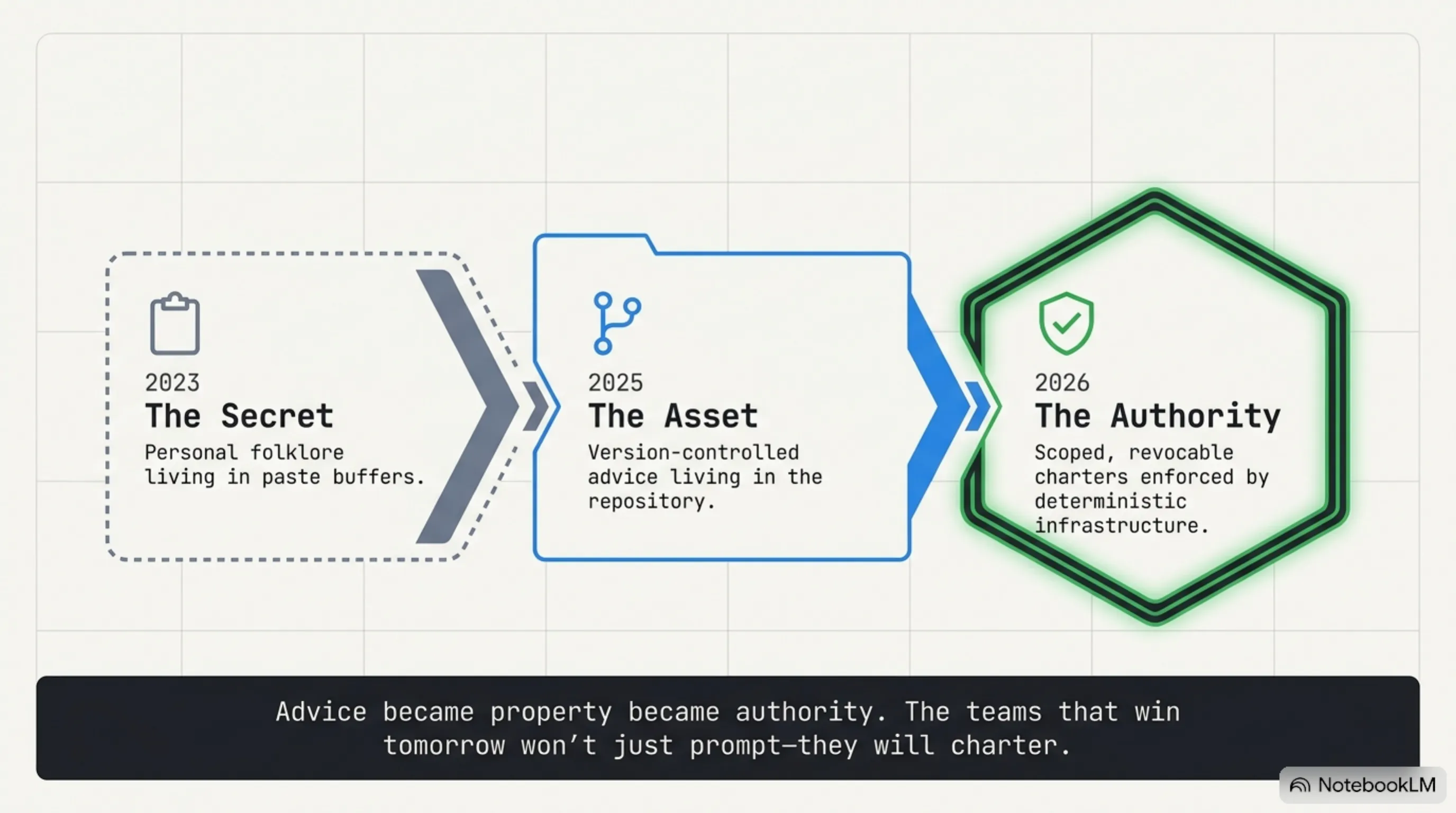
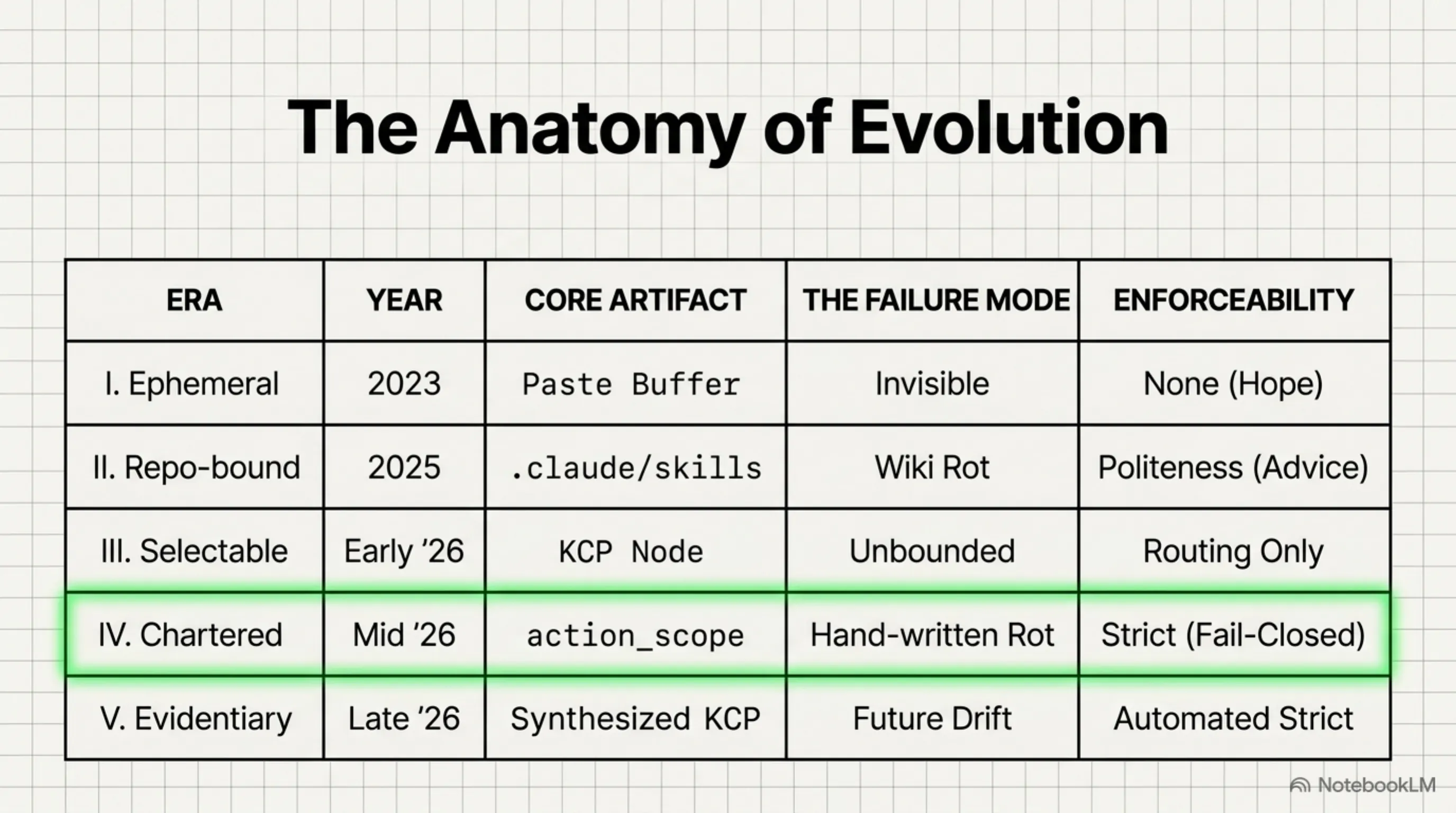
2023: the skill was a secret. 2025: the skill was an asset. 2026: the skill is a charter. Advice became property became authority — and authority, unlike advice, is something you can delegate, audit, revoke, and build an organization on.
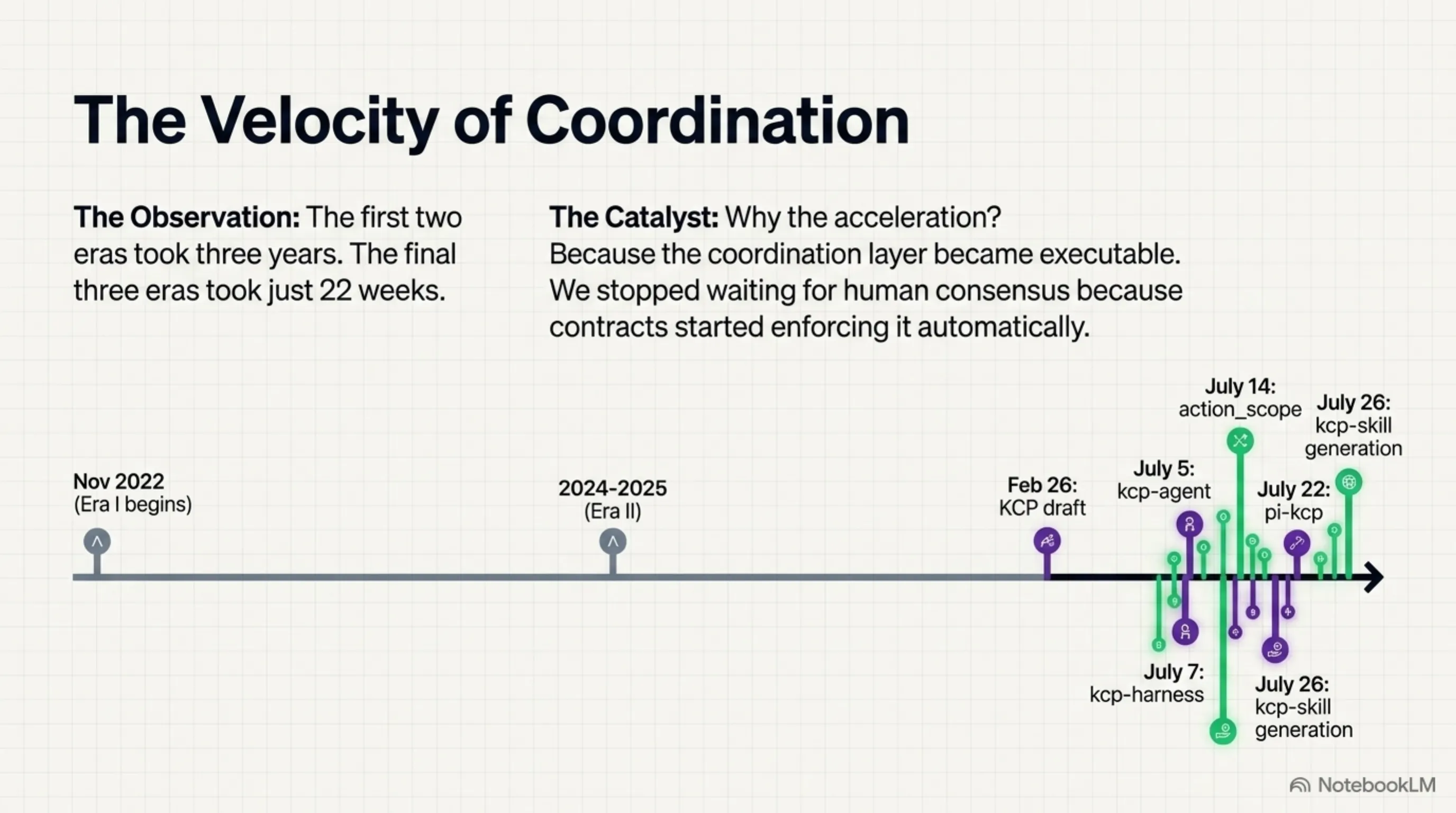
Notice the tempo. The first two eras took three years between them. The last three took twenty-two weeks — protocol draft in February, reference agent in early July, enforcement a week later, spec'd charters the week after that, generated charters today. That compression is not hype outrunning substance; every step above ships with a test suite and a conformance gauntlet. It is what happens when the coordination layer itself becomes executable: specs with reference implementations, linters with vectors, CI pinned to the neighbor's release. The eras stopped waiting for consensus because the contracts started enforcing it.
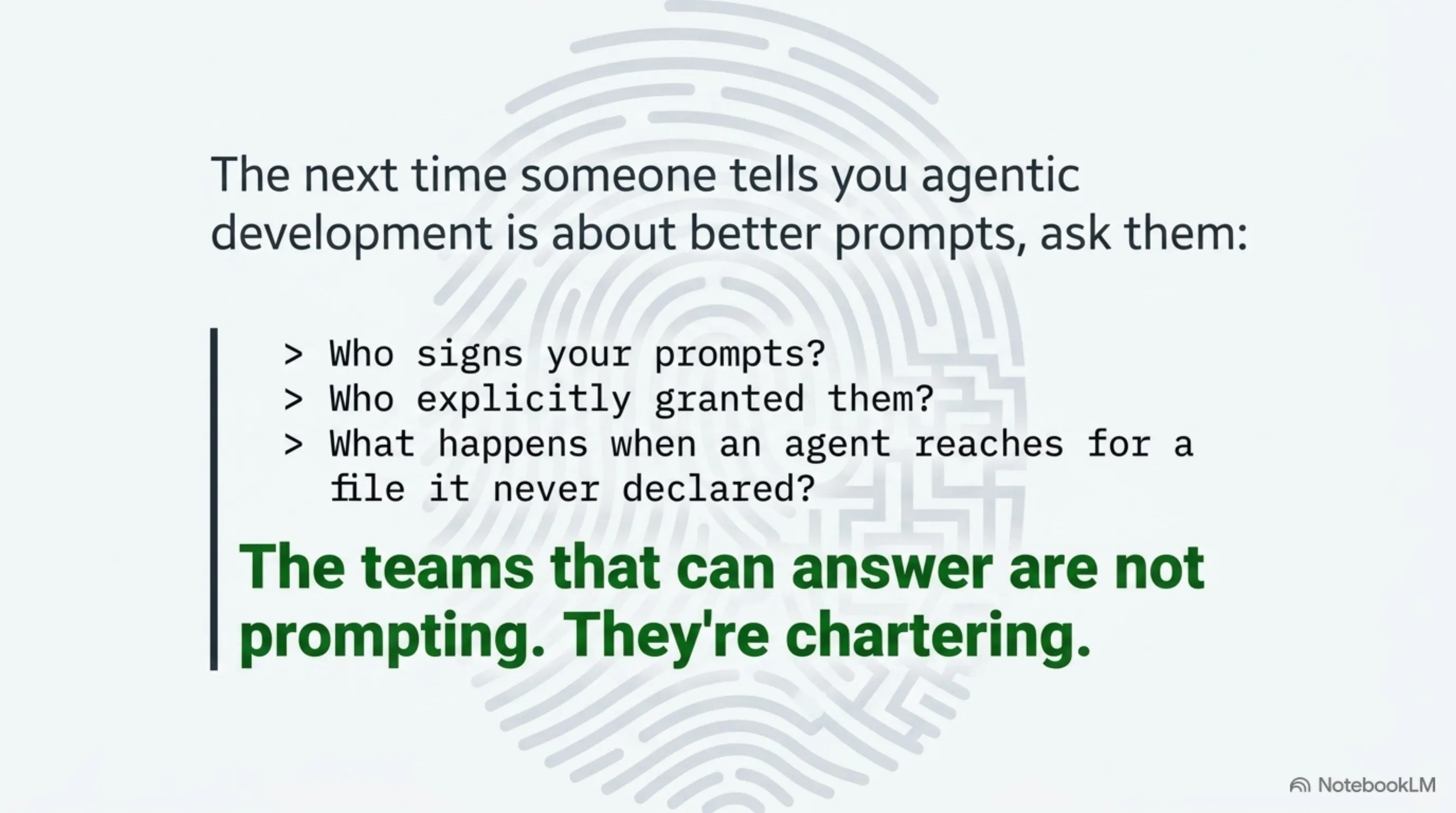
The next time someone tells you agentic development is about better prompts, ask them who signs their prompts, who granted them, and what happens when one reaches for a file it never declared. The teams that can answer are not prompting. They're chartering.
Appendix: the dates, measured¶
| Date | Event | Source |
|---|---|---|
| Nov 30, 2022 | ChatGPT ships; the pasted-prompt era begins | public record |
| Jul 2023 / Nov 2023 | OpenAI custom instructions / shareable GPTs | public record |
| 2024 | .cursorrules, .github/copilot-instructions.md — instructions enter the repo |
public record |
| Sep 2024 / Nov 2024 | llms.txt proposal / MCP — addressing for websites and tools | public record |
| Feb 2025 | Claude Code ships; CLAUDE.md becomes a convention (AGENTS.md follows the same year) |
public record |
| Oct 2025 | Claude Code Agent Skills — SKILL.md directories, loaded on demand |
public record |
| Feb 25, 2026 | KCP v0.1.0 draft published — knowledge gets a protocol | spec repo git history |
| Jun 12, 2026 | KCP v0.19 — temporal validity joins content hashes (v0.18) | spec repo tag |
| Jul 4, 2026 | KCP v0.25 | spec repo tag |
| Jul 5, 2026 | kcp-agent 0.1.1, the reference agent, first npm release | npm registry |
| Jul 7, 2026 | kcp-harness 0.1.0 — deterministic governance proxy | npm registry |
| Jul 14, 2026 | KCP v0.26 — kind: skill + action_scope: the charter, spec'd |
spec repo tag |
| Jul 22, 2026 | pi-kcp runtime-depth governance — envelopes enforced on live tool calls | pi-kcp repo |
| Jul 26, 2026 | kcp-skill v0.1.0 (conventions, linter, vectors) + synthesis kcp skills (charters generated from evidence) |
repo tags, this morning's runs |
The release-skill outputs above are real artifacts from this morning's toolchain runs — generated, linted, planned, and refused-by-default exactly as shown. Every date in this post is from a git tag, an npm publish timestamp, or the public record. Measured, not remembered.