The Agent That Knows What It Knows
Here is a confession. Our AI development rig — the one we call ExoCortex — has 644 skills: little packets of procedural memory that tell it how we deploy, how we review, how a specific client's CI is wired, how to publish to this very blog. And until this week, the way it found the right one, out of 644, was grep.
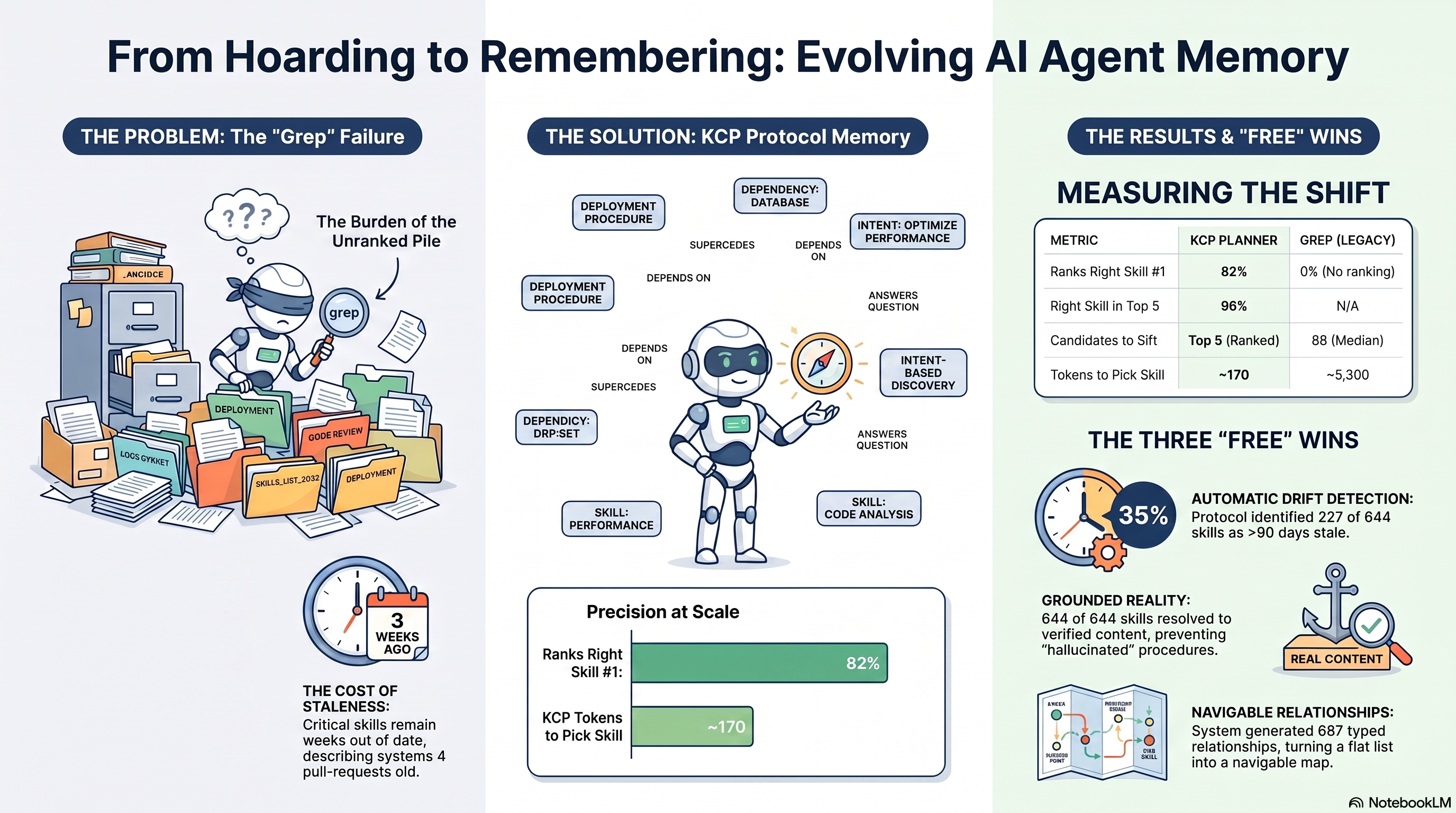
Keyword match against a flat index. No ranking. No freshness. When a query touched a common word, it got back a pile of candidates and had to read through them to guess. We only really noticed the cost the day we discovered that one of the skills it leans on daily had sat three weeks stale — describing a system four pull-requests out of date — and nothing, anywhere, had flagged it.
An agent that can't tell which of its own memories is rotting is not, in any deep sense, remembering. It's hoarding.
The reframe: skills are memory
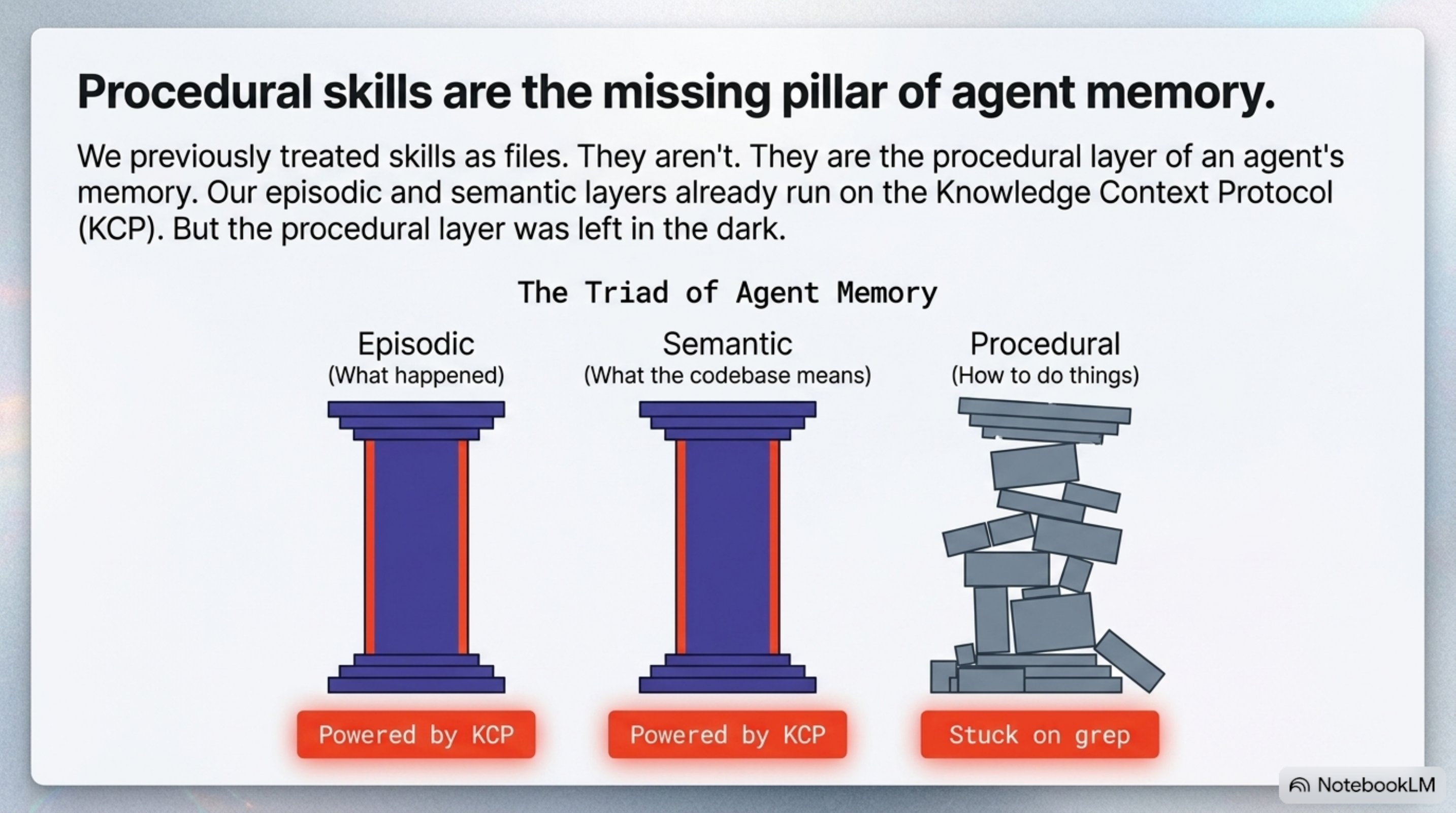
We'd been thinking about skills as files. They're not. They're the procedural layer of the agent's memory — the "how to do things" that sits alongside the episodic layer (what happened in past sessions) and the semantic layer (what the codebase means).
And here's the thing that made this itch impossible to ignore: the episodic layer already runs on a protocol. We built KCP — the Knowledge Context Protocol to make knowledge navigable by agents: every unit declares what question it answers, what it depends on, how fresh it is, who it's for. Our session memory speaks KCP. Our codebases speak KCP. The agent even governs other systems through KCP's organs.
Only the agent's own procedural memory was still grep.
So we asked the obvious question, and then — because a claim is a narrative and a measurement is evidence — we refused to answer it with a hunch.
Doing it honestly
We wrote the experiment down before we ran it. Pre-registered success thresholds, so we couldn't move the goalposts. A labelled question bank. And — the part that let us sleep — the whole thing was additive. The KCP manifest sat beside the live grep index; the live path was never touched. The fallback wasn't a recovery procedure, it was the default state: revert meant deleting one file.
Then we converted all 644 skills into a single KCP knowledge graph and pointed the real kcp-agent planner at it.
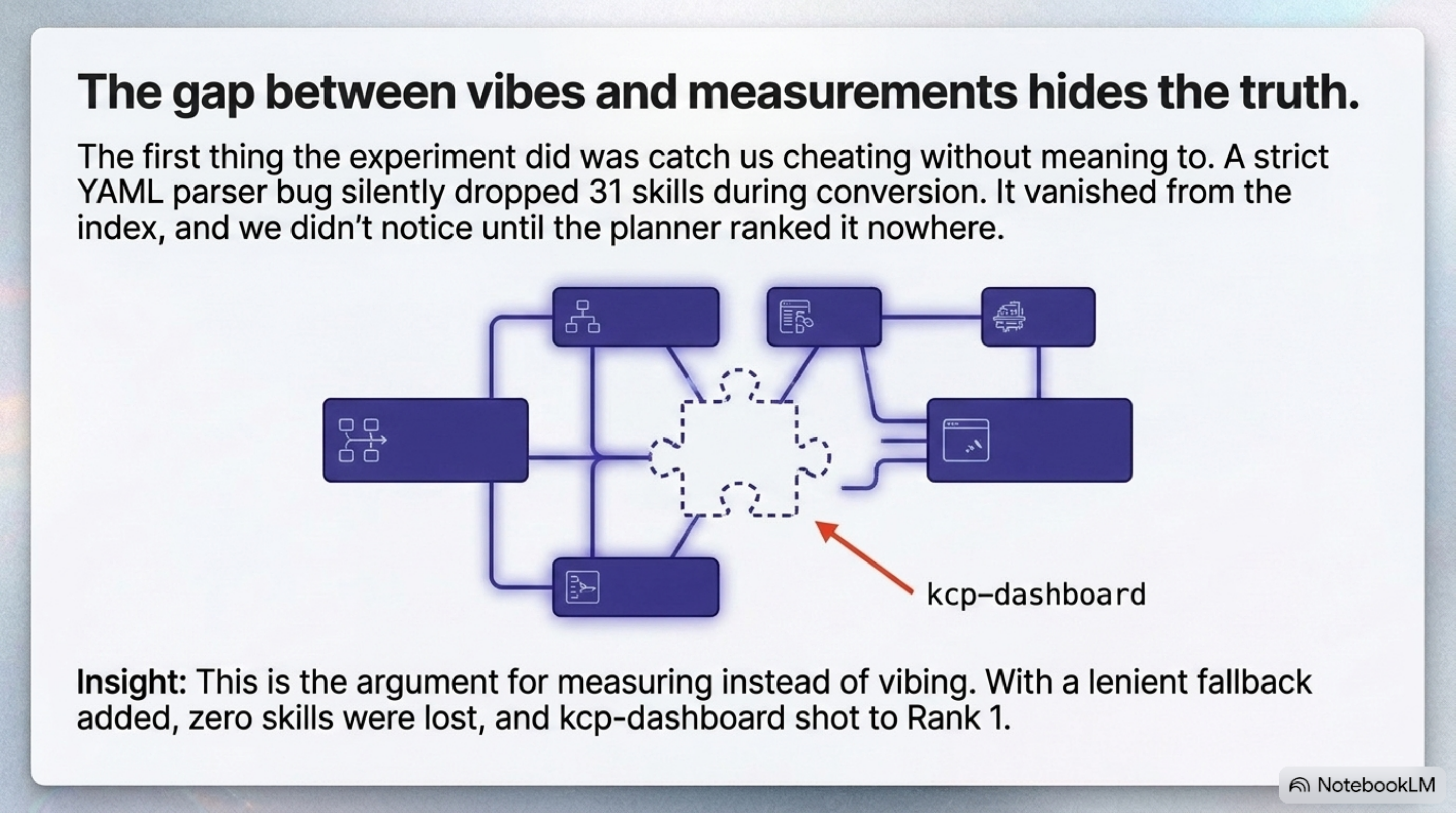
The first thing the experiment did was catch us cheating without meaning to.
Our converter silently dropped 31 skills whose contents broke a strict YAML parser — and one of them was kcp-dashboard, a skill we'd literally just used as a test question. It vanished from the index and we didn't notice until the planner ranked it nowhere. That's the whole argument for measuring instead of vibing: the gap between "we converted the skills" and "we converted the skills" is exactly where the truth hides. We added a lenient fallback; zero skills lost; kcp-dashboard went from absent to rank 1.
What we found
On a bank of real, skill-mapped questions, against the full 644-skill index:
| KCP planner | grep (today) | |
|---|---|---|
| Ranks the right skill #1 | 82% | — (no ranking) |
| Right skill in the top 5 | 96% | — |
| Mean reciprocal rank | 0.87 | — |
| Candidates to sift through | top 5, ranked | median 86, up to 284 |
| Tokens to pick the skill | ~170 | ~5,300 |
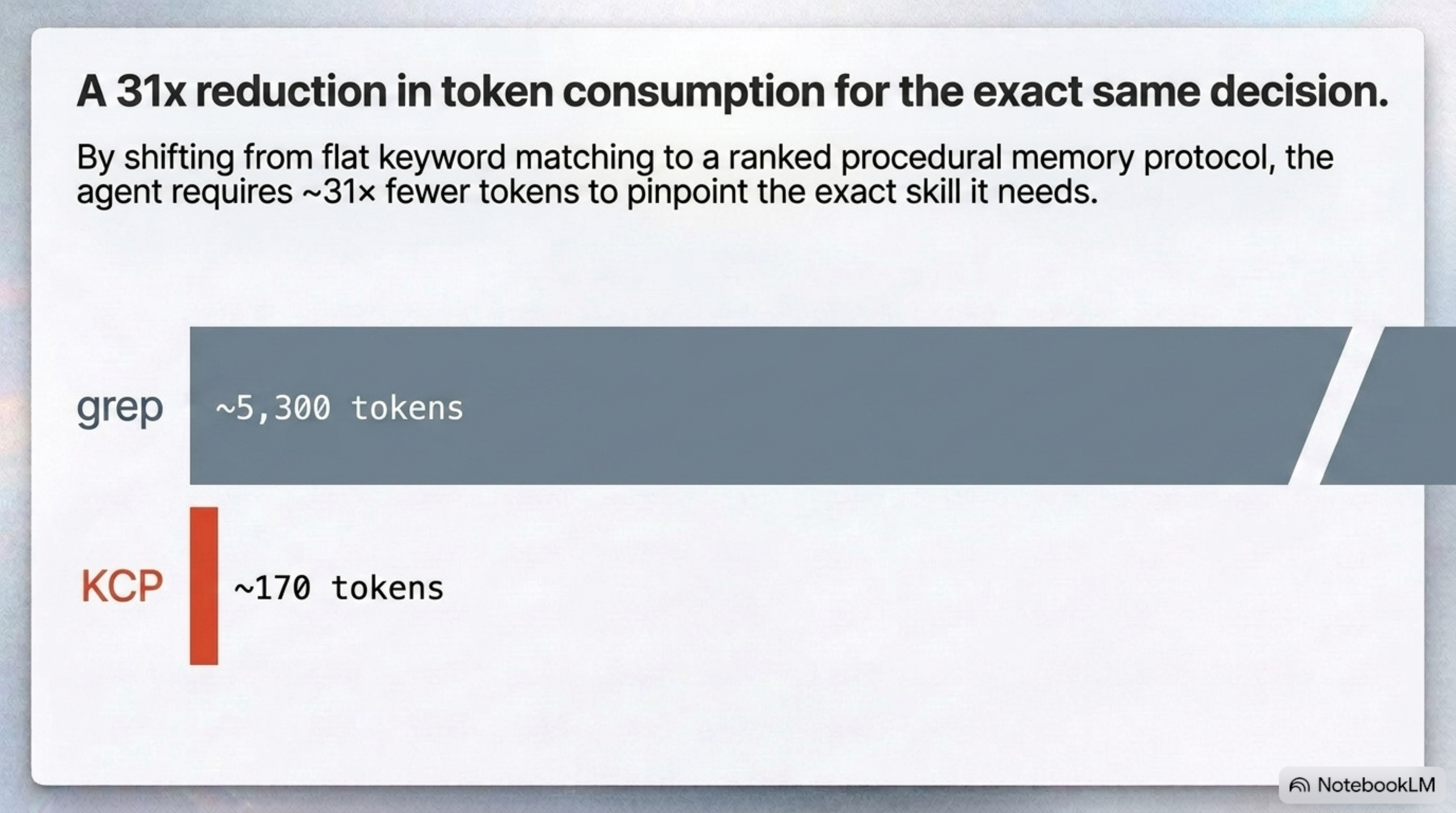
Read that bottom row twice. Both approaches find the right skill — grep's recall is fine. But grep finds it by handing the agent an unranked pile of 86 candidates (284, for "review the UI against the design system") and making it read its way to the answer. The planner hands back a ranked five, right one on top four times in five. That's ~31× fewer tokens to make the same decision — and the decision comes with its reasons attached.
Recall was never the problem. Discrimination was.
The three things grep can't do at all
The token win is the headline, but it's not the part that changes what the agent is. Three capabilities came for free with the protocol, and the register scores exactly zero on all of them:
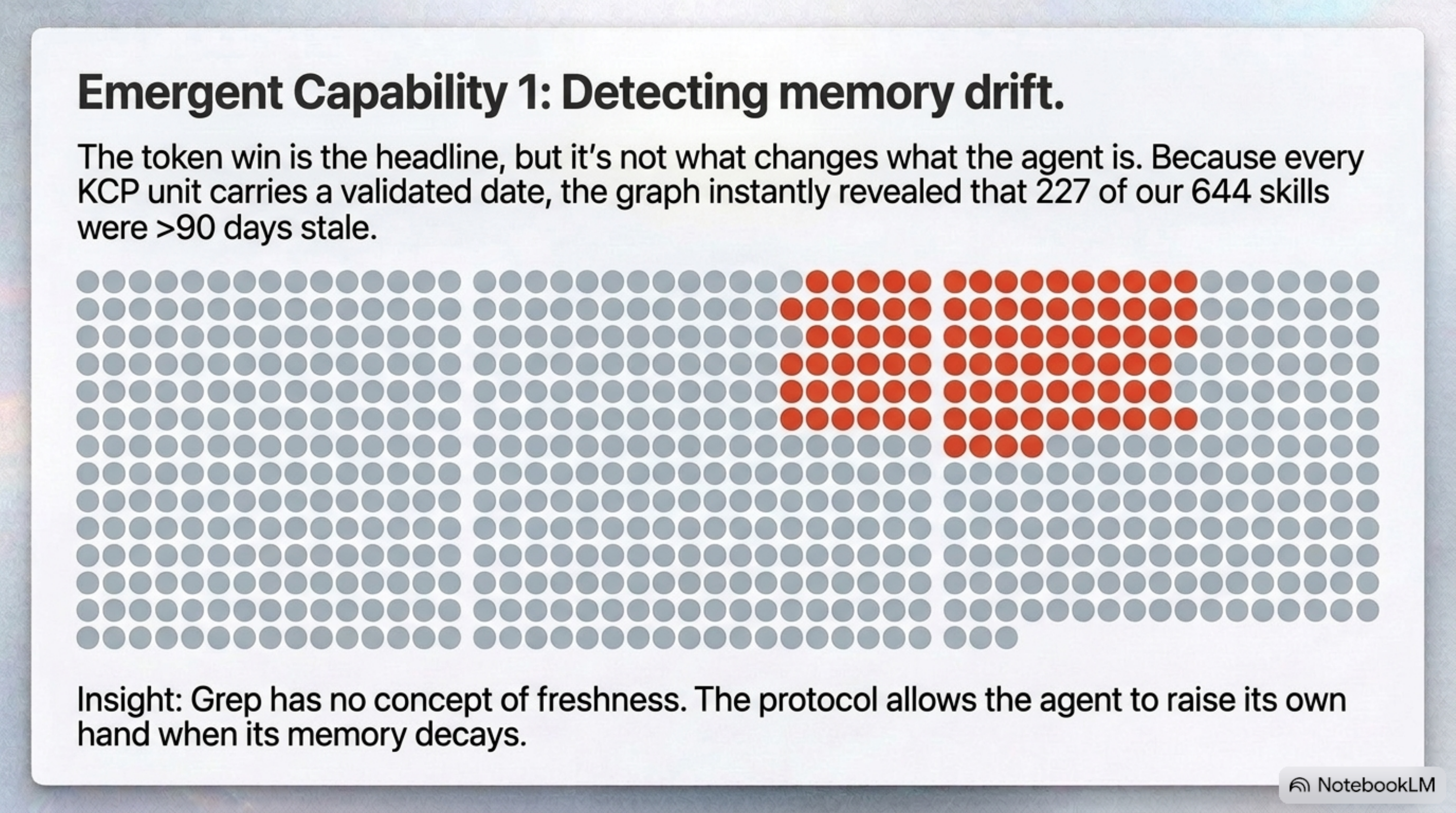
- Drift detection. Every unit carries a
validateddate. The moment we asked, the graph told us 227 of 644 skills are more than 90 days stale. The three-week-stale skill that started all this would now raise its own hand. Grep has no concept of freshness. - Grounding. Every unit points at real content; 644 of 644 resolved. A memory that can be checked against reality is a memory that can be caught lying — the same discipline we demand of the agent's actions, now turned on its knowledge.
- Navigation. 687 typed relationships — this enables that, this supersedes that — instead of a flat "see also" list. The memory became a graph you can walk.
The honest part
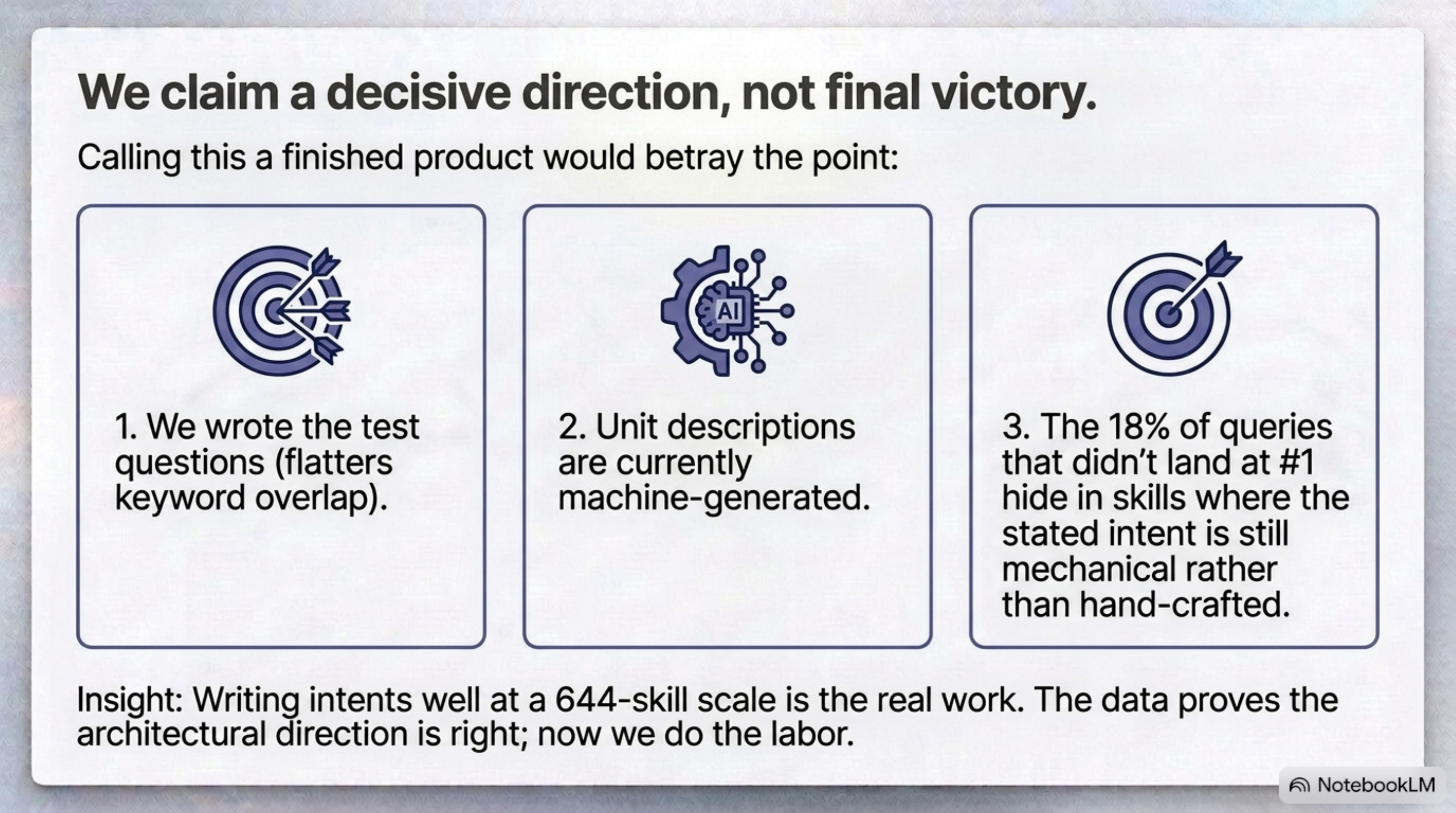
This is a first pass, and calling it anything else would betray the whole point. We wrote the questions ourselves, which flatters keyword overlap. The unit descriptions were machine-generated — good enough to win already, but the near-misses (the 18% that didn't land at #1) are exactly the skills whose intent — the question they claim to answer — is still mechanical rather than crafted. Writing those well, at 644 scale, is the real work, and it's the difference between 82% and the number we think is actually there.
So we're not claiming victory. We're claiming a direction, measured at full scale, decisive enough to keep walking: an agent's procedural memory, on a protocol, is ranked where grep is flat, fresh where grep is blind, and grounded where grep is unverifiable — at a thirty-first of the cost.
The pre-registered, skeptic-proof version — questions mined from real usage, hand-crafted intents, the full statistical treatment — is written down and waiting. We'll publish those numbers too, whichever way they fall. That's rather the point of keeping receipts.
Why this matters beyond us
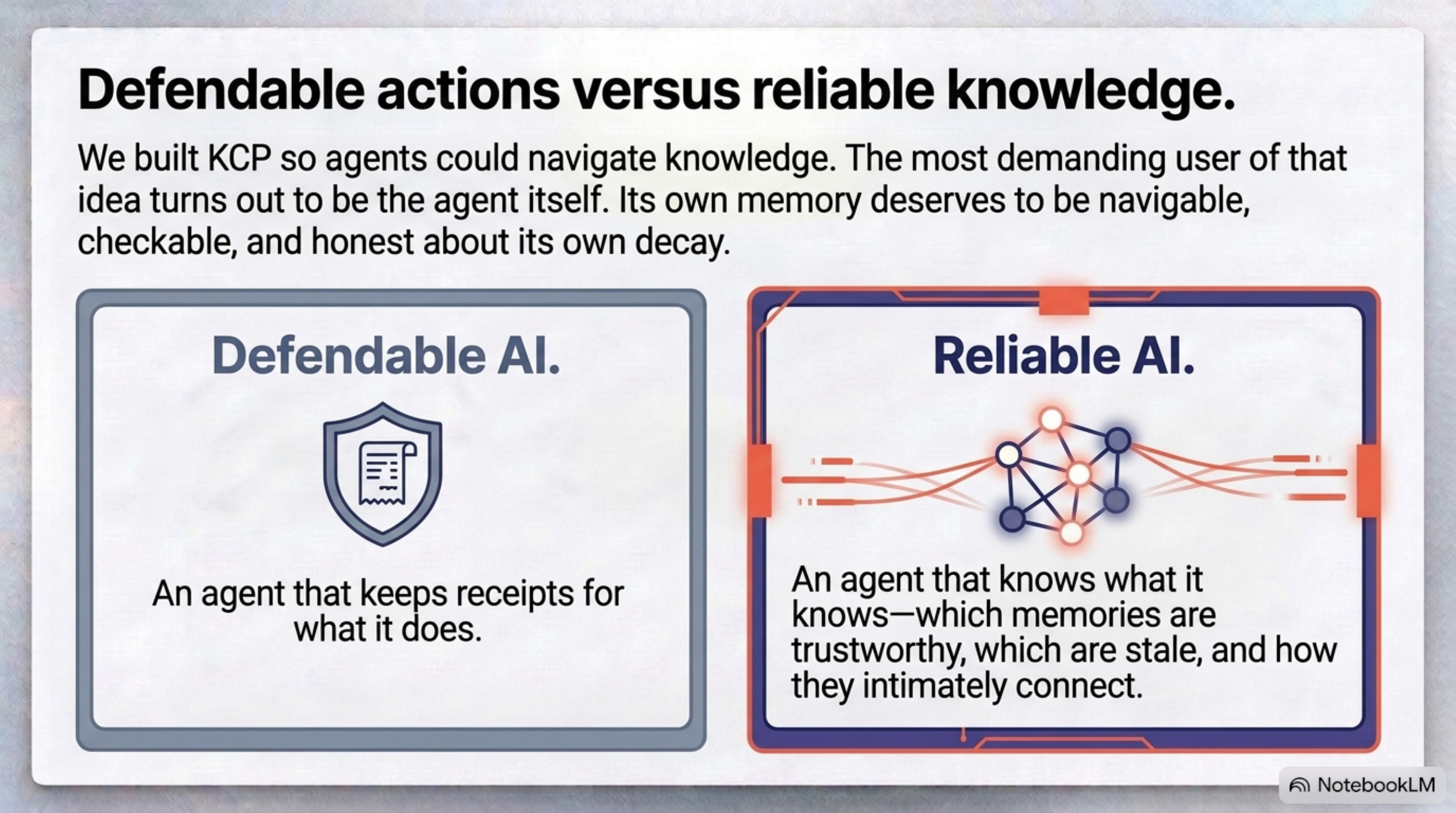
There's a tidy little recursion here that we find hard to look away from. We built KCP so that agents could navigate knowledge. The most demanding user of that idea turns out to be the agent itself — its own memory is knowledge, and it deserves to be navigable, checkable, and honest about its own decay.
An agent that keeps receipts for what it does is defendable. An agent that also knows what it knows — which of its memories are trustworthy, which are stale, how they connect — is something closer to reliable.
We're not there yet. But for the first time, our agent can tell us which of its 644 memories it should no longer trust. That feels like a beginning worth writing down.
The manifest, converter, and measurement harness are ExoCortex-internal for now; the protocol they run on is open source at Cantara/knowledge-context-protocol.