The CI Pipeline Is the Agent's Nervous System
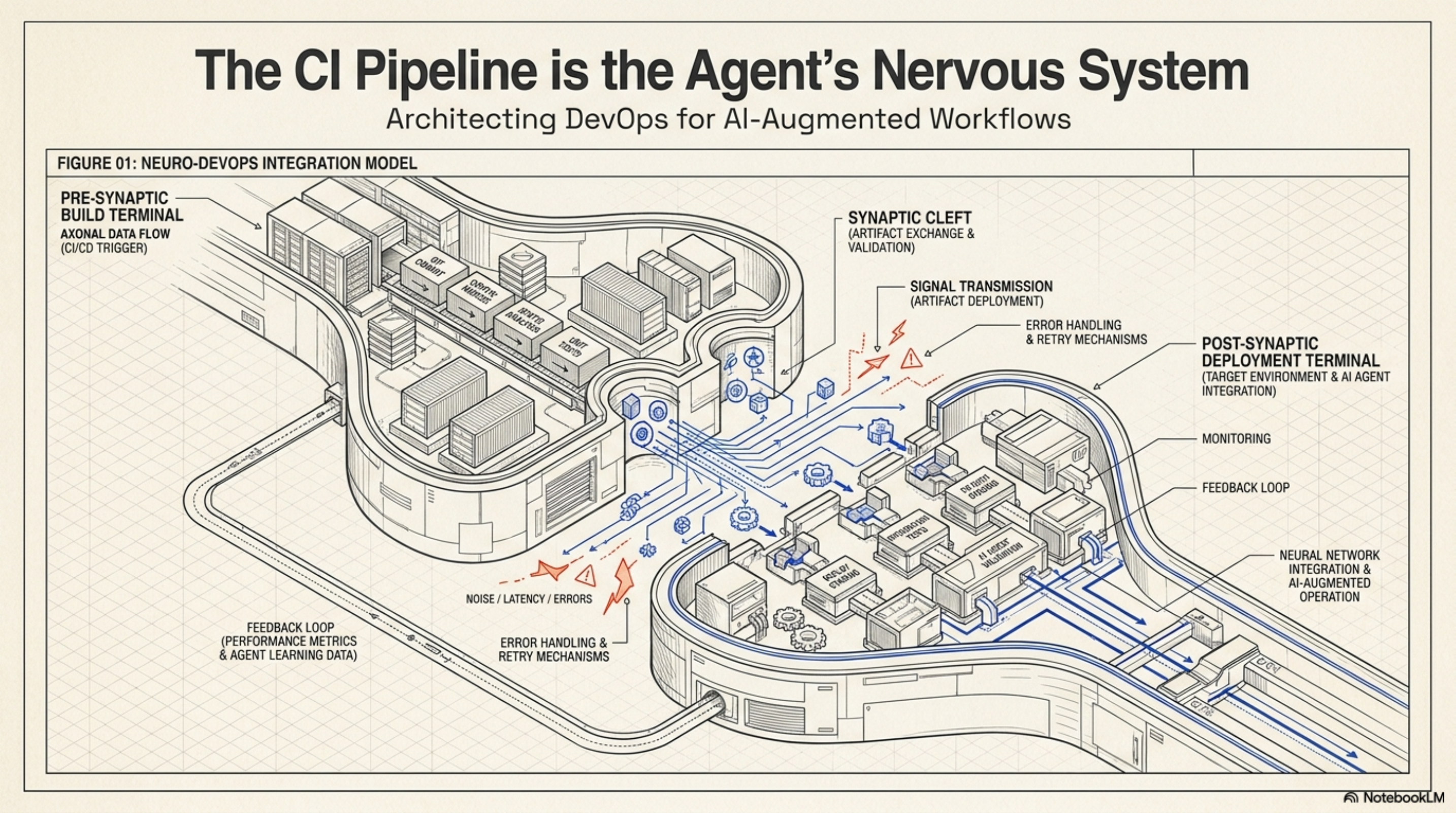
Six integration tests failed. All six with the same symptom: a 15-second timeout, no data loaded, supplier cards blank, compliance percentages absent. The backend was running. The database was seeded. The frontend was rendering. Every component was alive — and every assertion was blind.
This was last week on Mynder's compliance SaaS, where ExoCortex has been merging roughly 60 pull requests per week through an Azure DevOps CI/CD pipeline for seven weeks. The tests used testcontainers — real PostgreSQL, real backend, real Next.js frontend. Not mocked. The full integration stack. And all six scoring-evidence tests were dead on arrival in CI while passing perfectly on my local machine.
The failure logs said "timeout." The failure meant something else entirely.
The CORS Detective Story
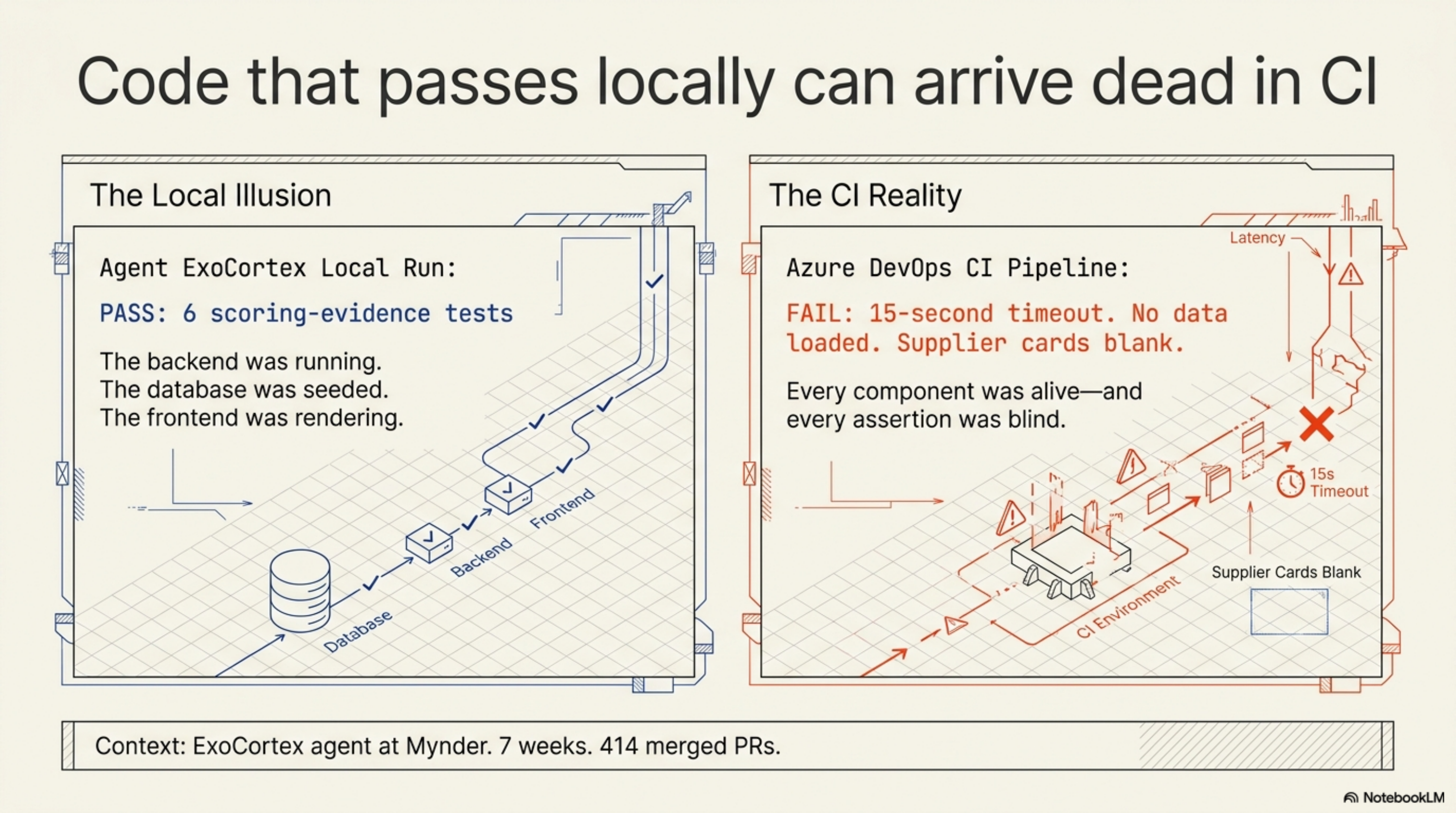
The backend defaults to CORS_ORIGIN=http://localhost:3000. On a developer machine, the frontend runs on port 3000. Always. That is the default, and no one thinks about it.
In CI, testcontainers allocate ports dynamically. The frontend landed on whatever port the OS handed it — 3217, 4891, whatever was free. The backend started with its default CORS origin of http://localhost:3000. Every API call from the frontend hit the CORS wall. Every request was blocked. Every component that depended on backend data rendered empty.
Six tests. Fifteen seconds each. All timing out on assertions that would never pass, because the data they were looking for could never arrive.
The commit message that fixed it tells the story in three lines:
"The backend defaults to CORS_ORIGIN=http://localhost:3000 but the testcontainer frontend runs on a dynamically-allocated port. All 6 scoring-evidence tests make real (non-mocked) backend calls, so CORS blocked every request and supplier/compliance data never loaded — causing 15s timeouts on all assertions."
The fix was one reordering of the startup sequence:
// Find the frontend port before starting the backend so we can pass it as
// CORS_ORIGIN. The backend CORS default is http://localhost:3000 which blocks
// real API calls when the frontend lands on any other port (e.g. in CI).
const frontendPort = await findFreePort();
const frontendBaseUrl = `http://localhost:${frontendPort}`;
const { pid, baseUrl } = await startBackend(dbInfo, publicKey, frontendBaseUrl);
The backend had been starting before the port was known. The fix was to determine the port first, then pass it as the CORS origin. One change in ordering. But finding it required tracing backward from a timeout symptom through the CORS policy, through the port allocation sequence, through the startup order of the test infrastructure, into an assumption about the runtime environment that was baked so deeply into the test setup that it was invisible.
The agent wrote those tests. They worked locally. The CI pipeline is what revealed the flaw — not a flaw in the test logic, but in the architectural assumption underneath it. Port 3000 is not a constant. It is a development convenience that the CI environment does not share.
The Cascade
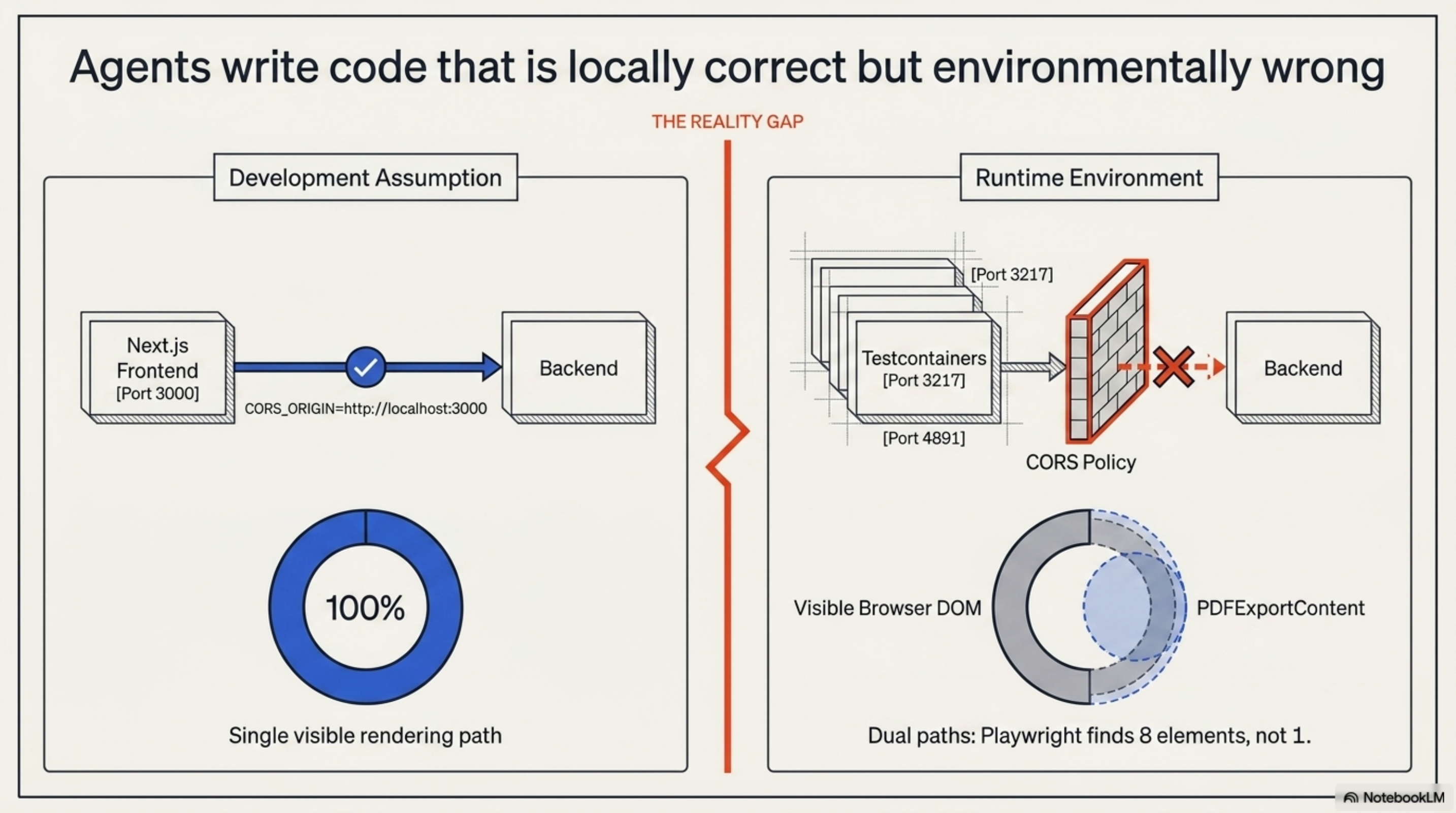
After fixing CORS, four of the six tests passed. Two compliance percentage tests still failed. Different symptom this time: getByText("100%") resolved to eight elements instead of one.
The component architecture had two rendering paths for the same data. The visible donut chart showed 100% in the browser. But a PDFExportContent wrapper — used for print rendering — duplicated the same elements inside a <div style={{ display: 'none' }}>. Eight matches. Some visible, some hidden. Playwright found all of them.
First attempt at a fix: locator('p[data-size="2xl"]').filter({ hasText: '100%' }). Found the element. It was the hidden one. The locator was precise but pointed at the wrong rendering path.
The actual fix required changing the application component. Add data-testid="compliance-overall-pct" to the visible donut span in ActiveFrameworksSummary.tsx, then use getByTestId() in the test. The pipeline found an ambiguity in the component architecture — two rendering paths for the same data with no semantic distinction — that no amount of local testing would have surfaced, because on a developer machine the print-rendering path never matters.
The Pattern
Both failures share a structure worth naming:
- Code worked correctly in the local development environment.
- The CI environment differed in a way that was invisible during development.
- The test assertion described the symptom (timeout, hidden element), not the cause (CORS policy, dual rendering path).
- Finding the cause required tracing backward from the CI failure into the application architecture.
- The fix changed the application or test infrastructure, not the test assertion.
This is not CI as build validator. This is CI as diagnostic instrument. The pipeline didn't just tell me the code was wrong. It told me where the architecture had an invisible assumption, and it did so by providing an environment different enough from local development to surface what local development hides.
And now the metaphor becomes unavoidable.
A Nervous System, Not a Gatekeeper
Every post about AI agents focuses on the agent's reasoning, its memory, its tools. Nobody writes about the CI pipeline. But after seven weeks and 414 merged pull requests, I can tell you what actually determines whether the agent's work is correct: it is the pipeline.
Not the model's reasoning ability. Not the prompt engineering. Not the skill library. The pipeline.
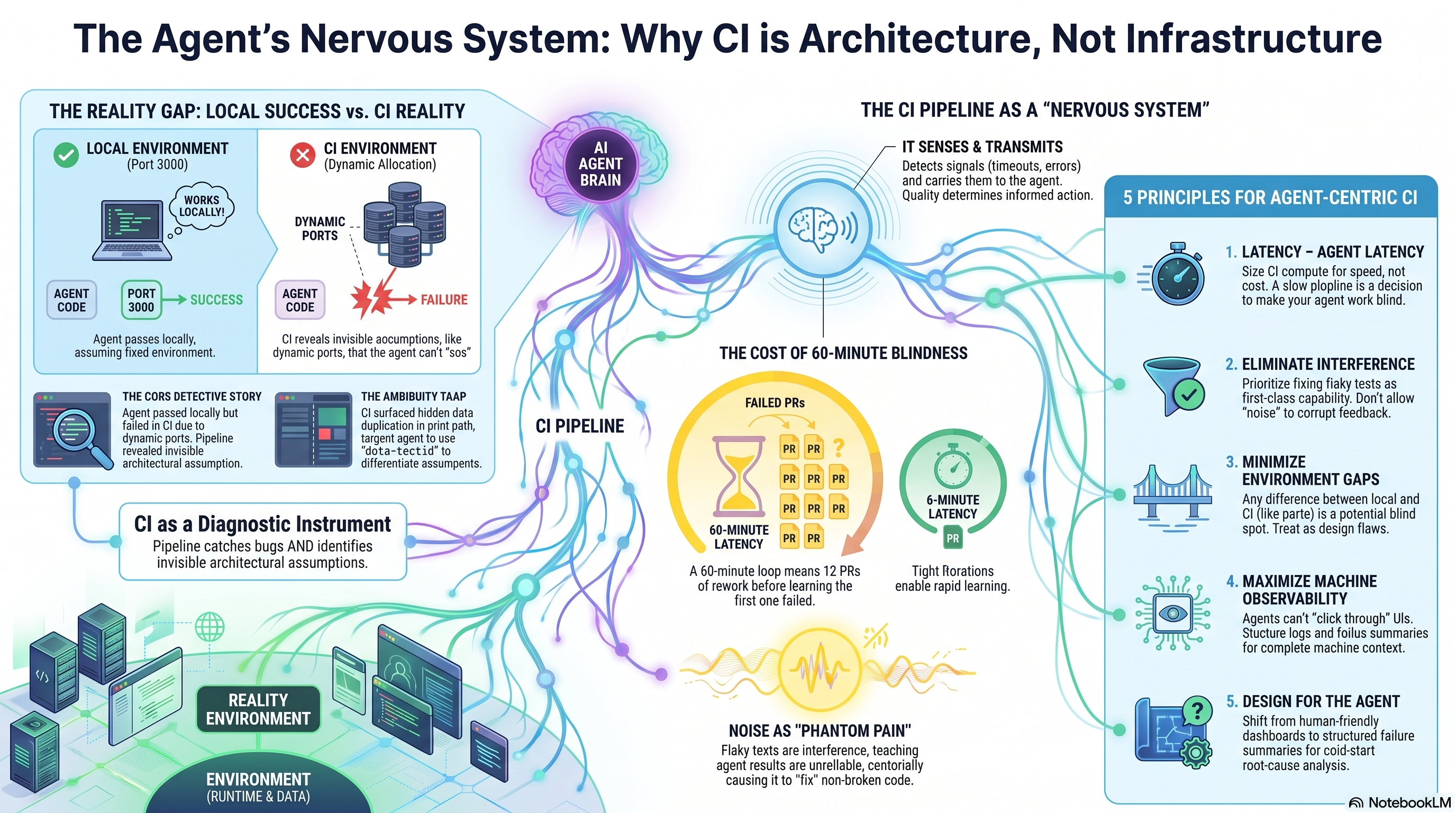
A nervous system does five things:
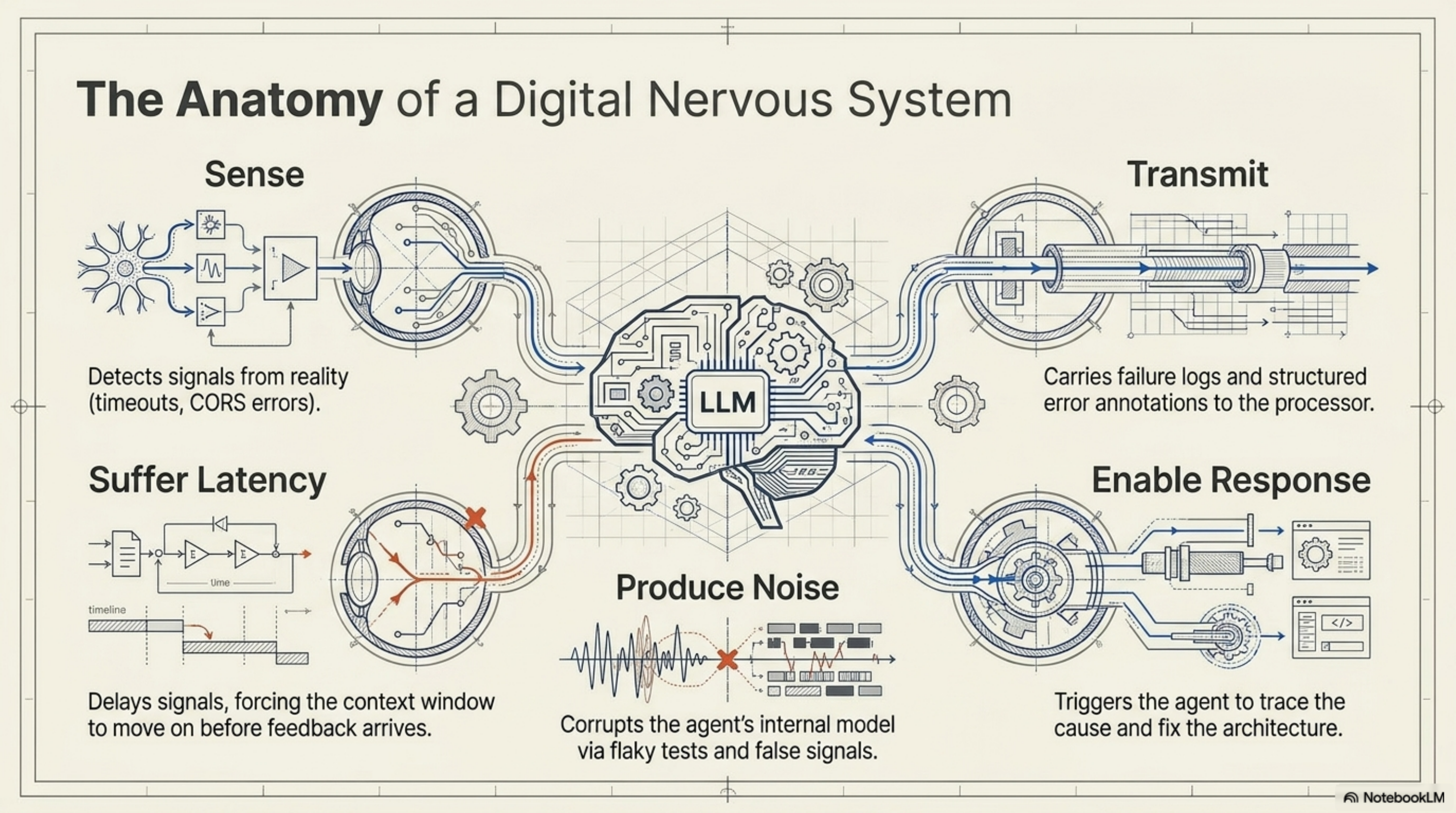
It senses. It detects signals from the environment — test failures, timeouts, CORS errors, element ambiguities. These signals correspond to real conditions in the runtime environment that the agent's model of the codebase does not contain.
It transmits. It carries signals to the processing center — PR build status, failure logs, error annotations. The quality of this transmission determines whether the signal is actionable or opaque.
It enables response. The processing center acts on the signal — the agent reads the failure, traces the cause, fixes the architecture. Without the signal, there is no response. Without the response, there is no learning.
It has latency. Slow signals mean slow responses. When the Mynder ADO pipeline ran on a 2-vCPU CI agent with 60-minute timeouts, the agent could not learn whether its work was correct until the context window had moved on. Sixty minutes of blindness. By the time the result arrived, the agent was working on something else, and the failure context had to be reconstructed from scratch.
It produces noise. Flaky signals cause incorrect responses. An intermittent test failure teaches the agent that something is wrong when it is not, or right when it is not. The agent builds patterns around false signals. This is worse than no signal at all, because it corrupts the agent's model of what works.
The CI pipeline is not infrastructure the agent's output passes through. It is the sensory apparatus that tells the agent whether its output corresponds to reality.
The Category Error
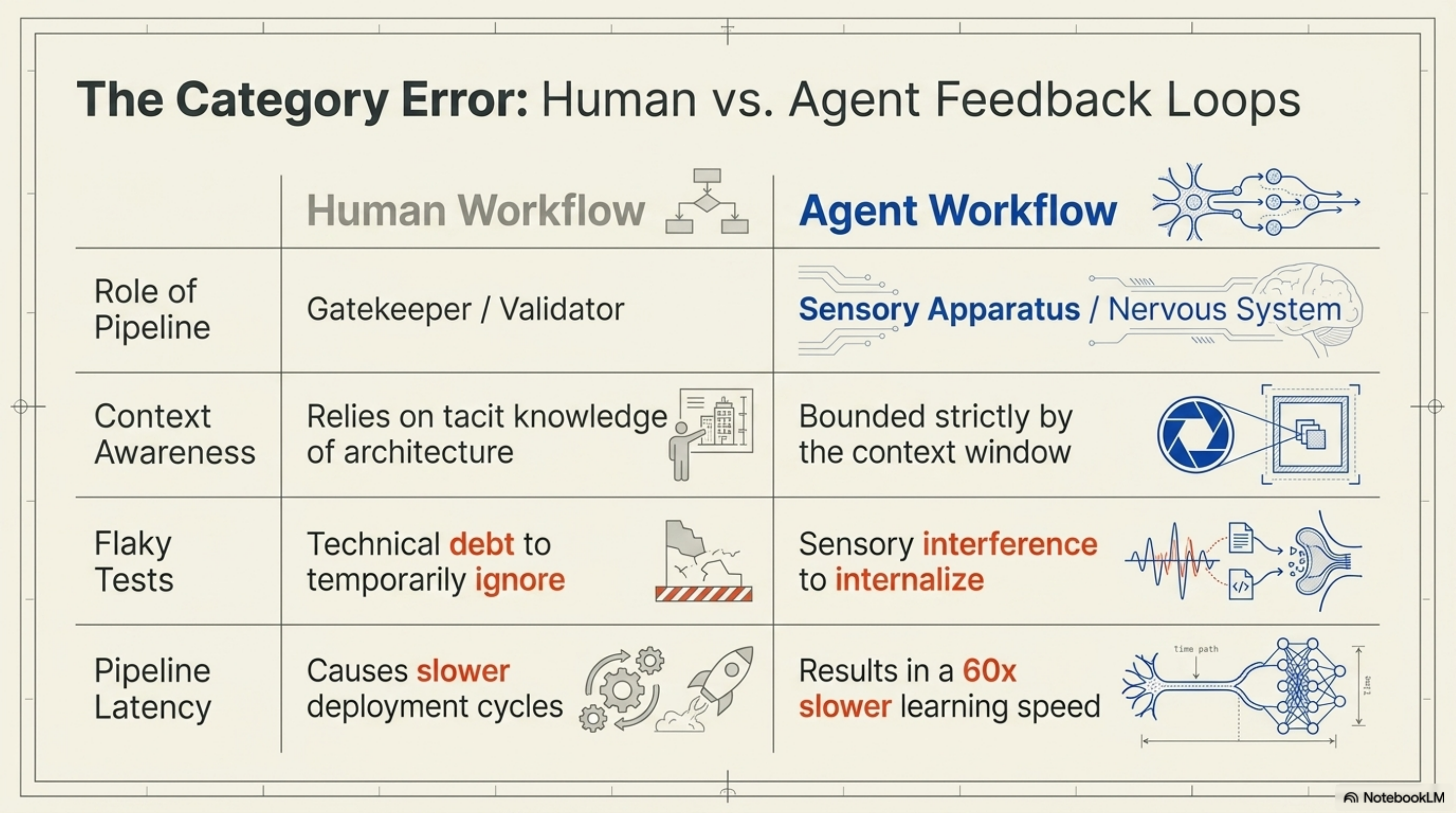
In a traditional workflow — human-only, no agent — CI/CD is legitimately infrastructure. The human who wrote the code already understands the architecture. When a build fails, the human investigates with full context: they know why they made the choice, what the alternatives were, what the system's constraints are. The CI feedback loop is complementary to the human's existing mental model. It confirms or denies. It does not teach.
In an agent-augmented workflow, CI/CD becomes something categorically different.
The agent can produce code that is locally correct but environmentally wrong. The CORS fix is the proof. The code was correct — the test logic, the assertions, the component rendering. What was wrong was an assumption about the runtime environment. The agent's "mental model" of the codebase is bounded by what it can fit in context. It does not have the developer's tacit knowledge that port 3000 is a convention, not a contract.
The CI pipeline is the only mechanism that tests the agent's output against reality — the actual runtime environment with its dynamic ports, its dual rendering paths, its resource constraints and timing variations. Not the agent's model of reality. Reality itself.
This means treating CI as infrastructure — something you provision, maintain, and forget about — is a category error. It would be like treating your eyesight as infrastructure. You do not "provision" vision. You depend on it to navigate the world. When it degrades, you do not file a ticket. You stop.
CI is not infrastructure. CI is architecture. It is a design decision about how the agent perceives the consequences of its work. And the AI tooling industry is making this category error right now, building ever more sophisticated agents while their CI pipelines run on the cheapest available compute with 45-minute feedback loops and flaky tests that nobody prioritizes because they are "just infrastructure."
What Sixty Minutes of Blindness Costs
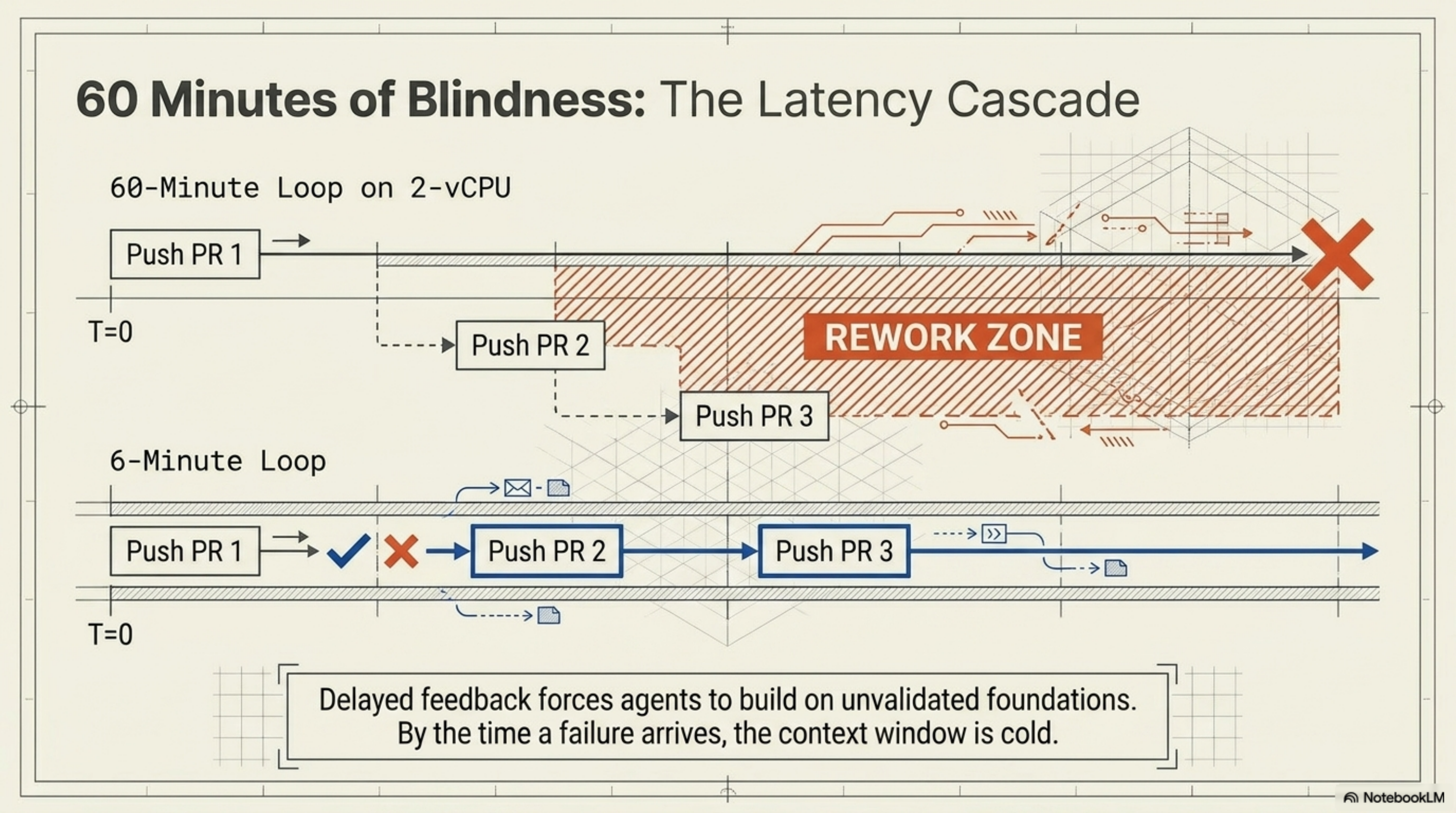
When the Mynder pipeline was running on undersized CI agents, a single pipeline run could take over an hour. During that hour, ExoCortex had no feedback on whether the previous PR was correct. It continued working — writing the next feature, preparing the next test suite, making architectural decisions that assumed the previous work was sound.
If the pipeline came back green, that assumption was validated. If it came back red, everything built on top of the failed PR was potentially wrong. Not necessarily wrong — but potentially, which means it all had to be re-evaluated. The agent's context had moved on. The failure context had to be reconstructed. The diagnostic trace that would have taken five minutes at submission time now took twenty because the working state was cold.
This is what pipeline latency costs in an agent-augmented workflow. It is not a cost measured in compute dollars. It is a cost measured in learning speed. A 60-minute pipeline on a 2-vCPU CI agent is not a cost decision. It is a decision to make the agent 60 times slower to learn whether its work was correct.
The compound effect is devastating. If each PR takes 60 minutes to validate and the agent produces 12 PRs per day, the feedback from the first PR arrives after the agent has already produced the second and third. The first failure cascades into rework on everything downstream. The agent is flying blind, building on unvalidated foundations.
Contrast this with a 6-minute pipeline. Feedback arrives before the next PR is started. Each PR is validated before the next one begins. The agent's model of what works stays synchronized with reality. No cascade. No rework. The nervous system is fast enough to keep the organism oriented.
![Pipeline latency is not a cost decision. It is an agent speed limit. [Context Window] + [Pipeline Latency] = [Agent Learning Speed]. A 60-minute pipeline on undersized compute doesn't save money. It makes the agent 60 times slower to learn whether its work was correct.](/assets/images/blog/ci-pipeline-nervous-system/ns-agent-speed-limit.png)
Flaky Tests Are Interference
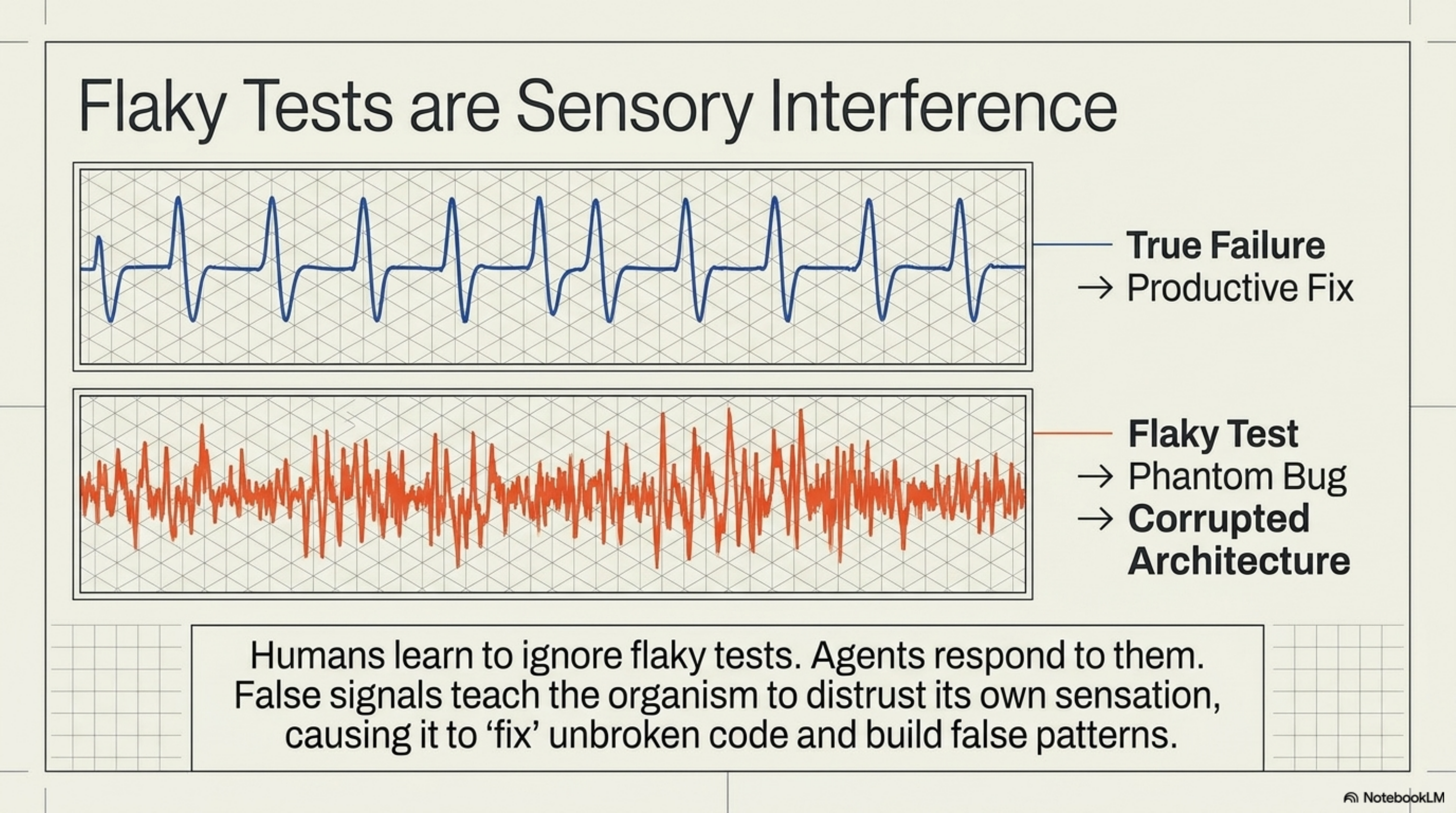
In a human-only workflow, a flaky test is technical debt. Annoying, worth fixing eventually, but manageable. The human developer learns to recognize it: "Oh, that test. It's flaky. Ignore it."
An agent cannot learn to ignore a flaky test. Not reliably. The agent sees a failure and responds to it. If the failure is real, the response is productive. If the failure is noise, the response is waste — or worse, the agent "fixes" something that was never broken, introducing an actual bug in the process of addressing a phantom one.
Flaky tests in an agent-augmented workflow are not technical debt. They are interference. They inject false signals into the agent's feedback loop. They corrupt the agent's model of which changes cause which failures. Over time, they teach the agent that test results are unreliable, which erodes the agent's trust in its own diagnostic apparatus — the equivalent of a nervous system that produces phantom pain. The organism learns to distrust sensation, and then it misses real injuries.
Five Design Principles
After seven weeks operating at this scale, these are the principles that have earned their way into the architecture:
1. Treat pipeline latency as agent latency. Every minute the pipeline takes is a minute the agent cannot confirm whether its work is correct. Size your CI compute for the feedback loop, not for the cost spreadsheet. A 60-minute pipeline is not cheap infrastructure. It is an expensive decision to operate blind.
2. Flaky tests are not technical debt. They are interference. In an agent-augmented workflow, a flaky test does not just waste time. It teaches the agent that something is wrong when it is not, or right when it is not. Prioritize flaky test elimination as a first-class agent capability concern, not a quality-of-life improvement.
3. CI environment differences are architecture decisions. The gap between local development (fixed port 3000) and CI (dynamic port allocation) was not an ops concern. It was a design flaw in the test infrastructure that the pipeline revealed. Every difference between local and CI is a potential blind spot in the agent's model of reality. Minimize the gaps or make them explicit.
4. The agent cannot see what the pipeline does not tell it. If the pipeline swallows logs, compresses failures into opaque error codes, or returns "FAILED" without context, the agent is diagnosing by shadows. Observability in CI is a first-class agent capability. Error messages should be complete. Log lines should include enough context for a cold-start analysis. Failure annotations should point to the source, not the symptom.
5. Design the pipeline for the agent, not for the human. A human developer can click through the Azure DevOps UI, expand collapsed log sections, cross-reference with local state, and use intuition to skip irrelevant output. An agent reads what it is given. Structure CI output for machine consumption: structured failure summaries, explicit root-cause annotations, clear separation between build failures and test failures. The nervous system should transmit signal, not noise.
The CORS bug was a one-line ordering change. Finding it required the CI pipeline to exist, to differ from local development, and to report the failure in a way the agent could trace. Without the pipeline, the agent would have shipped code that worked perfectly everywhere except production. The pipeline is not where the code gets validated. The pipeline is where the agent learns what reality looks like.
ExoCortex // Mynder CI Architecture