Fan-Out: What the Literature Already Knew About the Third Schedule
Earlier today I published The Third Schedule — an argument, tested against my own commit history, that the quiet assumption under Paul Graham's Maker's Schedule, Manager's Schedule has broken: maker time is no longer singular. Multiple simultaneous threads of real builder-work can now run under one human's direction, and the scarce resource has moved from the maker's unbroken afternoon to the director's judgment bandwidth.
That post was deliberately inward-looking: one claim, one practice, one dataset. This one looks outward, because a claim like that deserves two external checks it hasn't had. First: has someone already written the maker's-schedule update for the agent era? (Spoiler: yes, at least four times — and it's worth reading them honestly rather than pretending the field is empty.) Second, and harder: there is a substantial, well-established research literature saying human multitasking carries real, measured costs. If that literature is right — and it mostly is — how can "builder time parallelizes" be true at all?
The answer to the second question turns out to have been sitting in a different literature for twenty years, complete with a formula. And once you have the formula, the broader 2025–2026 conversation about agent-era productivity — which swings between "AI collapsed time itself" and "AI makes developers 19% slower" — acquires something it badly needs: a limit. That's where the one hard dataset I have earns its place. Not as proof. As a boundary.
The update has been attempted — four times that I found
An afternoon's genuine search turns up a small convergent literature of maker's-schedule updates, and the honest move is to report what each actually says.
The most sweeping is Shobhana Viswanathan's How AI Collapsed the Maker–Manager Schedule (October 2025): AI compresses research, ideation, and drafting from hours to minutes, memory systems carry context across sessions, and therefore time-blocking is obsolete — "AI didn't just make people faster. It collapsed time itself." She proposes a "Momentum Schedule" built on energy cycles rather than time blocks. It's the strongest version of the claim and the least evidenced; the argument runs on capability description, not on any measurement of a real working practice.
The closest neighbor to my own framing is Charlie Guo's The AI Manager's Schedule (January 2026). Guo describes moving from chatting with AIs to managing them — his phrase: "I'm moving away from chatting with AIs and moving towards managing them" — and sketches a day of 5–15 minute check-in intervals against delegated agent work. His evidence is capability benchmarks (SWE-Bench trajectories, METR's task-length curves) plus his own workflow. If you want the single best prior articulation of the director pattern, it's this one.
The counterweight is Aparna Chennapragada's Every Maker Is Now a Manager (of AI) (February 2026), which accepts the same shift and argues it costs more than it looks: supervision-by-dialogue is a high-effort cognitive mode, responsibility stays high while control over execution drops — she reaches for Karasek's demand-control model of workplace strain — and "when work is routed primarily through dialogue, I think our attention never really fully disengages." This is the piece the enthusiasts should be made to answer, and I'll come back to it, because she's pointing at something real.
And from the tooling side, Voxos's The Attention Bottleneck (February 2026) states the operational version plainly: the constraint on running many coding agents is not agent capability but human attention — the developer becomes a dispatcher, working memory holds three or four active items, and somewhere past a handful of parallel agents the human stops knowing which one needs them now. Practitioner guides in the same vein (Superset's parallel-agents guide, Agents Room, Addy Osmani's Code Agent Orchestra) converge on a working range of roughly three to eight parallel workstreams, with strain reported around the fourth.
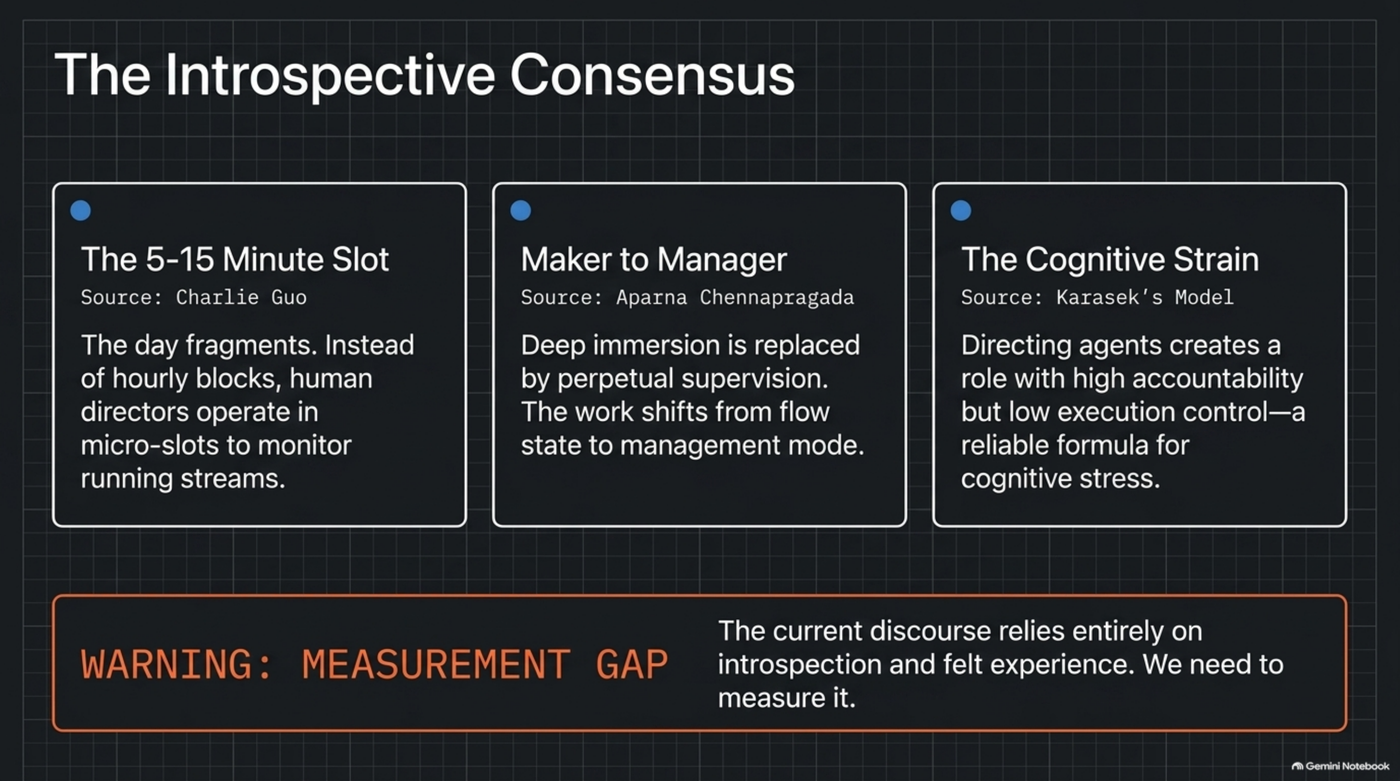
So: the obvious version of this post exists, several times over, and four independent arrivals at the same framing within a few months is itself evidence the shift is real. What none of them has — Guo comes closest and says so — is measurement. Every piece in this list argues from capability curves, introspection, or tooling experience. None puts a number on what a sustained directing practice actually looks like from the outside. That's the gap this post and its sibling try to fill, and it's also why the sibling's dataset matters more as a limit than as a headline.
The objection: interruption science says this shouldn't work
Now the harder check. There is a real research literature on what task-switching does to humans, it is decades deep, and a fair reading of it sounds like a refutation of everything above.
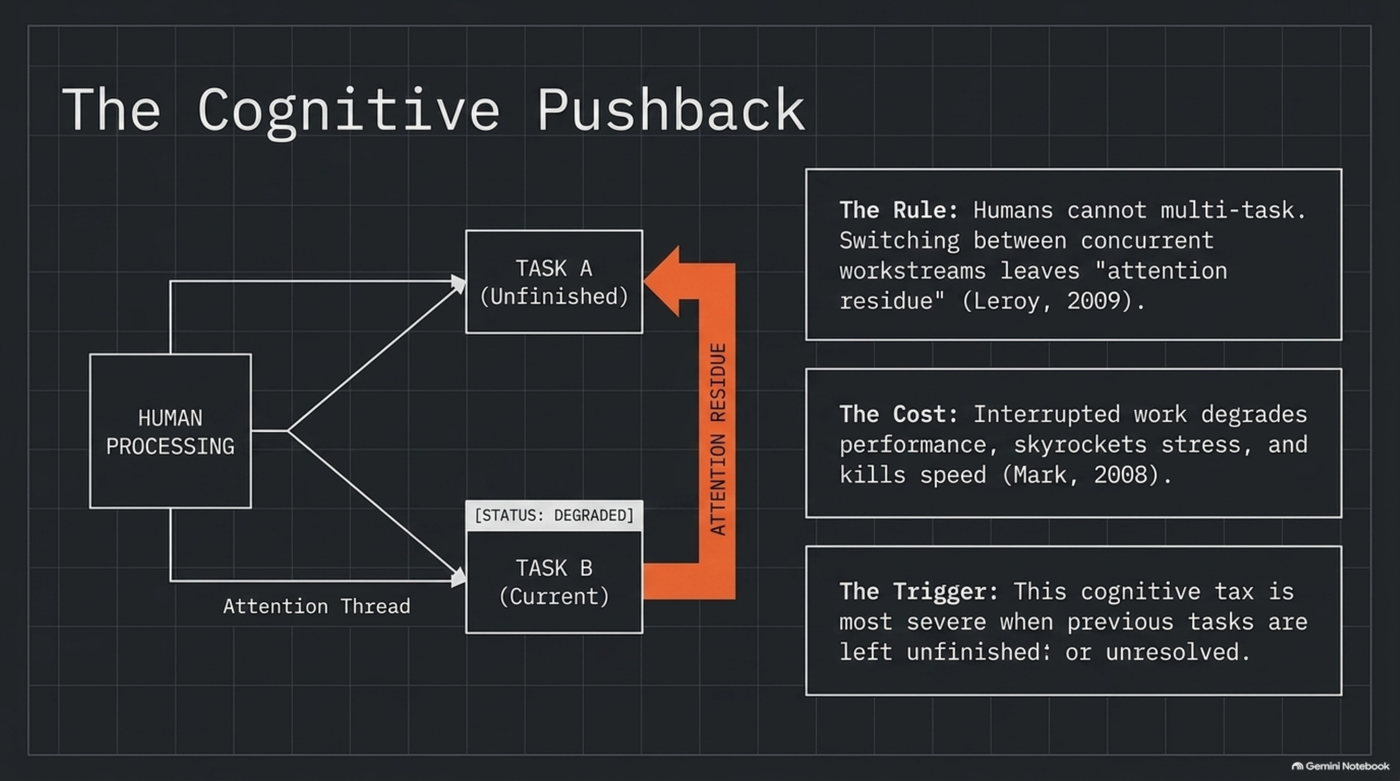
Gloria Mark's field studies at UC Irvine are the anchor. Her CHI 2008 paper with Gudith and Klocke, The Cost of Interrupted Work: More Speed and Stress, found something more interesting than the folklore version: interrupted workers actually completed tasks faster — they compensated — but paid for it in significantly higher stress, frustration, time pressure, and effort. Her earlier observational work found information workers switching activities every few minutes, and that interrupted work is rarely resumed directly; on average people pass through two intervening tasks before returning. Sophie Leroy's 2009 paper, Why is it so hard to do my work?, named the mechanism attention residue: when you switch from task A to task B, part of your attention stays with A — especially when A is unfinished or time-pressured — and performance on B measurably degrades.
One honesty detour, because this site cares about provenance: the most famous number in this literature — "it takes 23 minutes and 15 seconds to recover from an interruption," cited everywhere from productivity blogs to engineering-leadership newsletters — appears in none of Mark's papers. A careful trace by an independent blogger went through the primary sources and found the figure only in interviews and press quotes, never in a peer-reviewed publication; the papers themselves report recovery-adjacent measures in the 11–16 minute range, without the false precision. The lesson is not that interruption costs are fake — the peer-reviewed findings are solid. The lesson is that even a real literature accretes folklore numbers, and you should ask for the primary source. (Practitioners quoting productivity multipliers, myself formerly included, please take the point.)
Folklore trimmed, the genuine tension stands: switching costs are real, residue is real, and a day of hopping between five agent workstreams sounds like a maximally interruption-driven day. Chennapragada's warning lands squarely here. If directing parallel agents were multitasking, the science says it should feel fast and grind you down.
The resolution was formalized twenty years ago
Here's the thing I did not expect to find when I went looking, and the most useful single result of this whole search: the question "how many autonomous workers can one human effectively direct?" is not new. It has a twenty-year-old research literature with measured answers — it's just filed under robotics.
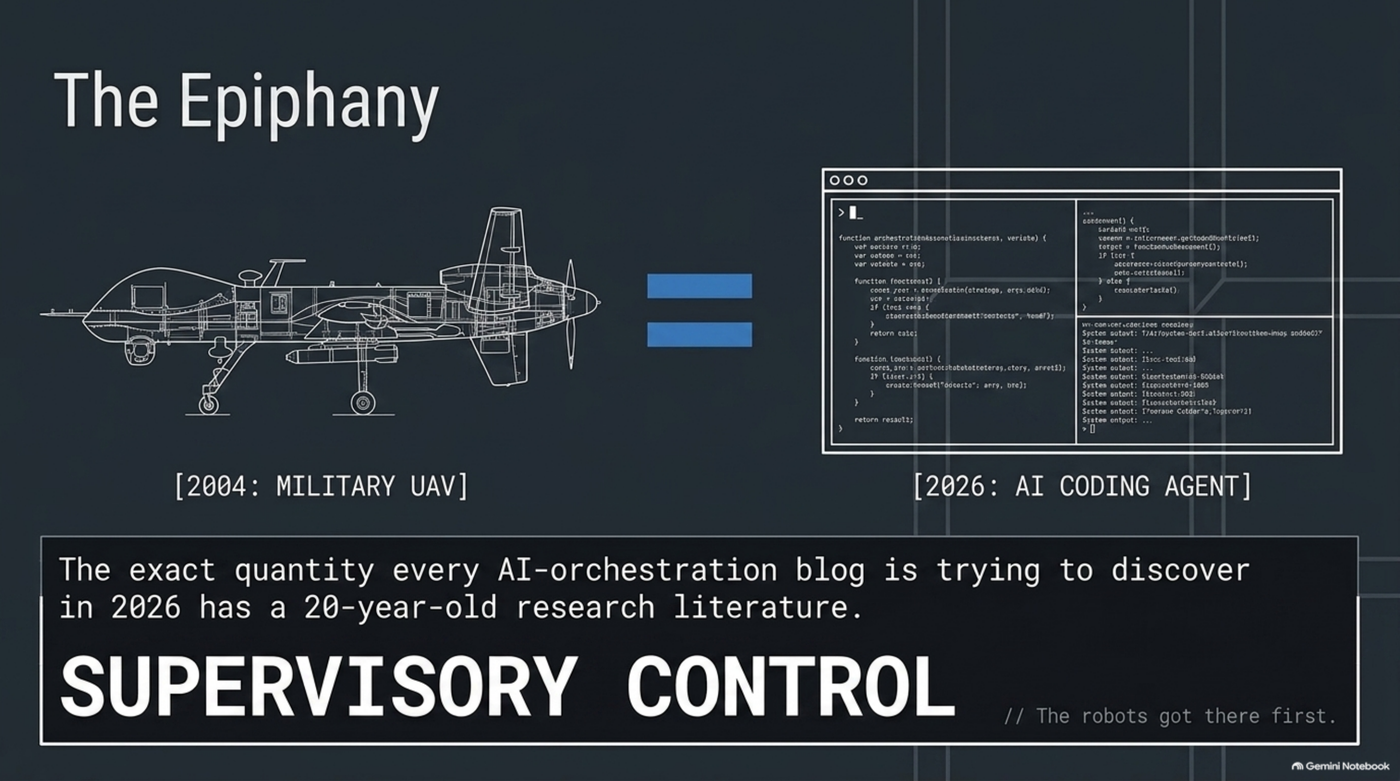
In human-robot interaction research it's called fan-out. Olsen and Wood's CHI 2004 paper, Fan-out: Measuring Human Control of Multiple Robots, building on Goodrich and Olsen's interaction metrics, formalized it: a robot has a neglect time (how long it operates acceptably without human attention) and an interaction time (how long the human must engage to service it). The number of robots one operator can supervise — the fan-out — grows with the ratio of neglect time to interaction time.
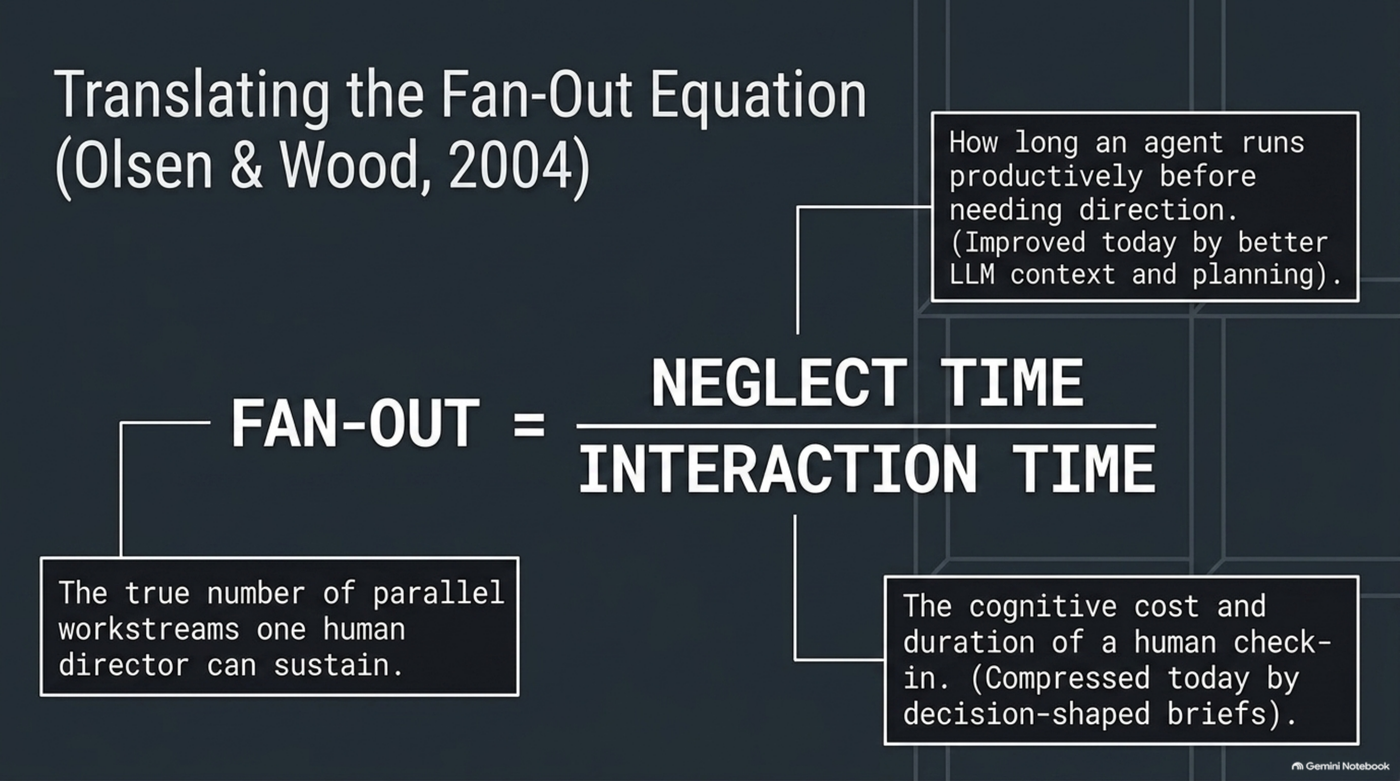
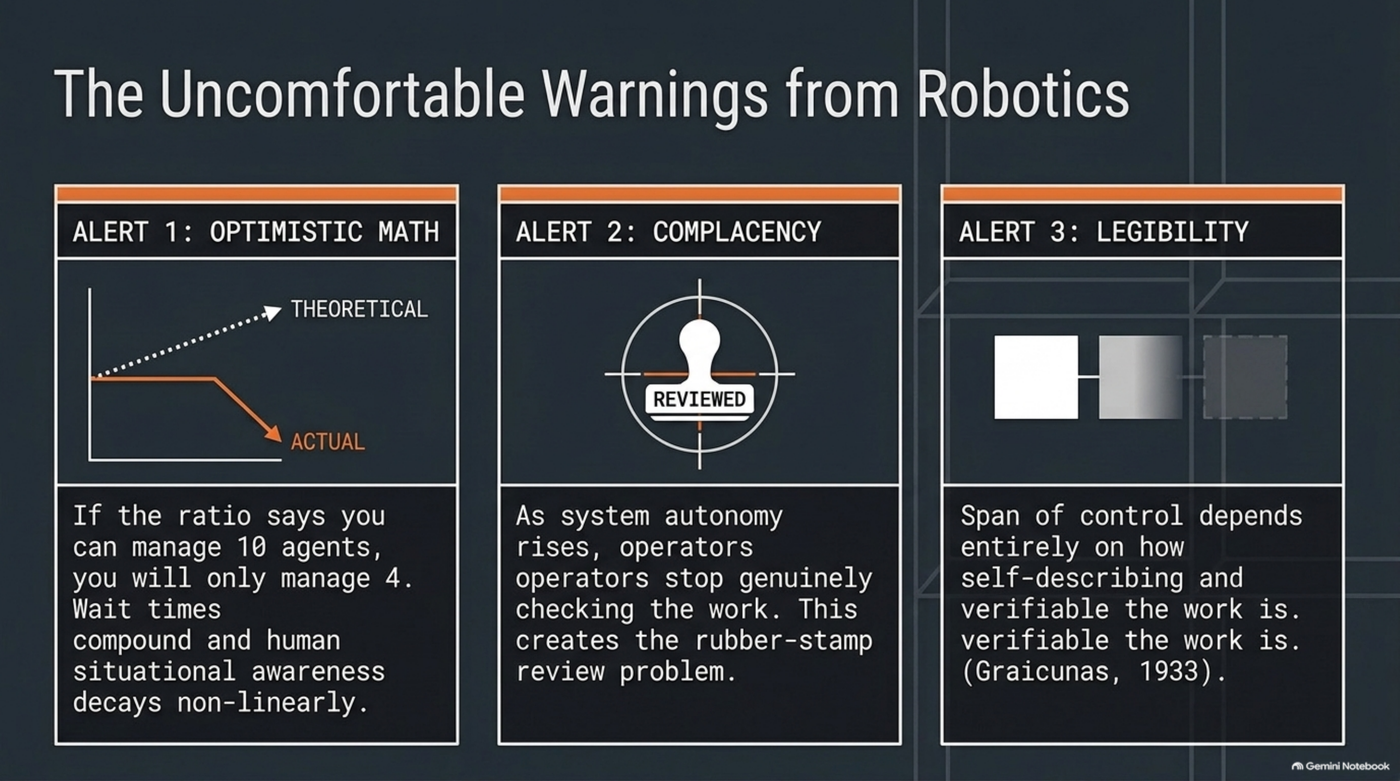
A whole applied literature followed, much of it from Missy Cummings's work on UAV supervision, extending the model with wait times, workload spikes, and the ways it breaks — because it does break, at exactly the failure modes any agent-runner will recognize: everything needing attention at once, alert fatigue, the operator losing track of which unit is blocked.
This literature dissolves the apparent contradiction with the interruption science, because supervisory control is not multitasking. The operator is not attention-splitting across five units simultaneously — they are sequentially servicing autonomous workers: full attention on one check-in, then the next. The parallelism lives in the fleet; the human remains serial. Mark and Leroy studied what happens when a task interrupts another task and attention must drag itself away mid-thread. A check-in against async work you delegated is a different operation: the thread you return to isn't in your head, it's externalized in the agent's state, which is exactly what makes resumption cheap. The switching cost doesn't vanish — every check-in boundary is still a switch, and Leroy's residue applies when a review leaves you uneasy and half your attention trails after it into the next slot. But the cost is amortized: paid per service interval, against work that advanced while you weren't looking, instead of paid per interruption against work that stopped when you did.
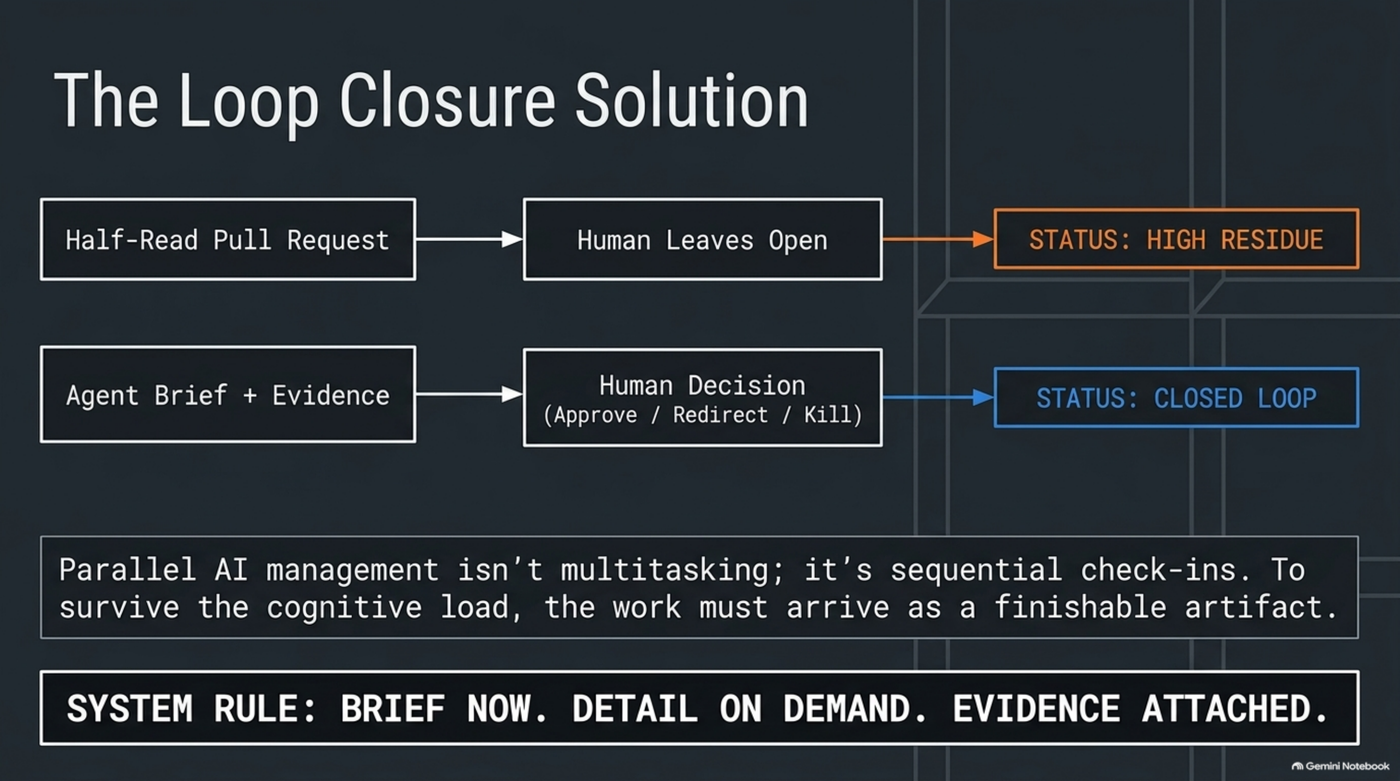
And the fan-out formula tells you precisely where the pattern collapses, which matches what I reported in The Third Schedule from the practice side: when interaction time balloons — an agent returns something large and consequential, where skimming would be negligent — the ratio craters, and the honest unit of engagement becomes the half-day again. Graham's essay reasserts itself at exactly the moments the servicing model predicts it should.
There's even an older antecedent. Management science has asked "how many reports can one person oversee?" since V.A. Graicunas computed in 1933 that relationship complexity grows geometrically with each added subordinate, and prescribed four to five — a number that classical span-of-control theory carried for decades before modern practice stretched it toward 8–15 for experienced, self-managing teams. Squint, and the concepts rhyme: self-managing reports are high-neglect-time workers. The practitioner consensus of three to eight parallel agents, straining at four, is Graicunas's range rediscovered by people who have never heard of him.
Now: the limit
So the field says the shift is real (four independent framings), the cognitive science permits it (as sequential servicing, not multitasking), and two older literatures predict a bounded fan-out set by the neglect-to-interaction ratio. What the field mostly doesn't have is a measured data point from a sustained real practice. Here is the one I can offer, from The Third Schedule — 9,806 commits across 183 repos over eight months, cut into gap-defined sessions — used here the way a boundary condition should be used: against the claims, in both directions.
Against "AI collapsed time itself": in the most parallel sustained practice I can document, 51.6% of working sessions touch two or more repositories, and 12.7% touch five or more — and those raw counts deserve a stress test before anyone leans on them. Re-scoring every commit for complexity — stripping out merges, scripted rollouts, doc-and-chore traffic, and trivially small diffs — moves the numbers to 42.2% and 5.2%: the multi-repo finding mostly survives strict scrutiny (four in five of those sessions still carry substantive work in two or more codebases), while the five-plus figure roughly halves. The most extreme real day — July 14 — needs the same honesty most of all. I had framed it as sustained work (three-plus commits each) landing in 44 repositories; complexity-scoring shows that 146 of the day's 205 commits were a single platform change, designed once and rolled out fleet-wide by script, and the genuinely substantive parallel threads that day numbered eight or nine. The corrected number is a cleaner boundary than the inflated one: eight or nine real threads is still a genuinely broken singular-maker assumption, and it is nowhere near time collapsing — and the mechanical/substantive split is the fan-out formula operating in the wild, breadth scaling exactly where per-task attention demand drops toward zero while the judgment-heavy core stays small. The rhythm still starts around 07:00 and stops by 23:00, and only 2.6% of commits happen overnight — neglect time, in this practice, is bounded by one human being awake, because the servicing is. Fleets of a hundred agents are technically launchable; nothing in my data suggests one director can absorb anything like that, and the fan-out literature explains why.
Against "AI makes developers slower": the METR randomized controlled trial (July 2025) deserves its prominence — 16 experienced open-source developers, 246 tasks on repos they knew deeply, measured 19% slower with early-2025 AI tools while believing themselves 20% faster.
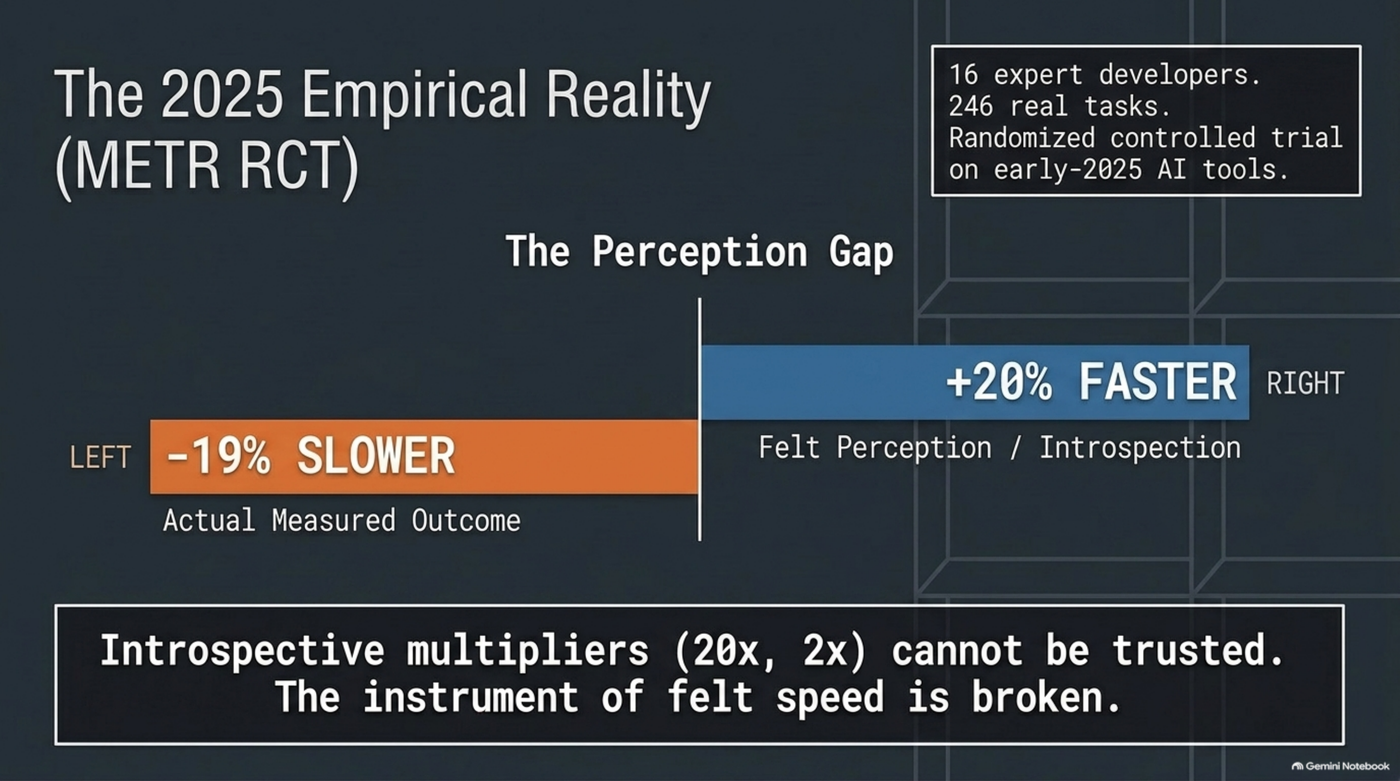
It's the best-designed study in this space and a permanent rebuke to vibes-based multipliers. But note what it measured: a single human in the loop of a single task, synchronously assisting. That's an interaction-time-dominated configuration — the setting where the fan-out ratio is at its worst. My data measures a different configuration: many async workstreams, human servicing sequentially. The two results don't contradict each other; they bracket the design space. And the honest connective tissue is the line I'll keep repeating: my own once-quoted 20x remains unmeasured. Commit timestamps prove parallel structure exists and show its shape. They do not prove a productivity multiplier, and after METR, nobody should accept one without a design at least that careful.
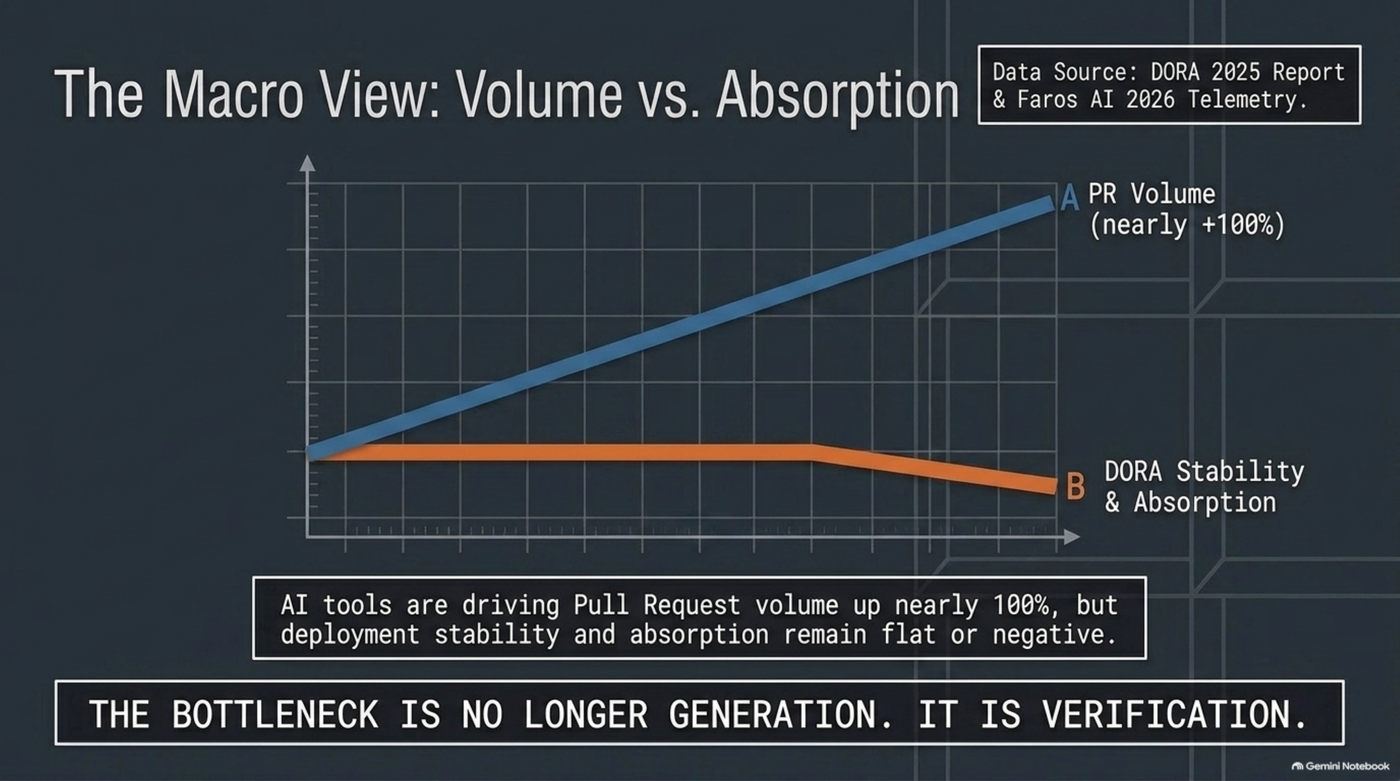
Against nothing, but worth the anchor: the 2025 DORA report found ~90% of respondents using AI at work, throughput now positively correlated with AI adoption — and delivery instability elevated alongside it, with about 30% reporting little or no trust in AI-generated code. Acceleration exposing weaknesses downstream, absorbed by teams whose verification capacity didn't scale with their generation capacity: that is the absorption problem from The Third Schedule showing up at industry scale, in someone else's data.
What a sample of one is for
Let me be exact about the epistemics, because the whole design of this post depends on it. One practitioner's commit history — my work, my choice of work, agents I configured, a portfolio unusually amenable to parallelism — cannot establish what is typical, cannot measure a multiplier, and cannot promise the pattern survives contact with a team of forty or a regulated codebase. That is why it appears here as a limit and not as proof. What real, verified, specific data from one practice can do is discipline a conversation that currently runs on capability curves and introspection: it shows that the parallel-director pattern exists outside anecdote, that its measured shape (half of sessions parallel in the raw count and just over two-fifths after complexity-scoring, five-plus substantive streams in about one session in twenty, eight or nine genuine threads on the most extreme day, zero overnight miracle) sits comfortably inside what supervisory-control theory predicts and practitioner consensus reports — and far below what the more excited corners of the conversation imply. When someone claims more, ask for their timestamps. When someone claims it's all slowdown, ask which configuration they measured.
Graham gave us the two human schedules and the economics of a scarce, fragile attention block. The agent era's first wave of commentary announced the block's obsolescence; its best study announced the opposite. The literature that actually fits is older and humbler than both: autonomous workers, sequential servicing, and a ceiling set by the ratio of how long your workers can be usefully ignored to how long it takes you to judge what they did. Raise the first, lower the second — that's the entire design program, and it's why evidence-attached briefs and earned-autonomy oversight are schedule technology, not just governance. The maker's afternoon was never the last scarce thing. It was just the first one we named.
Co-authored with Claude, which did the literature search this post is built on; the framing, the practice, and the dataset are Totto's. The commit-level findings cited here are published in full in The Third Schedule and were not re-derived for this post. The external survey reflects an August 2026 search — the field moves fast, and prior art beyond the four pieces found here may well exist.
Sources:
- Maker's Schedule, Manager's Schedule — Paul Graham, July 2009
- How AI Collapsed the Maker–Manager Schedule — Shobhana Viswanathan, October 2025
- The AI Manager's Schedule — Charlie Guo, January 2026
- Every Maker Is Now a Manager (of AI) — Aparna Chennapragada, February 2026
- The Attention Bottleneck: Managing 10 AI Coding Agents at Once — Voxos, February 2026
- The Complete Guide to Running Parallel AI Coding Agents — Superset
- How to Run 3 to 8 Coding Agents in Parallel Without Losing Track — Agents Room
- The Code Agent Orchestra — Addy Osmani
- The Cost of Interrupted Work: More Speed and Stress — Mark, Gudith & Klocke, CHI 2008
- Why is it so hard to do my work? The challenge of attention residue when switching between work tasks — Sophie Leroy, Organizational Behavior and Human Decision Processes, 2009
- Interruptions cost 23 minutes 15 seconds, right? — oberien, November 2023 (provenance trace of the folklore figure)
- It takes 23 mins to recover after an interruption — Addy Osmani (example of the figure in circulation)
- Fan-out: Measuring Human Control of Multiple Robots — Olsen & Wood, CHI 2004
- Metrics for Evaluating Human-Robot Interactions — Goodrich & Olsen, 2003
- Beyond Robot Fan-out: Towards Multi-operator Supervisory Control — Whetten, Goodrich et al.
- The Span of Control and the Formulas of V.A. Graicunas — Fred Nickols
- Span of control — Wikipedia
- Measuring the Impact of Early-2025 AI on Experienced Open-Source Developer Productivity — METR, July 2025
- Announcing the 2025 DORA Report — Google Cloud
- The Third Schedule — wiki.totto.org, August 2026
Series: The Third Schedule
← The Third Schedule: A Field Survey · Part 4 of 5 · The Negative Control →