The Robots Got There First
Earlier today I published The Third Schedule — an argument that the quiet assumption under Paul Graham's Maker's Schedule, Manager's Schedule has broken: maker time is no longer singular. That post argued from the inside out — one practitioner's commit record, 9,806 commits across 183 repositories, used to show that multiple simultaneous threads of real building under one human director is a thing that measurably exists.
A fair reader should have two objections ready. First: one practitioner's git log is not a literature. Second: hasn't a rather large body of cognitive science spent decades establishing that humans are bad at exactly this — that multitasking is mostly an illusion with a well-documented price tag? If the research says context switching is expensive and attention doesn't split, then "builder time has become parallelizable" needs to explain itself, not just point at a busy July.
This post is the opposite motion: out into the field. I went looking for three things — whether someone has already written the AI-age update to Graham's essay (spoiler: several people have, and they deserve engagement rather than silence); whether the cognitive science actually forbids the working pattern I described (it doesn't, but the reconciliation is narrower and more interesting than I expected); and what the measured 2025–2026 record says about how far any of this scales. The most useful thing I found was in none of the places I expected. It was in robotics — a twenty-year-old research literature on single operators supervising fleets of semi-autonomous vehicles, with a formula, failure modes, and a name for the exact quantity every agent-orchestration blog post is currently rediscovering. The robots got there first.
Throughout, our own dataset plays a specific and deliberately limited role: not as the primary evidence — the external literature is the subject here — but as the limit-setter. Where the broader conversation makes claims about achievable parallelism and plausible multipliers, one real, measured practice provides a concrete ceiling to check them against. A sample of one can't confirm a trend. It can absolutely bound a hype curve.
Someone already wrote this post. Several someones.
Honesty first: the idea of updating Graham's essay for the agent era is not novel, and pretending otherwise would be the kind of move this wiki exists to avoid.
The best-argued version I found is Charlie Guo's The AI Manager's Schedule (January 2026). Guo's update: where Graham's manager ran on hour-sized slots, the human directing AI runs on 5-to-15-minute slots — the day fragments further, because the unit of human contribution shrinks from implementing to specifying and judging. He's clear-eyed about the cost side: multiple delegated tasks run simultaneously at near-zero marginal cost, but the constant switching between monitored streams carries real cognitive strain, and he flags the emerging evidence that AI assistance can slow down experienced developers rather than speed them up.
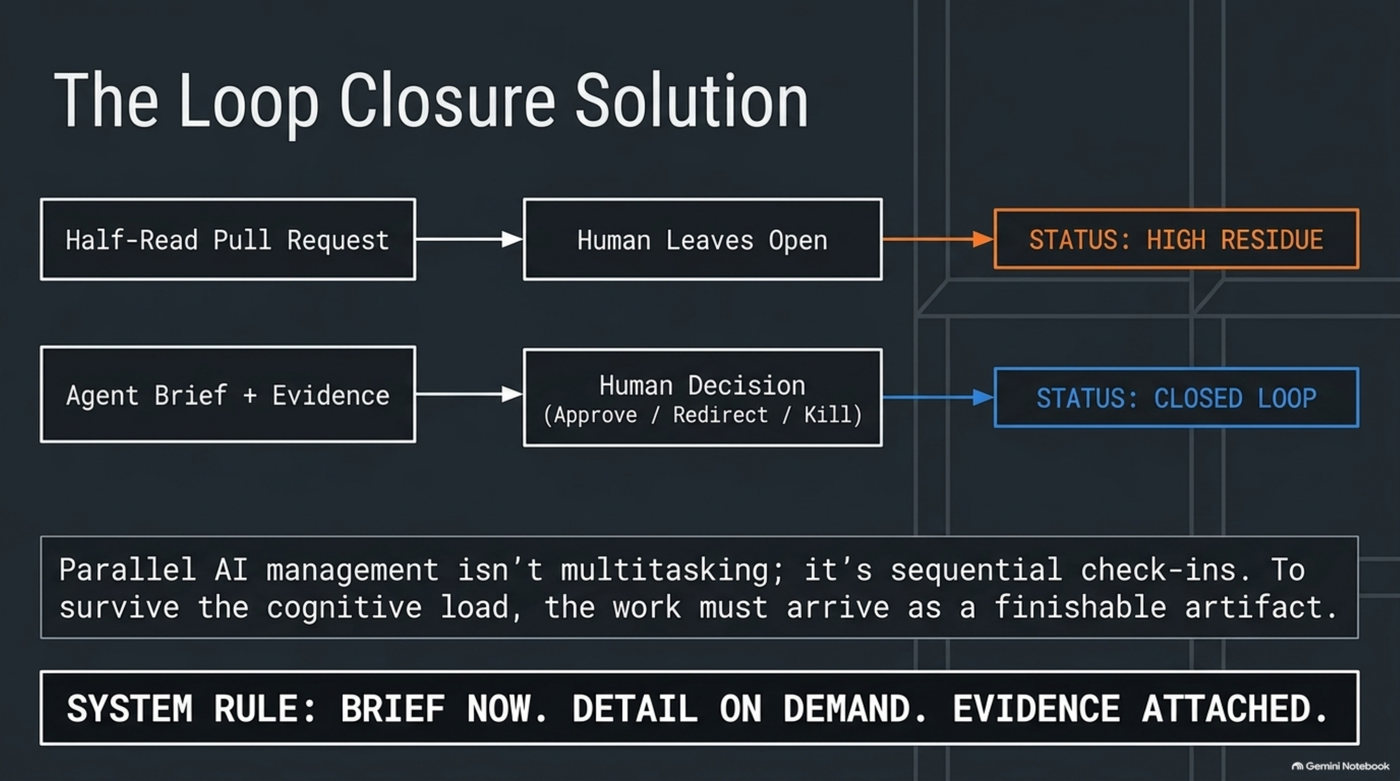
The most psychologically serious version is Aparna Chennapragada's Every Maker Is Now a Manager (of AI) (February 2026). Her frame: working with agents structurally pulls makers into management mode — supervision instead of immersion — and she reaches for Karasek's demand-control model to explain why it feels bad: roles with high accountability and low execution control reliably produce cognitive strain, and directing agents is exactly that role. Her proposed fix is an interface one — work should arrive as "artifact rather than running commentary," so the human evaluates rather than perpetually supervises. That is, convergently, the same conclusion The Third Schedule reached as "brief now, full detail on demand, evidence attached." When two people argue from different premises to the same design, that's worth noting.
Beyond those two there is a steady stream of essays in the same key — How AI Collapsed the Maker–Manager Schedule, The New Maker Schedule Isn't About Making, and more arriving monthly. The genre is real.
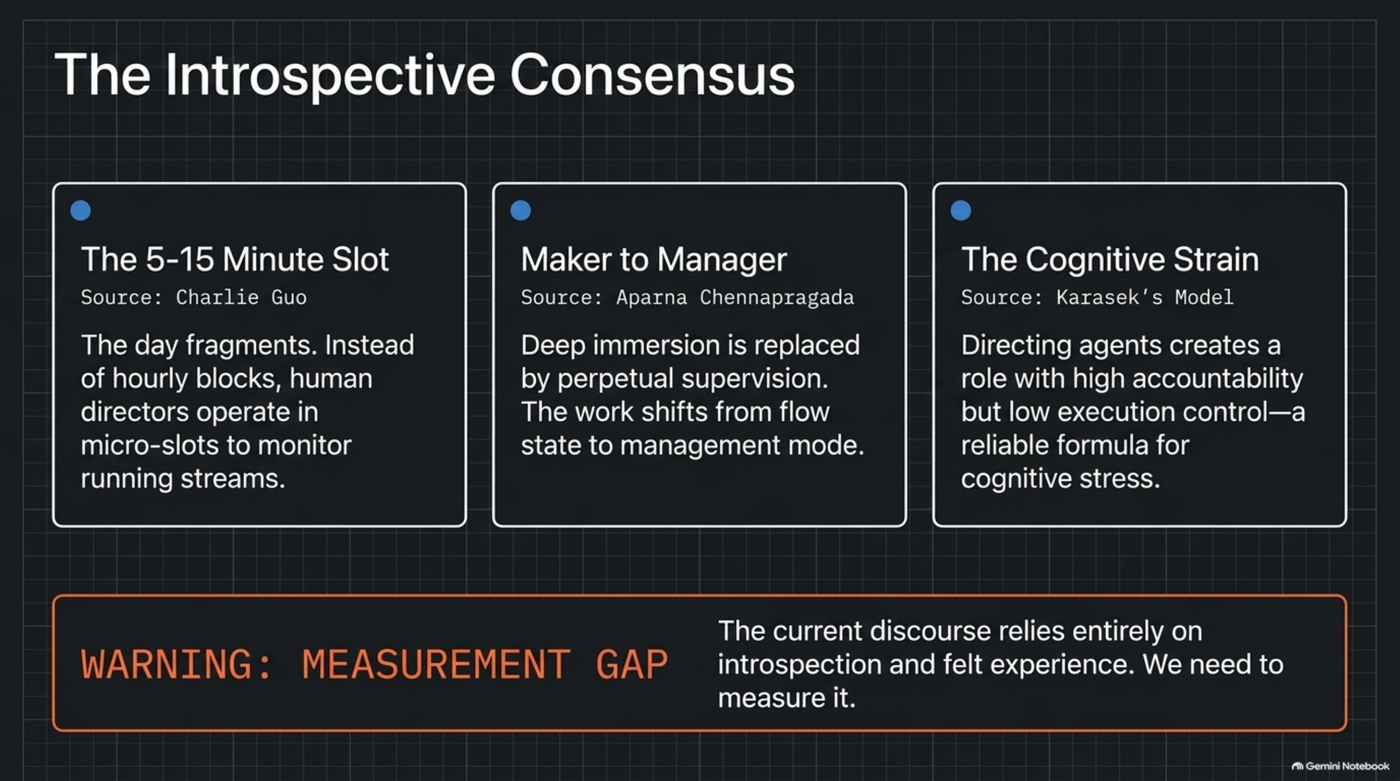
So what does The Third Schedule add that this genre hasn't already said? Two things, I think, and I'll state them carefully because "my take is different" is what everyone in a crowded genre says. First: the existing pieces argue from the human's seat — the maker's day fragments, the maker becomes a manager, the strain is real. The Third Schedule's core claim is about the unit of maker time itself — that the thing Graham treated as inherently singular now runs plural, which is a claim about the work, not the worker, and it survives even if the human's day turned out pleasant. Second, and more simply: none of these pieces measure anything. They are all argued from introspection and anecdote — good introspection, but the genre runs entirely on felt experience. The one thing our companion post contributes to this conversation is a dataset, and this post's job is to put that dataset in context.
Doesn't the cognitive science forbid this?
Now the harder objection. There is a substantial, decades-deep literature on what task switching costs humans, and anyone claiming "parallel builder time" owes it a direct look rather than a wave.
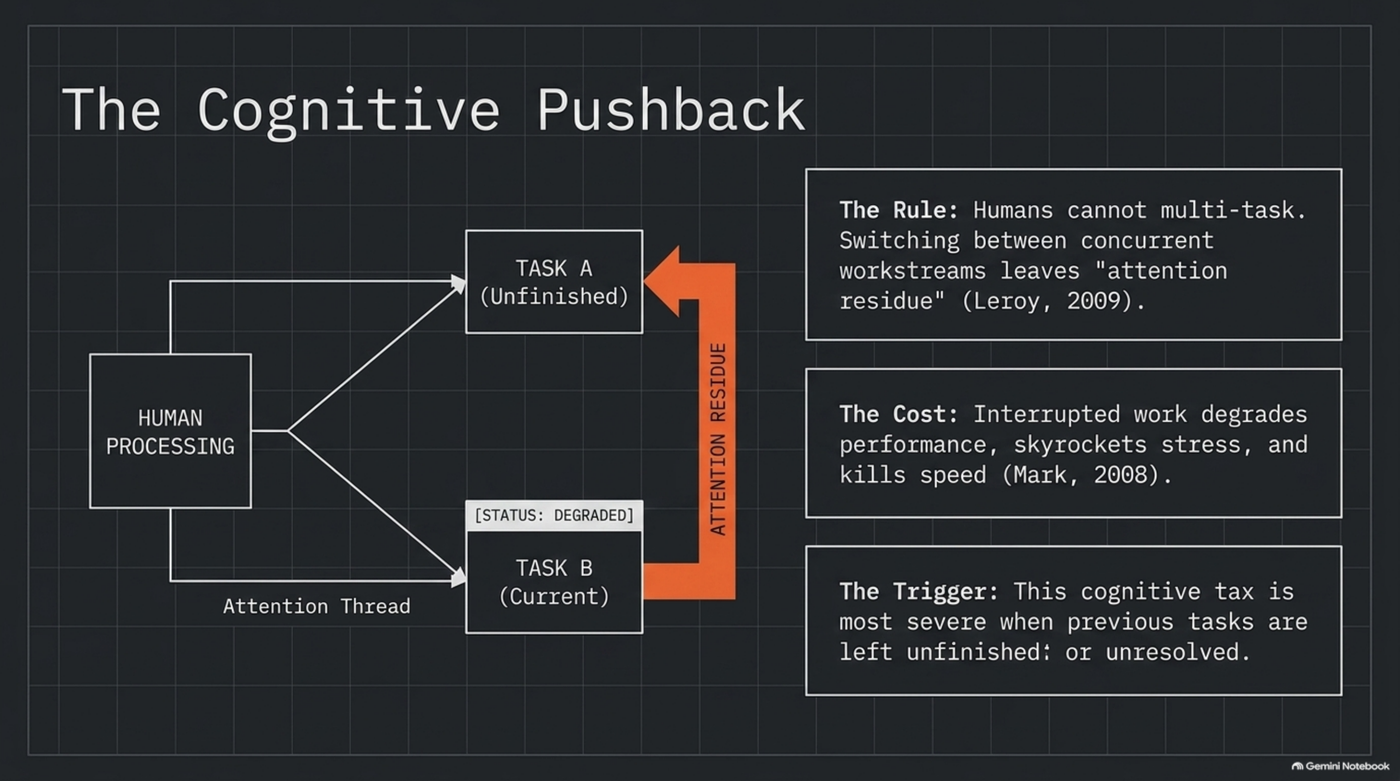
The canonical findings. Gloria Mark's group at UC Irvine put observers behind information workers and later ran controlled interruption experiments; the famous 2008 paper, The Cost of Interrupted Work: More Speed and Stress, found that interrupted workers actually complete tasks — faster, even — but at measurably higher stress, frustration, and effort. Sophie Leroy's 2009 work named attention residue: when you switch tasks, part of your attention stays with the previous task, and your performance on the next one suffers — worst of all when the previous task is unfinished. This literature is real, replicated in its essentials, and I'm not going to argue with it.
One sharp-edged detail, though, because it's instructive. The most-quoted number in this entire field — "it takes 23 minutes and 15 seconds to recover from an interruption" — turns out to be untraceable to any published paper. A careful attempt to source it found it exists only in interviews and press coverage; the published studies report different, vaguer, mostly smaller numbers, and the famous CHI paper never measures recovery time at all. I flag this not to dunk on Mark — her actual published findings stand — but because it's the same disease The Third Schedule diagnosed in the 20x productivity multiplier: a vivid number, repeated until it becomes load-bearing, resting on nothing but its own circulation. The interruption literature's most famous statistic and the agent discourse's most famous multiplier share an epistemic status: gut numbers in lab coats.
So: how is "builder time parallelizes" compatible with a literature that says human attention doesn't split? The resolution — and I went looking for reasons to reject it, because it sounds convenient — is that the claim never involved attention splitting. At any given instant in the working pattern The Third Schedule describes, the human holds exactly one thread. The parallelism lives in the agents: the workstreams execute concurrently while unattended, and the human performs short, sequential check-ins against them. Cognitively, that's not multitasking. It's much closer to what the human-factors field calls supervisory control — a different operation, with its own literature, which I'll get to in a moment, because it's the interesting one.
But intellectual honesty requires the next sentence too: sequential check-ins are still task switches, and Leroy's residue applies to every one of them. The pattern doesn't escape the switching literature; it renegotiates terms with it. And Leroy's own findings say exactly which term matters most: residue is worst when the prior task is left open. A check-in that ends in a closed decision — approve, redirect, kill — is engineered to be finishable in a way that a half-read pull request is not. That is what "brief now, detail on demand, evidence attached" is for, read through this lens: it converts the day from a pile of open loops into a sequence of closures, which is precisely the structure the residue research says humans can survive. I want to be exact about the epistemic status here: this reconciliation is consistent with the published literature, but nobody has run Leroy's paradigm on agent check-in workflows. It's a well-grounded hypothesis, not a finding.
The robots got there first
Here's the discovery that reframed this post for me. The question every agent-orchestration article is currently groping toward — how many parallel semi-autonomous workers can one human effectively direct? — has a twenty-year-old research literature with a formula, and it comes from robotics.
In 2004, Olsen and Wood published Fan-out: Measuring Human Control of Multiple Robots, defining fan-out as the number of robots a single operator can usefully control, and modeling it as a ratio: roughly, how long a robot can run productively without attention (neglect time, or activity time) divided by how long the operator needs to service it (interaction time). Crandall and Cummings and the MIT Humans and Automation Lab spent the following decade refining this for operators supervising multiple UAVs — adding the terms the simple ratio misses: queueing (a vehicle that needs you while you're servicing another waits, and the waiting costs), loss of situation awareness as the fleet grows, and operator complacency as autonomy increases.
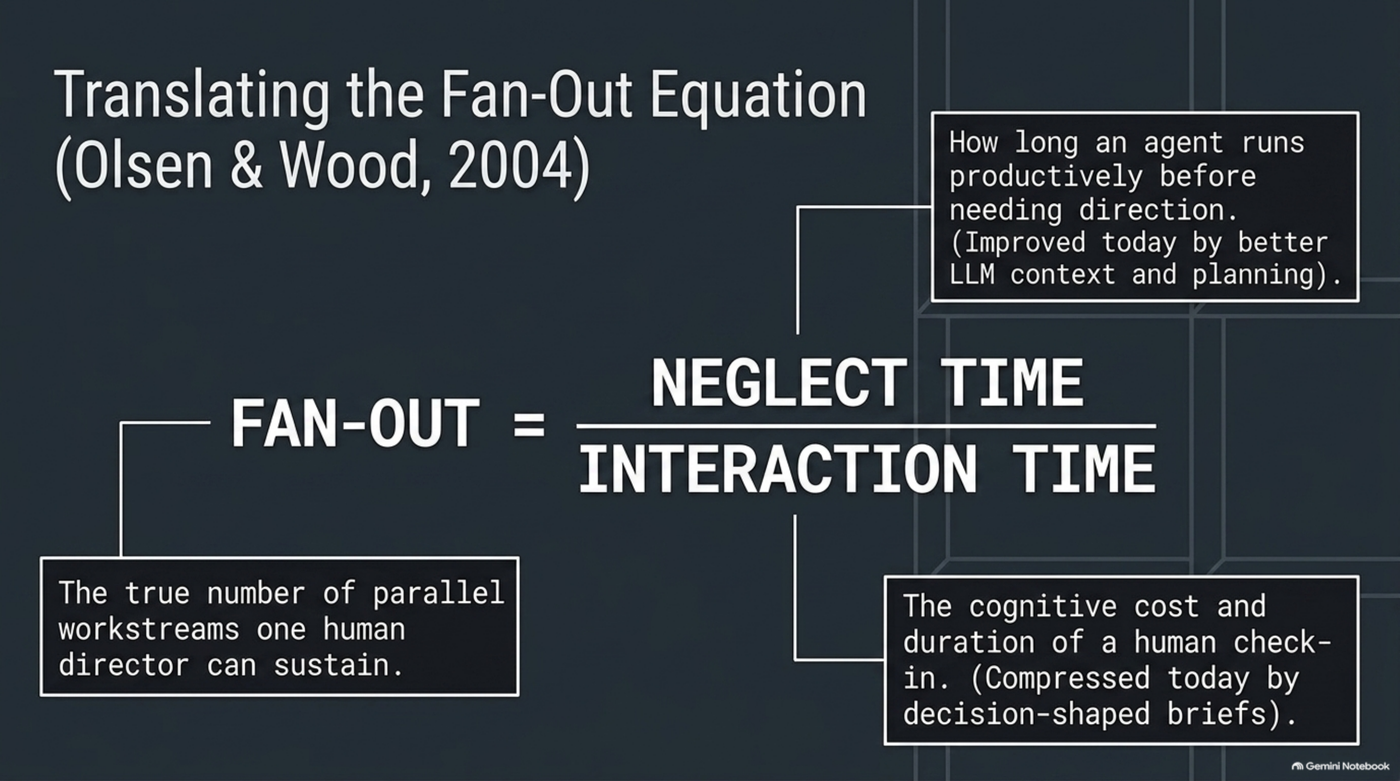
Substitute "agent" for "robot" and every term maps. Neglect time is how long a coding agent runs usefully before it needs direction — extended, in current practice, by better planning, better context, better self-recovery. Interaction time is the cost of a check-in — compressed by decision-shaped briefs with evidence attached. Fan-out is the number of parallel workstreams one director can sustain, and the entire agent-tooling ecosystem is currently, mostly unknowingly, rebuilding the instrumentation this literature already specified.
Two of the field's hard-won warnings transfer directly, and they're the uncomfortable ones. First: naïve fan-out predictions are systematically optimistic — the ratio says ten, the operator manages four, because wait times compound and situation awareness decays nonlinearly with fleet size. Anyone extrapolating agent parallelism from the cheerful arithmetic of "each agent only needs me five minutes an hour" is re-deriving the mistake this literature spent a decade correcting. Second: increasing autonomy raises fan-out and breeds complacency — the operator stops genuinely checking. In the agent world that failure mode has a name too; it's what happens when review becomes rubber-stamping, and it's the exact problem graduated-oversight designs (including our own) exist to manage.
Management science ran a parallel track, older still. Graicunas's 1933 analysis of span of control argued from combinatorics — relationships grow far faster than headcount — to a recommended four-to-five direct reports; later empirical work found successful organizations running spans with a median around ten, and the field eventually settled on the sensible resolution: there is no magic number, because span depends on the supervision cost per report, which depends on the nature of the work and how self-describing it is. That last clause should sound familiar. Lowering supervision cost per workstream by making the work legible — evidence attached, checkable rather than merely readable — is the entire absorption argument, discovered independently by management theorists a century ago.
What the 2025–2026 measurements actually say
Against that theory backdrop, the current empirical record — thin, fast-moving, and worth stating precisely.
The most rigorous single result is negative. METR's randomized controlled trial (arXiv, July 2025): 16 experienced open-source developers, 246 real tasks in repositories they knew deeply, randomized to allow or disallow early-2025 AI tools. Result: 19% slower with AI — while the developers themselves estimated, afterward, that AI had made them 20% faster. Forecast before: +24%. Belief after: +20%. Measurement: −19%. That perception gap is, to my mind, the single most important finding in this entire field, because it invalidates the instrument every practitioner essay (including ours) is written with: felt speed. If sixteen careful experts can misread a one-fifth slowdown as a one-fifth speedup, no one's introspective multiplier — not 20x, not 2x — deserves the benefit of the doubt.
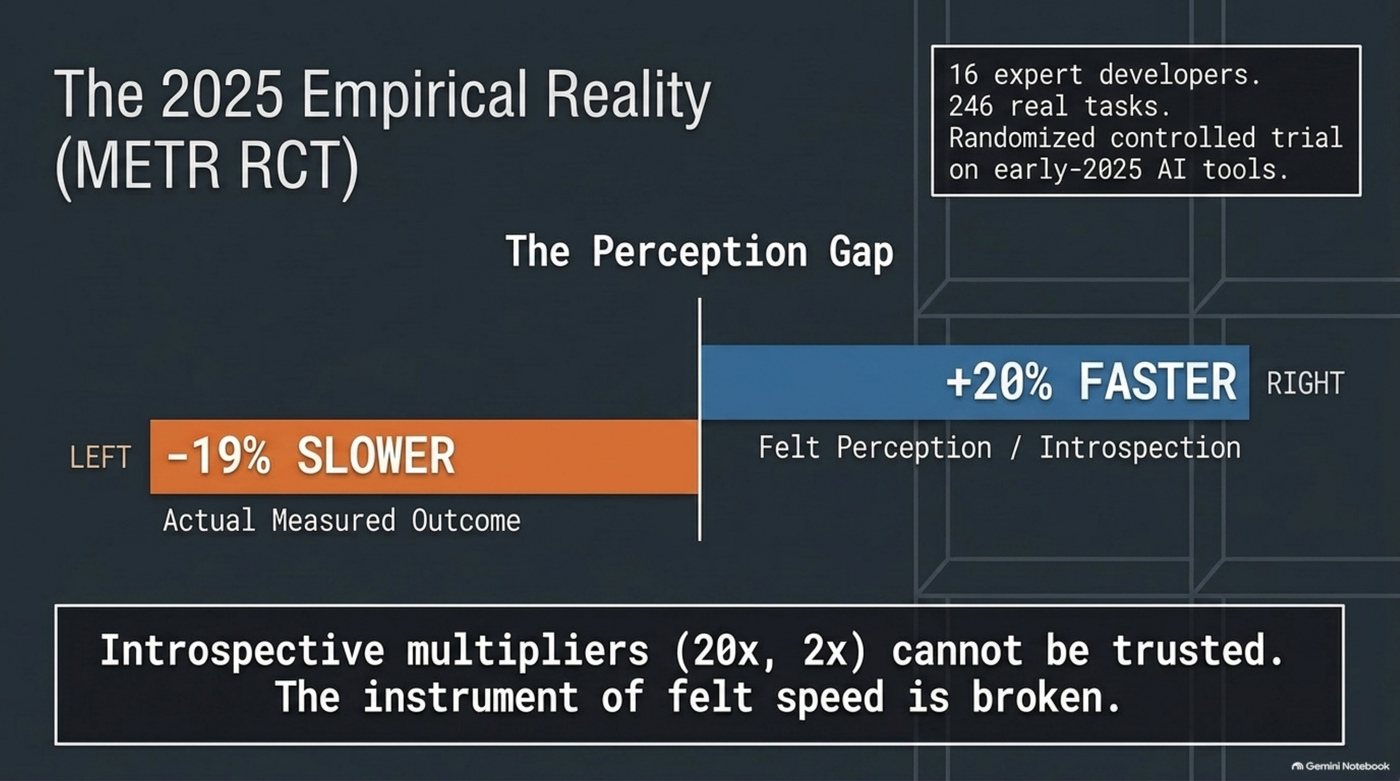
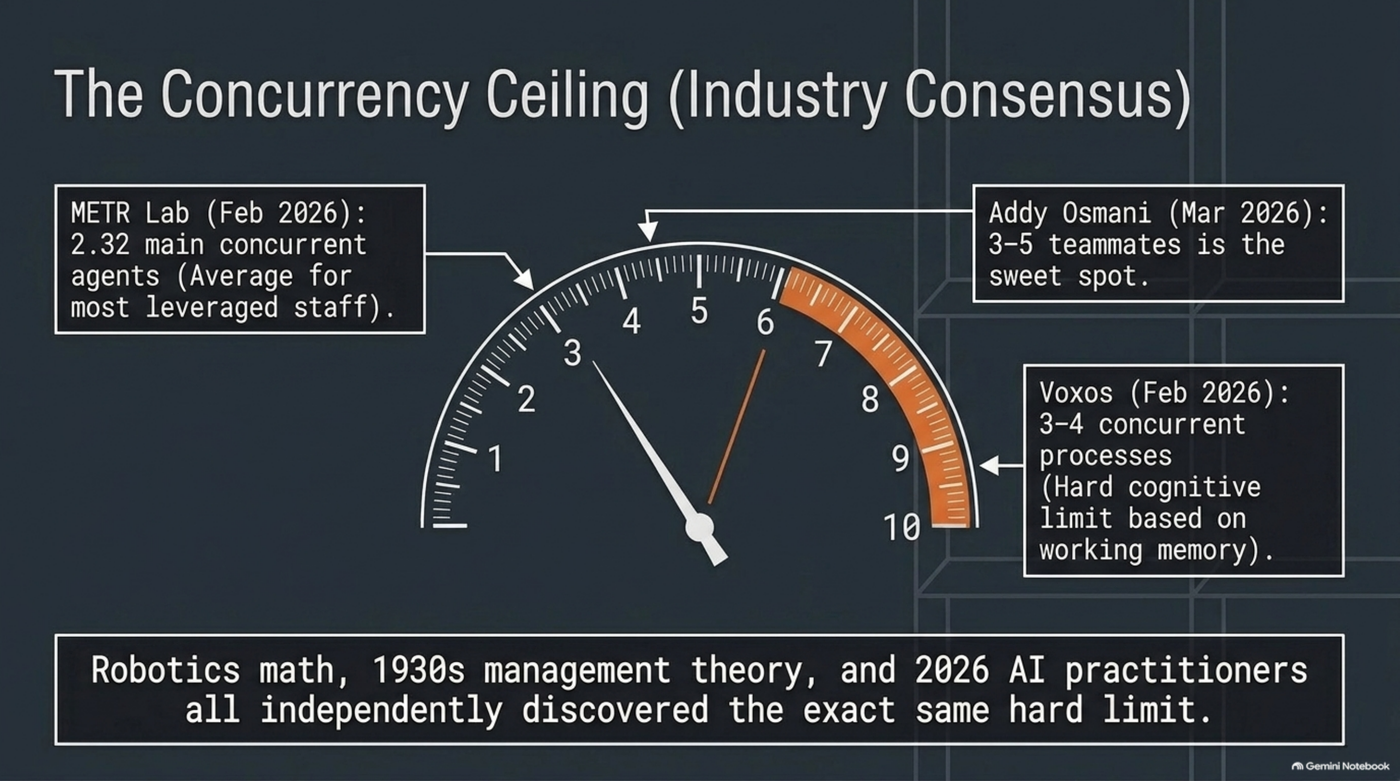
But the instrument's scope matters. The RCT tested single-threaded assistance — one developer, one task at a time, early-2025 tooling. METR's own February 2026 follow-up note analyzed 5,305 Claude Code transcripts from seven of their technical staff and estimated time-savings factors of roughly 1.5x to 13x on AI-assisted tasks — explicitly labeled "a soft upper bound," with a caveat list the authors deserve credit for: task substitution toward lower-value work, selection effects, an LLM judge with thin validation. Two details matter for this post. Higher agent concurrency correlated with higher savings — and METR now says their own RCT's one-task-at-a-time design "may understate AI's potential impact," with future studies needing to allow parallel work. And the concurrency their most-leveraged staff member actually ran, averaged over a month? 2.32 main agents. Hold that number.
Aggregate industry data shows the absorption problem at population scale. The 2025 DORA report found AI adoption positively correlated with delivery throughput (reversing 2024) but still negatively correlated with stability — more change failures, more rework. Faros AI's telemetry, as reported in a 2026 roundup, showed PR volume per developer nearly doubling with no measurable improvement in DORA metrics — volume up, absorption flat. And the 2025 Stack Overflow survey is a useful humility check on how frontier any of this is: 84% of developers use or plan to use AI tools, but trust in their accuracy keeps falling, and roughly half of respondents weren't using agents at all. The working pattern discussed on this wiki is a leading edge, not the median — anyone writing about it (me included) should say so.
Practitioner convergence is remarkably tight. Addy Osmani's The Code Agent Orchestra (March 2026): "3–5 teammates is the sweet spot," and — his emphasis — "the bottleneck is no longer generation. It's verification." A February 2026 analysis of multi-agent attention reaches for Nelson Cowan's working-memory research to argue humans actively track only 3–4 concurrent processes, whatever the tooling promises. Guides on parallel workflows cluster in the 3-to-8 range. Different authors, different stacks, same small number — and it's the robotics fan-out literature's number, and Graicunas's number, rediscovered a third time.
Where our data sets the limit
Now the promised move: our one measured practice, from The Third Schedule, held up against the field's claims — as a ceiling, in both directions.
Against the skeptical reading, the data says parallel building is real and routine. After re-scoring every commit for complexity — stripping out merges, scripted rollouts, doc/chore traffic, and sub-10-line tweaks, which is exactly the discipline the fan-out literature demands, since its whole point is that per-task attention demand is what limits span — 42.2% of working sessions still contain substantive commits in two or more repositories (51.7% if any commit counts; four in five multi-repo sessions survive the stricter test). Sessions with five or more genuinely substantive threads: 5.2%, roughly half the unstratified 11.7%. And the extreme day — July 14, 205 commits across 60 repositories in twelve hours — resolves under the same scoring into one platform change, designed once and rolled out across ~60 repos by script, running alongside roughly eight or nine genuinely parallel threads of substantive work. Whatever the METR RCT says about single-threaded assistance in early 2025, the structure of multi-threaded agent-directed work is not hypothetical. It leaves fingerprints — and the fingerprints, honestly read, are smaller than the raw counts.
Against the enthusiastic reading, the same data draws four hard lines. First: those repo counts are breadth over a session, not simultaneous span — and July 14, complexity-scored, is the cleanest demonstration in our record of what Olsen and Wood's equation actually predicts. Fan-out rises as per-task attention demand falls: the day's sixty-repo breadth came from driving attention-per-unit toward zero — one change, scripted across the fleet — while the sustained-judgment core was eight or nine threads, serviced by sequential check-ins over twelve hours. Instantaneous fan-out at any moment was a handful, entirely consistent with the 3–5 the practitioners report and the 2.32 concurrent agents METR measured at a frontier lab studying itself. A raw repo-touch count would have made that day look like an outlier the supervisory-control literature predicts against; scored for attention demand, it is the literature's textbook case — huge breadth exactly where the per-task cost approaches zero, a small hard core exactly where judgment lives. Nothing in our record contradicts the field's small numbers; the record is what those small numbers look like when sustained all day, with a mechanical halo around them. Second: 2.6% of commits at night. No autonomous overnight fleet, no "agents working while you sleep" — the whole apparatus starts around 07:00 and stops by 23:00, anchored to one waking human. Current real-world neglect tolerance is measured in minutes to hours, not days, and anyone claiming otherwise should show timestamps. Third: the multiplier remains unmeasured. We have never published a productivity factor from this practice, and the METR perception gap is precisely why — our felt sense of speed is exactly the instrument that study discredited. Fourth: the weekend-erasure finding (25.2% of commits on weekends) cuts both ways and honesty requires the second edge: the same structure that lets a check-in fit into Sunday morning without costing the Sunday is also what Guo and Chennapragada warn about — a day that fragments into 5-to-15-minute judgment slots with no natural boundary. Our data shows the boundary dissolved. It does not show that dissolving it was free.
And the sample-size-of-one caveat, stated precisely. One practitioner, self-selected work, self-configured tooling, repositories he controls, measured by an instrument (commit metadata, complexity-scored by auditable rules) that captures structure and rough attention-weight but not quality, authorship, or counterfactual value. This dataset can do exactly two jobs: prove existence (the pattern is real, not hypothetical) and set a measured ceiling (here is what one intense, real practice actually reached — treat claims far beyond it with suspicion). It cannot do the third job of a study: generalize. When I use it above to bound the field's claims, that's the whole use. It bounds. It doesn't prove.
What's missing, and an ending
The honest 2026 state of this field, then: the direction is confirmed from many independent seats — essayists, practitioners, METR's own trajectory from "19% slower" to "our RCT design may understate the parallel case." The magnitude is measured almost nowhere, and the two best-measured numbers in the whole conversation — a 19% single-threaded slowdown, and 2.32 concurrent agents at the lab that measures this for a living — are both dramatically smaller than the discourse. Our own complexity-scored ceiling — two to four substantive threads in a routine session, eight or nine on the most extreme day on record — sits in the same modest band, which is precisely what makes it credible: the practitioner data and the research finally agree with each other.
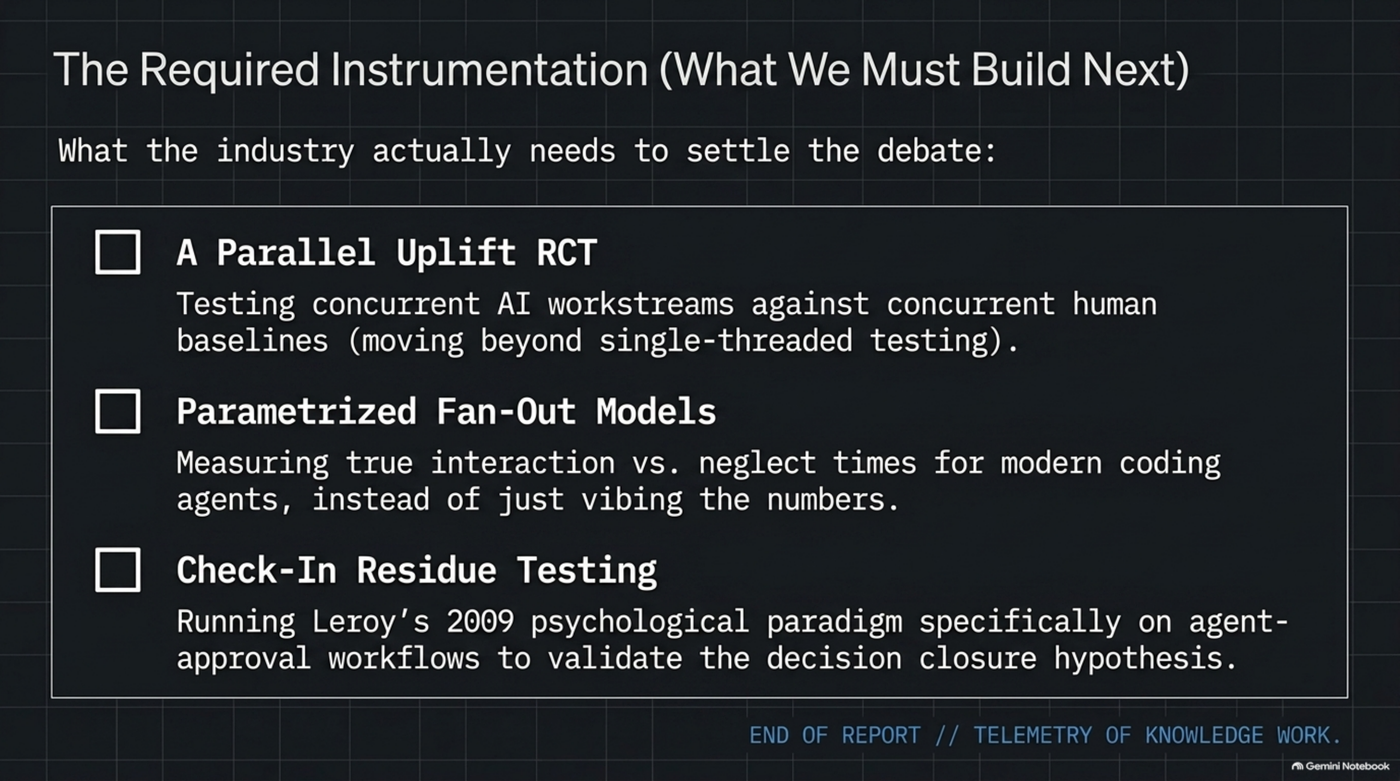
What would settle it is visible and nobody has built it yet: an uplift RCT that allows parallel work (METR has said they want this); a fan-out model actually parametrized for coding agents — neglect time, interaction time, situation-awareness decay, measured rather than vibed; and Leroy's attention-residue paradigm run on check-in workflows, to test whether decision-closure really buys what I argued above it buys. Three concrete studies. The robotics field ran its versions twenty years ago with far worse robots.
Graham wrote his essay to name a structure everyone was living inside without seeing. The naming turned out to be the useful act — it let people stop blaming themselves for what was structural. The equivalent act in 2026 might be smaller and less flattering than the discourse wants: not "everything has changed," but the structure you're living inside already has a literature — supervisory control, span of control, attention residue — and it says the numbers are small, the failure mode is complacency, and the way out is making the work cheap to verify. Our own data, for whatever a sample of one is worth, says the same thing. The afternoon didn't become infinite. It became a fleet — a small one, with a human-shaped limit that three separate research traditions found independently, decades before the first agent wrote a line of code.
Co-authored with Claude, which did the field research and drafting; the framing, the practice described, and the dataset are Totto's. The companion piece with the underlying measurements is The Third Schedule; this post deliberately re-derives none of them.
Sources:
- Maker's Schedule, Manager's Schedule — Paul Graham, July 2009
- The AI Manager's Schedule — Charlie Guo, Ignorance.ai, January 2026
- Every Maker Is Now a Manager (of AI) — Aparna Chennapragada, February 2026
- How AI Collapsed the Maker–Manager Schedule — Change Alchemist
- The New Maker Schedule Isn't About Making — Curiously Chase
- The Cost of Interrupted Work: More Speed and Stress — Mark, Gudith & Klocke, CHI 2008 (PDF)
- Interruptions cost 23 minutes 15 seconds, right? — oberien, on the untraceable provenance of the famous figure
- Why is it so hard to do my work? The challenge of attention residue when switching between work tasks — Sophie Leroy, OBHDP 109(2), 2009
- Fan-out: Measuring Human Control of Multiple Robots — Olsen & Wood, CHI 2004
- Identifying Predictive Metrics for Supervisory Control of Multiple Robots — Crandall & Cummings, IEEE Trans. Robotics 2007 (PDF)
- The Span of Control and the Formulas of V.A. Graicunas — Fred Nickols (PDF)
- Span of control — Wikipedia (empirical span findings)
- Measuring the Impact of Early-2025 AI on Experienced Open-Source Developer Productivity — METR, July 2025 · arXiv:2507.09089
- Analyzing coding agent transcripts to upper bound productivity gains from AI agents — METR, February 2026
- DORA: State of AI-assisted Software Development 2025
- 2025 Stack Overflow Developer Survey — AI section · Developers remain willing but reluctant to use AI — Stack Overflow blog, December 2025
- The Code Agent Orchestra — Addy Osmani, March 2026
- The Attention Bottleneck: Managing 10 AI Coding Agents at Once — Voxos, February 2026
- How to Run 3 to 8 Coding Agents in Parallel Without Losing Track — Agents Room
- AI Coding Agent Productivity Debates: The 2026 Paradox — Exceeds.ai (Faros AI dataset summary)
Series: The Third Schedule
← The Third Schedule · Part 2 of 5 · The Third Schedule: A Field Survey →