175 Posts, No Map
I have spent six months writing about one idea: AI made creating easy but understanding harder. Output outruns navigation. Every jump in creation speed eventually produces a library with no catalog.
Last week I looked at this site and laughed. One hundred and seventy-five posts. Six series. Tens of thousands of words about knowledge infrastructure — organized as a reverse-chronological feed, which is to say, organized by the only dimension nobody searches by. The site about the comprehension bottleneck had hit its own comprehension bottleneck. If you arrived here from a search result, your options were the newest post and archaeology.
So the past week was a renovation — done the way the posts themselves argue it should be done.
Ways in, instead of a feed
The blog format is honest about one thing: what I was thinking most recently. It is silent on everything else — what matters most, where to start, how the pieces relate.
The renovation added the missing entry layers:
- Start Here — four guided paths through the whole body of work, by reader: developers, architects, compliance and security leaders, and the merely curious. A library catalog, not a firehose.
- Topic pillars — standalone, indexable pages for the load-bearing concepts: Knowledge Context Protocol, Synthesis, Skill-Driven Development, and the Agentic Web. Each one is the map of a territory that used to exist only as a trail of dated posts.
- Comparison pages — KCP vs MCP and SDD vs Spec-Driven Development, because those are the questions people actually type into a search box, and the answers were buried in paragraph six of three different posts.
- A site Glossary and a cleaned-up category taxonomy with browse-by-topic — the boring infrastructure that every knowledge base needs and every blog postpones forever.
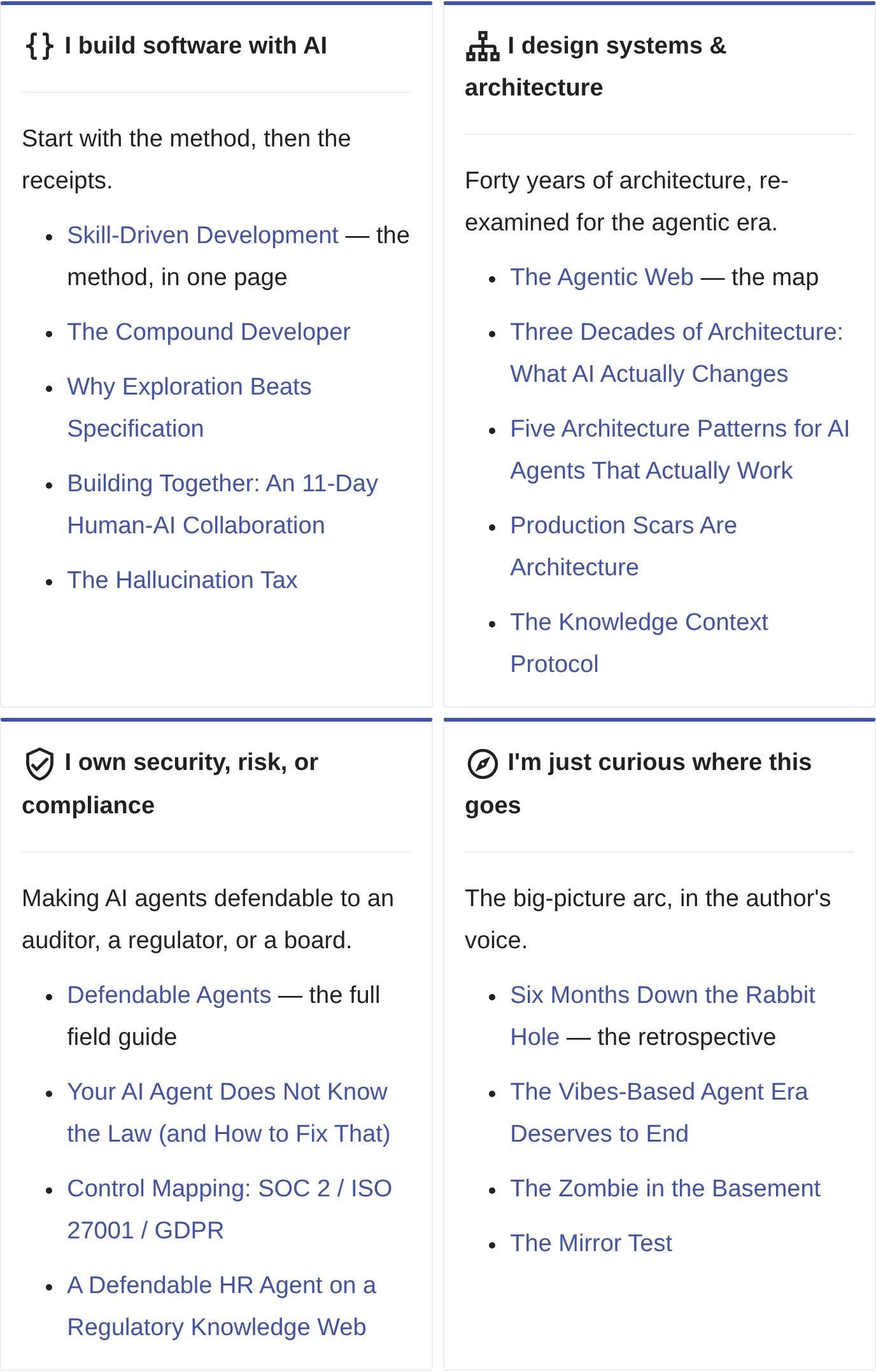
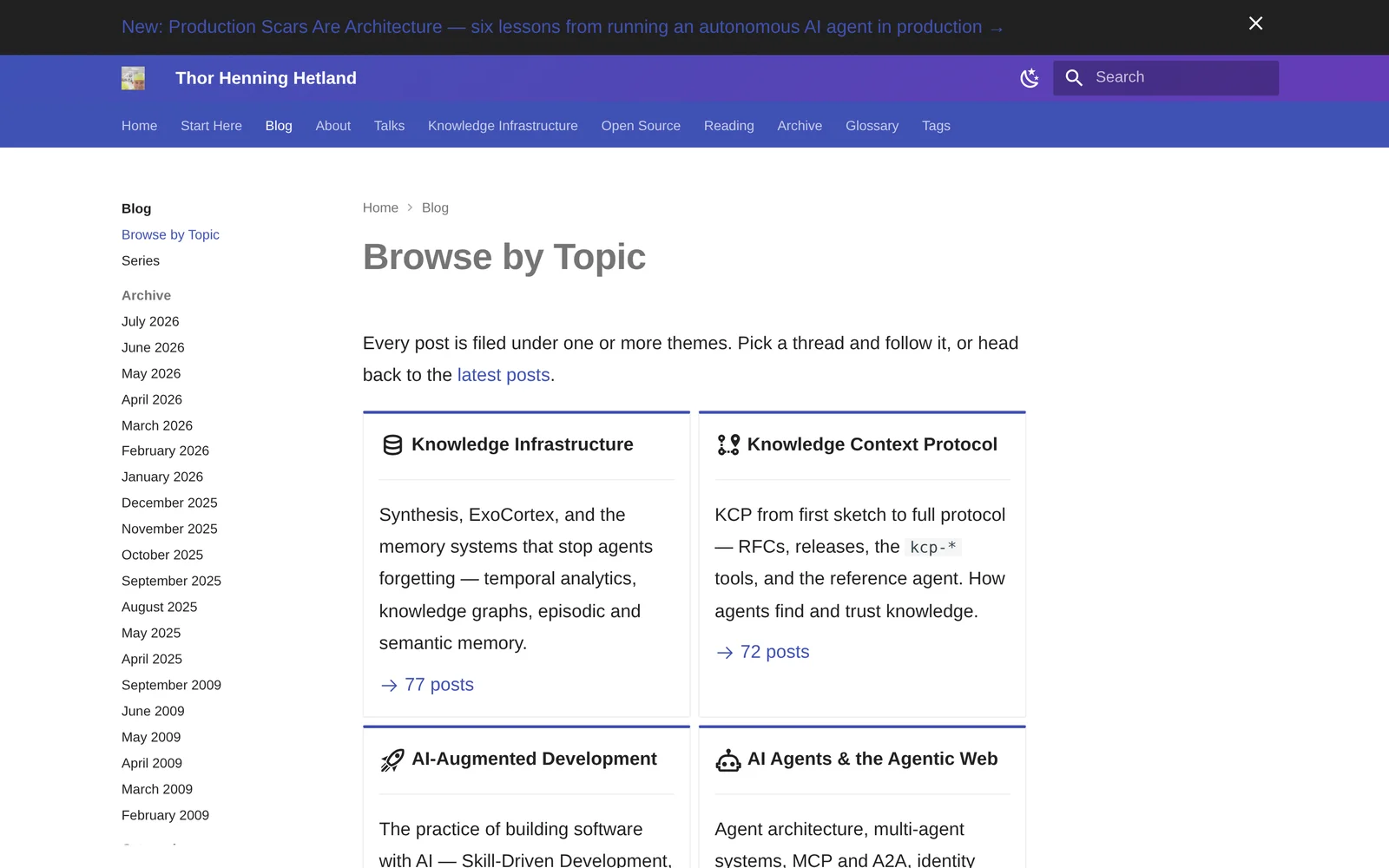
The blog index itself flipped to feed-first — newest writing immediately visible, the topic grid moved to its own page. The chronological view is still there; it is just no longer the only view.
The Defendable Agents field guide
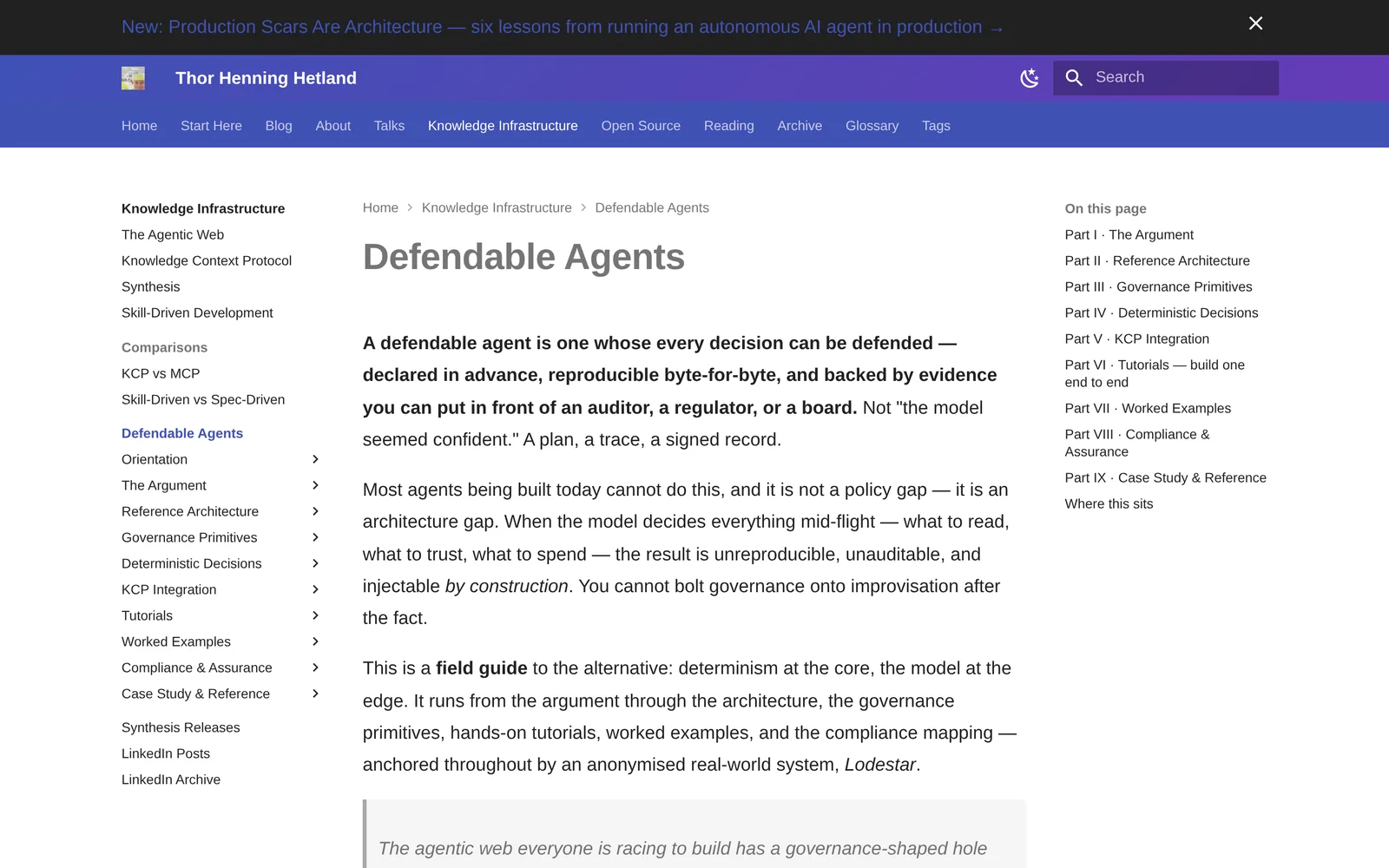
The biggest single addition is a new kind of section entirely: a 56-page, ~60,000-word technical field guide on defendable agents — architecture, primitives, KCP wiring, worked examples, tutorials, and a compliance crosswalk mapped to ISO 27001:2022.
It did not arrive polished. It arrived as a draft that then took a multi-day editorial and fact-checking pass: decay wording corrected, a drift rule fixed, weak compliance mappings replaced, an anonymized regulatory-QA trace added as a real worked example. Publishing the guide was the easy half; making every claim in it survive review was the work. That, too, is the thesis: memory that is not maintained becomes memory that lies — and so does a field guide.
Automating the parts that drift
Here is the pattern I trust least on any website: a hand-maintained "recent posts" section. It is wrong within a week, always, everywhere, because diligence is not a mechanism.
So the home page's "Recent writing" cards are now generated at build time by a hook that reads the newest posts and writes the cards. Nobody updates them, so they are never stale. The same pass added per-post social images and richer structured data — the machine-facing metadata that makes 175 posts legible to search engines and link previews, generated rather than hand-tended.
And because this site practices what it preaches: the wiki carries signed KCP manifests of its own content, refreshed by a bot on every push, and the new field guide is declared in the root manifest — meaning an agent running kcp-agent can plan a route through this site the same way it plans a route through a codebase. The site is not just about knowledge infrastructure. It is a working installation of it.
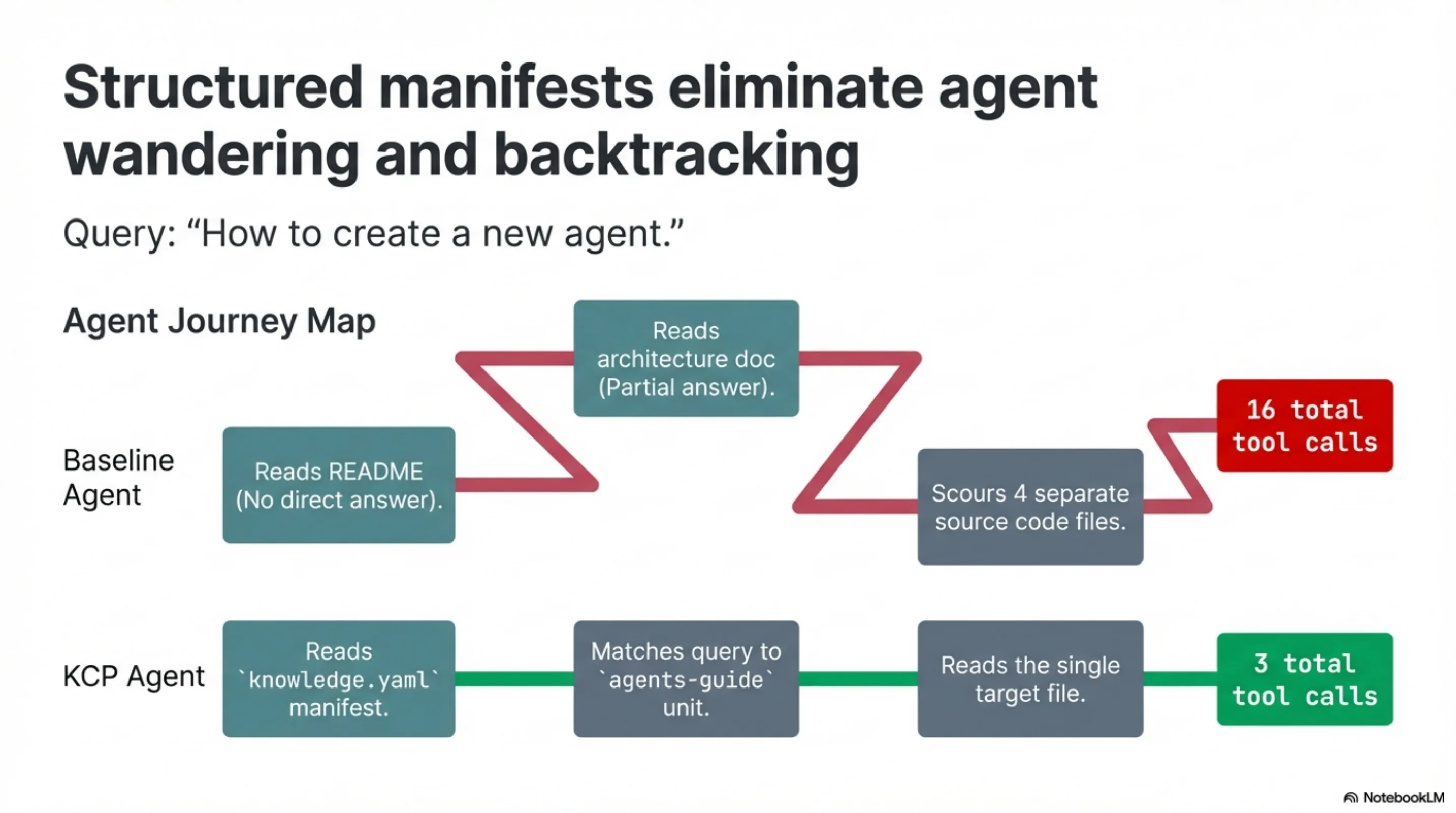
That journey map is what "no map" costs, measured: the same question answered in sixteen tool calls of wandering or three of navigation. Human readers were paying the sixteen-call price here too. Start Here, the pillars, and the glossary are the green line.
What the renovation turned up
One byproduct deserves a mention. A content pass over this many pages is also an audit, and it tripped over stale facts the way audits do — most notably that the Synthesis numbers quoted around the site had drifted well behind the codebase. Pulling on that thread turned into its own two-day story involving a README that was off by a factor of six and a repo with three different licenses. That one is worth telling properly, another day.
The meta-lesson stands without it: content creation outruns content navigation on every scale. A 200,000-line codebase in eleven days, an enterprise documentation estate, or one person's blog — same curve, same crisis, same fix. Build the map. Generate what drifts. Verify what claims.
The library finally has a catalog. Now I get to find out what people read when they can actually find things.
The renovation was done across several sessions with Claude in Claude Code — taxonomy,
pillars, the field guide's editorial pass, the build hooks, and this post. The 175 count is
ls docs/blog/posts/*.md | wc -l, measured, not remembered.