Skip to content

Software Architecture

The Organisational Amnesia Problem

Here's a question most organisations can't answer: what was Pump 47's vibration reading before it failed?

Not a complex question. A specific measurement, at a specific point in time, for a specific piece of equipment. But in most asset management systems, if that reading was overwritten when the failure was logged, it's gone. The data archaeology required to reconstruct it — if it's possible at all — involves manual investigation across multiple systems, log files, and human memory.

The same pattern applies everywhere.

From Data to Action: The Alchemy and Aurora Stack

The hardest part of analytics isn't the analysis. It's getting the data there in the first place.

Most organisations have data in a dozen places. ERP systems. HR platforms. CRM. Custom databases. Real-time event streams. Legacy systems that predate modern API design. Getting all of that into a consistent, queryable format is the project that takes eighteen months and still isn't finished.

Xorcery AAA is built around two components that solve this problem together.

Rethinking Systems for AI

Most software systems were designed for a world without AI.

Not in the sense of lacking ML features — in the deeper sense of having an architecture shaped by assumptions that AI changes. Assumptions about where intelligence lives, what questions systems should answer, what "the right data model" looks like.

Those assumptions are worth examining.

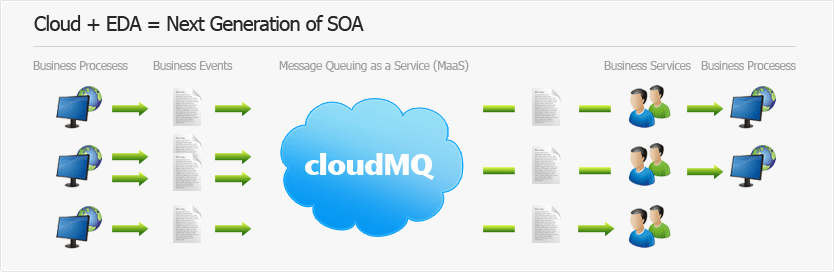
CloudMQ

cloud-eda.gif

Platform components as a service will hit the software marked hard in 2009 and 2010, but until developers and architects understand how to leverage the platform components in a clear and consistent way, they will add more pain than salvation... Read up on some of the architecture axioms and distributed architectures and analyse your current design and architectures before moving to platform component services is advised. :)