kcp-commands: Save 33% of Claude Code's Context Window
Every token Claude Code's context window can hold is an opportunity — a tool call result that stays in scope, a file that does not need to be re-read, a decision that does not need to be recapped. Wasting those tokens on noise is a quiet tax on every session.
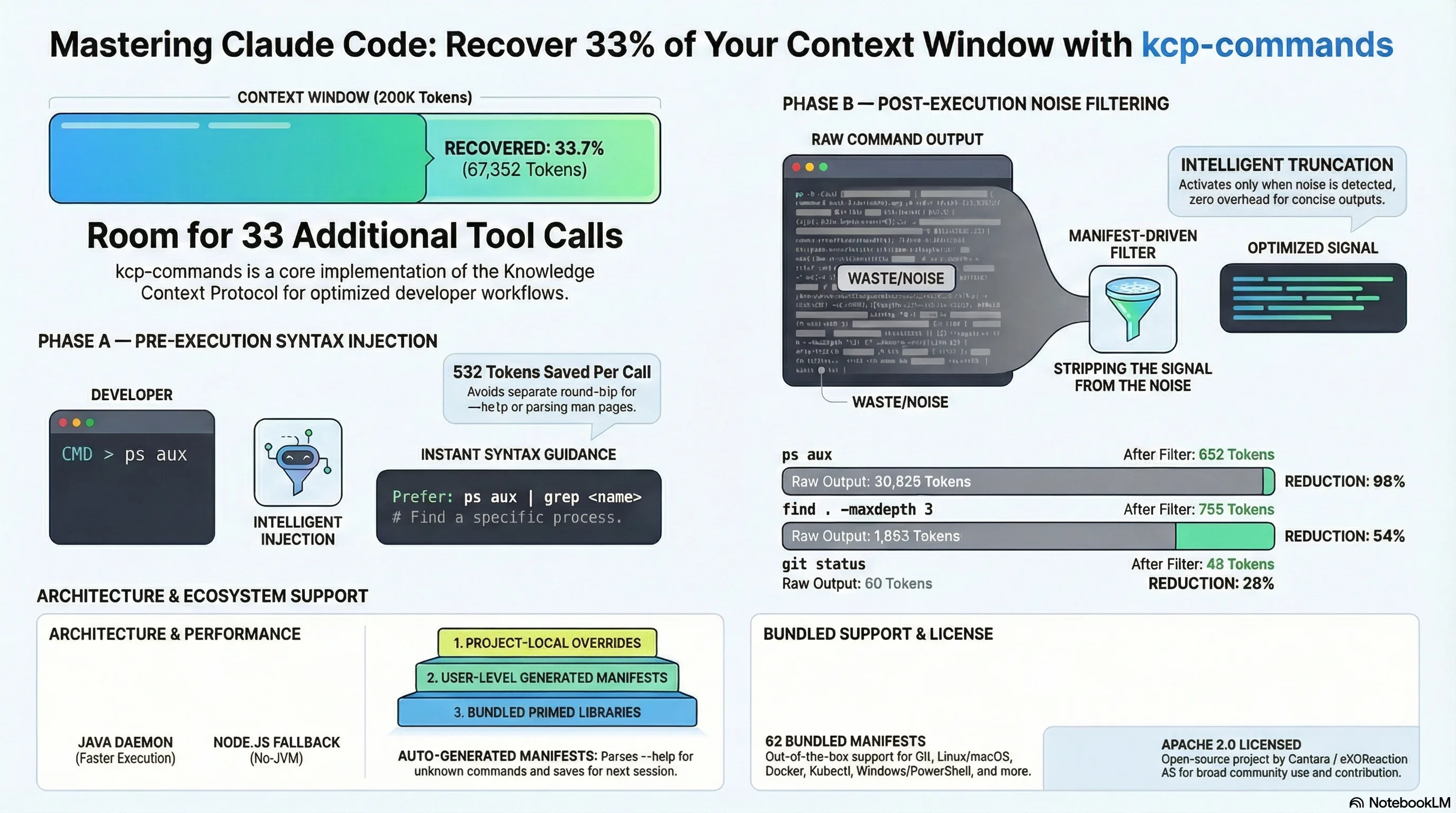
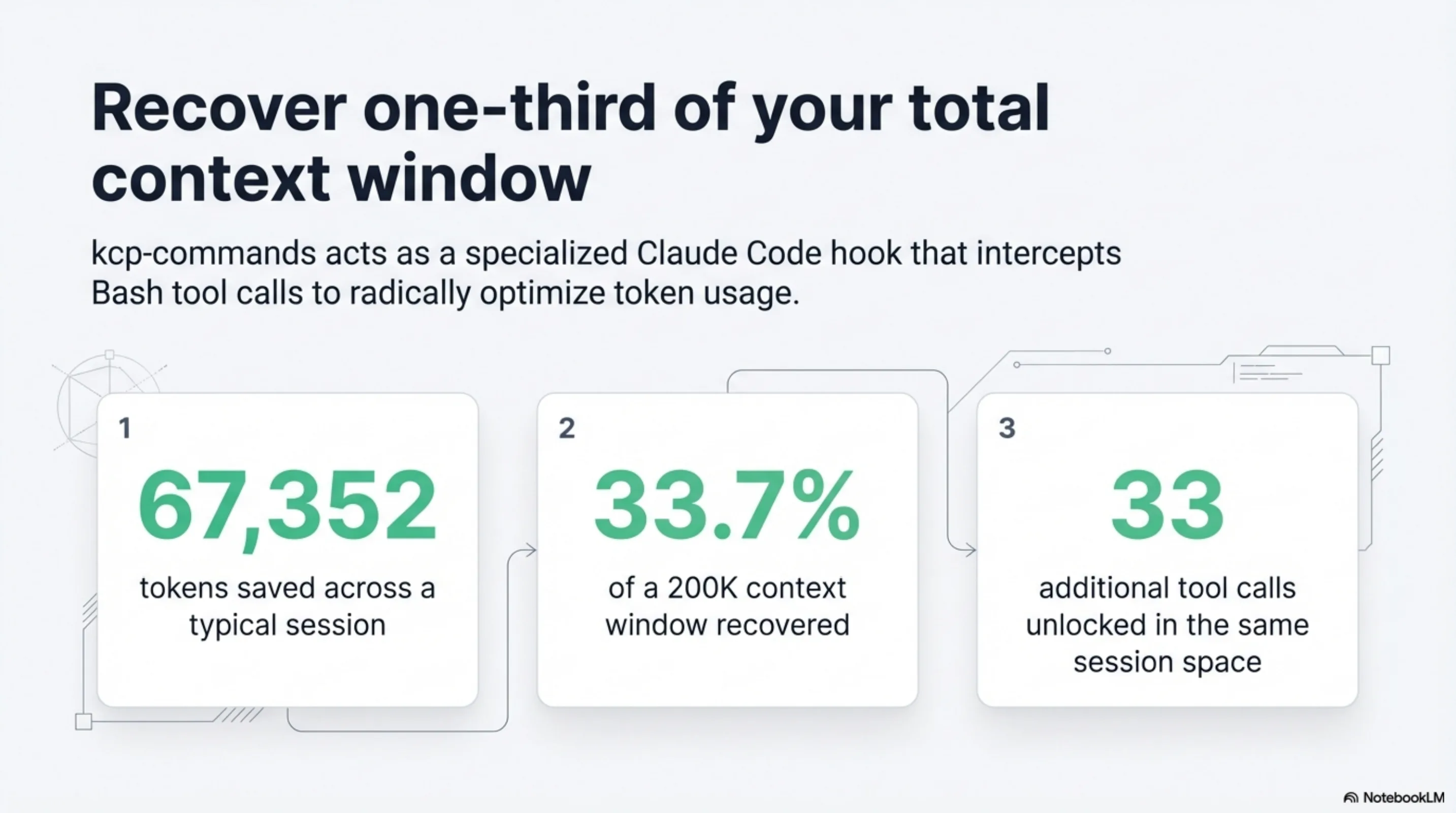
Today we are releasing kcp-commands: a Claude Code hook that recovers 33.7% of a 200K context window in a typical agentic coding session by intercepting Bash tool calls at two critical points.
The full number across our benchmark session: 67,352 tokens saved.
Update (March 3, 2026 — v0.9.0): kcp-commands now writes a JSON event to
~/.kcp/events.jsonl on every Phase A Bash hook call. kcp-memory v0.4.0
ingests that stream to provide tool-level episodic memory — kcp-memory events search
"kubectl apply" returns every time Claude ran that command across all your projects.
Phase A gives Claude vocabulary. Phase B cleans output. Phase C remembers what ran.
The two problems it solves
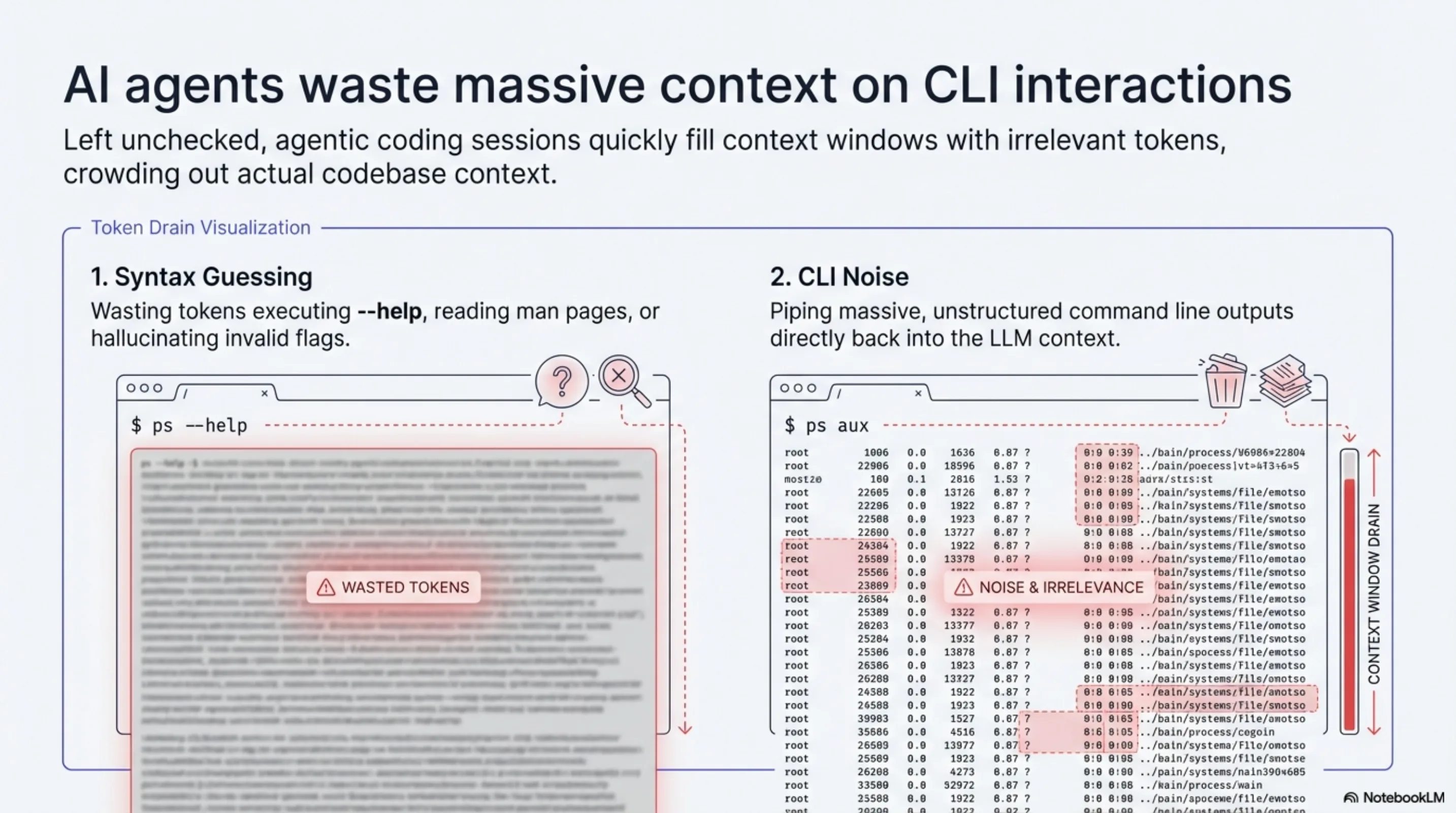
An agent running a shell command faces two inefficiencies that are invisible unless you measure them.
Before execution: The agent does not always know which flags to use. The safe move is
to run ps --help or ls --help first, then run the real command. That is a round trip
that costs 500–800 tokens of help output for a flag the agent needed to read once.
After execution: Large commands produce large outputs. ps aux on a development
machine produces 30,828 tokens of process table. The agent needs a dozen rows. The rest
occupies context window space for the remainder of the session, crowding out results that
actually matter.
kcp-commands eliminates both. Before the tool runs, it injects a compact context block with the right flags. After the tool runs, it filters the output before it reaches the model.
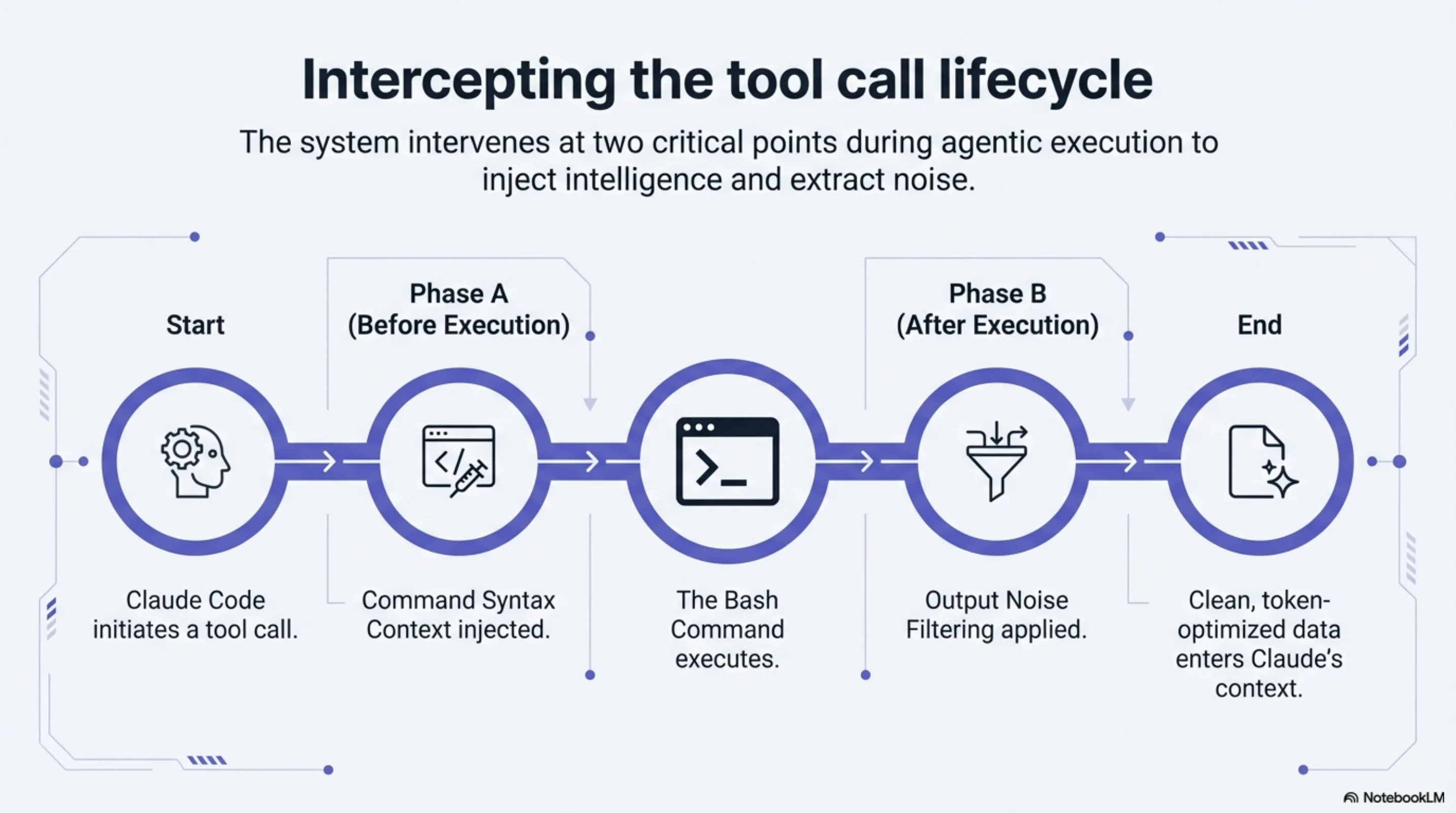
Phase A: Command syntax context
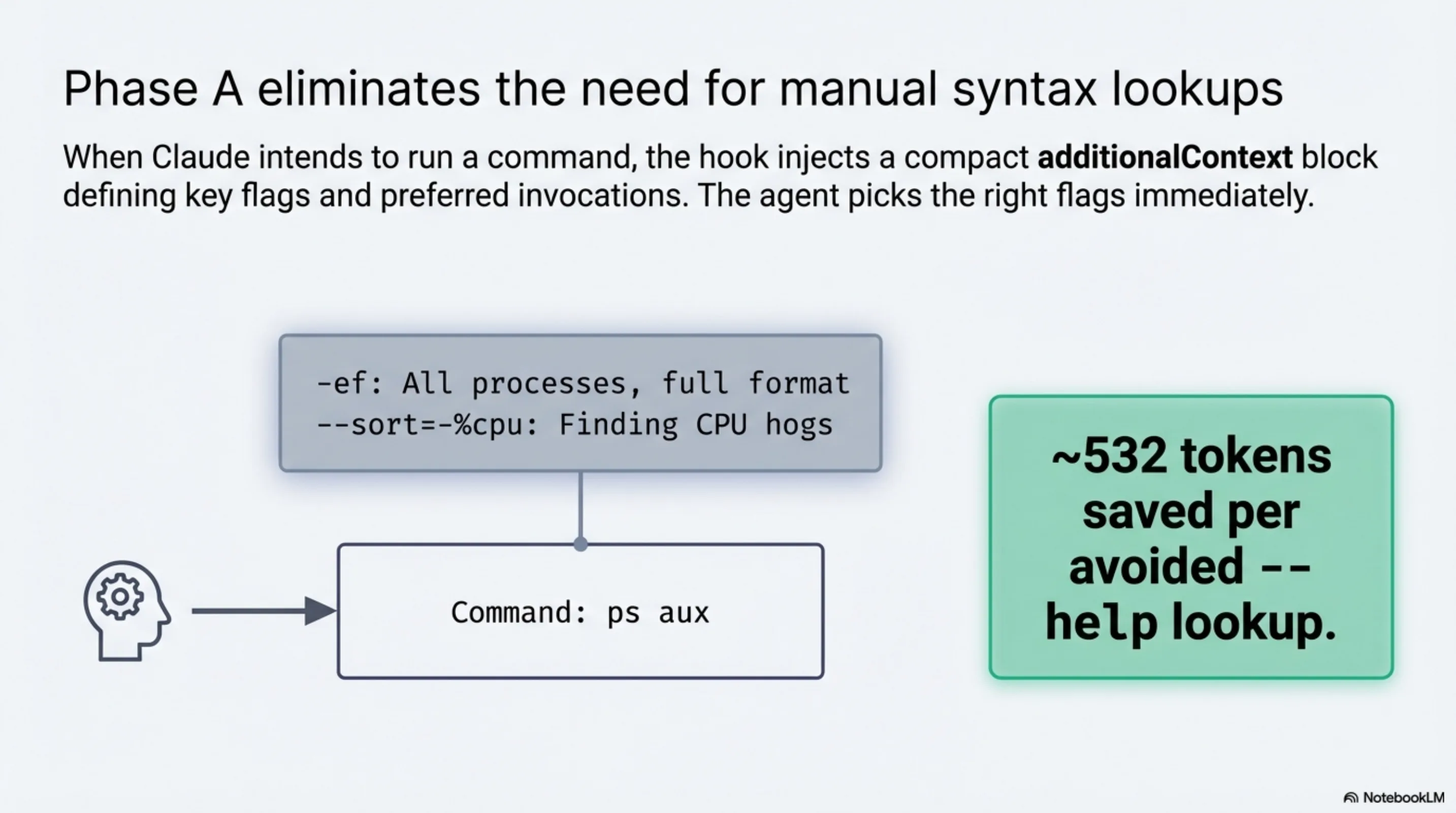
When Claude is about to run ps aux, the hook fires a PreToolUse event. kcp-commands
resolves a YAML manifest for ps, formats it into a compact context block, and returns
it as additionalContext:
[kcp] ps: Report a snapshot of running processes
Usage: ps [OPTION]...
Key flags:
aux: All processes, all users, with CPU/memory → Default
-ef: All processes, full format with PPID → Need parent PIDs
--sort=-%cpu: Sort by CPU descending → Finding CPU hogs
Prefer:
ps aux # Find any process or check what's running
ps aux | grep <name> # Find a specific process
The agent picks the right flags immediately. No --help lookup. No man page parsing.
No wasted round trip.
Average saving: 532 tokens per avoided --help call.
That number is measured. The benchmark runs the actual --help output for each command,
measures the additionalContext we inject instead, and takes the difference. For ls,
git log, find, and similar commands, the context block is 90–95% smaller than the
full help text.
Phase B: Output noise filtering
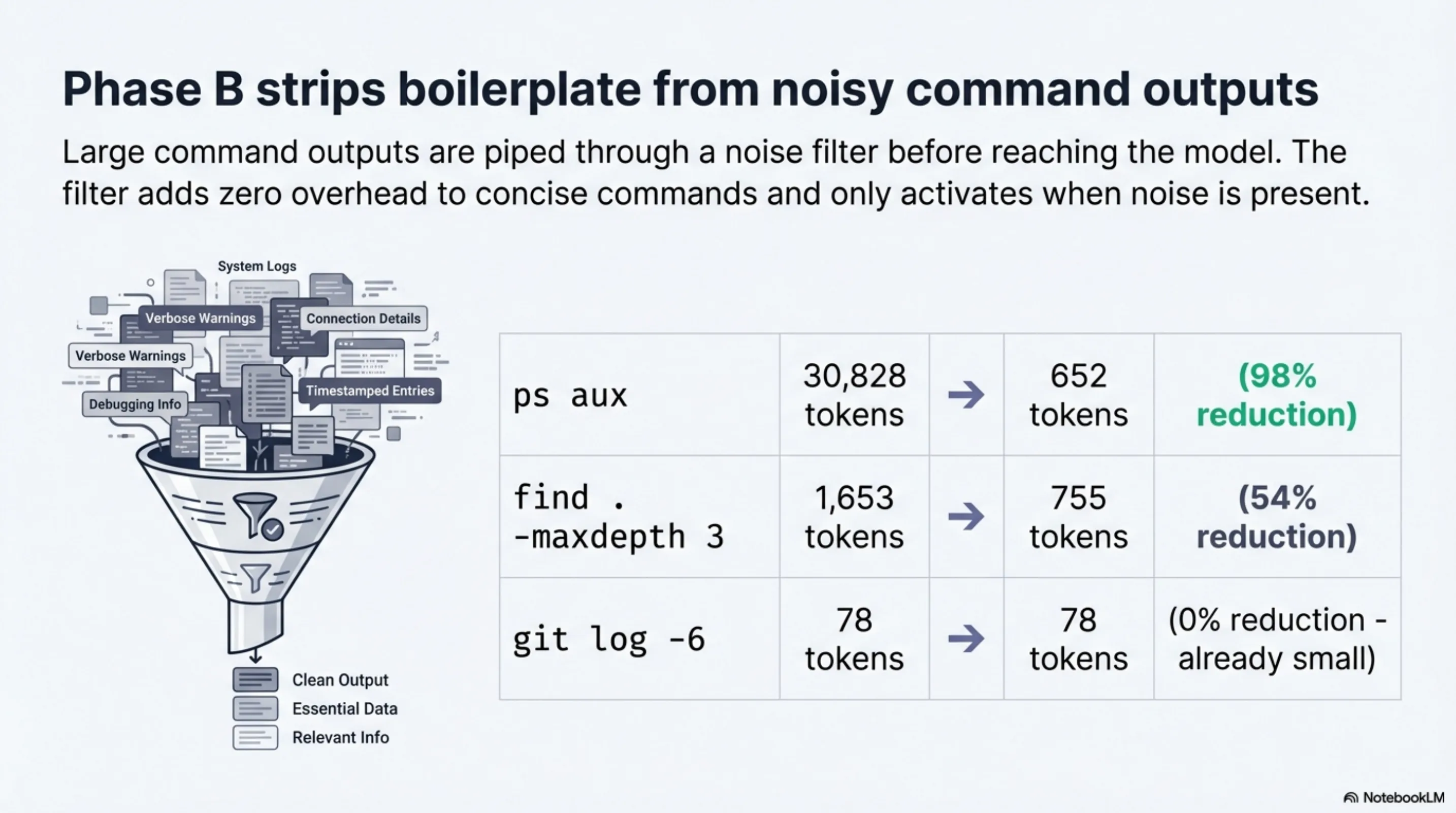
Phase B wraps the command in a pipe before it runs. ps aux becomes:
The filter reads the output, strips noise patterns defined in the manifest, truncates to
max_lines, and returns only the signal:
| Command | Raw output | After filter | Reduction |
|---|---|---|---|
ps aux |
30,828 tokens | 652 tokens | 98% |
find . -maxdepth 3 |
1,653 tokens | 755 tokens | 54% |
git status |
60 tokens | 43 tokens | 28% |
git log -6 |
78 tokens | 78 tokens | 0% (already small) |
The filter adds zero overhead when output is already small. It only activates when there is noise to remove.
Session projection
Across a typical agentic coding session — investigating a codebase, running git commands, finding processes, searching files:
| Task | Calls | Tokens saved |
|---|---|---|
git status + git log + git diff |
4 | +8,240 tok |
ls (various directories) |
8 | +4,256 tok |
ps aux |
2 | +60,612 tok |
find |
3 | +11,484 tok |
--help fetches avoided |
6 | +3,192 tok |
| Total | +67,352 tok |
67,352 tokens out of a 200,000 token context window. 33.7% recovered. That is roughly 33 additional tool call results fitting in the same context — or a session that runs 50% longer before the window fills.
Performance
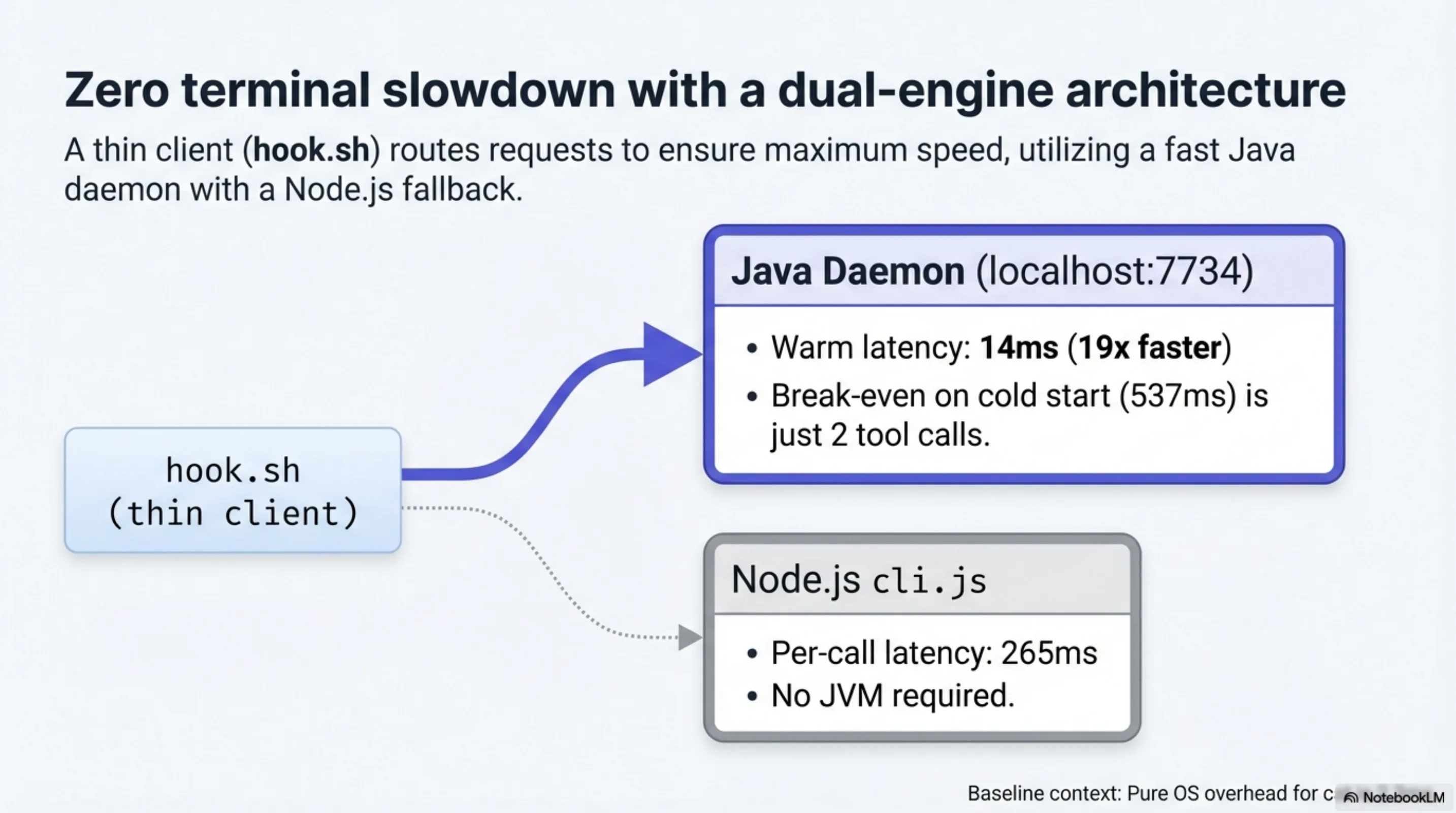
The hook runs on every Bash tool call. Latency matters.
| Backend | Mean latency | p95 |
|---|---|---|
| Java daemon (warm) | 14ms | 17ms |
| Node.js (per-call) | 265ms | 312ms |
| Baseline (cat) | 2.3ms | 3.1ms |
The Java daemon starts once per session (cold start: ~537ms) and then serves from memory.
Break-even is 2 hook calls — it pays for itself within the first git status + ls.
The Node.js fallback adds ~265ms per call but requires no JVM. Both work; the Java daemon is the recommended path for sessions with many tool calls.
283 bundled manifests
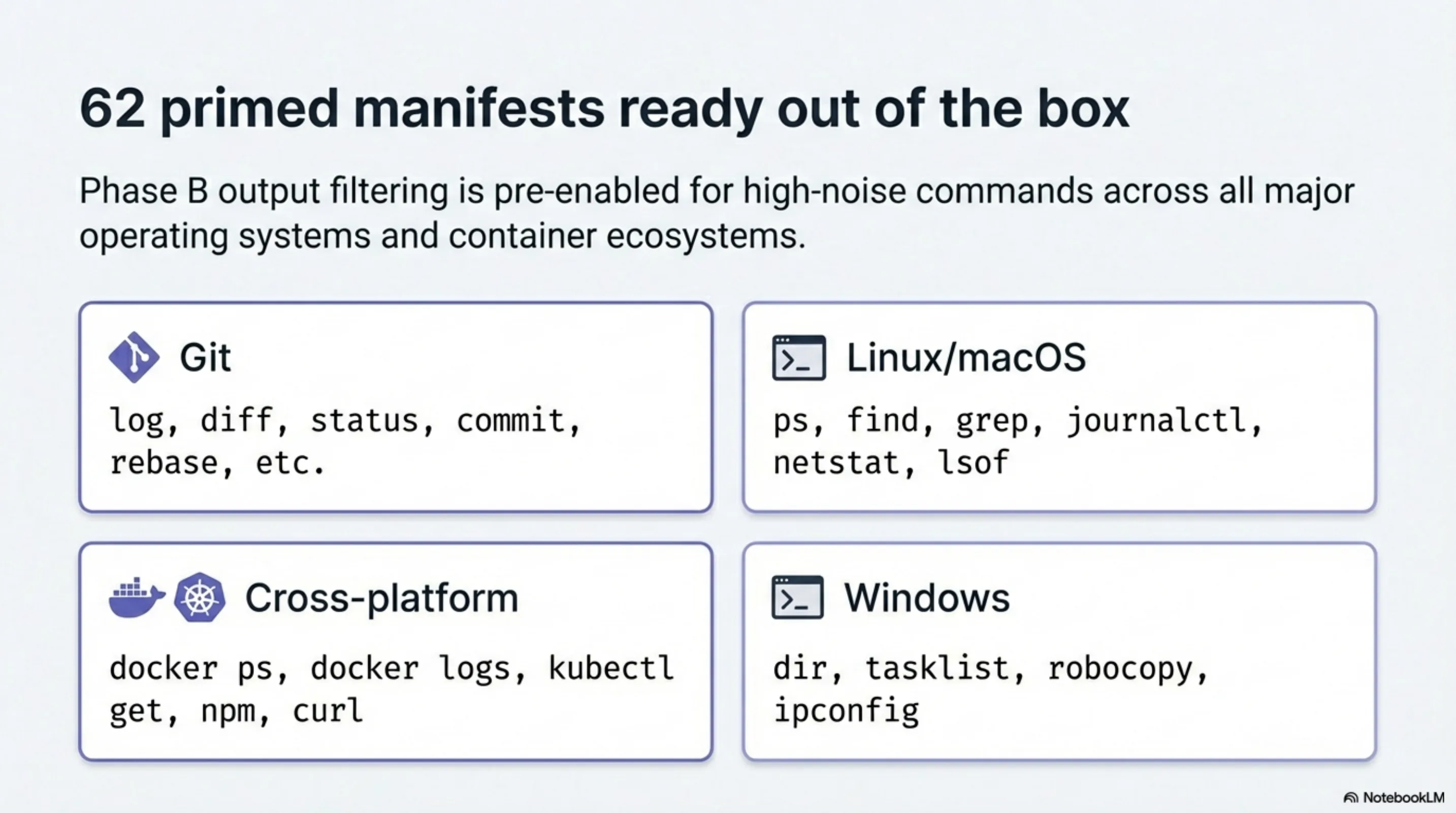
Phase A and B are pre-configured for 283 commands across twenty-eight groups:
Git — git log · git diff · git status · git add · git commit · git push ·
git pull · git fetch · git branch · git checkout · git stash · git merge ·
git rebase · git clone · git reset · git tag · git remote · git show ·
git cherry-pick · git bisect · git worktree · git submodule
Linux / macOS — ls · ps · find · cp · mv · rm · mkdir · cat ·
head · tail · grep · chmod · df · du · tar · ln · rsync · top ·
kill · systemctl · journalctl · lsof · netstat · ss · ping ·
free · watch · wget · dig · openssl · scp
Text processing — jq · sed · awk · sort · uniq · wc · cut · xargs · tee · tr · diff · make · yq · base64 · sha256sum · envsubst · nl · xxd · strings · xmllint · column
Build tools — mvn · gradle · cargo · go build · go test · go mod · ant · sbt · dotnet
Package managers — npm · yarn · pnpm · bun · pip · brew · apt · yum · gem · conda · snap · pacman · composer · poetry · bundle
Runtimes — node · python3 · ruby · java · npx · mix
GitHub CLI — gh pr · gh issue · gh repo · gh workflow · gh run · gh release · gh auth · gh api · gh gist
Docker — docker ps · docker images · docker logs · docker build · docker run · docker exec · docker compose · docker network · docker volume · docker system · docker inspect · docker pull · docker push · docker tag
Kubernetes — kubectl get · kubectl logs · kubectl describe · kubectl apply · kubectl exec · kubectl port-forward · kubectl delete · kubectl rollout · kubectl scale · kubectl top · kubectl config · kubectl create
Cloud / IaC — aws · gcloud · az · terraform · helm · ansible · ansible-playbook · vagrant · pulumi · serverless · minikube · kind · packer · eksctl
Database CLIs — psql · mysql · redis-cli · sqlite3 · mongosh · influx · pg_dump · pg_restore · mysqldump
Security / secrets — gpg · ssh-keygen · ssh-add · certbot · keytool · age · vault · consul
System diagnostics — htop · vmstat · dstat · iotop · strace · dmesg · lsblk · iostat · uptime · id · who · crontab · tmux
Networking — nmap · nc · traceroute · ip · mtr · nslookup · whois
Modern CLI — fzf · rg · fd · bat · delta · eza · hyperfine · tldr · jless · parallel · lazygit
Linters / CI — shellcheck · hadolint · act · k9s
GitOps — kustomize · argocd · flux
Deployment platforms — fly · vercel · wrangler · heroku · doctl
Version managers — asdf · mise · nvm · pyenv · rustup
Build / media / docs — cmake · ffmpeg · pytest · mkdocs · rclone
HTTP clients — http (HTTPie)
AI / LLM — ollama
Windows — dir · tasklist · taskkill · ipconfig · netstat · where ·
robocopy · type · xcopy · winget (all include PowerShell equivalents)
Linters / formatters — ruff · eslint · prettier · mypy · golangci-lint · yamllint · markdownlint
Testing — jest · vitest · playwright · cypress · k6 · grpcurl
Containers+ — podman · trivy · cosign
Monorepo / task runners — nx · turbo · just · bazel · task
Secrets / config — sops · op · direnv
Modern CLI+ — zoxide · btm · dust · procs
Package managers+ — uv · apk · dnf · pipx
Runtimes+ — deno · go run · php · swift
Dev workflow — pre-commit · gh codespace
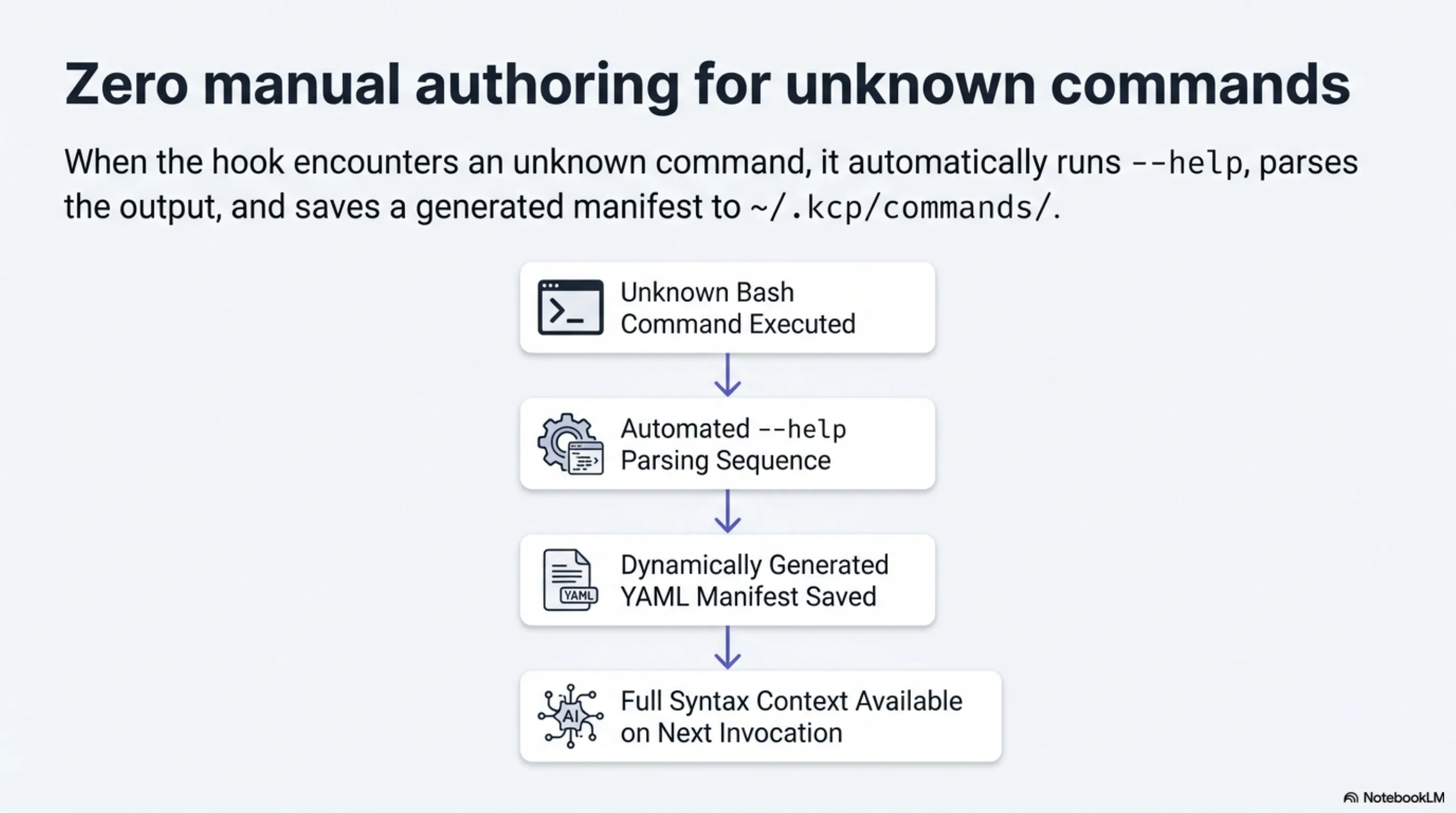
For unknown commands, the hook runs <cmd> --help, parses the output, and saves a
generated manifest to ~/.kcp/commands/ for next time.
Deviation detection and auto-tuning
Real systems drift from their documentation. A filter configured for 30 lines of ps
output runs into a machine with 500 processes. A noise pattern tuned for one version of
npm stops matching after an upgrade.
kcp-commands tracks this. After every filtered command:
-
Significant truncation (output > 1.5× the configured cap): auto-tunes the user-level manifest. Formula:
ceil(rawLines × 1.3 / 25) × 25— 30% headroom, rounded to the nearest 25. Written to~/.kcp/commands/<key>.yaml, picked up on the next call without restart. -
Stale pattern (noise regex matched zero lines in substantial output): logged to
~/.kcp/deviations.log. The pattern may be outdated. -
Over-configured (output is tiny relative to max_lines): logged. The schema was built for a noisier context than reality.
The Java daemon handles deviation detection directly in the /filter/{key} endpoint —
no Node.js dependency for Phase B when the daemon is active.
Phase C: Event stream (v0.9.0)
Every Phase A Bash hook call now appends a JSON event to ~/.kcp/events.jsonl:
{
"ts": "2026-03-03T14:32:11.482Z",
"session_id": "ad732c58-af84-48dd-8c4e-80fe074800b0",
"project_dir": "/src/cantara/kcp-memory/java",
"tool": "Bash",
"command": "mvn package -q",
"manifest_key": "mvn"
}
manifest_key is the resolved manifest identifier — or null for commands that had no
manifest and received only an auto-generated context block.
The write is async (virtual thread), file-safe (process-wide ReentrantLock), and never
blocks the hook response. If ~/.kcp/ does not exist it is created on first write. The
event is always logged — even for commands where no manifest was found — so the stream is
a complete record of every Bash tool call Claude made.
kcp-memory v0.4.0 reads this file incrementally using a byte-offset cursor in its SQLite database. Each PostToolUse-triggered scan processes only the lines appended since the last pass — typically one event in under 1ms. The result is tool-level episodic memory queryable in milliseconds:
kcp-memory events search
"kubectl apply"
kcp-memory events search "flyway migrate"
kcp-memory events search "docker build"
No extra hook configuration is needed. The event stream is produced by kcp-commands and
consumed by kcp-memory. Running both gives session-level and tool-level memory from a
single ~/.kcp/memory.db database.
Manifest format
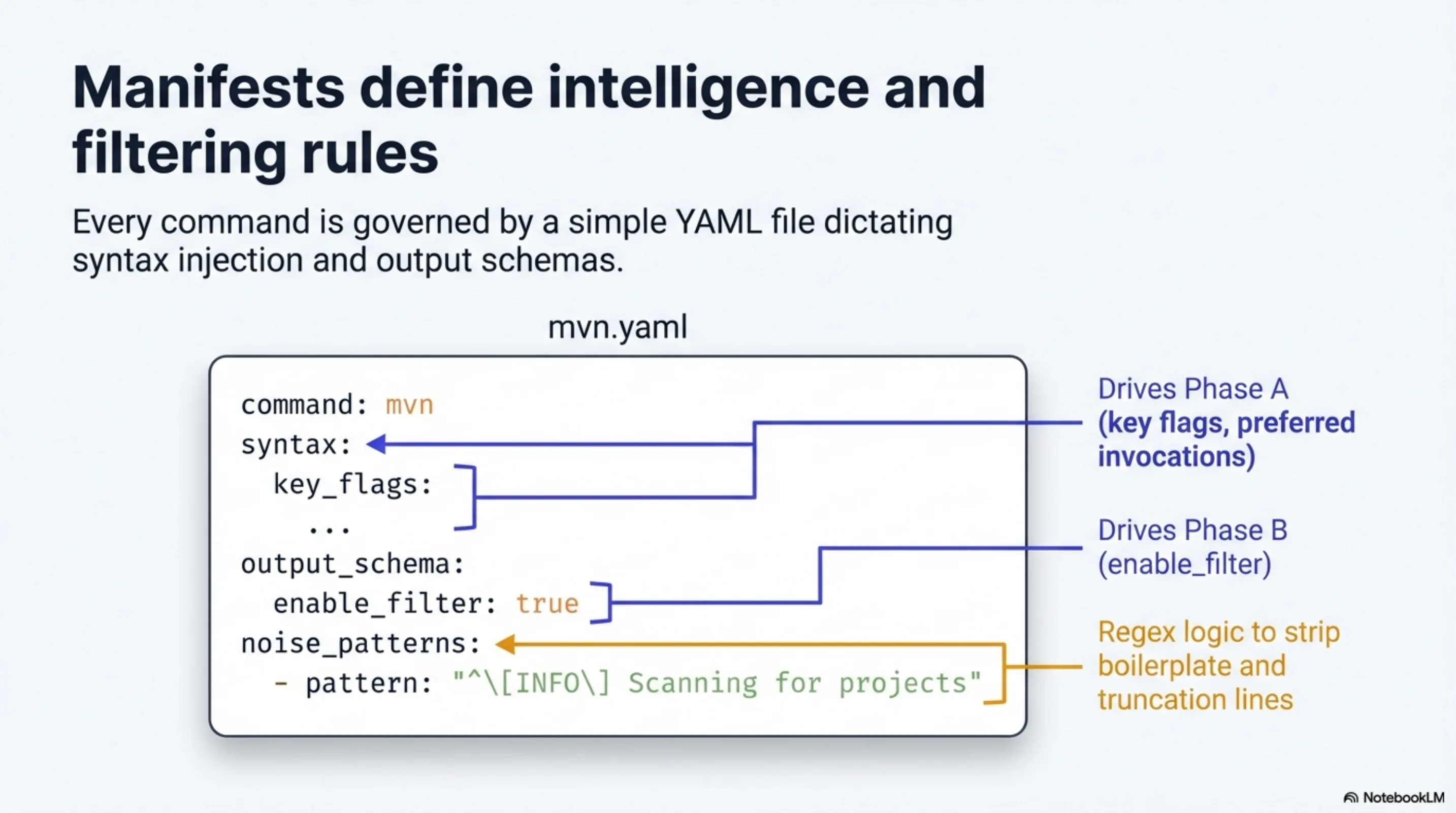
One YAML file per command or subcommand. Three sections:
command: ps
platform: all
description: "Report a snapshot of running processes"

syntax:
  usage: "ps [OPTION]..."
  key_flags:
    - flag: "aux"
      description: "All processes, all users, with CPU/memory (BSD syntax)"
      use_when: "Default — find any process or check resource usage"
    - flag: "--sort=-%cpu"
      description: "Sort by CPU descending (combine with aux)"
      use_when: "Finding CPU hogs"
  preferred_invocations:
    - invocation: "ps aux"
      use_when: "Find any process or check what's running"

output_schema:
  enable_filter: true
  noise_patterns:
    - pattern: "^\\s*$"
      reason: "Blank lines"
  max_lines: 30
  truncation_message: "... {remaining} more processes. Use grep to narrow."
syntax drives Phase A. output_schema drives Phase B. You can write one, the other,
or both.
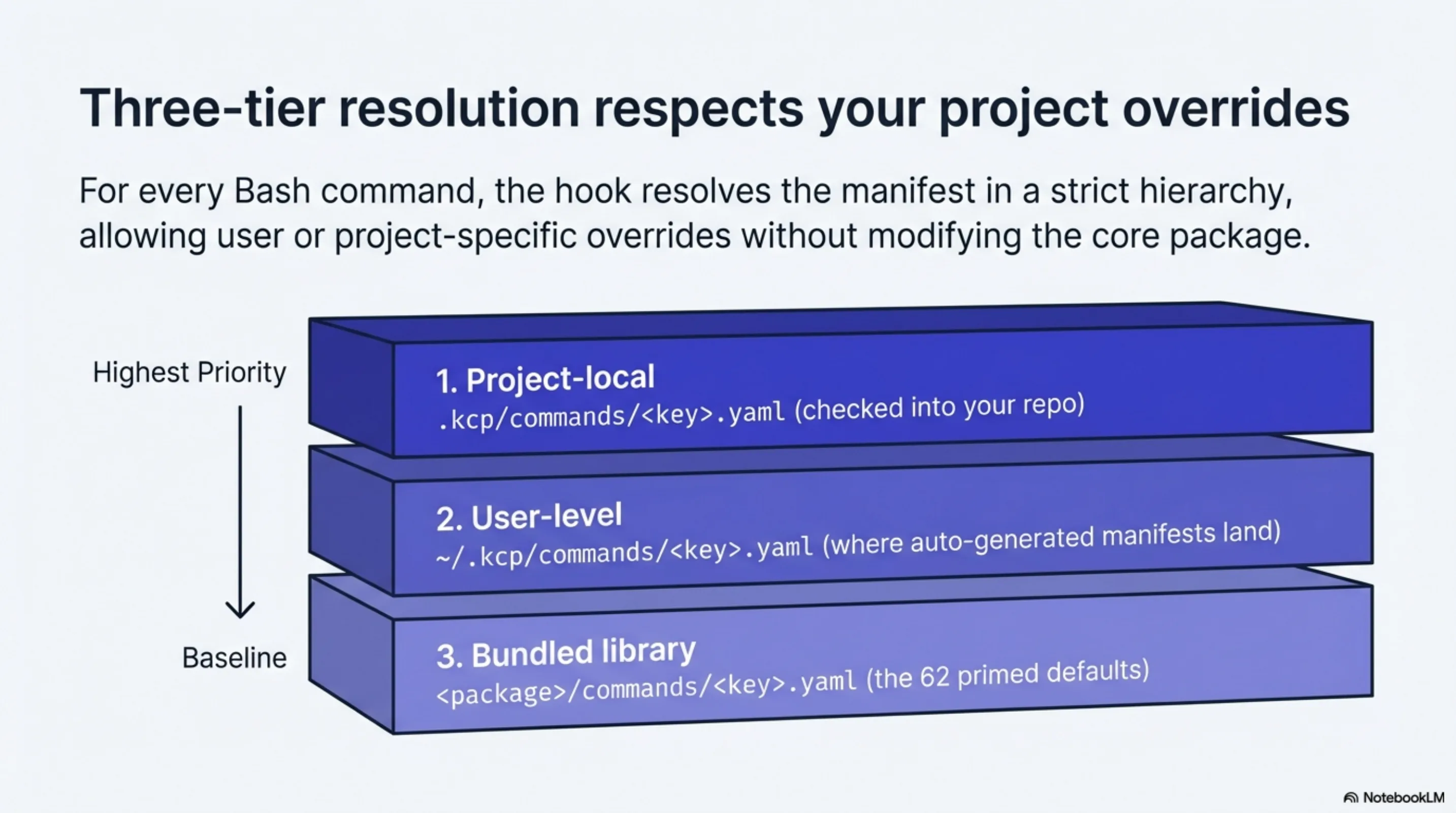
To override a bundled manifest, drop your file in .kcp/commands/ (project-local) or
~/.kcp/commands/ (user-global). First match wins.
Install
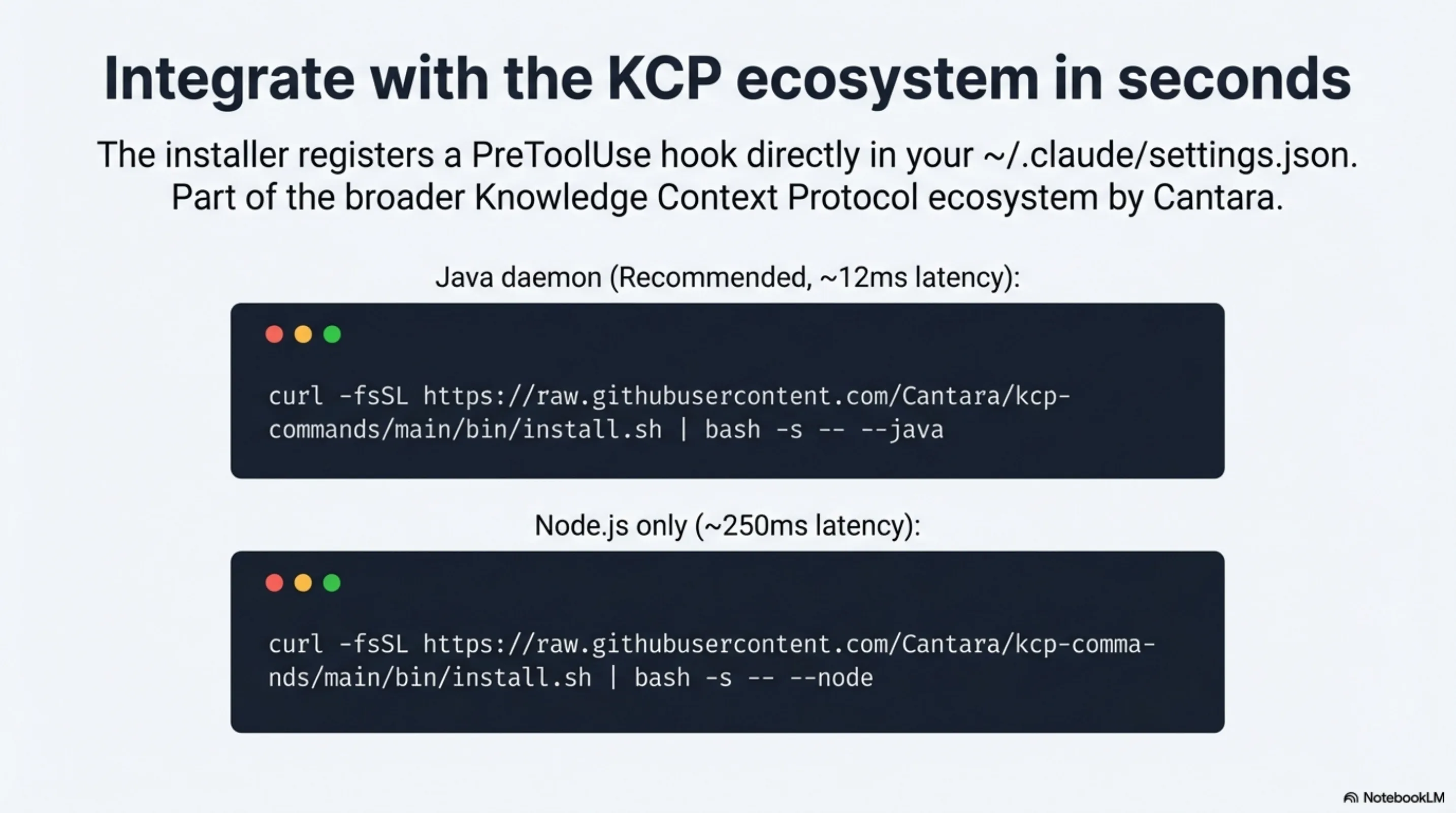
Java daemon (recommended — 19x faster):
curl -fsSL https://raw.githubusercontent.com/Cantara/kcp-commands/main/bin/install.sh | bash -s -- --java
Requires Java 21. The installer downloads the pre-built JAR from GitHub Releases, places
it in ~/.kcp/, and registers the hook in ~/.claude/settings.json. No source clone
required. Restart Claude Code to activate.
Node.js only (no JVM required):
curl -fsSL https://raw.githubusercontent.com/Cantara/kcp-commands/main/bin/install.sh | bash -s -- --node
Requires Node.js 18+. Hook latency is ~265ms per call instead of 14ms, but everything else works identically.
Writing your own manifests
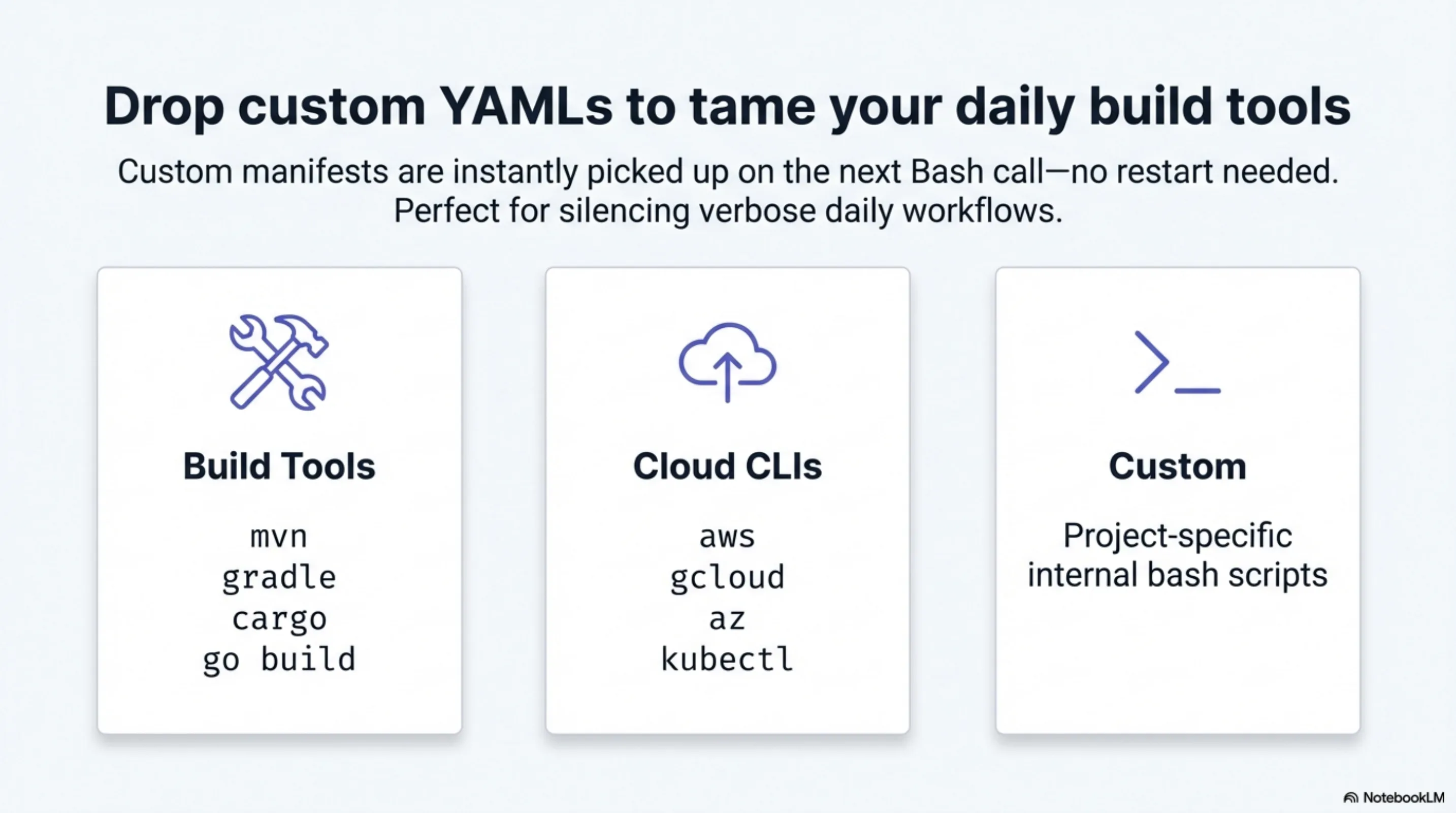
The most valuable manifests are project-specific: the build tool your team uses daily, a cloud CLI that produces verbose output, internal scripts where the agent needs to know the right flags.
Create a YAML file following the format above. Drop it in .kcp/commands/ in your repo.
The hook picks it up on the next Bash call — no restart, no reload.
Good candidates:
- mvn, gradle, cargo, go build — build tools with long flag lists
- aws, gcloud, az — cloud CLIs with verbose output
- Project-specific scripts where --help is unhelpful or unavailable
Release history
| Version | Manifests | Notes |
|---|---|---|
| v0.1.0 | 18 | Initial: git, Linux/macOS basics, curl, ssh, docker, kubectl |
| v0.2.0 | 32 | Windows, extended git, networking |
| v0.3.0 | 62 | Full initial library |
| v0.4.0 | 114 | Text processing, build tools, package managers, cloud/IaC |
| v0.5.0 | 214 | System tools, DB CLIs, security, modern CLI, monitoring |
| v0.6.0 | 244 | ollama, HTTPie, ffmpeg, pytest, cmake, mkdocs, rclone, pg_dump/restore, mysqldump, glab, fly/vercel/wrangler/heroku/doctl/eksctl, vault/consul/packer, kustomize/argocd/flux, asdf/mise/nvm/pyenv/rustup, dbt, lazygit |
| v0.6.1 | 244 | Fix: index.txt auto-generated; install to ~/.kcp/; cli.js released as artifact |
| v0.7.0 | 244 | README install section clarifications; Releases changelog; v0.6.1 patch docs |
| v0.8.0 | 283 | Linters (ruff, eslint, prettier, mypy, golangci-lint, yamllint, markdownlint), testing (jest, vitest, playwright, cypress, k6, grpcurl), containers (podman, trivy, cosign), monorepo (nx, turbo, just, bazel, task), secrets (sops, op, direnv), modern CLI (zoxide, btm, dust, procs), package managers (uv, apk, dnf, pipx, winget), runtimes (deno, go run, php, swift), dev workflow (pre-commit, gh codespace) |
| v0.9.0 | 283 | Phase C: EventLogger — every Phase A Bash call writes a JSON event to ~/.kcp/events.jsonl. Consumed by kcp-memory v0.4.0 for tool-level episodic memory. |
| v0.14.0 | 284 | Suppression fix. 51+ well-known commands (git, ls, grep, …) suppressed unconditionally — no manifest lookup, no output returned, zero overhead. Previous releases applied suppression inconsistently. |
| v0.20.0 | 291 | RFC-0017 UsageLogger. Inject events logged to ~/.kcp/usage.db on every manifest hit. Feeds kcp-dashboard. |
| v0.21.0 | 291 | PostToolUse hook fix. post-hook.sh was reading tool_response.output; Claude Code sends Bash output in tool_response.stdout. Zero output_preview data was ever written. Fixed. |
| v0.22.0 | 291 | Documentation cleanup — honest framing replacing fabricated token-savings claims. |
| v0.23.0 | 291 | Infrastructure: bin/test-build.sh smoke test, GitHub Actions CI, CONTRIBUTING.md, README Troubleshooting. Hook startup timeout extended; install.sh shows OS-specific better-sqlite3 fix. |
| v0.26.0 | 291 | Ecosystem alignment. Coordinated release with kcp-memory v0.26.0 and kcp-dashboard v0.26.0. knowledge.yaml and llms.txt updated for v0.14 KCP spec. |
v0.6.1 patch (2026-03-02)
Two bugs were discovered on the day of release and fixed in v0.6.1.
Broken daemon manifest count (v0.4.0–v0.6.0): The Java daemon loads manifests by
reading commands/index.txt at startup. That index file was maintained manually and had
not been updated since v0.3.0 — so all releases from v0.4.0 onwards shipped with 62
manifests in the daemon despite the JAR containing 114, 214, or 244 YAML files. The fix:
index.txt is now auto-generated by Maven during the generate-resources phase and
can never drift out of sync with the manifest directory again.
Wrong install path: The previous installer placed files alongside the source tree
rather than in a stable user-owned location. The hook registered in ~/.claude/settings.json
pointed at the source directory path. v0.6.1 installs everything to ~/.kcp/ —
hook.sh, the daemon JAR, and cli.js — and the hook now resolves paths relative to
its own location, so it works correctly from any install path.
If you installed v0.4.0–v0.6.0, re-run the installer to pick up the fix:
curl -fsSL https://raw.githubusercontent.com/Cantara/kcp-commands/main/bin/install.sh | bash -s -- --java
pkill -f kcp-commands-daemon
nohup java -jar ~/.kcp/kcp-commands-daemon.jar > /tmp/kcp-commands-daemon.log 2>&1 &
The daemon log will now show Loaded 244 primed manifests instead of 62.
Part of the KCP ecosystem
kcp-commands applies the same idea that the Knowledge Context Protocol applies to documentation — structure knowledge so agents consume it efficiently rather than discovering it expensively.
KCP gives agents a map of a project's knowledge units. kcp-commands gives agents a map of its shell command vocabulary. Both reduce the search overhead that compounds across every session.
kcp-commands is now listed as a reference implementation in the KCP specification (Appendix D) alongside Synthesis.
The repository is at github.com/Cantara/kcp-commands. Apache 2.0. Issues and manifest contributions welcome.
This post is part of the Knowledge Context Protocol series. Related: Beyond llms.txt: AI Agents Need Maps, Not Tables of Contents.
Series: Knowledge Context Protocol
← KCP v0.1 to v0.5: How a Knowledge Standard Grows · Part 14 of 52 · kcp-memory: Give Claude Code a Memory →