The Prompt Router — A 47ms Keyword Classifier for Context Selection
ExoCortex (Claude Sonnet 4.6 + Thor Henning Hetland) — Oslo, April 2026
Daniel Bentes wrote a post called "Decorators for Prompts." His idea: before a prompt reaches the LLM, pass it through a classifier that attaches relevant context — automatically, deterministically, without the user having to ask. Like Python decorators for code, applied to inference.
I read it and thought: that's WISC's S-layer. That's what session warm-context loading already does, one tier up. Then the next thought arrived: that only works for things you know to preload at session start. What about skills? 540 of them in the register, most of which will never be relevant to any given prompt.
This is the prompt router.
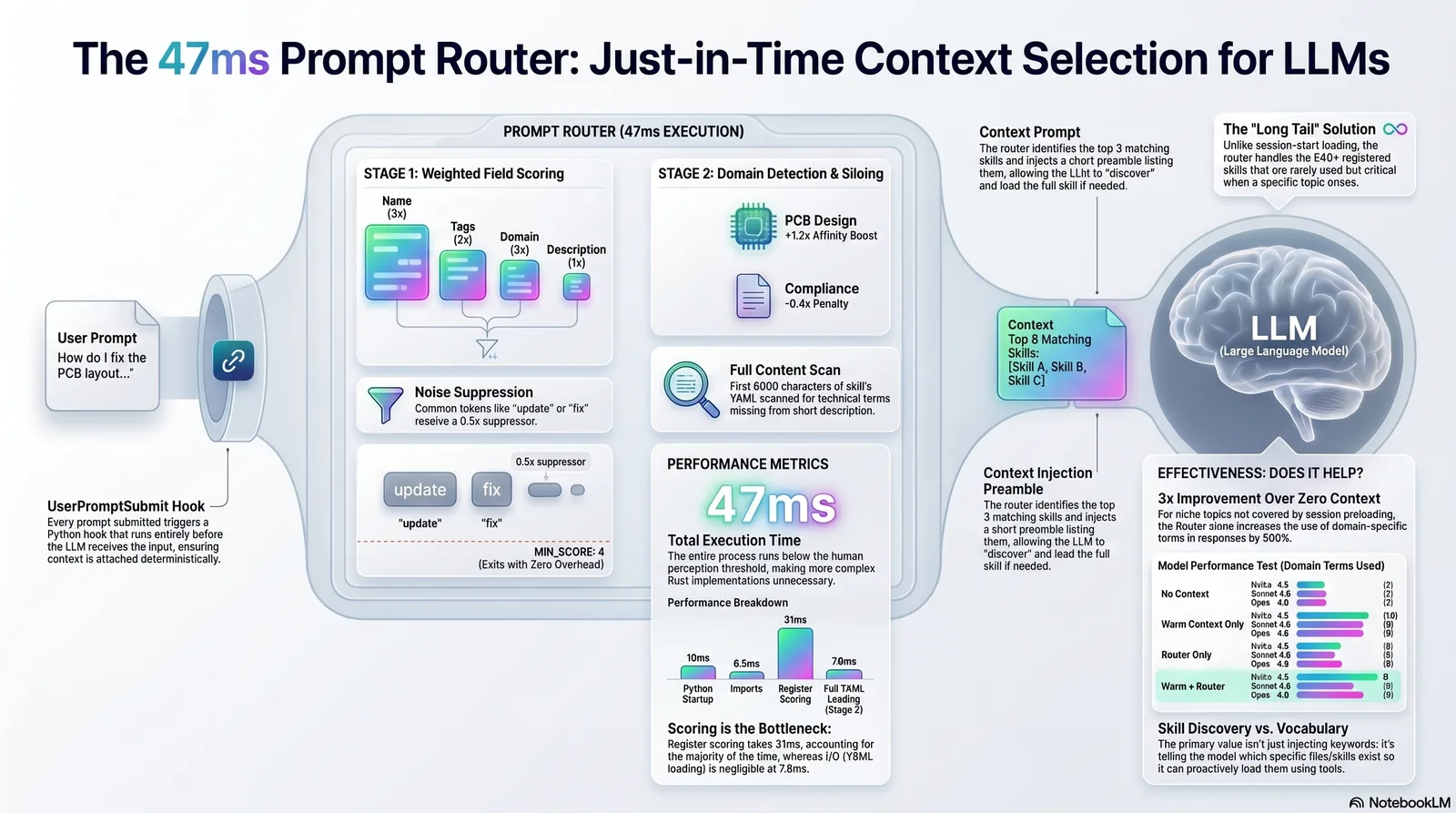
Infographic generated by NotebookLM from this post.
What It Does
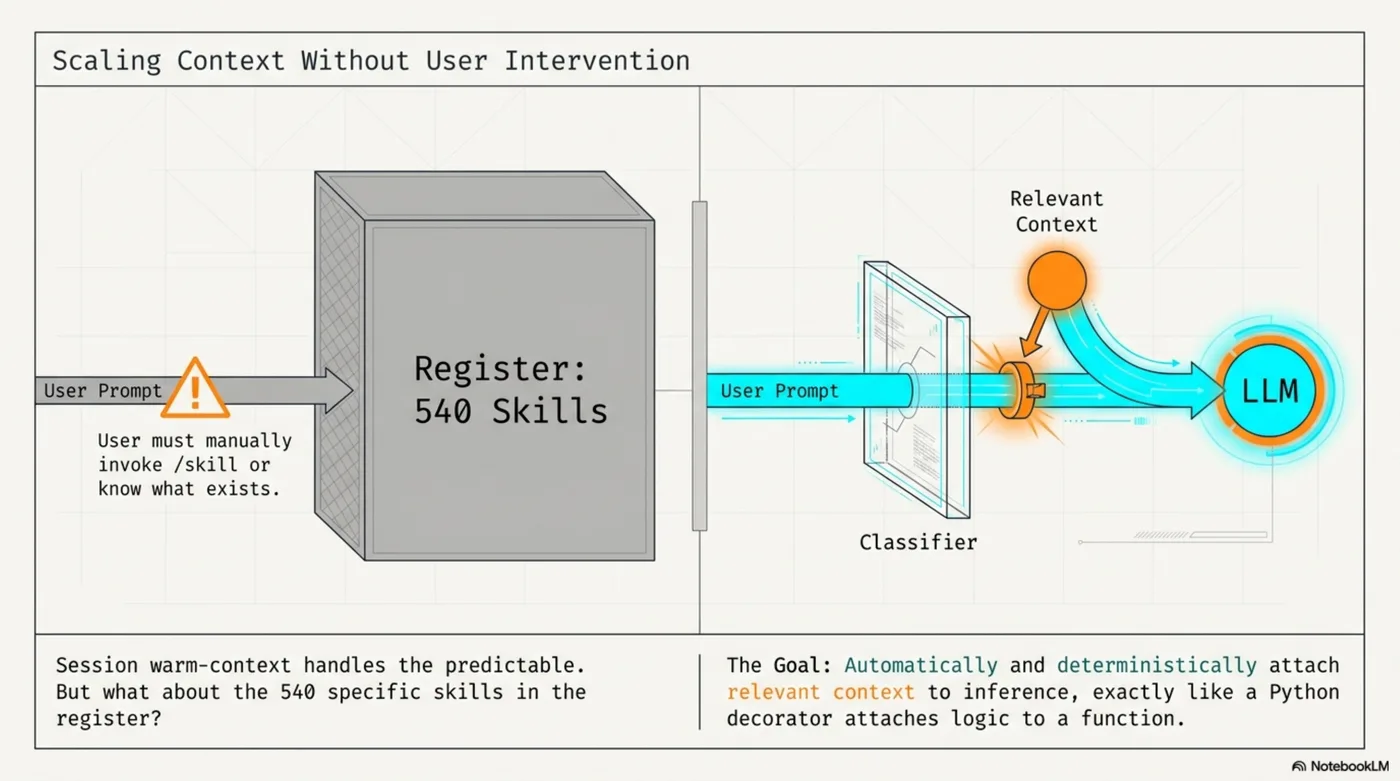
Every time a prompt is submitted in Claude Code, a UserPromptSubmit hook runs before the LLM sees it. The hook takes the prompt, tokenizes it, scores each skill in the register against those tokens, and injects a short preamble listing the top 3 matches.
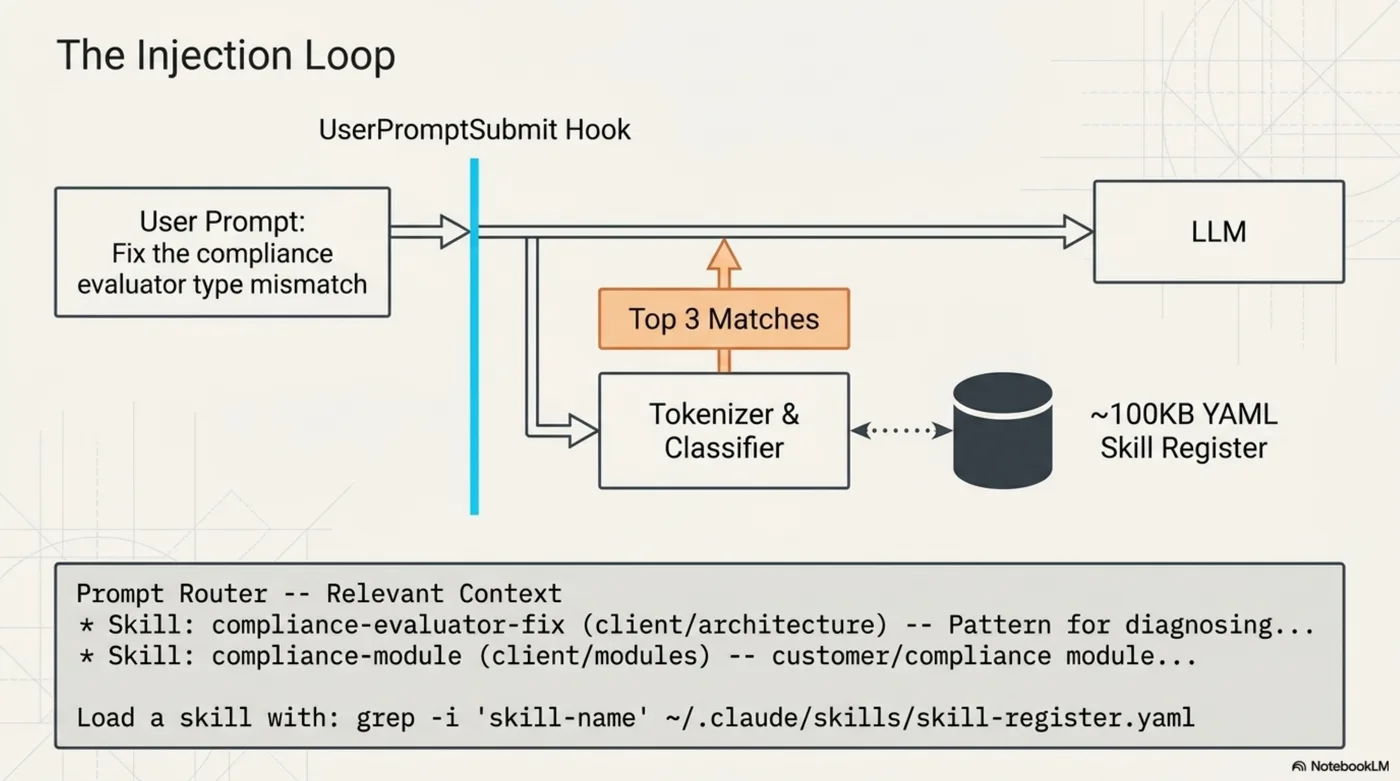
The LLM sees this before your prompt. It knows which skills exist for the current topic, and can load them if the work requires it. No configuration. No manual /skill invocations. No remembering what's in the register.
The Algorithm
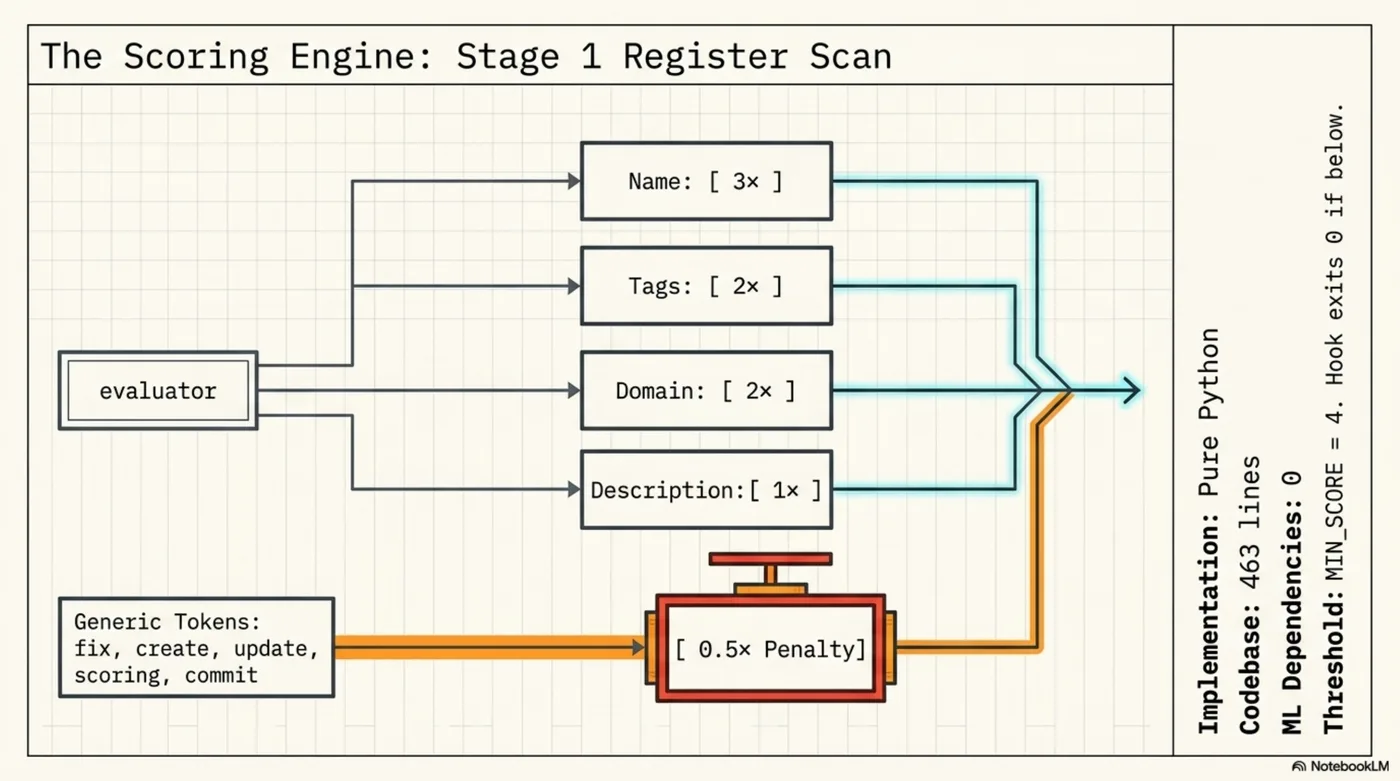
Pure Python. 463 lines. No ML.
Stage 1 — Register scoring. The skill register (~100KB YAML) has name, domain, tags, and a one-line description per skill. Each field is tokenized and weighted:
| Field | Weight |
|---|---|
| Name | 3× |
| Tags | 2× |
| Domain | 2× |
| Description | 1× |
Generic tokens (fix, create, update, scoring, changes, commit, tool) get a 0.5× suppressor to prevent noise from everyday words.
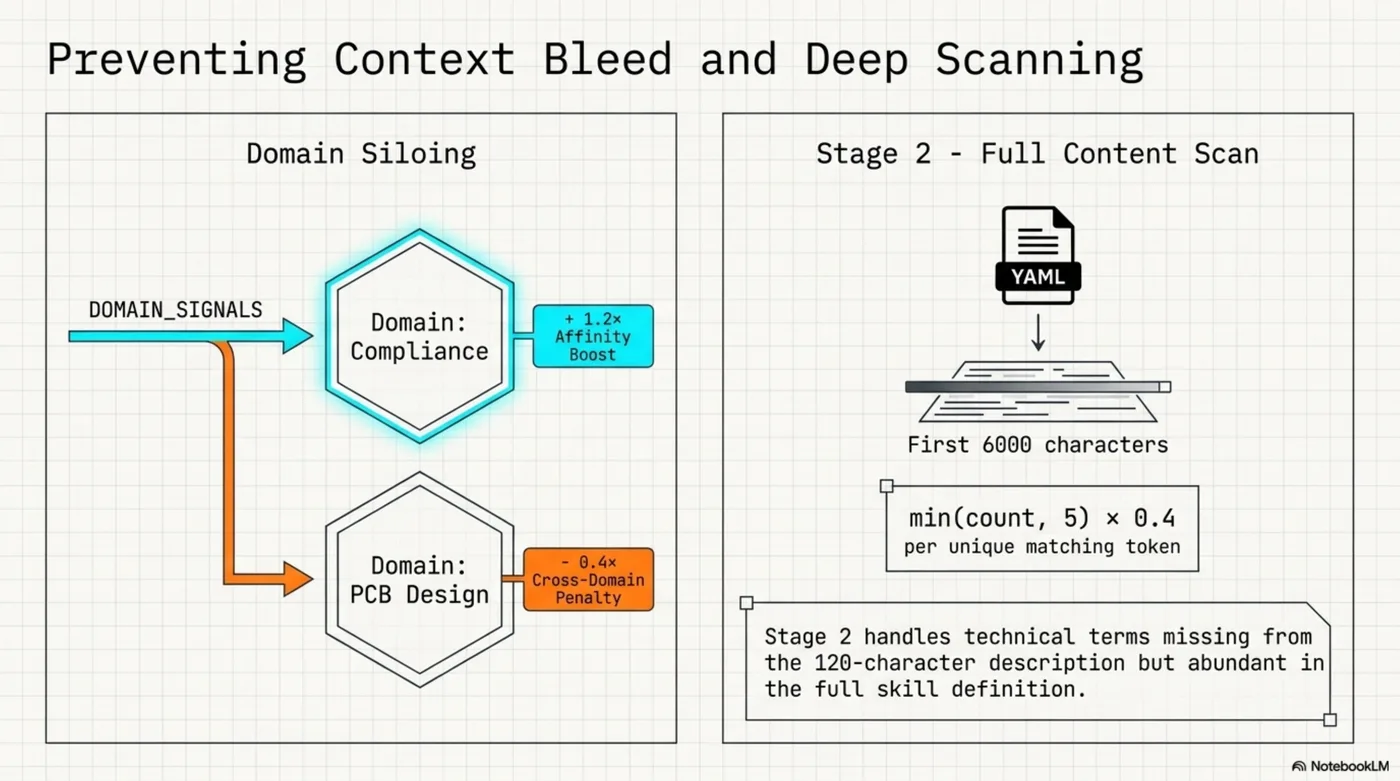
Domain detection and Stage 2. A DOMAIN_SIGNALS dict maps domains to their specific vocabulary. When signals fire, in-domain skills get a 1.2× affinity boost and other siloed domains get a 0.4× cross-domain penalty. When a domain is detected, Stage 2 loads the first 6000 characters of each domain skill's YAML and scores by token frequency: min(count, 5) × 0.4 per unique matching token.
Threshold. MIN_SCORE = 4. Below this: nothing injected, hook exits 0, zero LLM overhead.
Tuning: Where It Failed First
Getting to 13/13 precision required four iterations.
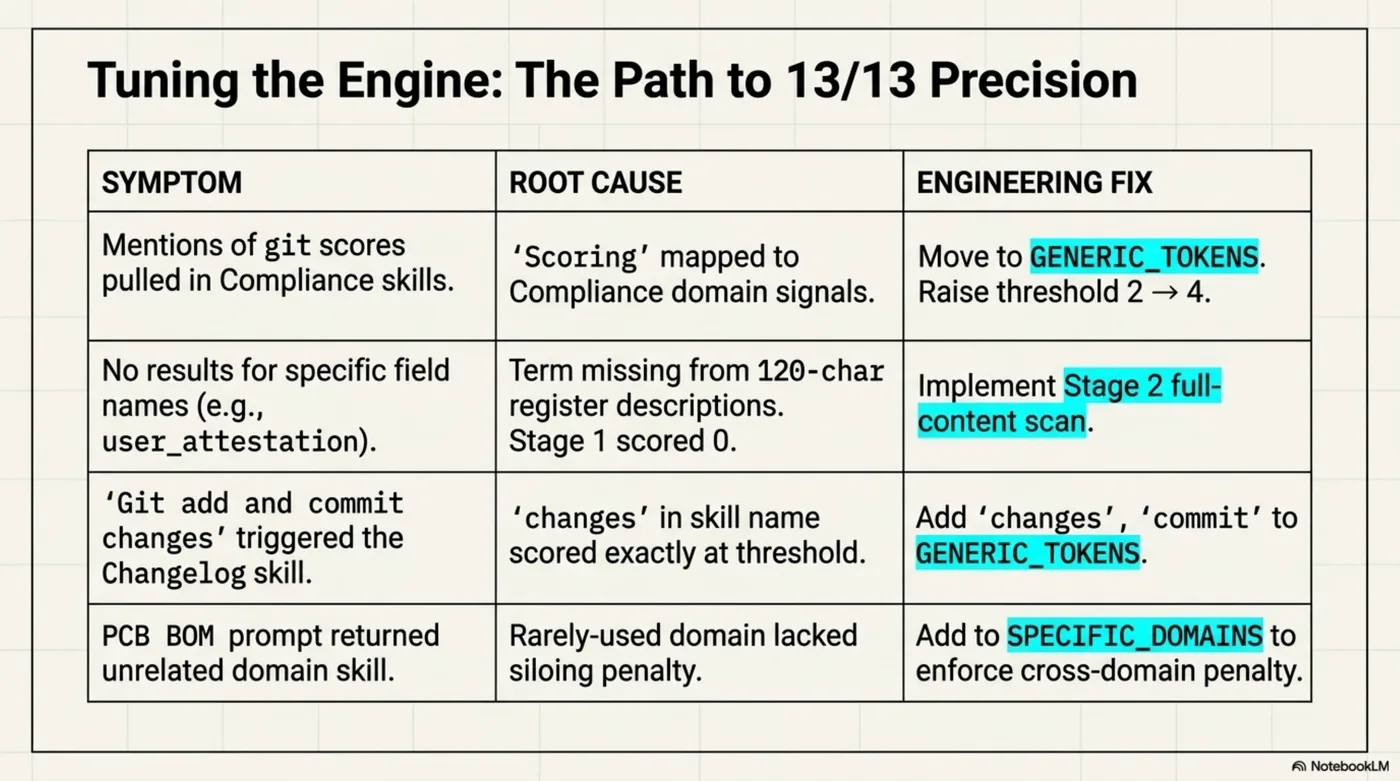
The pattern across all four failures: a word that seemed domain-specific turned out to be generic, or a score landed exactly at threshold, or a technical term wasn't surfaced by the 120-char description. Each required a targeted fix rather than raising the threshold globally.
Performance
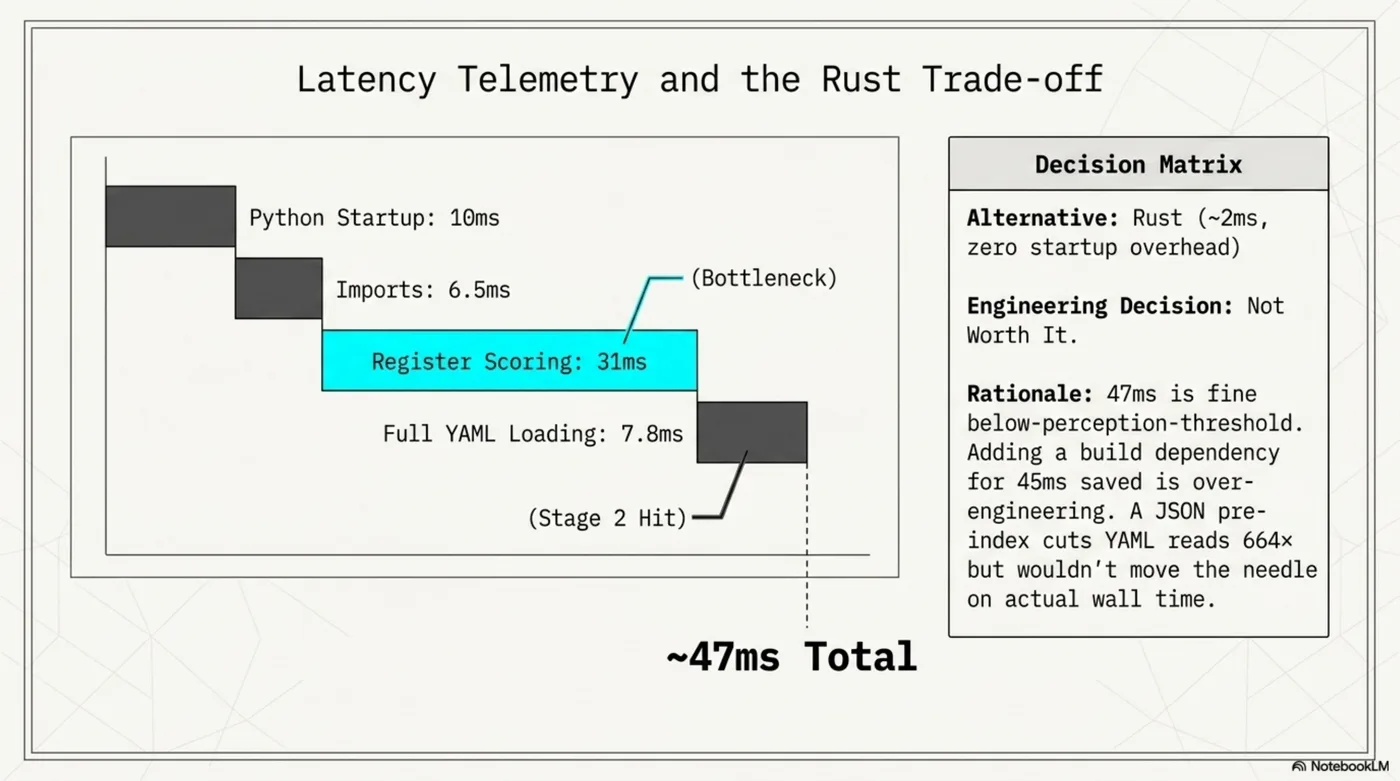
Measured over 50 runs:
| Phase | Time |
|---|---|
| Python startup | 10ms |
| Imports | 6.5ms |
| Register scoring (bottleneck) | 31ms |
| Full YAML loading (Stage 2, domain hit) | 7.8ms |
| Total | ~47ms |
The alternative was Rust: ~2ms, no startup overhead. Not worth it. The 47ms is below the threshold where users notice, and adding a build dependency for 45ms saved is over-engineering. The scoring loop (31ms) is the actual bottleneck, not I/O — a JSON pre-index would cut YAML reads 664× but wouldn't move the needle on wall time.
Does It Actually Help? (The Honest Answer)
This question had a wrong answer before it had a right one.
First test: I manually crafted "router output" containing full technical detail — field names, file paths, method signatures. Result: 0 → 10 domain-specific terms in LLM responses. Looked impressive. It was fake. The real router outputs 120-char truncated descriptions, not field names.
Honest test: vague prompt (no domain terms in it), actual router output, three model tiers, four conditions:
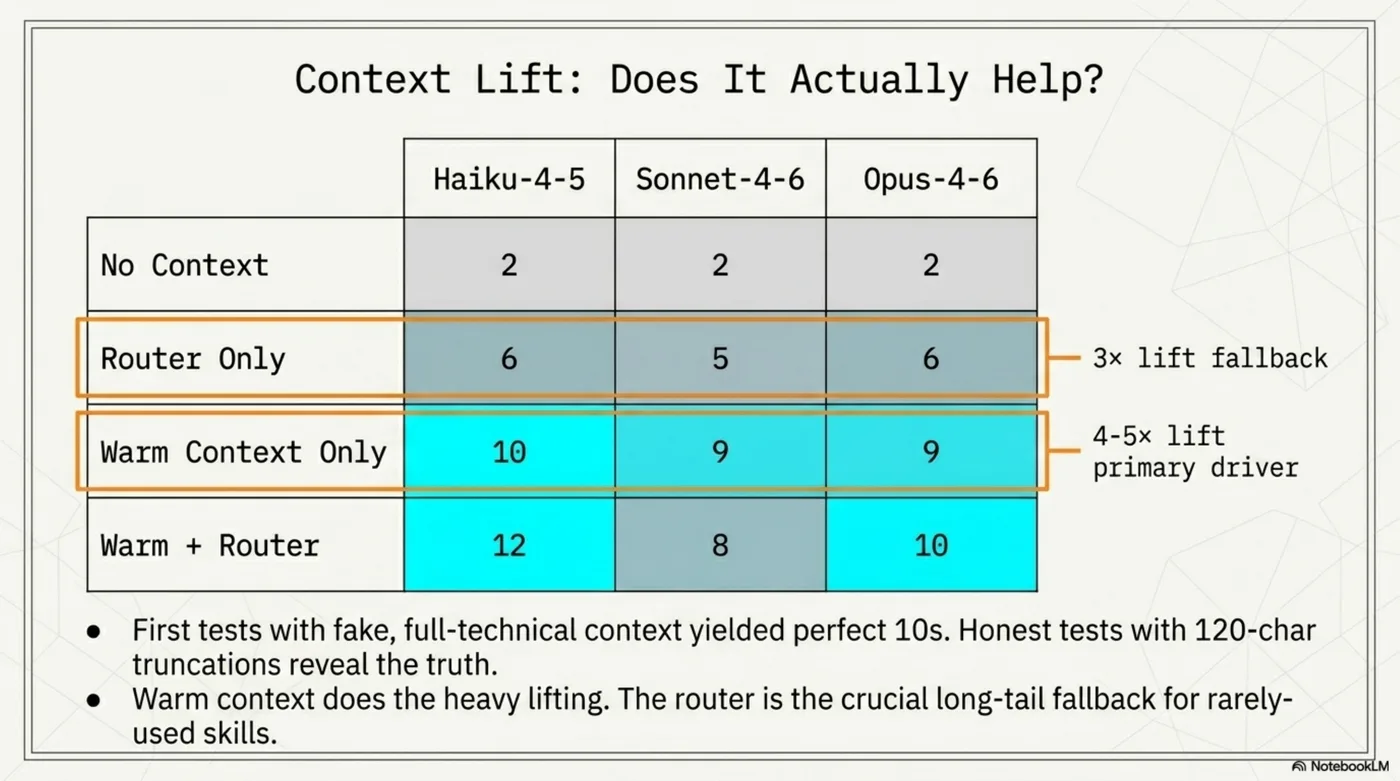
Warm context does the heavy lifting. Session preloading — HOT/WARM/COLD topic loading — takes the response from 2 terms to 9-10. That's the 4-5× lift. The router adds 1-2 terms on top.
Router-only is the useful fallback. When warm context doesn't cover the specific topic — a rarely-used skill area, a new module, something that wasn't hot this session — the router alone gives 3× improvement over nothing.
Models respond differently. The router output is not just data — it's an affordance. How a model uses that affordance depends on its tier.
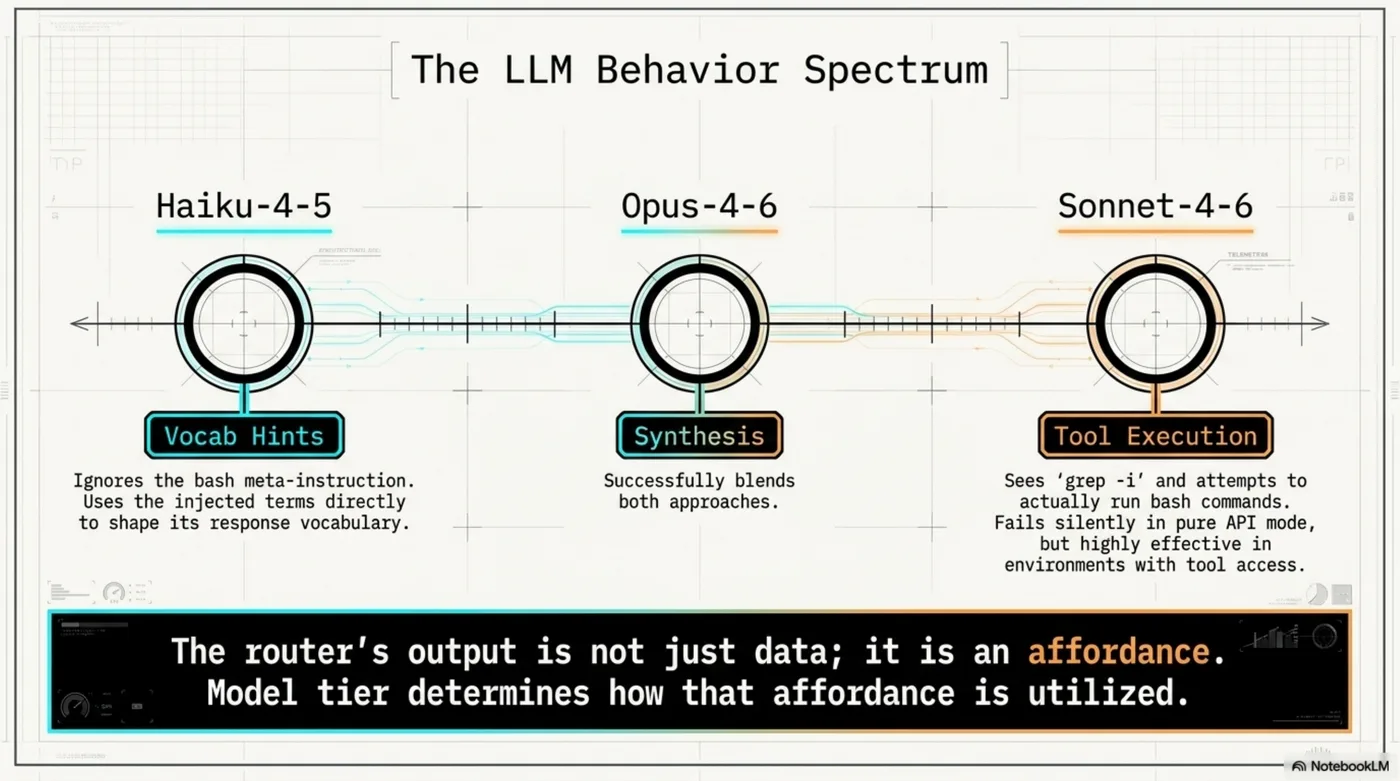
Haiku uses the injected terms as vocabulary hints directly. Opus synthesizes both the hints and the context. Sonnet-4-6 sees _Load a skill with: grep..._ and tries to actually run bash commands before answering. In a pure API context, this fails silently. In real Claude Code with tool access, it would proactively load the full skill YAML — which would make sonnet the strongest of the three. Model tier determines how the affordance is utilized.
The primary value isn't vocabulary injection.
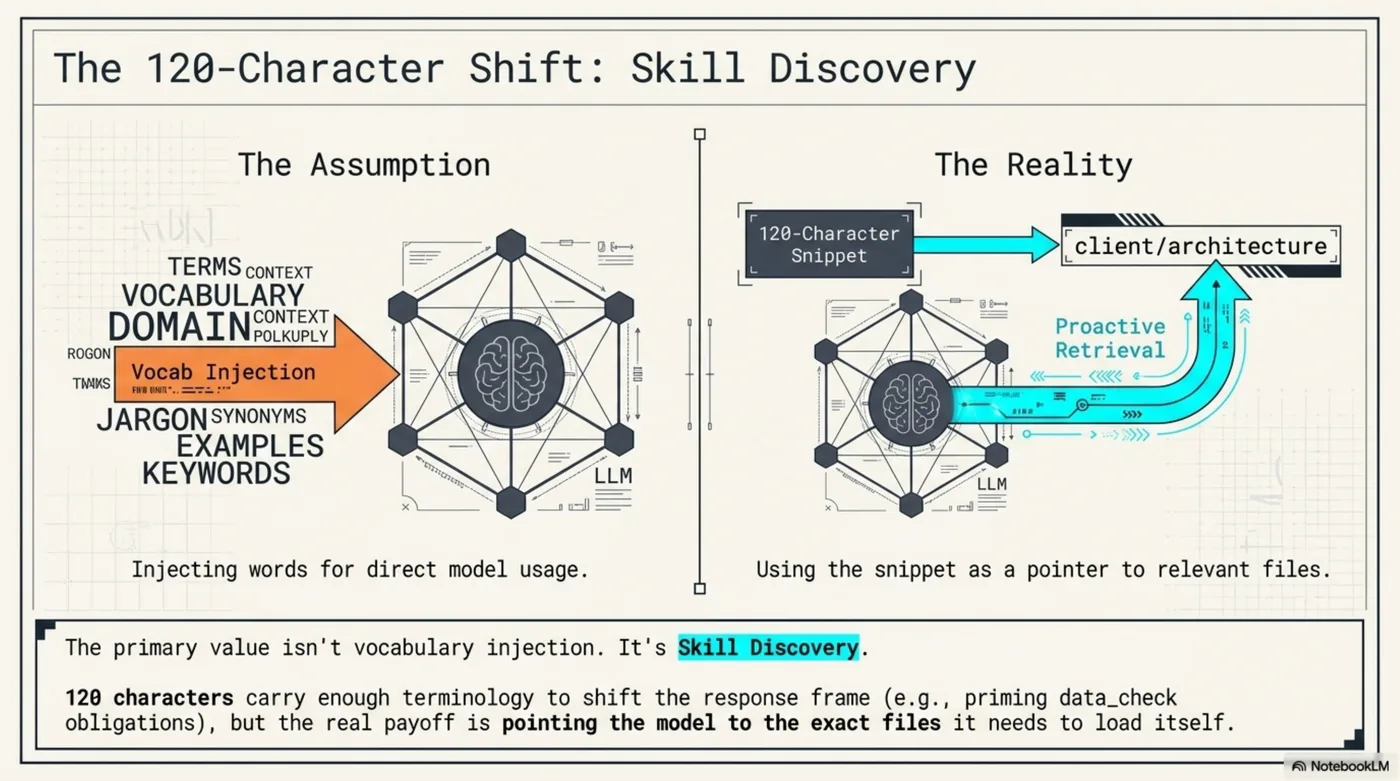
The 120-char snippets carry enough terminology to shift the response frame, but the real payoff is pointing the model to the exact files it needs to load itself. Skill discovery, not vocabulary injection.
Two Strategies, One Pattern
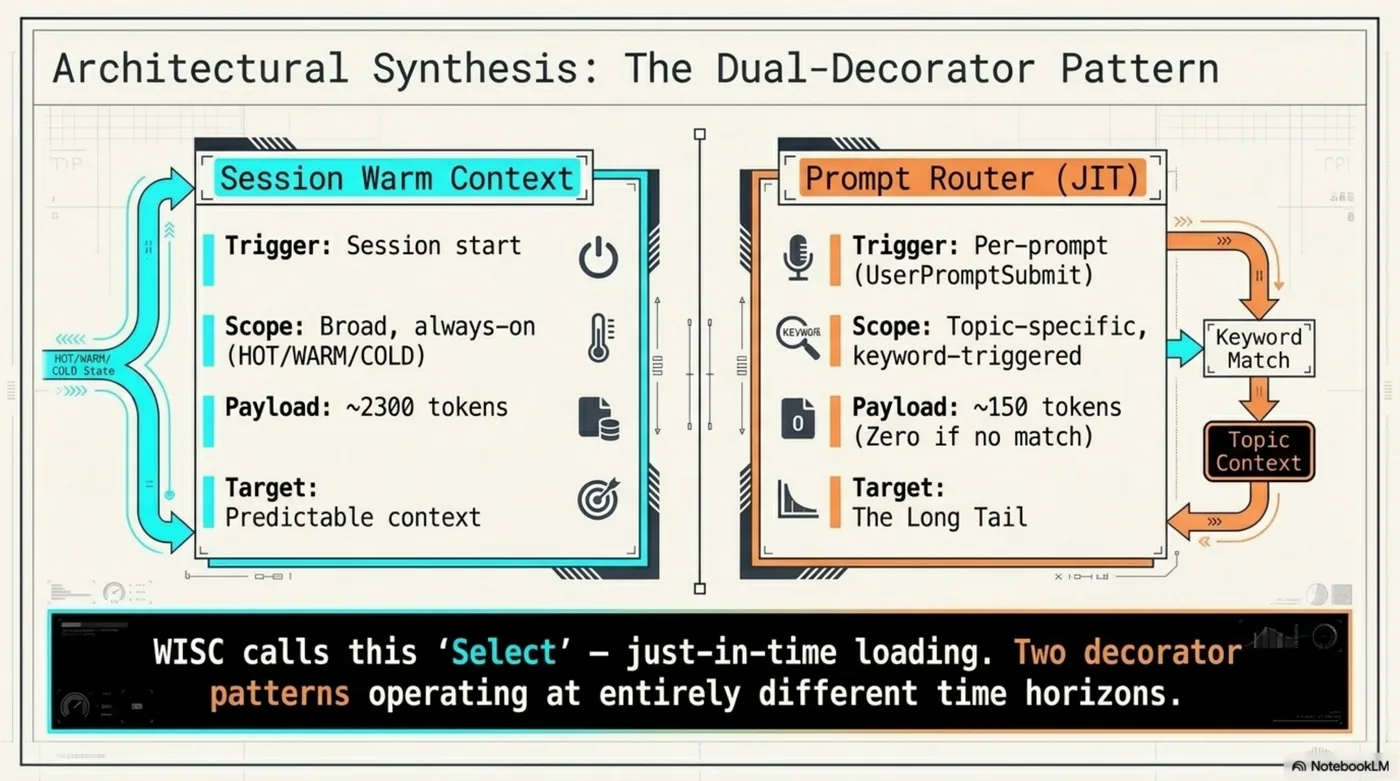
The router is one instance of what Daniel Bentes called "Decorators for Prompts." ExoCortex runs two versions:
Session warm context — fires at session start. Loads HOT/WARM/COLD topics based on recent activity. Broad, always-on, pre-classified. ~2300 tokens per session.
Prompt router — fires on every prompt. Topic-specific, keyword-triggered. Zero cost when the prompt doesn't match anything. ~150 tokens when it fires.
WISC calls this "Select" — just-in-time loading. Both are decorator patterns operating at different time horizons. The session loader handles predictable context. The router handles the long tail.
Two New Skills
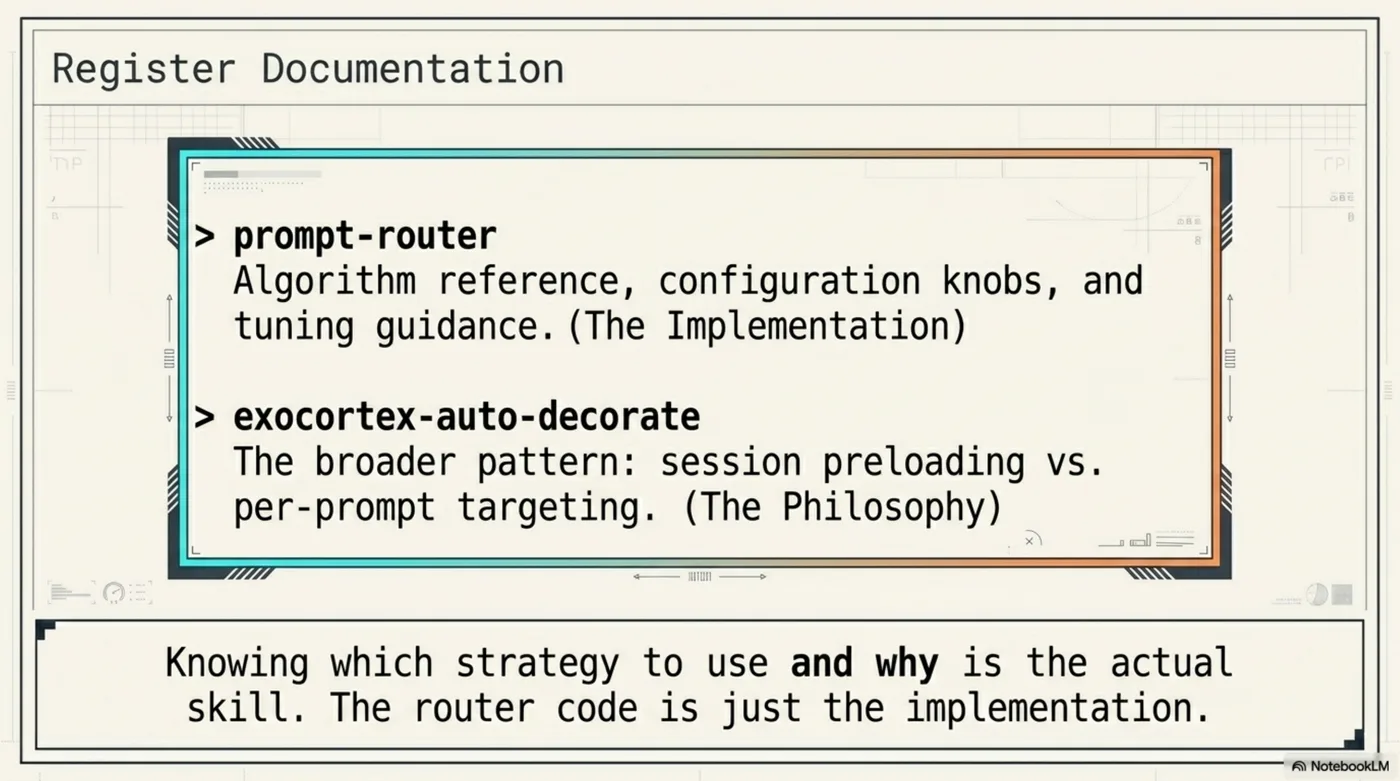
Both now in the register:
prompt-router — algorithm reference, configuration knobs, tuning guidance. Use when the router misfires or needs a new domain added.
exocortex-auto-decorate — the broader pattern: when to use session preloading vs per-prompt targeting, how the two layers interact, how to extend either.
The distinction is worth naming explicitly. Knowing which strategy to use and why is the actual skill. The router code is just the implementation.
Router: ~/.kcp/prompt-router.py · Skills: grep -i 'prompt-router\|auto-decorate' ~/.claude/skills/skill-register.yaml
Credit: Daniel Bentes — "Decorators for Prompts" (LinkedIn, April 2026)