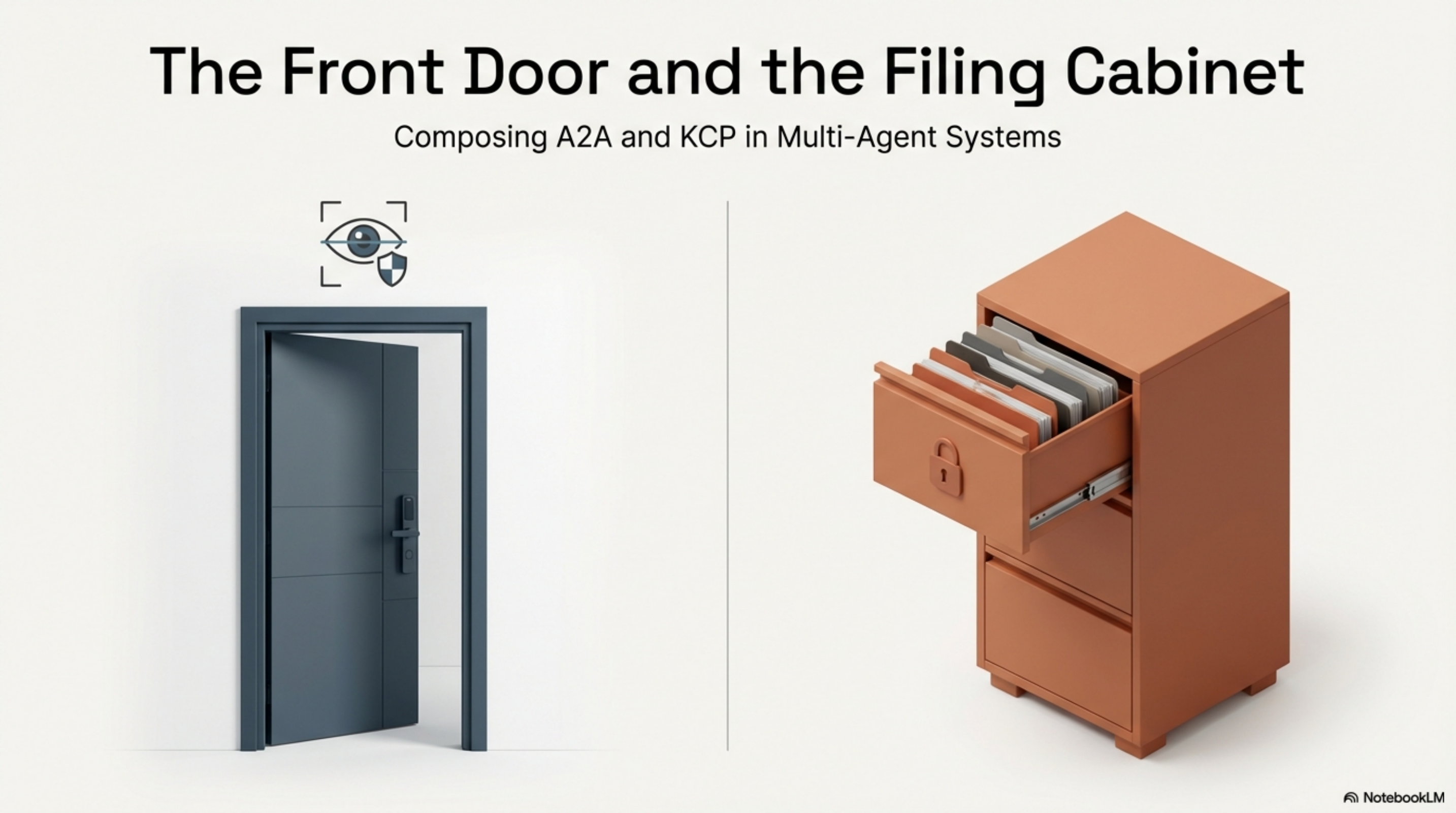
Multi-agent systems need two kinds of identity. The first answers "who is this agent and how do I call it." The second answers "what knowledge does this agent have and who is allowed to see each piece of it." Google's A2A protocol handles the first. KCP handles the second. They are not competitors. They are different layers of the same stack.
This post started as that explanation. Then, the same day it was published, we built four simulators and 150 adversarial tests against the spec. The tests found 8 concrete gaps. Those gaps are now driving KCP v0.7. The full story follows.
A few days ago we prepared a roadmap for bringing KCP to GitHub Copilot users. Three phases,
estimated ten days. This is the post where I explain that we shipped all three phases today —
and then shipped a fourth: a complete zero-MCP path for enterprises that cannot run MCP servers.
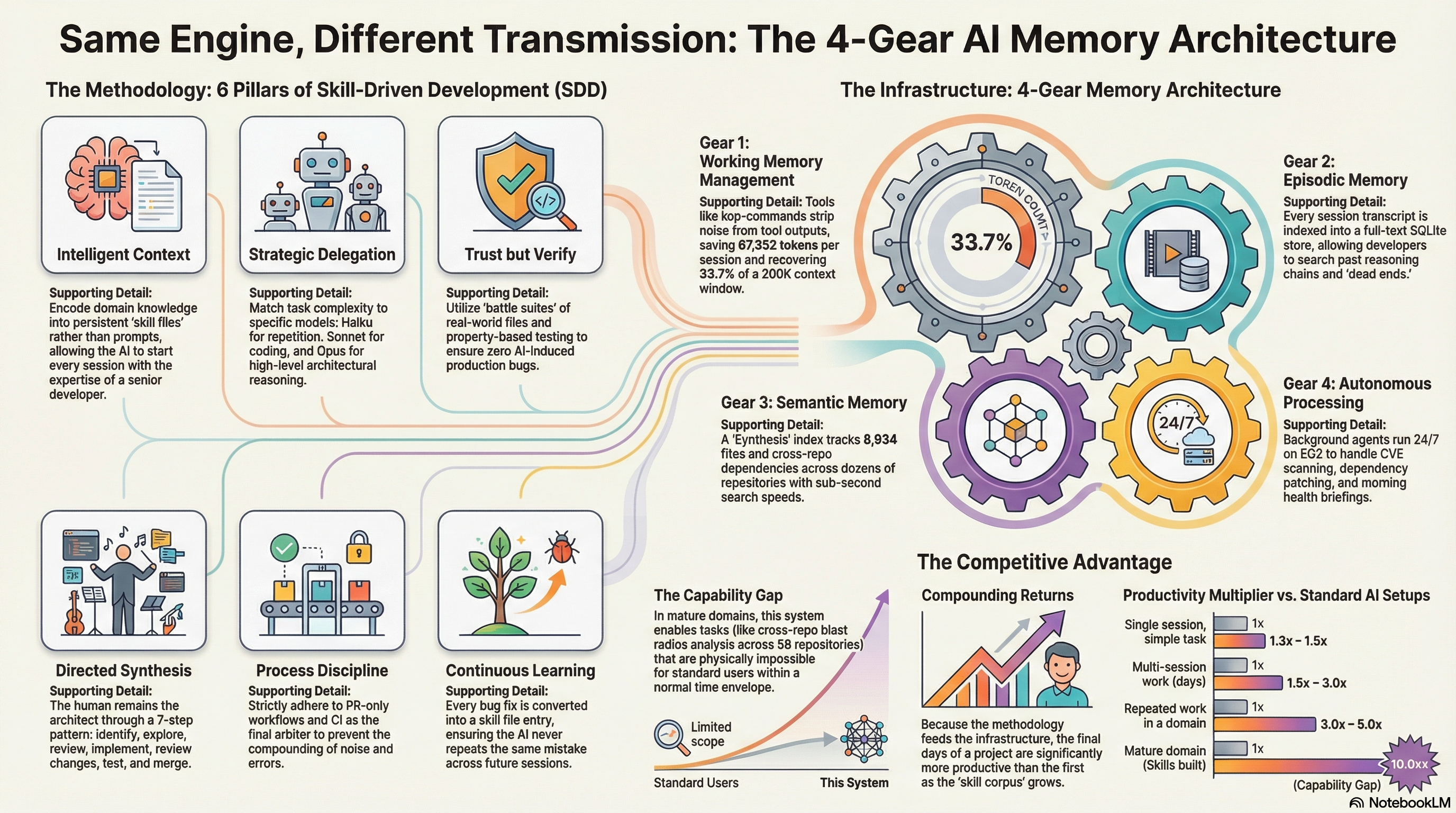
Most AI productivity discussion asks the wrong question. "How much faster?" assumes the difference is speed. It is not. Two developers using the same model, the same IDE integration, the same subscription tier -- one of them starts every session cold and the other does not. The gap between them is not the engine. It is the transmission. But the transmission alone is not the full story either. There is a third variable: how the driver was trained.
Every token Claude Code's context window can hold is an opportunity — a tool call result
that stays in scope, a file that does not need to be re-read, a decision that does not
need to be recapped. Wasting those tokens on noise is a quiet tax on every session.
Today we are releasing kcp-commands: a Claude Code hook that recovers 33.7% of a
200K context window in a typical agentic coding session by intercepting Bash tool calls
at two critical points.
The full number across our benchmark session: 67,352 tokens saved.
Update (March 3, 2026 — v0.9.0): kcp-commands now writes a JSON event to
~/.kcp/events.jsonl on every Phase A Bash hook call. kcp-memory v0.4.0
ingests that stream to provide tool-level episodic memory — kcp-memory events search
"kubectl apply" returns every time Claude ran that command across all your projects.
Phase A gives Claude vocabulary. Phase B cleans output. Phase C remembers what ran.
Every Claude Code session starts the same way. The context window is empty. The agent
has no recollection of what it did yesterday, which files it touched last week, or how
it solved a similar problem three sessions ago. Each session is day one.
That is not a limitation of the model. It is a missing infrastructure layer.
Today we are releasing kcp-memory v0.1.0: a standalone Java daemon that indexes
~/.claude/projects/**/*.jsonl session transcripts into a local SQLite database with
FTS5 full-text search. Ask it "what was I working on last week?" and it answers in
milliseconds.
Update (same day — v0.2.0): kcp-memory now ships with tool-level granularity.
kcp-commands v0.9.0 writes every Bash tool call to
~/.kcp/events.jsonl; kcp-memory ingests that stream and makes individual commands
searchable via kcp-memory events search. Session-level and tool-level memory in one
daemon, one database, zero additional dependencies.
Update (same day — v0.3.0): kcp-memory now ships as an MCP server. Run
java -jar ~/.kcp/kcp-memory-daemon.jar mcp — registered in mcpServers in
~/.claude/settings.json — and Claude Code can call kcp_memory_search,
kcp_memory_events_search, kcp_memory_list, and kcp_memory_stats inline during a
session, without leaving the context window.
Update (same day — v0.4.0): Two new MCP tools close the remaining gaps.
kcp_memory_session_detail(session_id) returns full session content — user messages,
files touched, tools used — completing the search → read flow. kcp_memory_project_context()
reads PWD from the process environment and returns the last 5 sessions and 20 tool events
for the current project, with no query needed. Call it at the start of every session and
Claude immediately knows what it was doing here last time.
kcp-commands recovers 33% of Claude Code's context window
by intercepting Bash tool calls. Today we are extending that same principle to
OpenCode — the 114K-star TypeScript alternative to
Claude Code.
The result is opencode-kcp-plugin: a plugin
that injects a knowledge.yaml knowledge map into every OpenCode session and annotates file
search results with intent descriptions. The mechanism is different from kcp-commands, and the
target is different, but the underlying idea is identical: give the agent a map so it does not
have to rediscover the territory on every session.
Every session starts from zero. The agent cannot remember the decision it helped you make last Tuesday, the bug it spent three hours debugging last week, or the architectural pattern you established last month. This is not a model capability problem. It is a memory architecture problem — and it has a tractable solution.
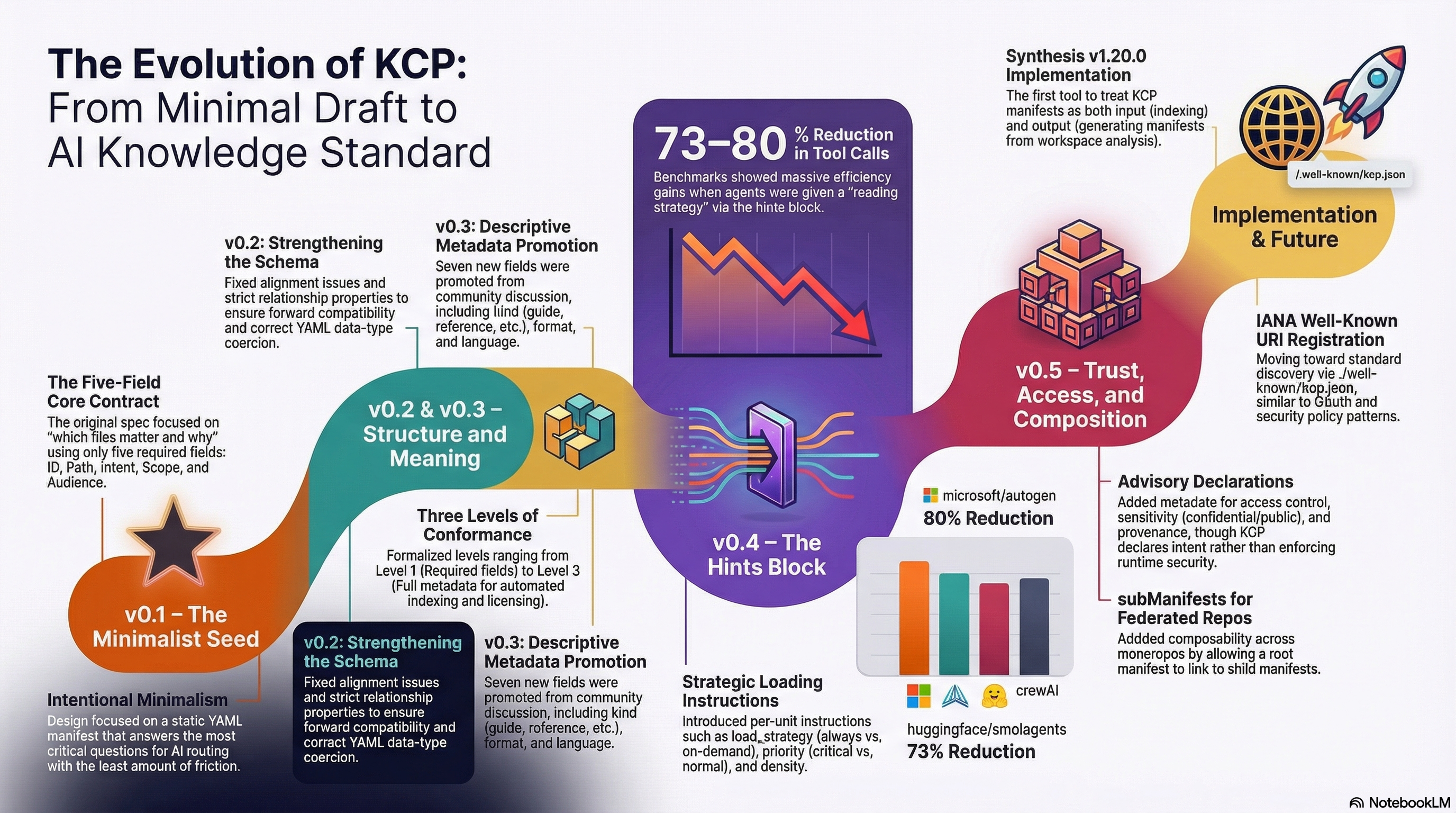
KCP (Knowledge Context Protocol) has gone from a draft proposal to a v0.5 spec in one
week. This post walks through what each version added, why those decisions were
made, and where the spec is heading next.
The short version: every release promotes optional fields from community RFCs into the
normative core. The spec is a strict superset at each step — a manifest written for v0.1
is still valid under v0.5.