Every Agent That Queries a Knowledge Manifest Reinvents Filtering¶
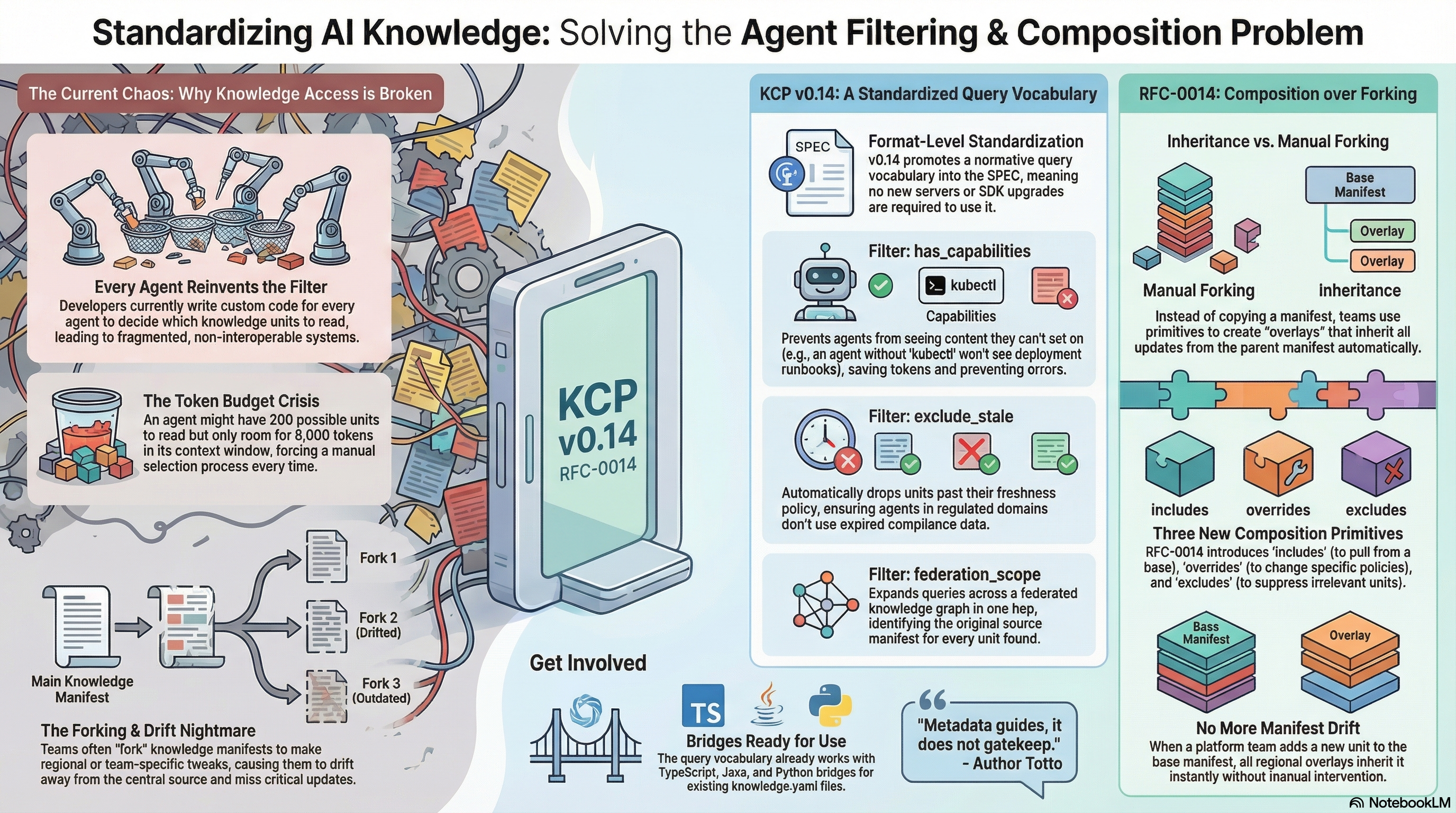
Your agent has a task, a token budget, and a manifest with 200 knowledge units. Which units should it actually read? Every team answers this question differently — custom audience filters, ad-hoc staleness checks, bespoke capability gates. The logic works, but none of it interoperates. Swap one tool for another and you rewrite the glue.
KCP v0.14 standardises the query. RFC-0014 standardises composition. Together, they solve the two problems that make knowledge manifests painful at scale.
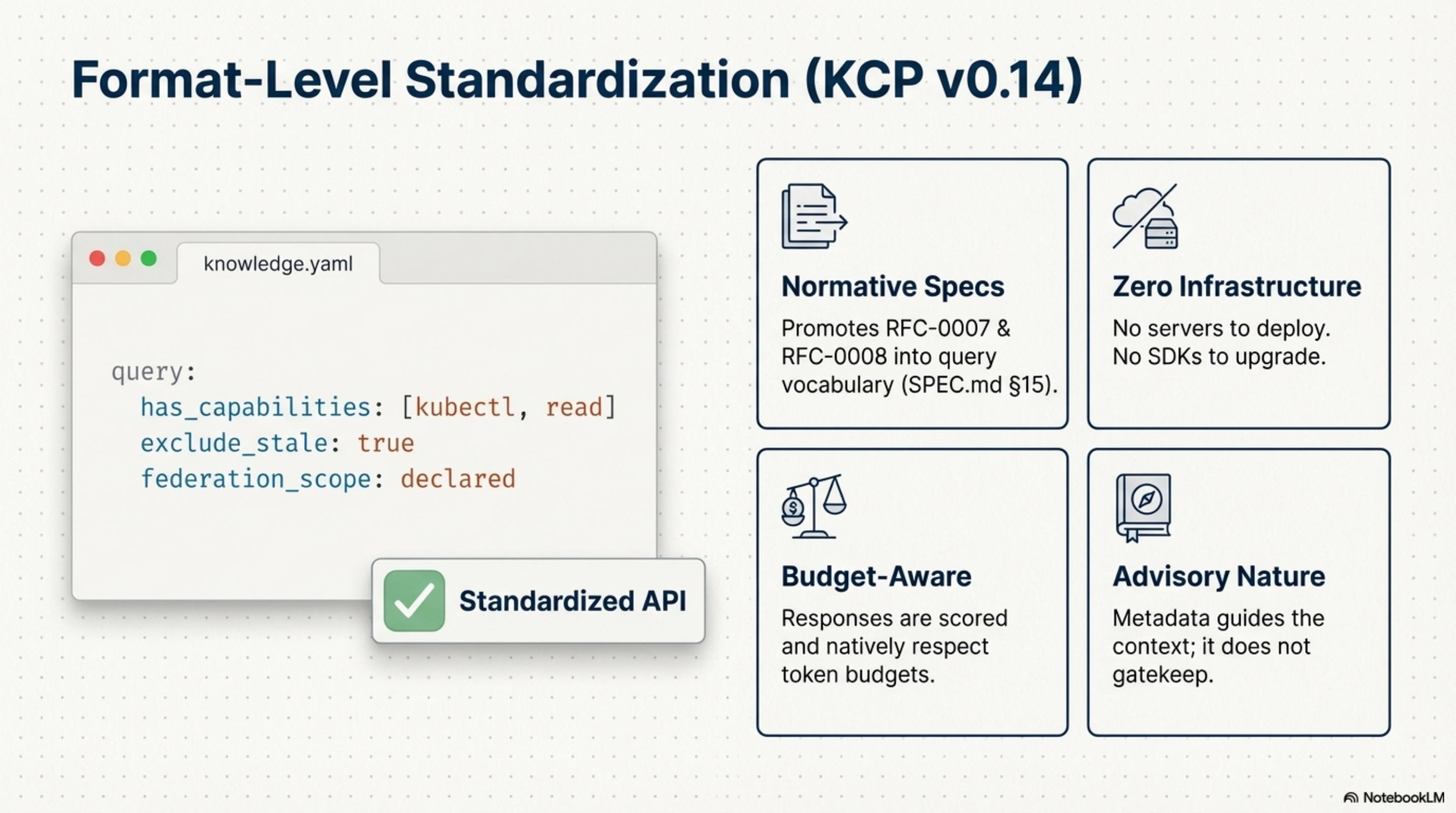
Both are format-level changes. No servers to deploy, no SDKs to upgrade. If you have a knowledge.yaml, you can start using the query vocabulary today. Composition is an open RFC — we want your input before it ships.
Repo: github.com/cantara/knowledge-context-protocol
The Token Budget Dilemma¶
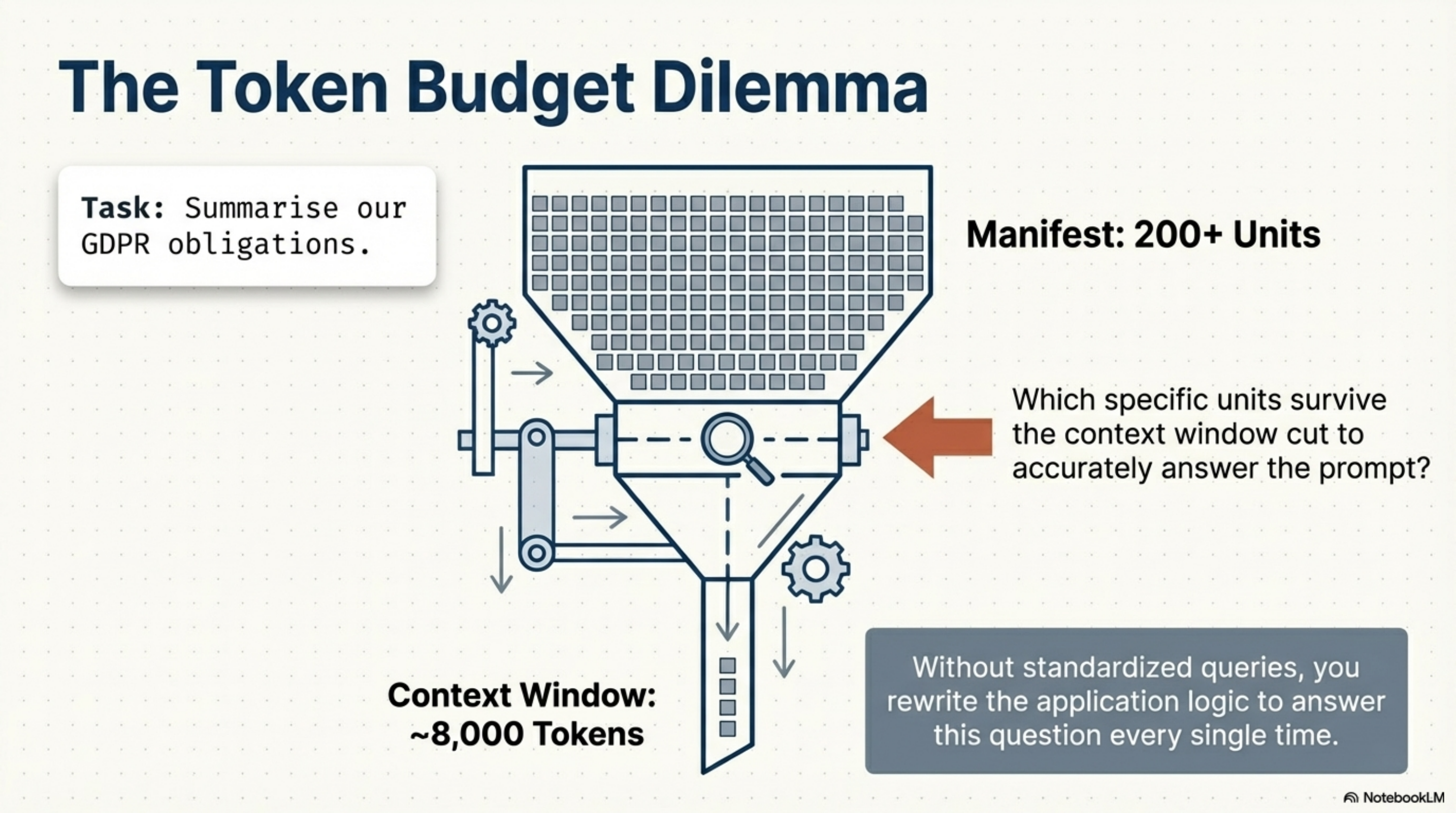
An agent gets a task: "summarise our GDPR obligations." The manifest has 200 units. The context window fits maybe 8,000 tokens of loaded content. Task + token budget + manifest = an unsolved selection problem. Every time.
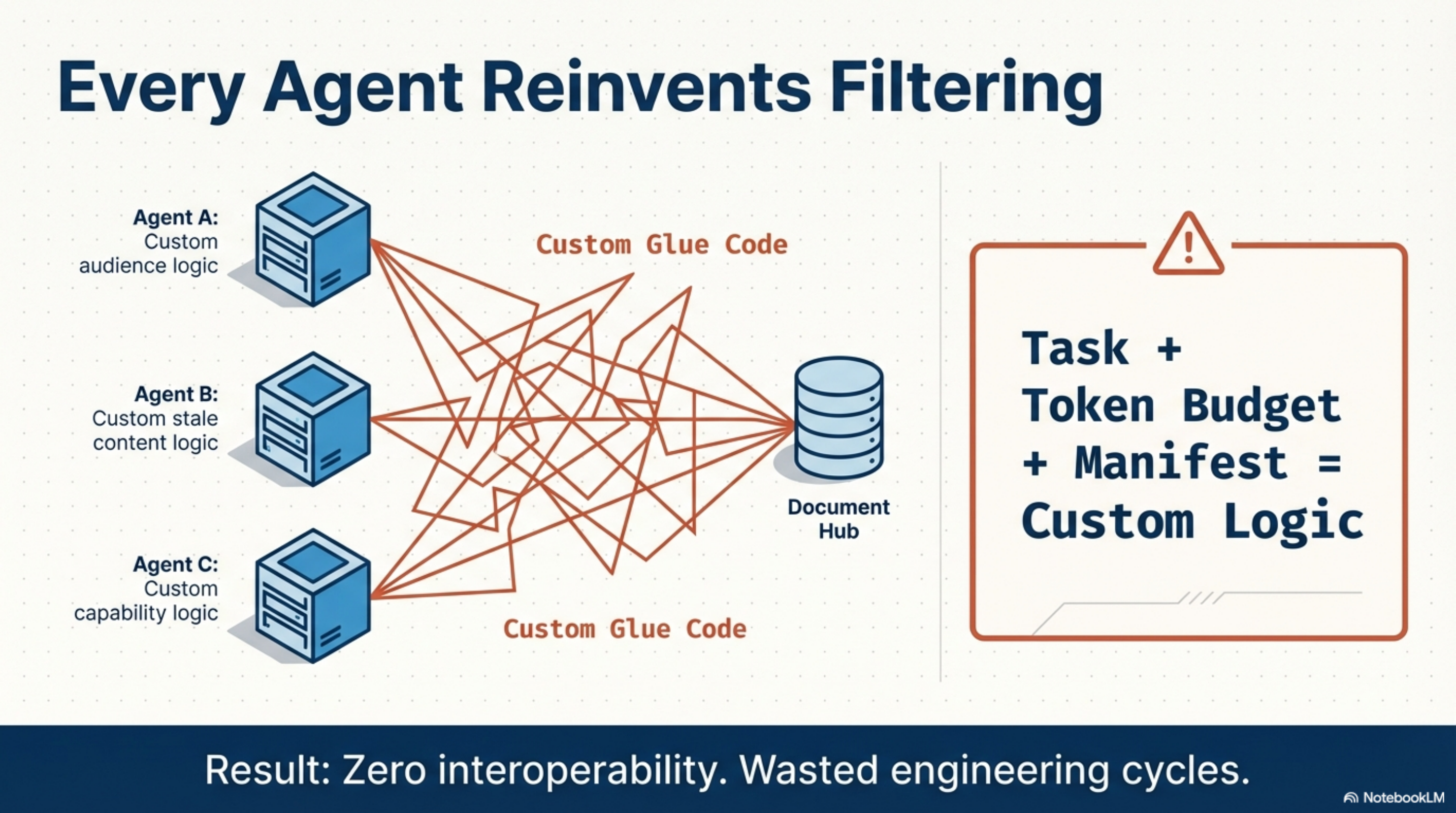
Without a standard, Agent A writes custom audience logic. Agent B writes custom staleness logic. Agent C writes custom capability logic. All three hit the same document hub. All three use different glue code.
Result: Zero interoperability. Wasted engineering cycles.
v0.14 promotes RFC-0007 and RFC-0008 into a normative query vocabulary (SPEC.md §15). All fields are optional. An empty query matches everything:
terms: ["authentication", "oauth2"]
audience: agent
max_token_budget: 8000
has_capabilities: [tool:kubectl, permission:deploy-prod]
exclude_stale: true
federation_scope: declared
The response is scored and budget-aware:
results:
  - unit_id: auth-guide
    score: 13
    path: docs/api/authentication.md
    token_estimate: 4200
    match_reason: [trigger, intent]
    source_manifest: null

  - unit_id: sso-integration-guide
    score: 8
    path: docs/sso.md
    token_estimate: 3100
    match_reason: [intent]
    source_manifest: identity-service
Precision Context Management¶
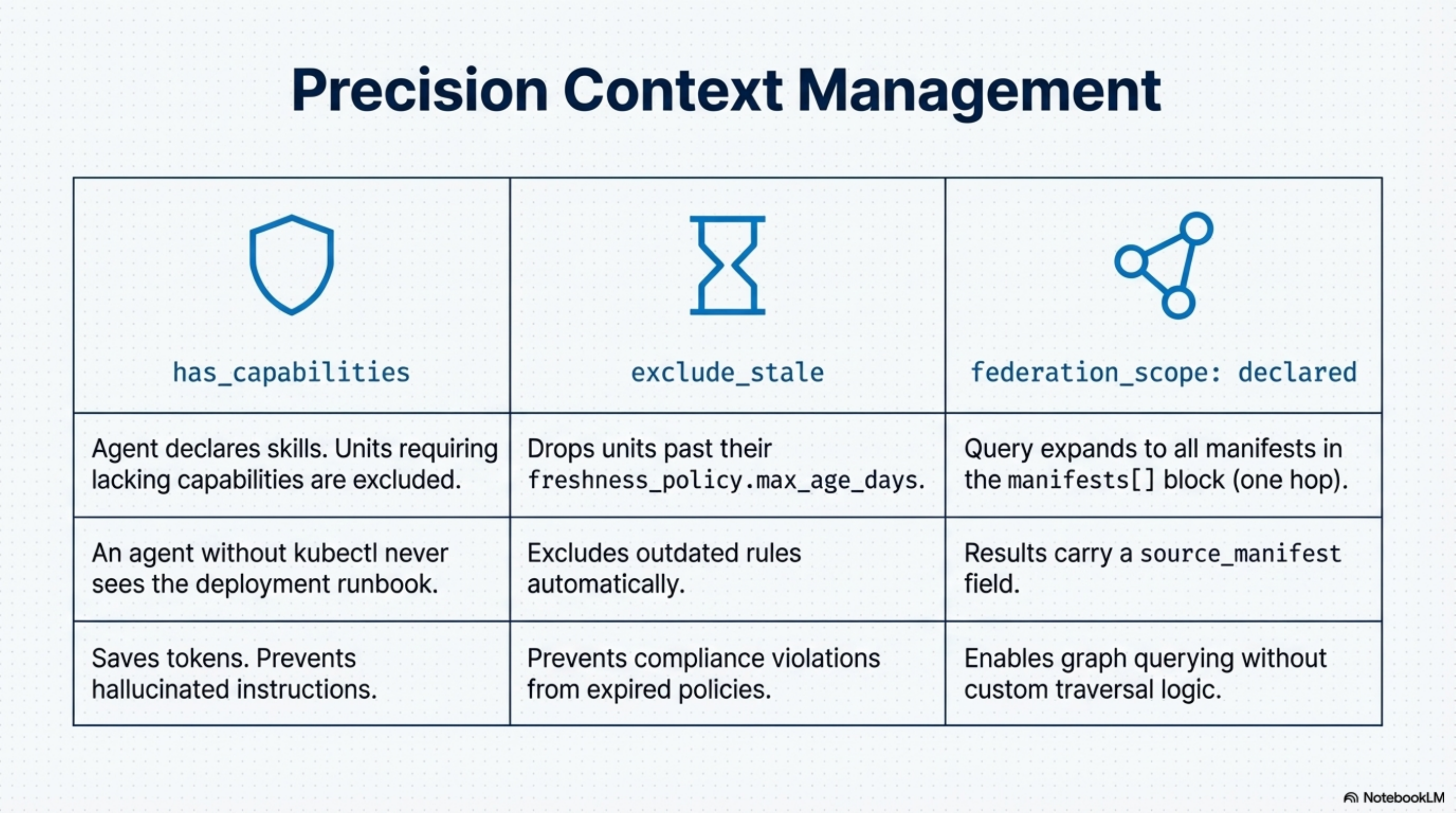
The three new filters in v0.14 are not a grab-bag of features. They are a single idea: let the agent declare its constraints, and let the manifest respond with only what fits.
has_capabilities — the agent states what it can do. Units requiring capabilities the agent lacks are excluded. An agent without kubectl never sees the deployment runbook — saving tokens and preventing it from generating instructions it cannot execute.
exclude_stale — units past their freshness_policy.max_age_days are dropped. In regulated domains, an agent silently basing answers on a compliance policy that expired six months ago is not a minor bug. It is a liability.
federation_scope: declared — the query expands to all manifests in the manifests[] block, one hop. Results carry a source_manifest field so the agent knows where each unit lives. Federated knowledge graph queries, without custom traversal logic.
All of this is advisory. Metadata guides, it does not gatekeep.
Inherit, Don't Copy¶
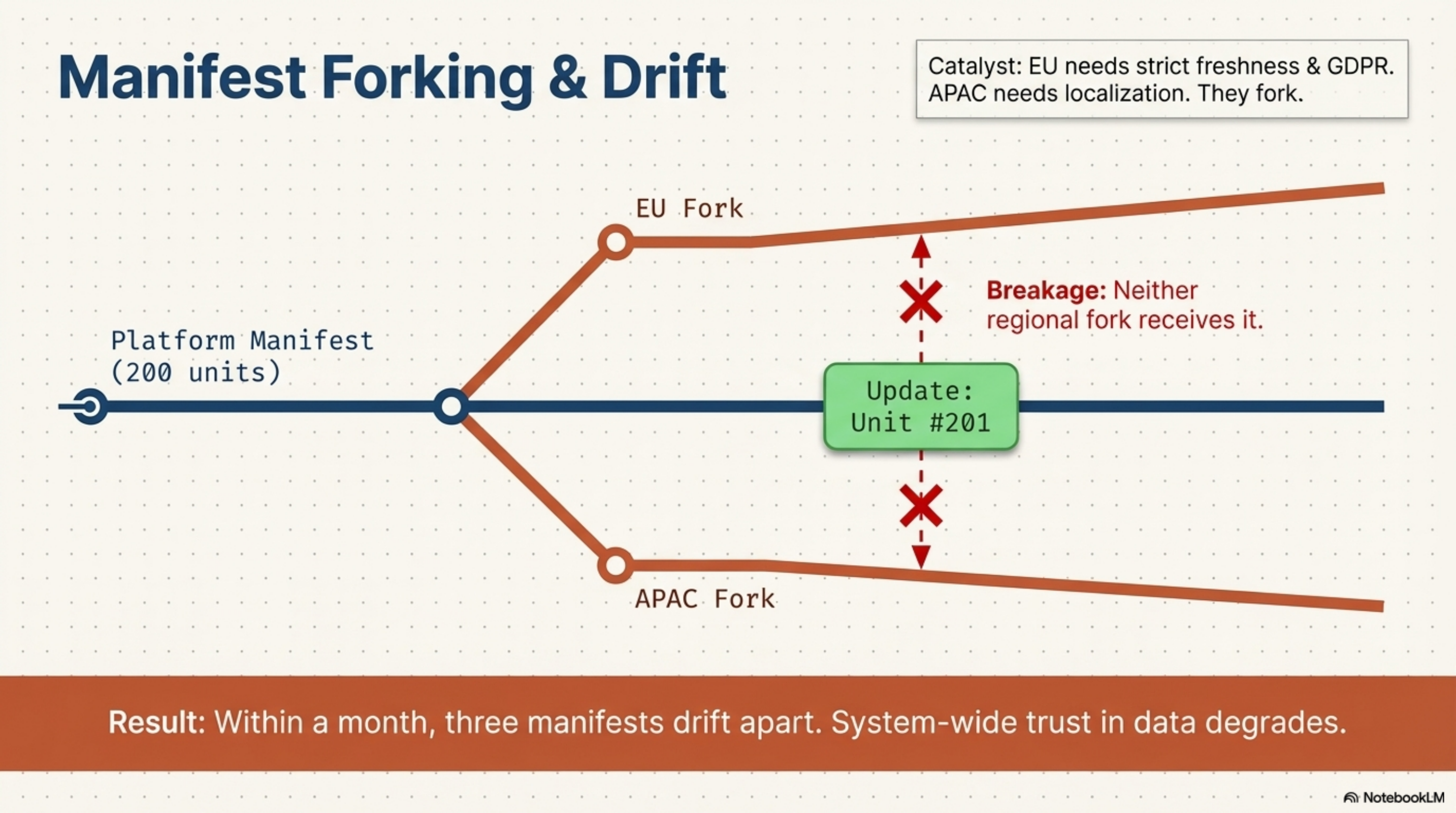
A platform team maintains a manifest with 200 units. The EU compliance team needs those 200 units — but with tighter freshness policies on some, three US-only units suppressed, and GDPR-specific triggers added to others. An APAC team needs the same base with different localised content.
Today, both teams fork. The platform team ships unit #201. Neither fork gets it.
Result: Within a month, three manifests drift apart. System-wide trust in data degrades.
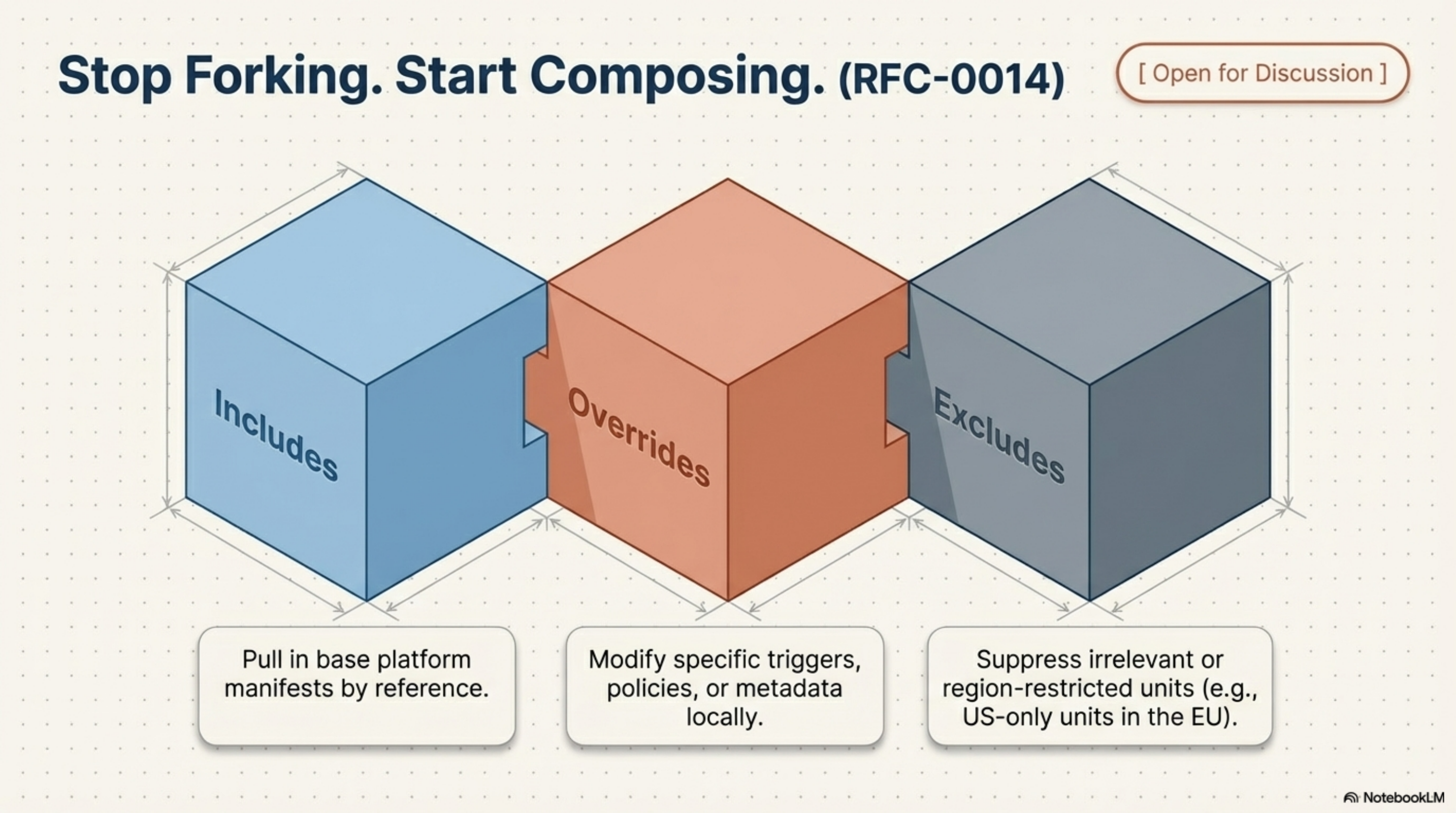
RFC-0014 proposes three composition primitives — includes, overrides, excludes — so you never have to fork again:
# eu-compliance/knowledge.yaml
composition:
  includes:
    - source: https://platform.acme.internal/knowledge.yaml

  overrides:
    - id: data-retention-policy
      triggers: ["GDPR", "data retention", "right to erasure"]
      sensitivity: confidential

  excludes:
    - id: us-state-tax-calculation
    - id: us-hipaa-audit-log

units:
  - id: gdpr-data-map
    path: compliance/gdpr-data-map.md
    intent: "What personal data does the platform process and under what GDPR legal basis?"
    triggers: [GDPR, data map, legal basis, Article 6]
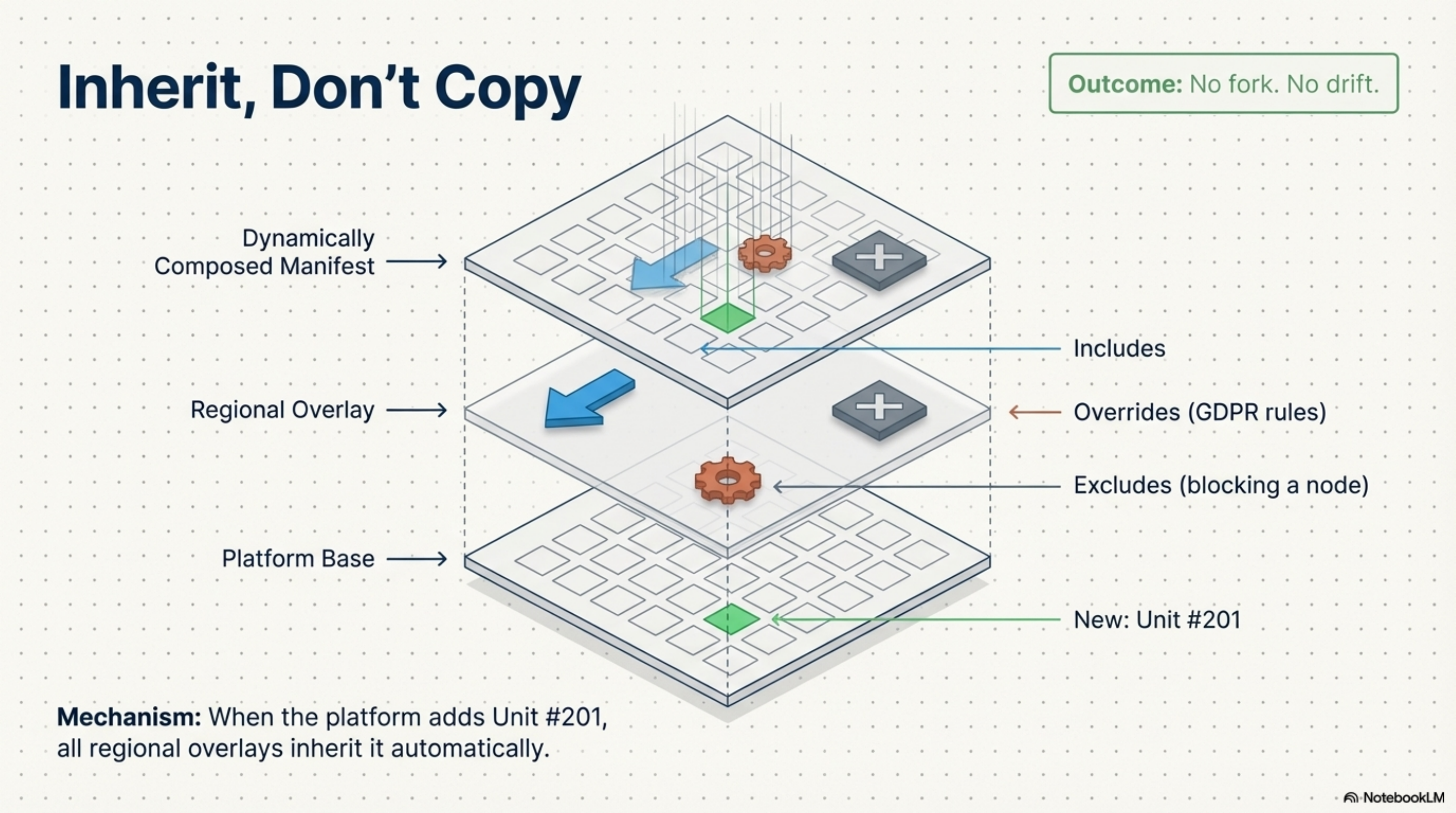
Includes pull in base platform manifests by reference. Overrides modify specific triggers, policies, or metadata locally. Excludes suppress irrelevant or region-restricted units.
When the platform team adds unit #201, all regional overlays inherit it automatically. No fork. No drift.
This is an RFC, not shipping code. The open questions — schema merging semantics, version pinning in includes, conflict reporting — are exactly what needs input from people who manage knowledge at this scale.
Implement Today. Shape Tomorrow.¶
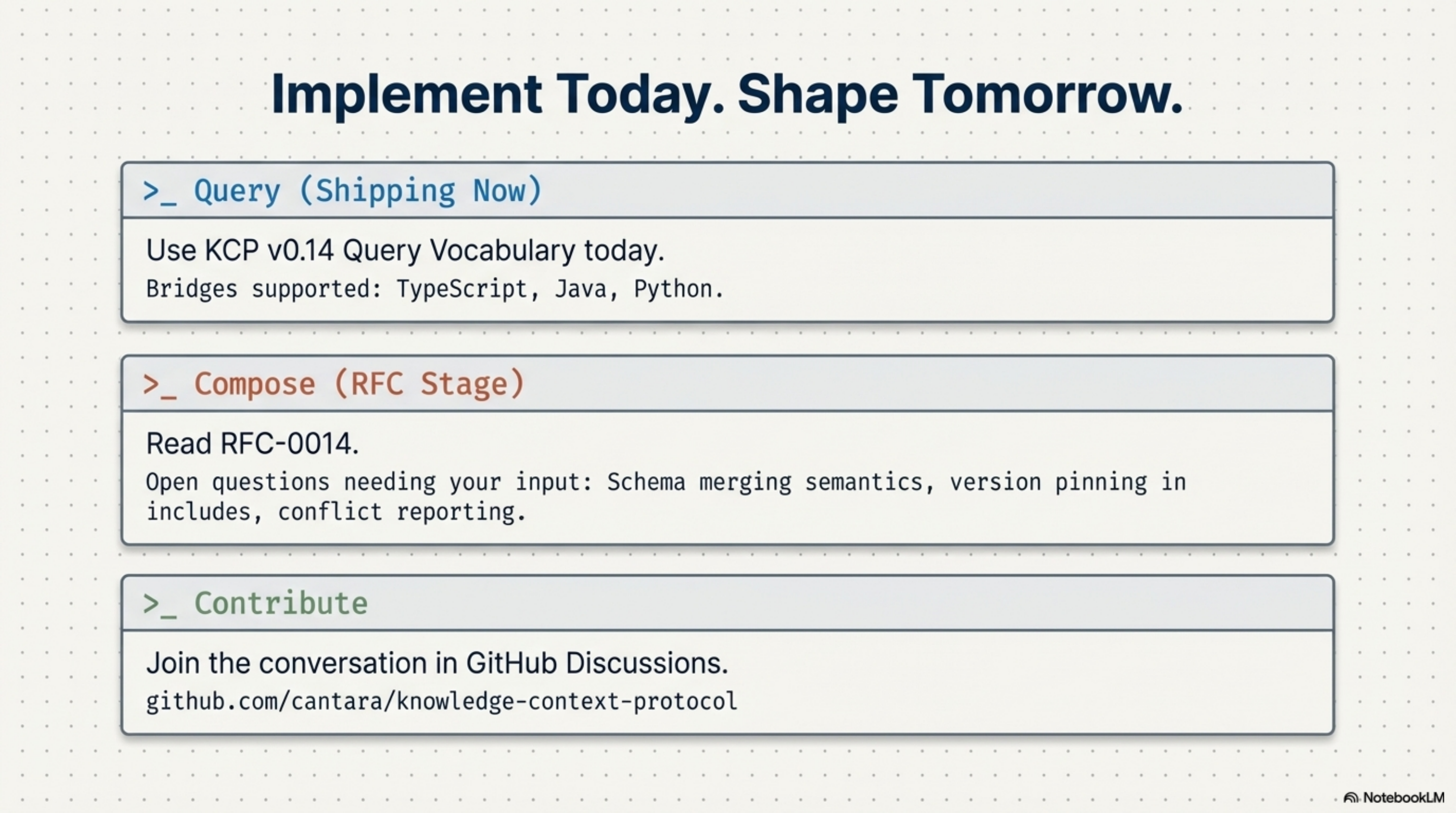
Query vocabulary — shipping now. Read the query vocabulary spec (§15). If you have a knowledge.yaml, you can use it today.
Composition — RFC stage. Read RFC-0014. Tell us what is wrong with it.
Contribute. Join the conversation in GitHub Discussions.