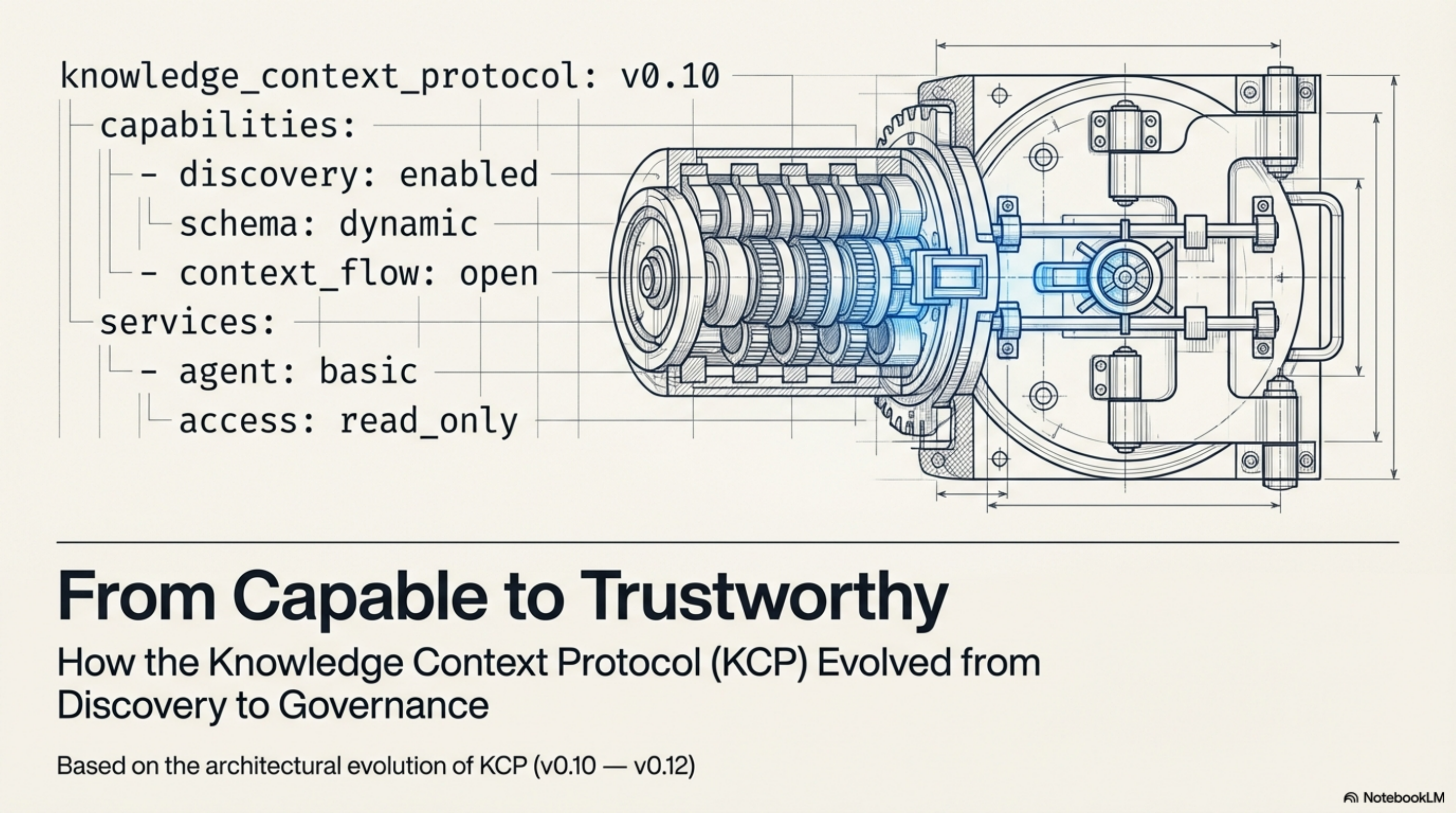
From Capable to Trustworthy: How KCP Evolved from Discovery to Governance
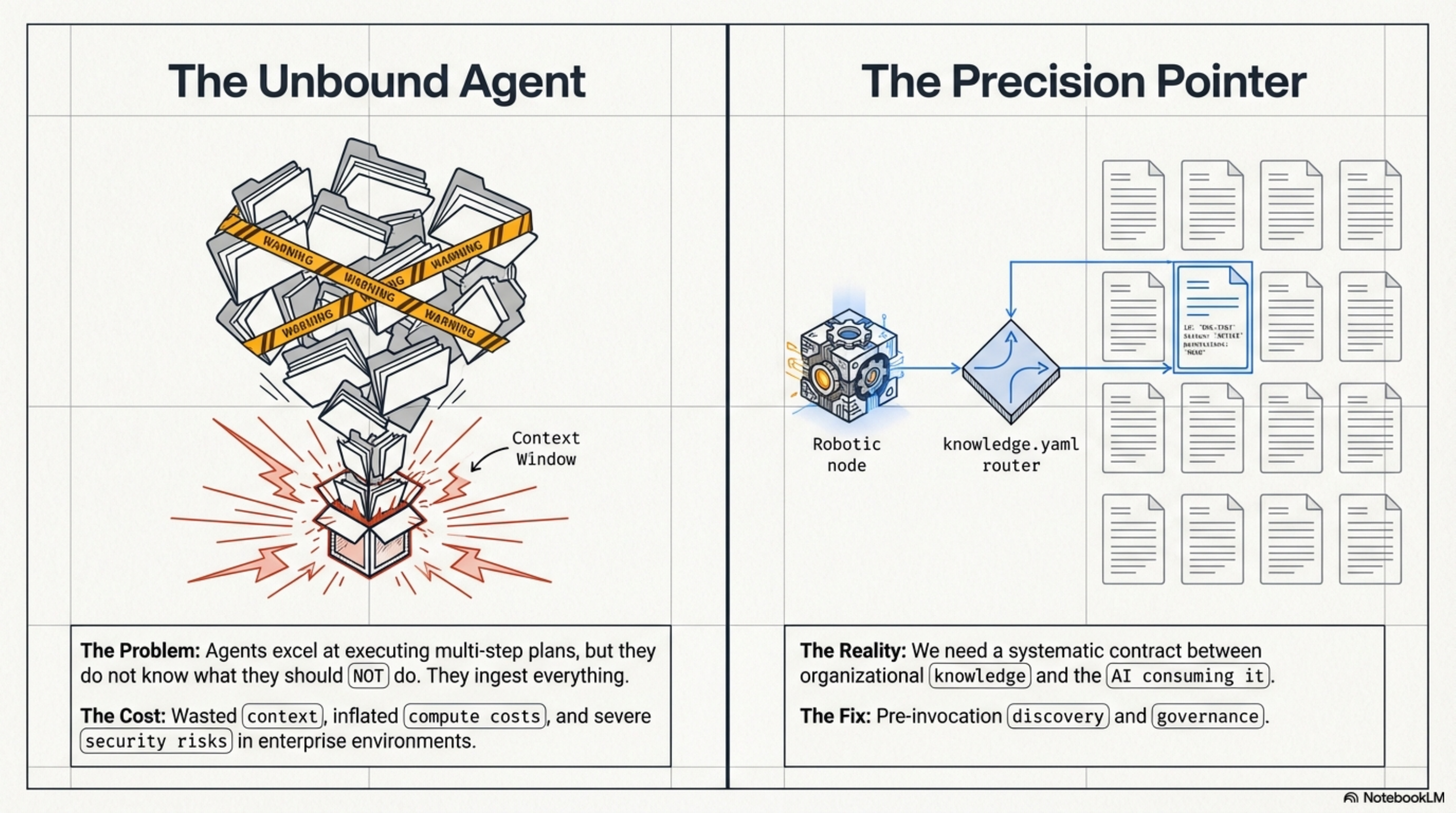
AI agents are getting remarkably good at doing things. They read code, traverse APIs, generate summaries, and execute multi-step plans across sprawling codebases. What they are still bad at is knowing what they should not do.
Today, an agent dropped into a new repository does the equivalent of walking into a library and reading every book on every shelf before deciding which one is relevant. This is expensive, slow, and -- in environments where some shelves contain confidential material -- genuinely dangerous.
The problem is not intelligence. It is the absence of a shared contract between the knowledge and the agent consuming it. That is what KCP -- the Knowledge Context Protocol -- tries to address: a simple YAML manifest (knowledge.yaml) that sits in a repository and tells agents what is here, what it is for, and how to navigate it before they start loading everything.
Over the past few months the spec has evolved through three releases. The trajectory tells a story worth examining -- from capability declaration to governance.
The Systemic Contract
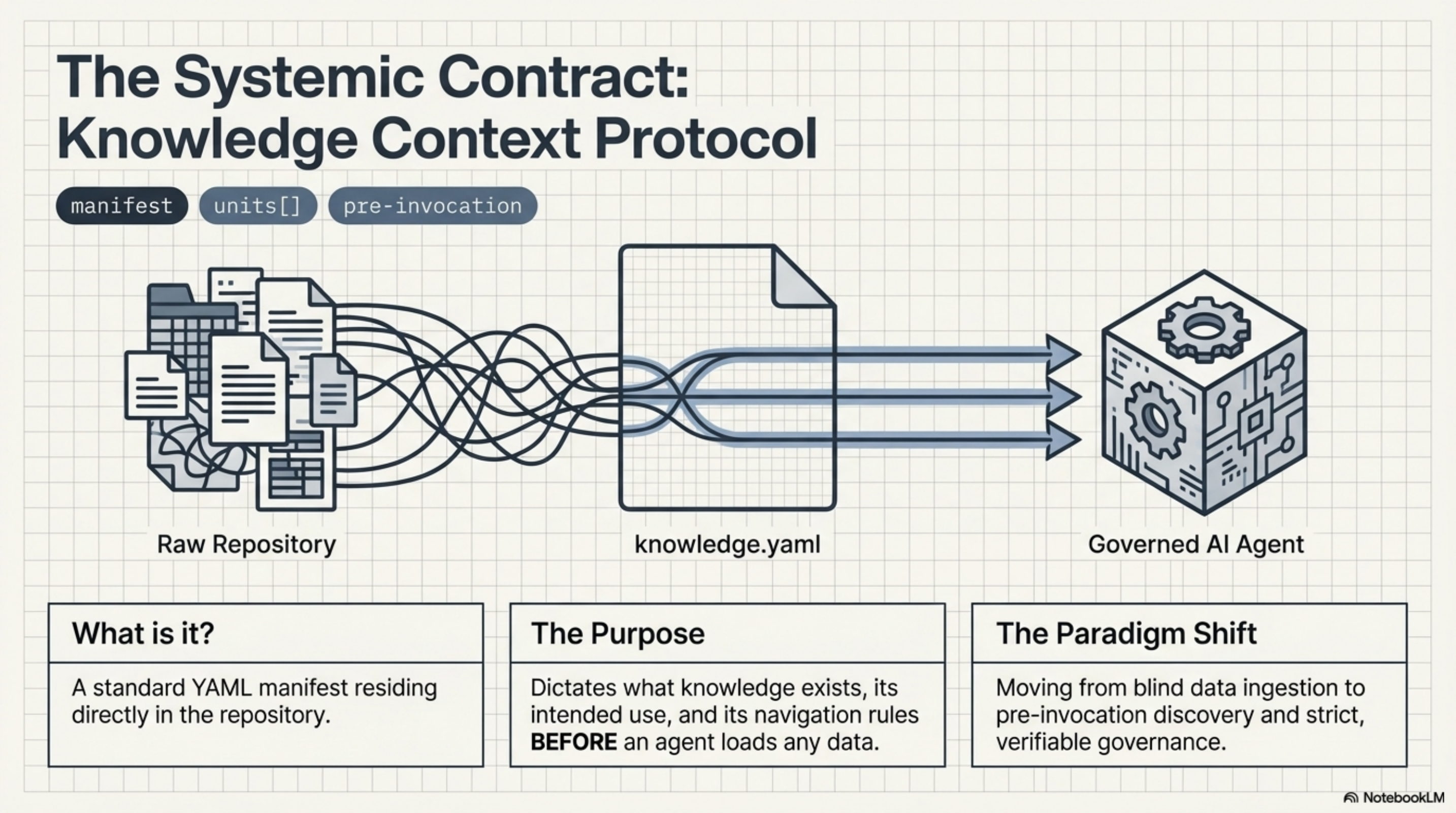
knowledge.yaml is a standard YAML manifest sitting directly in the repository. It dictates what knowledge exists, its intended use, and its navigation rules before an agent loads any data. The paradigm shift: from blind data ingestion to pre-invocation discovery and strict, verifiable governance.
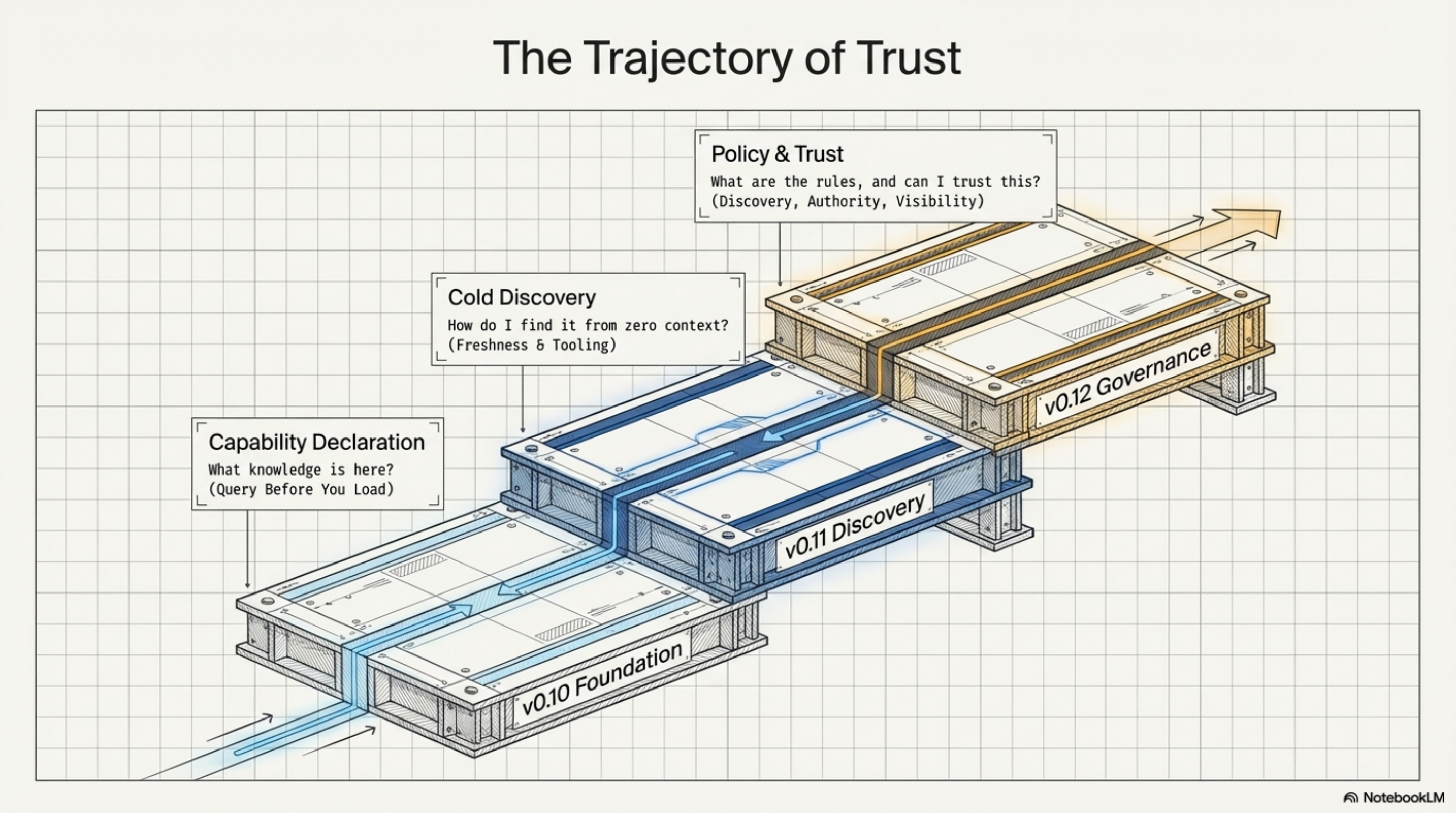
v0.10: The Foundation -- Query Before You Load
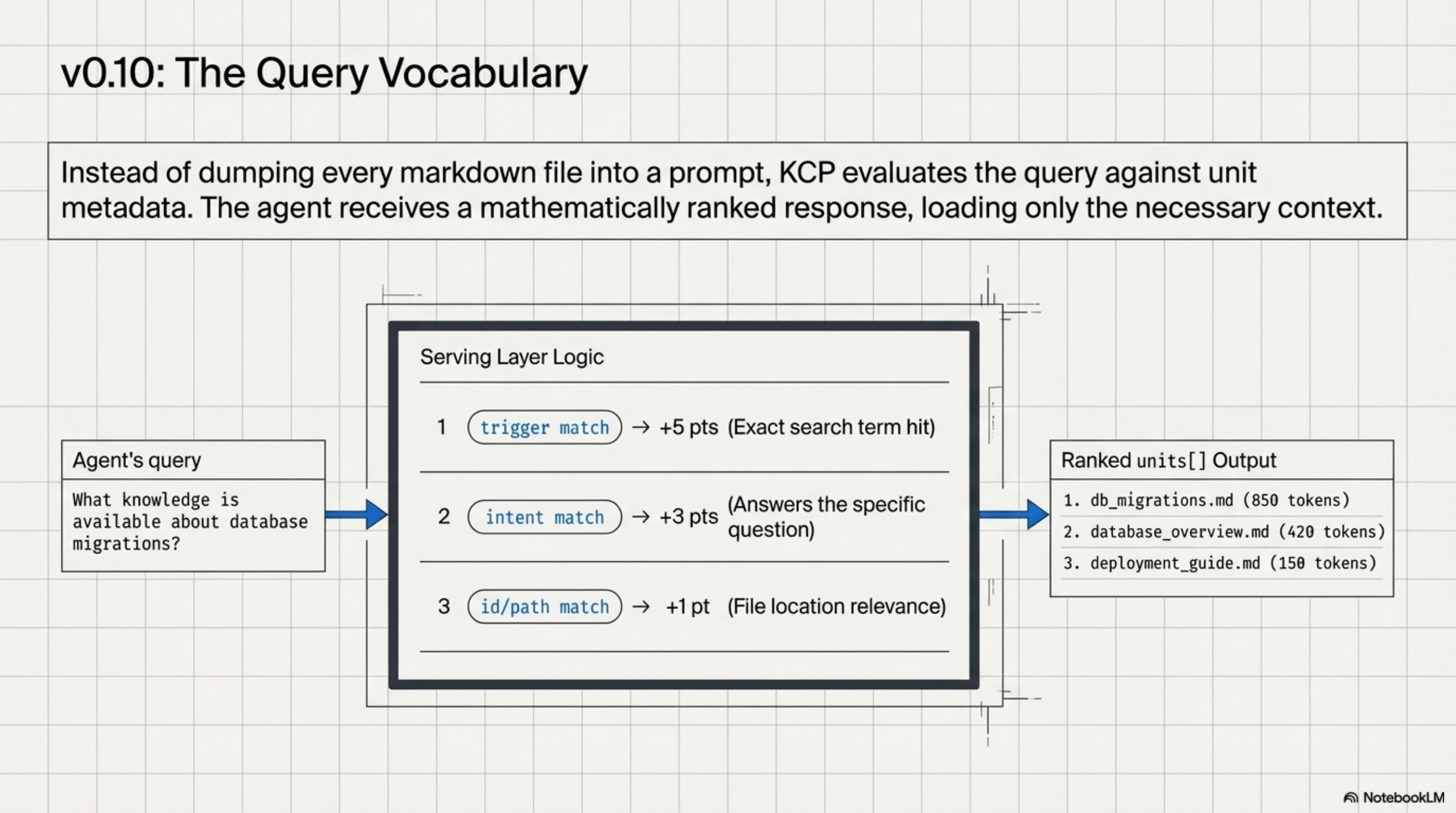
KCP v0.10 introduced the core manifest format: a knowledge.yaml file containing units[], where each unit describes a piece of knowledge with an id, a path, an intent (what question does this unit answer?), triggers (what search terms should surface it), audience, scope, and depends_on.
The key idea was the query vocabulary. Instead of an agent loading every markdown file in a repository and hoping its context window can hold them all, the manifest enables pre-invocation discovery. The agent asks: "What knowledge is available about database migrations?" The serving layer scores units by trigger match (+5 pts), intent match (+3 pts), and id/path match (+1 pt), returning ranked results with token estimates. The agent loads only what it needs.
Federation support (manifests[] pointing to other knowledge.yaml files) and version pinning (kcp_version for parsers to validate against) rounded out the release.
v0.11: Cold Discovery -- Finding Knowledge from Nothing
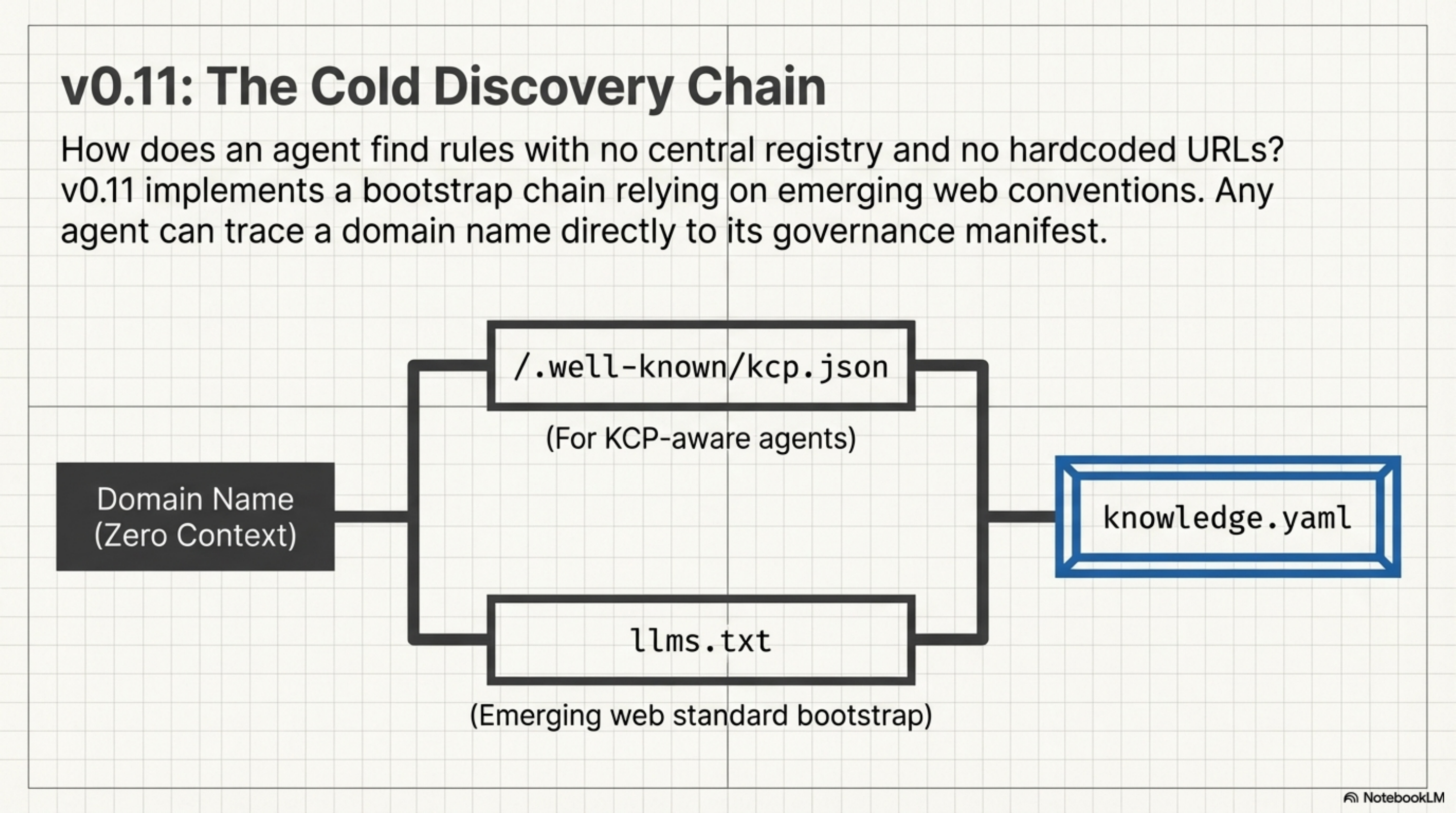
v0.11 tackled a gap that any practitioner deploying KCP across an organisation would immediately hit: how does an agent find the manifest in the first place?
The solution was an llms.txt bootstrap chain. An agent visiting a domain follows a standard path: check for /.well-known/kcp.json or parse llms.txt for a pointer to knowledge.yaml. No central registry, no hardcoded URLs -- just a chain of well-known locations that any agent can follow from zero context.
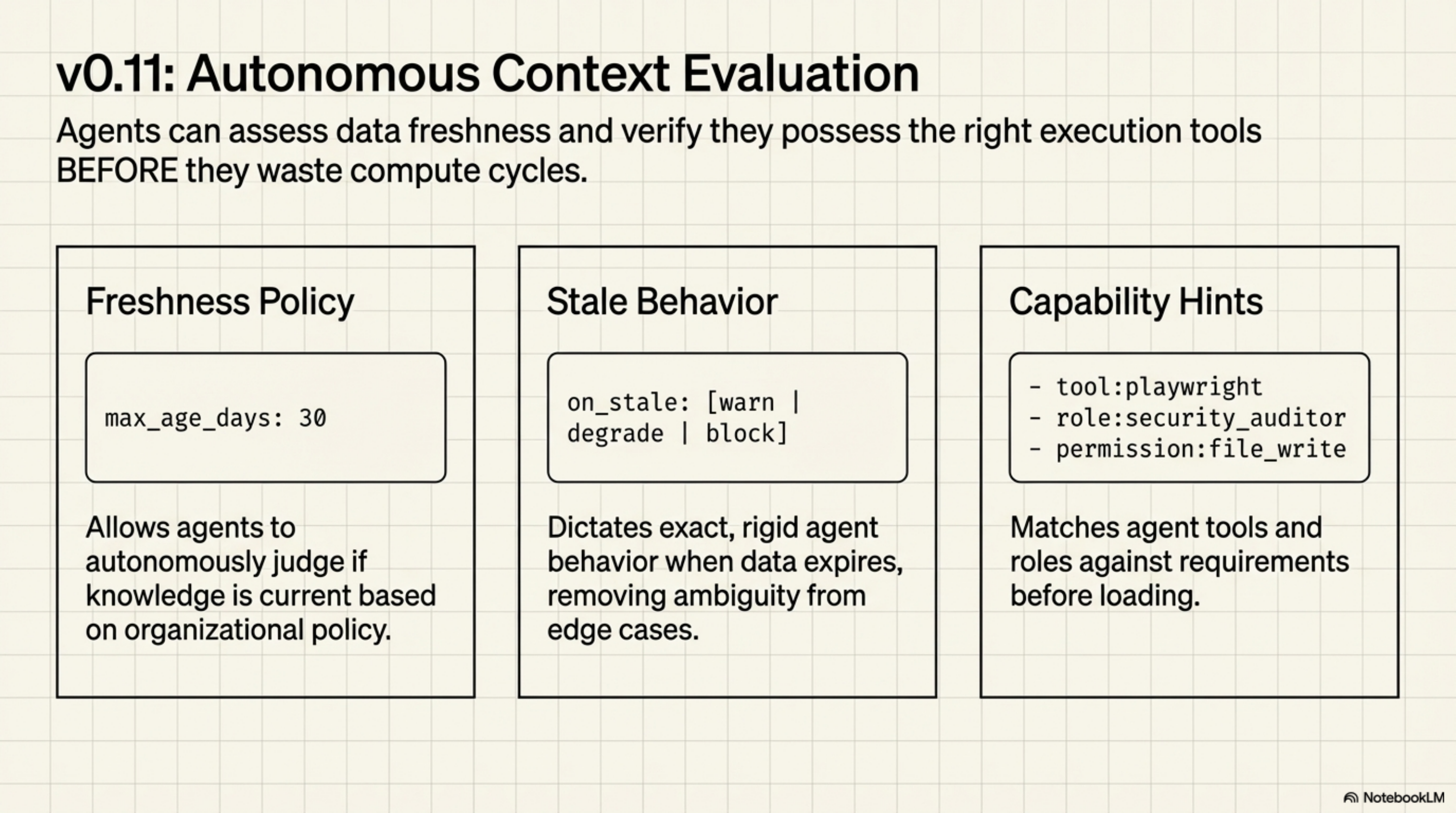
v0.11 also added freshness_policy hints -- max_age_days, on_stale behaviour (warn, degrade, or block), and a review_contact -- so agents could assess whether knowledge was current without a human in the loop. And requires_capabilities on individual units let manifest authors declare tool and role requirements before loading: tool:playwright, permission:file_write, role:security_auditor.
v0.11.1 followed with housekeeping: validation fixes, schema tightening, version corrections. The kind of cleanup that says the spec is being used in anger.
v0.12: The Pivot from Capability to Governance
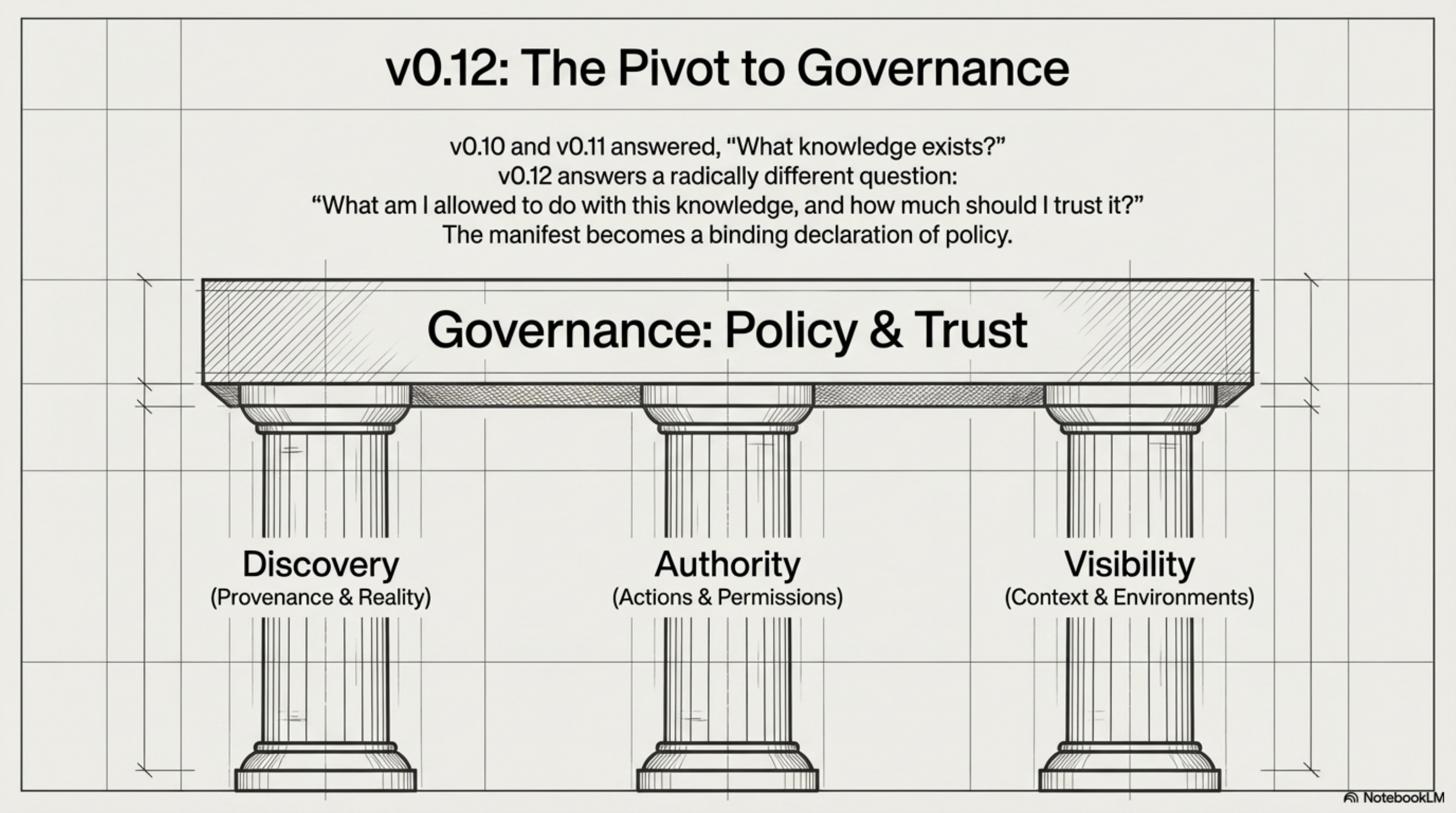
v0.10 and v0.11 answered: "What knowledge exists and how do I find it?" v0.12 answers a different question entirely: "What am I allowed to do with this knowledge, and how much should I trust it?"
The release introduces three new blocks -- discovery, authority, and visibility -- that work together as a governance layer. Together, they transform the manifest from a catalogue of knowledge into a declaration of policy.
Pillar 1: Discovery -- How Do We Know This Is Real?
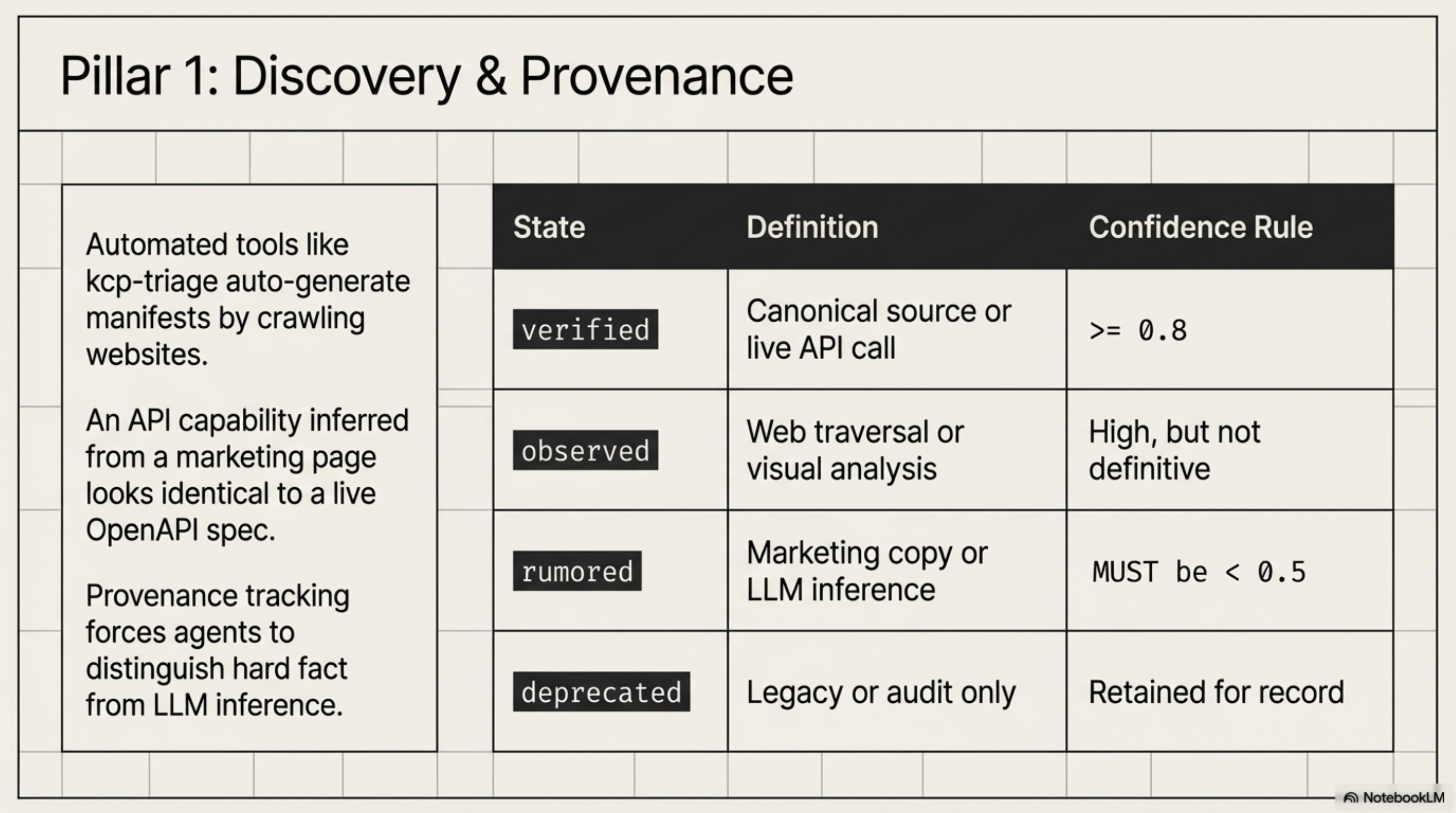
The discovery block (RFC-0012) adds provenance tracking to knowledge units. This matters because KCP manifests are increasingly generated by automated tooling, not hand-authored by developers.
Consider kcp-triage, built by Stig Lau at Skatteetaten (the Norwegian Tax Authority). It is a 7-step LLM pipeline that crawls a website and generates a KCP manifest from what it finds. It has already generated manifests for multiple Norwegian public services.
But a capability inferred from a marketing page is not the same as a capability confirmed against a live API. Without provenance, both look identical in the manifest. The discovery block fixes this with four verification states:
verified: confirmed against a canonical source -- an OpenAPI spec, official docs, a successful live API call (confidence ≥ 0.8)observed: found via direct technical observation (web traversal, screenshot analysis) -- high confidence, not yet definitiverumored: inferred from indirect sources -- marketing copy, LLM inference. The spec enforces a normative rule: rumored units MUST declareconfidence < 0.5deprecated: was previously verified but is no longer present. Retained for audit, not live operation
Pillar 2: Authority -- What May an Agent Do?
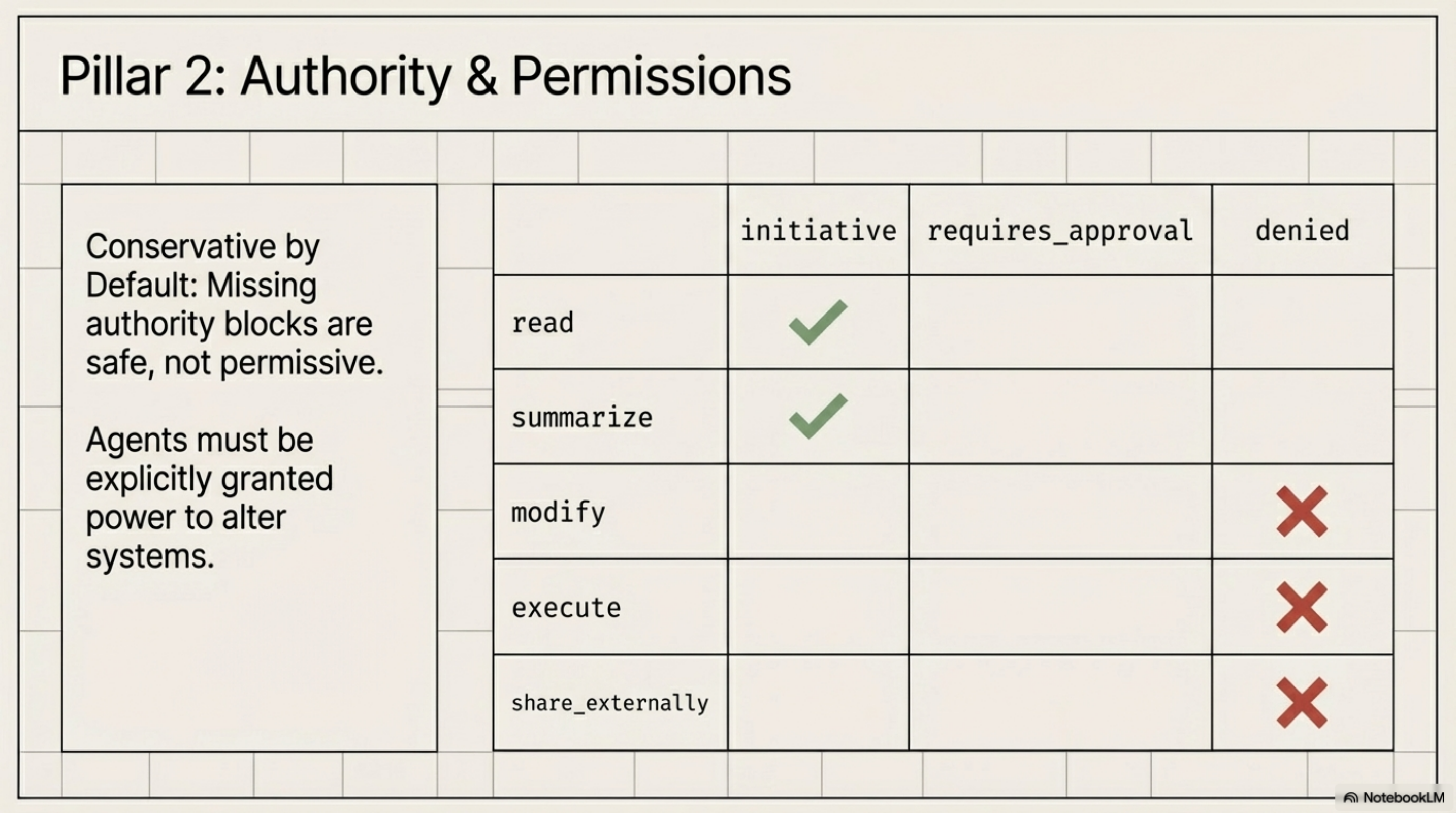
The authority block (RFC-0009) provides fine-grained action permissions. Three permission values:
initiative: the agent may proceed on its ownrequires_approval: the agent must ask a human firstdenied: the agent must not perform this action
These apply to five standard actions: read, summarize, modify, execute, and share_externally. Custom domain-specific actions are also supported.
The defaults are intentionally conservative: read and summarize default to initiative; everything else defaults to denied. A missing authority block is safe, not permissive.
Pillar 3: Visibility -- Context-Aware Access
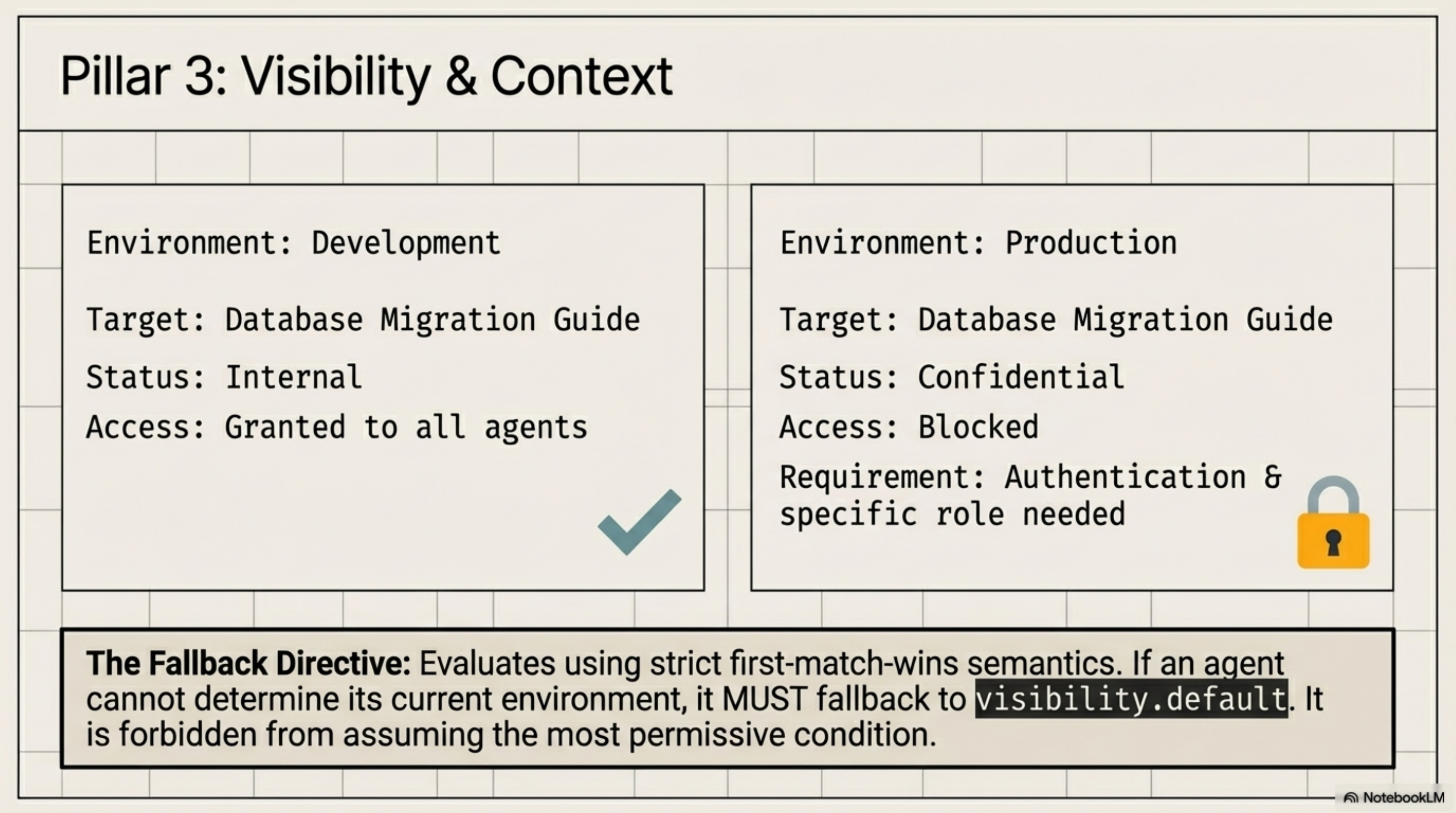
The visibility block makes access declarations conditional on environment and role. The same database migration guide is internal in development and confidential in production.
Conditions evaluate with first-match-wins semantics. The spec is strict about the fallback: when the agent cannot determine its environment, it MUST use visibility.default. It must not assume the most permissive condition.
Putting It Together: The Nova Corp Payments API
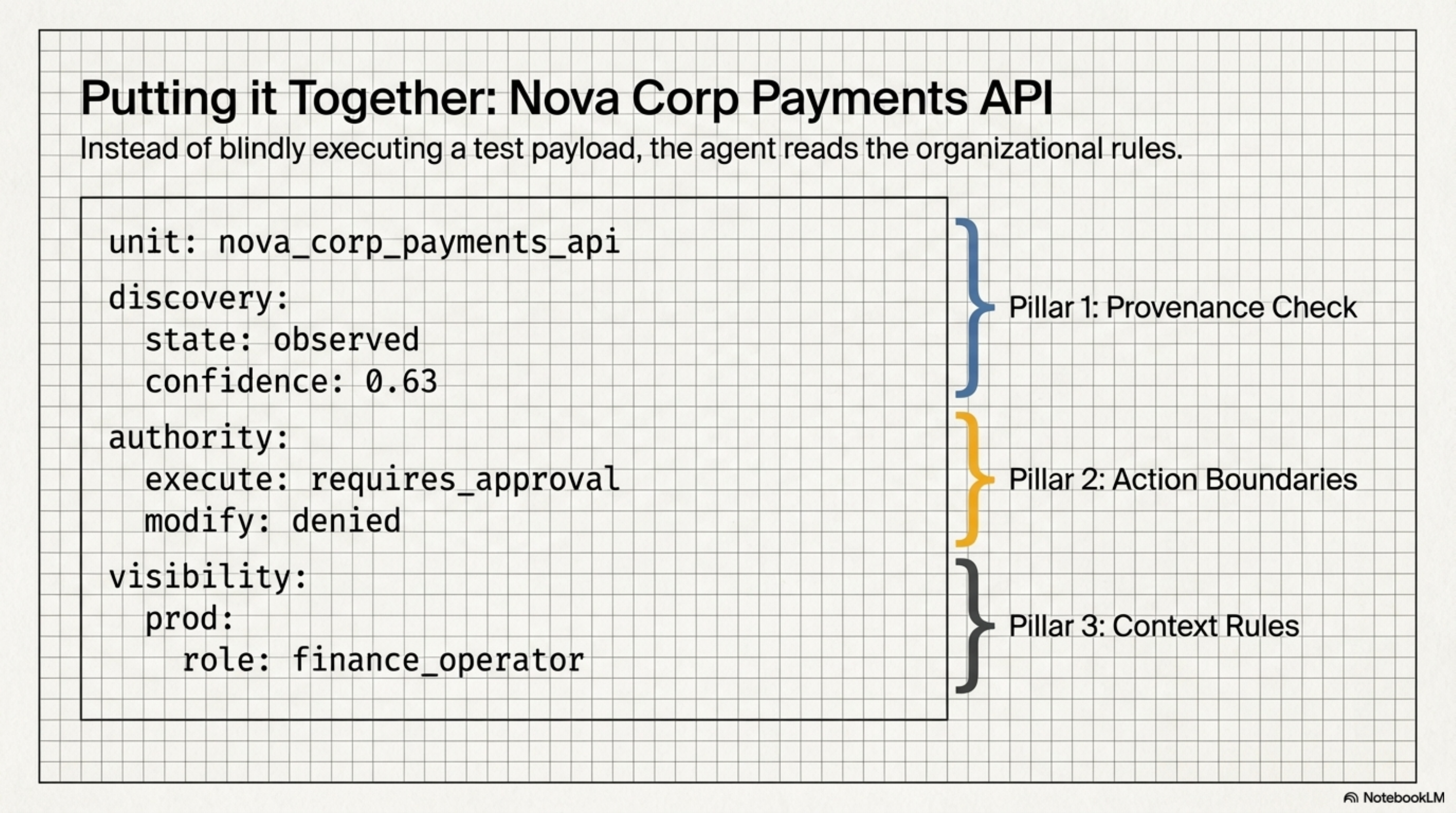
The value of these three blocks becomes clear when they work together:
units:
  - id: payments-api
    path: docs/api/payments-v2.md
    intent: "How do I submit a payment via the Nova Corp payments API?"
    triggers: [payment, invoice, billing, submit-payment]

    discovery:
      source: web_traversal
      verification_status: observed
      confidence: 0.63
      observed_at: "2026-03-19T10:02:00Z"

    authority:
      read: initiative
      summarize: initiative
      modify: denied
      execute: requires_approval
      share_externally: denied

    visibility:
      default: internal
      conditions:
        - when:
            environment: [production]
            agent_role: [finance_operator]
          then:
            sensitivity: confidential
            requires_auth: true
        - when:
            environment: [development, local]
          then:
            sensitivity: internal
            requires_auth: false
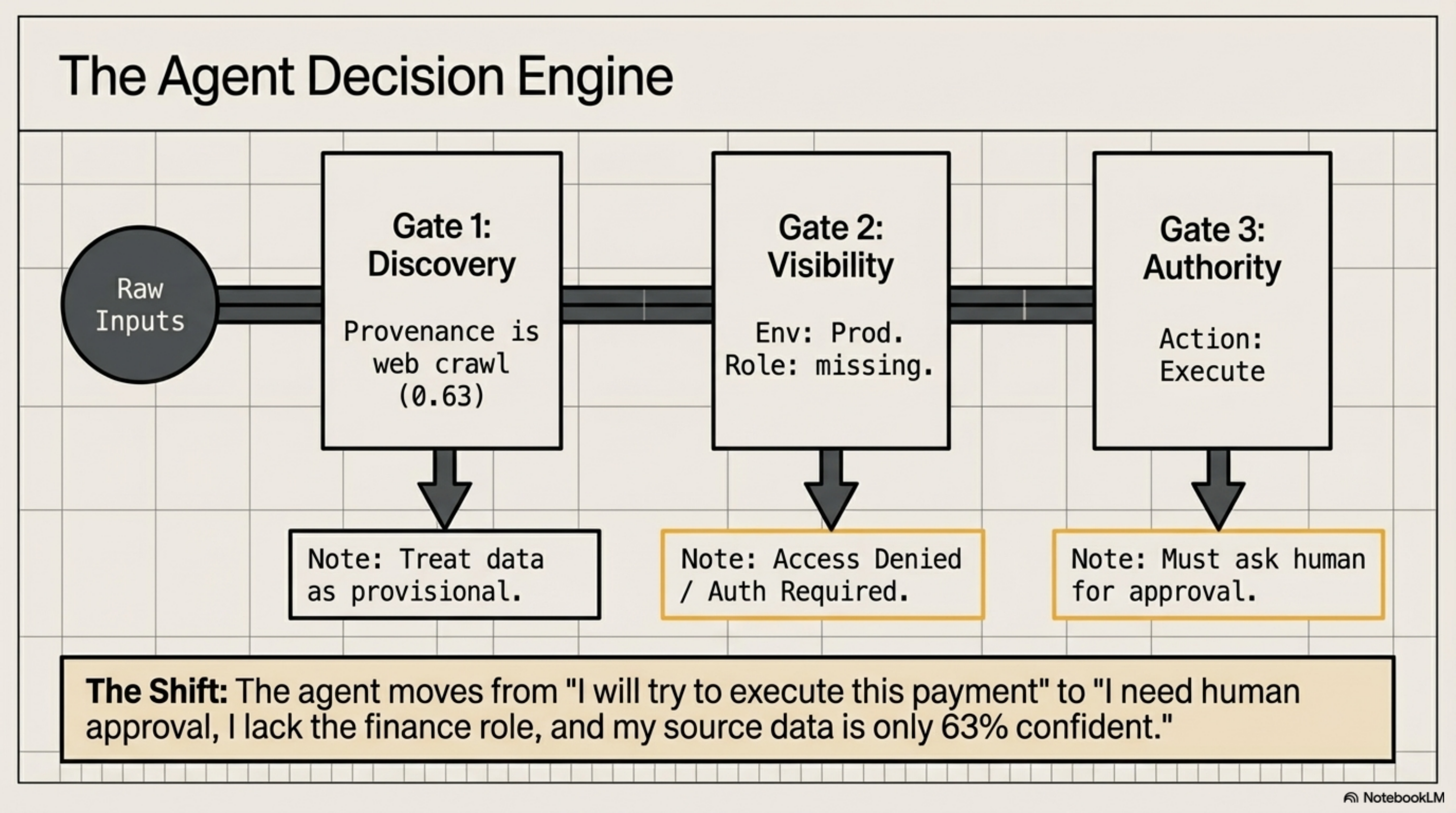
The agent moves from "I will try to execute this payment" to "I need human approval, I lack the finance role, and my source data is only 63% confident."
State of the Ecosystem
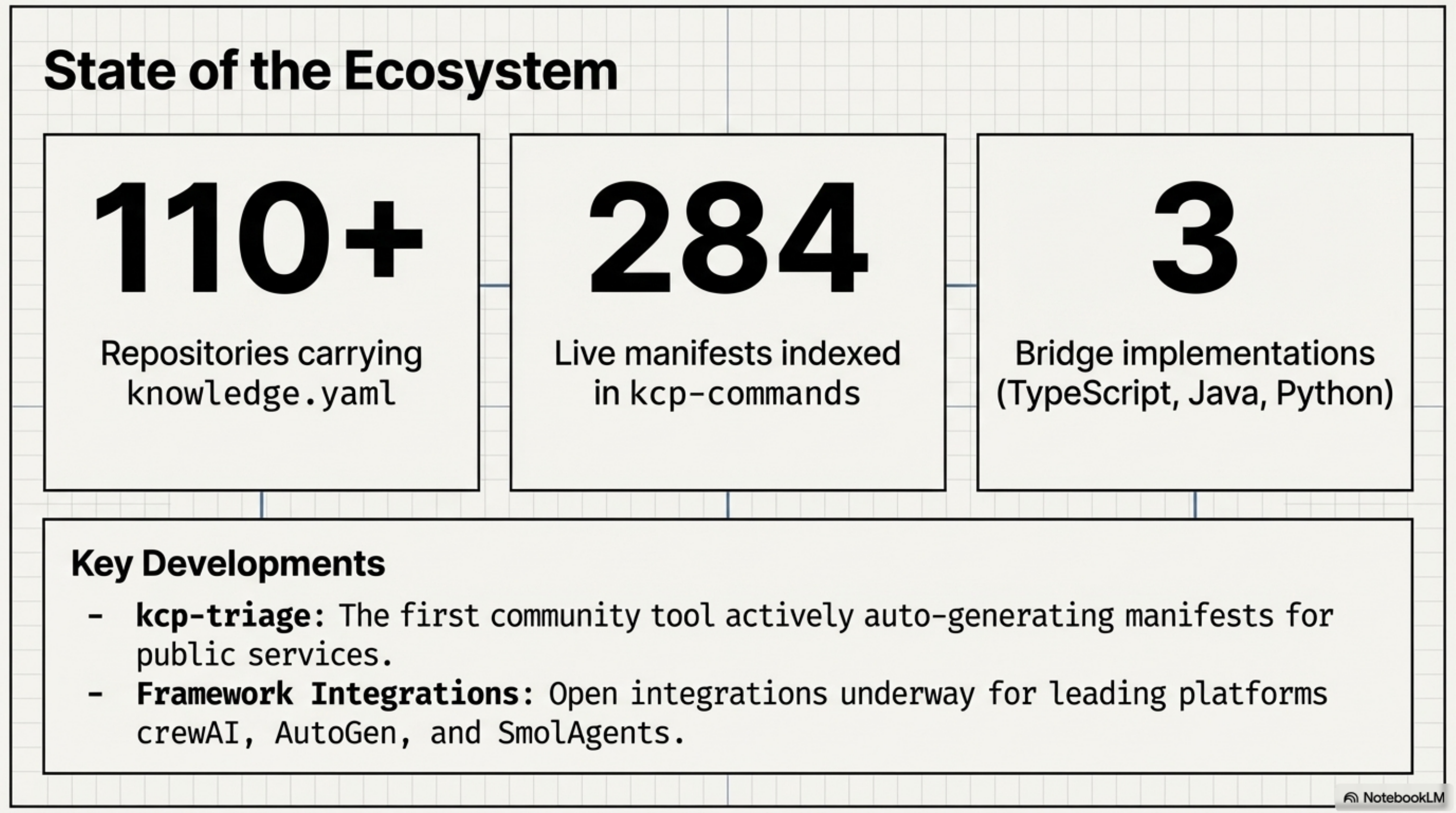
Some numbers, without embellishment:
- 110+ repositories across the Cantara, Quadim, and eXOReaction ecosystems carry
knowledge.yamlmanifests - 284 live manifests indexed by kcp-commands
- 3 bridge implementations (TypeScript, Java, Python) at full query parity
- kcp-triage -- the first community-built tool that produces KCP manifests automatically -- is exactly the use case the
discoveryblock was designed for - Open framework integrations underway for crewAI, AutoGen, and SmolAgents
The Path Forward
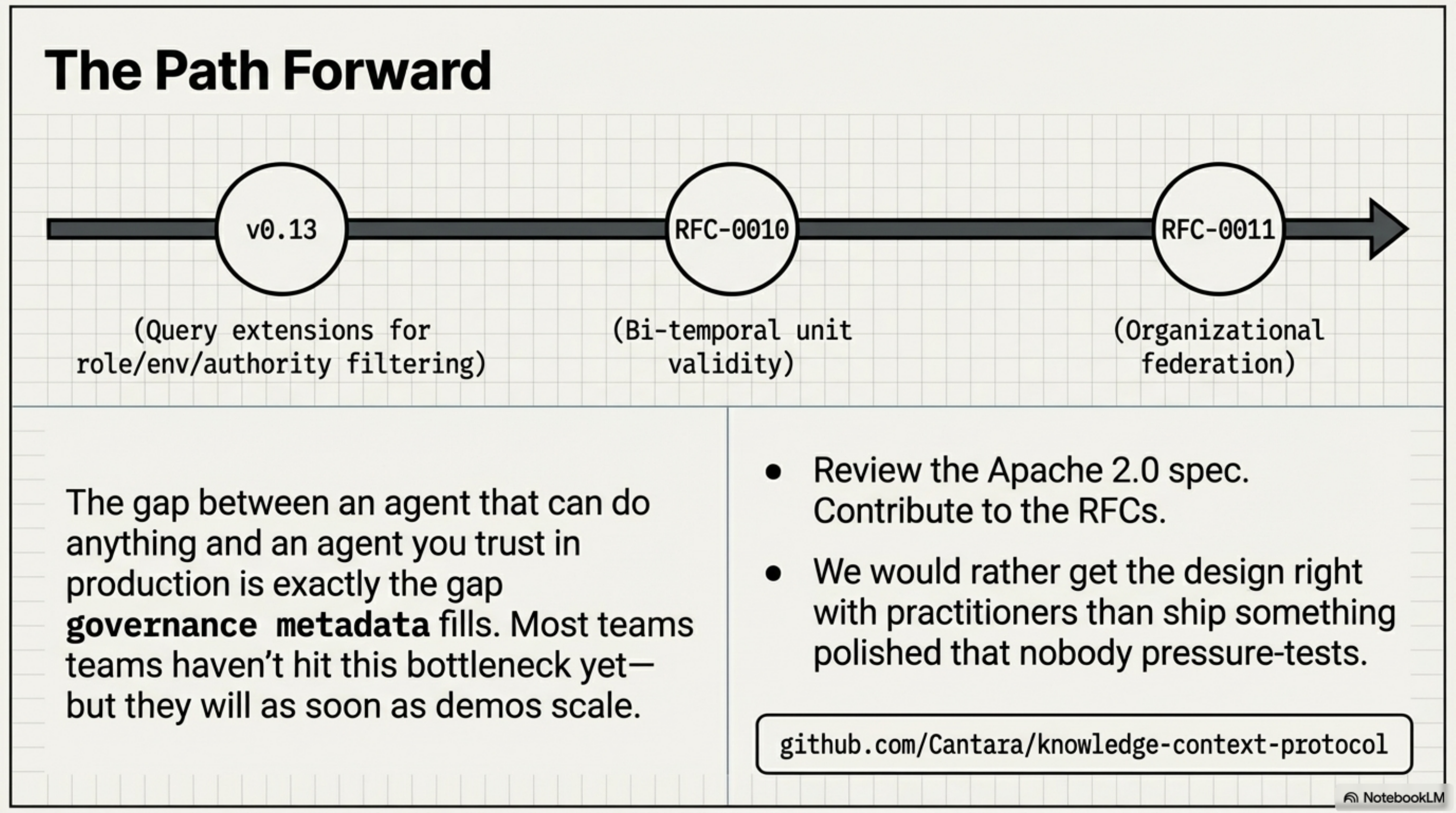
v0.12 deferred query extensions for agent_role, environment, and authority_filter to v0.13 -- the schema is there, but the serving layer does not filter on these dimensions yet. RFC-0010 (bi-temporal unit validity) and RFC-0011 (organisational federation) are in discussion.
The honest reflection: KCP is a small spec with a small community solving a problem that most teams have not yet hit -- but will, as agent deployments move from demos to production. The gap between "an agent that can do anything" and "an agent I trust to operate in my production environment" is exactly the gap that governance metadata fills.
If you are building agentic systems and running into the question of how your agents know what they should and should not do, the spec is there. Contributions, feedback, and hard questions are welcome.
The spec is open source under Apache 2.0: github.com/Cantara/knowledge-context-protocol
CLI tooling: github.com/Cantara/kcp-commands