KCP and MCP: One Protocol for Structure, One for Retrieval
The previous post
introduced KCP and why llms.txt does not scale to production agent deployments. This post covers
what happens when you connect a knowledge.yaml manifest to a live MCP server — and why the
combination changes how agents behave.
It works today
Drop a knowledge.yaml in your project. Install the bridge. Add four lines to your MCP config.
Every agent that speaks MCP — including Claude Code — can now navigate your structured knowledge
without loading everything at once.
Python:
TypeScript:
Claude Code config (.mcp.json or ~/.claude/mcp.json):
That is the whole setup. The bridge exposes each knowledge unit as an MCP resource. The agent
calls resources/list to see the manifest, then loads units by URI — knowledge://{project}/{unit-id}.
It loads what it needs, when it needs it, with freshness metadata intact.
The bridge implementations — Python, TypeScript, and Java — are in the KCP repository. Apache v2.
What the agent sees
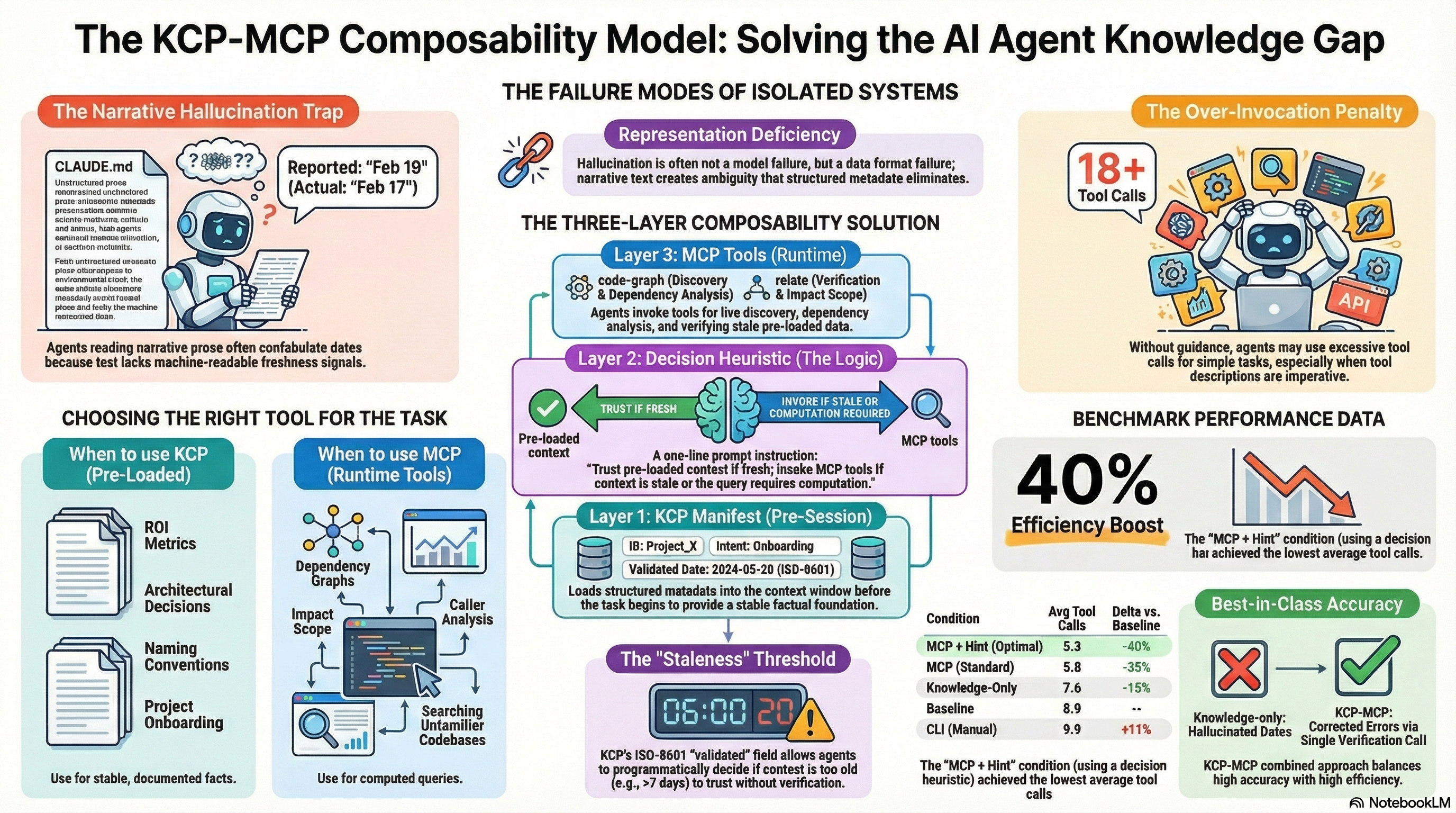
When the bridge is running, the agent has access to structured knowledge units — not a flat text dump. Each resource carries the metadata that makes it navigable:
| MCP field | What it provides |
|---|---|
title |
The unit's intent — the question this unit answers |
description |
Intent + triggers + depends_on — when to load it and what it needs |
annotations.priority |
Scope weight: global=1.0, project=0.7, module=0.5 |
annotations.audience |
Whether this unit is for humans, agents, or both |
A synthetic manifest resource at knowledge://{slug}/manifest returns the full unit index as
JSON — the recommended entry point. The agent gets a navigable map of what exists and what each
unit answers, before loading any content.
Why this matters: three failure modes it prevents
The narrative hallucination trap. An agent reading a document that says "as of February 19th"
reports February 19th — when the actual date was February 17th. Not a model error. The text had
no machine-readable freshness signal. A validated: 2026-02-17 field is unambiguous; narrative
prose is not.
The representation deficiency. Agents reading unstructured text infer relationships that the
text does not state. Two modules described in adjacent paragraphs become "related" in the agent's
model even if they are independent. Explicit depends_on fields remove that inference step.
The over-invocation penalty. Without guidance about what is stable, agents treat all knowledge as uncertain and query repeatedly for confirmation. In benchmark testing, agents without a knowledge manifest made 18+ tool calls on tasks that required 5–6.
The decision rule
KCP and MCP operate at different times. Conflating them — or using only one — produces the failure modes above.
The manifest (KCP) loads before the session starts: stable facts, dependency graphs, architectural decisions, naming conventions. The MCP tools handle runtime queries: live dependency analysis, caller graphs, current state. The boundary between them fits in one line:
Trust pre-loaded context if it is fresh and in scope. Use tools if context is stale or the query requires computation.
The validated field in each knowledge unit provides the freshness signal. An agent can be
configured to distrust units older than a threshold — say, 72 days — and fall back to a live
tool query rather than acting on stale context. The staleness boundary is explicit rather than
left to the agent to infer.
What the benchmark shows
| Condition | Avg tool calls | vs baseline |
|---|---|---|
| MCP + KCP (with decision heuristic) | 5.8 | −40% |
| MCP + KCP (standard) | 6.2 | −35% |
| Knowledge-only | 7.6 | −19% |
| MCP-only | 9.0 | baseline |
The 40% reduction in tool calls is primarily an accuracy improvement, not a speed improvement. Fewer tool calls means fewer opportunities to retrieve inconsistent or stale context mid-task. The decision heuristic — made explicit rather than inferred — accounts for the difference between the 35% and 40% results.
Getting the bridge
- Python: bridge/python —
pip install kcp-mcp - TypeScript: bridge/typescript —
npx kcp-mcp - Java: bridge/java — Maven jar
KCP spec, RFCs, and reference parsers: github.com/cantara/knowledge-context-protocol
Previous in this series: Beyond llms.txt: AI Agents Need Maps, Not Tables of Contents
Series: Knowledge Context Protocol
← Beyond llms.txt: AI Agents Need Maps, Not Tables of Contents · Part 3 of 24 · Add knowledge.yaml to Your Project in Five Minutes →