Trust, But Verify:
The Hook
Most developers won't admit this.
$ whoami --honest
"I'm scared of AI."
01Scared the AI is hallucinating and I can't tell
02Scared something will break in production
03Scared "done" means half-built and I missed it
04Scared costs will spiral out of control
05Scared of losing control to the AI
06Scared of silent failures nobody notices
Those fears built the system.▏
Before We Start
Who's talking.
Totto · eXOReaction · Ægis
40 years building software
Co-founder of JavaZone, 2001
Founder, eXOReaction · Ægis · Quadim
Sunstone Tech · Cantara · former president, javaBin
Java Champion since 2005
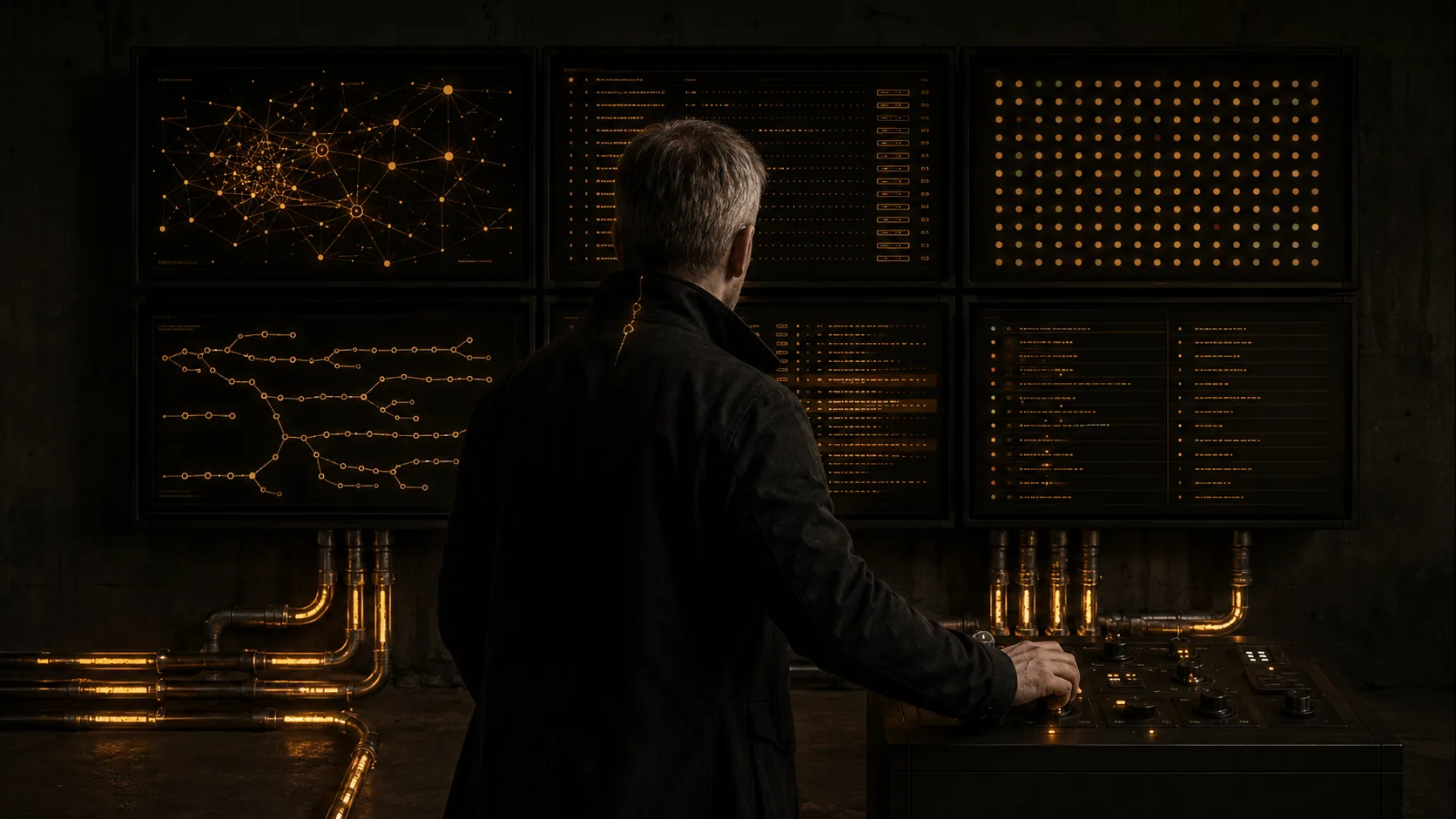
These days: running ExoCortex — my AI practitioner rig — to ship production code at speeds that shouldn't be possible.
The Experiment
January 16, 2026 — how far could I push Claude Code in a weekend?
Domain: PCB manufacturing file formats — binary parsers, validators, industry specs. I knew almost nothing about it. Not a prototype — production code for real fabricators.
197,831
Lines of Java (day 11)
7,461
Tests, day 11 (99.8% pass rate)
445
Commits, day 11, all via PR
25–66×
vs. a 9–24 month industry estimate
8 file-format parsers · 28 validators · 17 auto-fix types · a domain I didn't know — still a week of hardening left; final numbers land on the Proof slide.
Where We're Going
Six fears. Six systems. Then what happened next.
01
The Framework — every fear becomes a system
02
Fear → System — one fear at a time, six times
03
The Proof — the numbers, the zero bugs
04
Down the Rabbit Hole — what came after
05
Welcome to the Dark Side — where we are today
06
The Lesson
The Framework
Fear Without Systems = Just Anxiety
Fear With Systems = 10× Productivity
Every fear in this talk became a system.
Every system made things faster. Watch how.
Fear #1 · AI Hallucinations
Day 4, midnight. A 500KB file wanted to be 1.1 gigabytes.
"The format needed 11 primitive fields — ints, bools, floats — before any strings. The parser read a string first."
"One misplaced field type. The whole byte stream silently misaligned."
The crash:"Requested 1174405120 bytes (1.1GB) for string length exceeds buffer size."
// Spec: 11 primitives BEFORE strings.
String name = reader.readString(); // ← reads garbage
int type = reader.readInt8();
// 575KB later: misalignment explodes → 1.1GB requested
I can't trust my ability to spot hallucinations by reading code.
System #1 · Round-Trip Testing
If You Can't Trust What You Read, Prove What It Does
Round-trip test
byte[] original = Files.readAllBytes(testFile);
PCBDesign design = parser.parse(testFile);
byte[] written = writer.write(design);
assertArrayEquals(original, written);
// If this fails → AI lied somewhere
Property-based test
@Property
void boundingBoxContainsAllFeatures(Layer layer) {
BoundBox box = layer.getBoundBox();
for (Feature f : layer.getFeatures()) {
assertTrue(box.contains(f.getBoundBox()));
}
}
// AI can't hallucinate away invariants
23 tests → 10,035 tests. Zero false confidence.
Fear #2 · Production Bugs
Tests passed. Production broke. Next day.
"I implemented filtering of embedded documentation from German PCB manufacturer files. Tests pass. Looks great."
User reports:"The drill holes are 2× too large."
"Coordinate scaling in DrillListing.java was calibrated against inflated dimensions (400mm). After filtering, actual PCB is 216mm — but drill holes still scale to 432mm."
The code looked fine. But there was a lurking interaction between two features I'd never tested together.
System #2 · Battle Testing
Test Against the Chaos of the Real World
Collected 191 real PCB files from the wild — KiCad, Altium, Eagle, German manufacturers, ancient legacy formats
Every change runs against ALL 191. If ANYTHING breaks, build fails.
Not synthetic examples. Real-world chaos you'd never invent.
terminal
$ mvn test
Running com.exoreaction.pcb.BattleTestSuite
Tests run: 10,035, Failures: 0, Errors: 0, Skipped: 30
[INFO] BUILD SUCCESS
Fear #3 · Shipping Bad Code
main was broken for 23 minutes.
$ git log --oneline
7c8d9e4 Fix bounding box (for real this time)
2e5f6a3 Revert "Actually fix bounding box"
8b9c4d2 Actually fix bounding box calculation
3a7f2e1 Fix bounding box calculation
Working directly on main, accepting AI suggestions, committing fast.
The 'fix' introduced a bug that broke 47 tests. For 23 minutes, main was broken.
Direct commits to main with AI-generated code is playing Russian roulette.
System #3 · CI as Final Arbiter
CI is the Truth. Not My Code Review.
#!/bin/bash
if [ "$(git rev-parse --abbrev-ref HEAD)" = "main" ]; then
echo "ERROR: Direct commits to main are forbidden"
echo "Use: git checkout -b feature/your-branch"
exit 1
fi
Branch
→
AI generates
→
Local tests
→
PR · CI · 10,035 tests
→
Merge
CI is the final gate. AI can convince me. It cannot convince CI.
695 commits. Zero broken builds on main.
Fear #4 · Cost Spiral
$80,000–$120,000. For one 2.5-week project.
$80K–$120K
Not per year. For this one project, at heavy usage, metered.
Heavy AI usage. Multiple sessions per day. Long context windows. All the testing, verification, and measurement required for Fear-Driven Development.
What if I build my entire workflow around this and the pricing changes?
System #4 · Sustainable Economics
Make the Economics Non-Negotiable
Claude MAXFlat-rate usage makes FDD economical. Without it, exhaustive testing and verification can cost $80K–$120K per project.
Why optimize even on flat-rate? Latency + discipline + future-proofing.
Model selection
| Complexity | Model | Use |
|---|---|---|
| Simple queries | Haiku | File ops, searches |
| Standard coding | Sonnet | Most work (60–70%) |
| Architecture | Opus | Complex reasoning |
Fear #5 · Losing Control
47 changed files. Understood maybe 60%.
"I gave Claude a high-level description. It came back with a plan."
"I said 'looks good, do it.' One hour later: 47 changed files."
"I merged it. Tests passed."
"But I had this nagging feeling: I just shipped code I don't understand."
Am I still a developer if the AI is doing the thinking?
System #5 · Directed Synthesis
Don't Grade Your Own Homework
For a deep-dive report (10+ pages) I don't just re-read it — I ask ExoCortex, then pick whichever lens actually answers my question. Rarely all three.
Is the science real?
ChatGPT deep-research: verify against real research.
Does it match my mental model?
NotebookLM → infographic: a fast visual gut-check.
Do I actually understand it?
NotebookLM → slide deck (10–20 slides): forces me to learn it.
Different areas need different lenses. The point: never check the AI's work with the same kind of AI that produced it.
Fear #6 · Silent Failures
Green tests. Wrong answer.
A user reports: "The PCB bounding box is wrong. The board should be 216mm wide, but your library says 425mm."
"Individual drill holes: correct position. Assembly components: correct position."
"Overall bounding box: including a documentation layer with inflated coordinates."
Tests were green. The code worked. But the result was wrong because I was measuring the wrong thing.
Green tests don't mean the system is correct. They mean it matches what you tested.
System #6 · Extreme Measurement
Don't Just Test. Measure.
System.out.printf("PCB boundBox: %.1fmm × %.1fmm%n",
width / 1_000_000.0, height / 1_000_000.0);
System.out.printf("Expected: ~216mm × 206mm%n");
System.out.printf("Alignment: %.1f%%%n", misalignment * 100);
assertTrue(misalignment < 0.25,
"BoundBox should be within 25% of copper dimensions");
if (Math.abs(x) > 3_000_000_000L) { // 3 meters
logger.warn("Extreme coordinate: {}mm. Overflow?", x/1_000_000.0);
}
Test countTracked ↑ over time
Pass rateMust stay >99%
Battle coverage191 real files, 100%
The System
Fear → System → Result
| Fear | System | Result |
|---|---|---|
| AI hallucinations | Round-trip + property tests | 10,035 tests, zero false confidence |
| Production bugs | Battle testing (191 files) | Zero AI bugs reach prod |
| Shipping bad code | PR-only + CI gates | main always green, 695 commits |
| Cost spiral | Claude MAX subscription | $80K–$120K exposure → $0 spent |
| Losing control | Directed synthesis | Better code understanding |
| Silent failures | Extreme measurement | Fast bug detection |
Formula: Fear → Discipline → Results
The Proof
2.5 Weeks. Real Numbers.
10,035
Tests (99.8% pass rate)
695
Commits (278/week, ~40/day)
0
AI-induced bugs past the systems
$0
API costs (Claude MAX)
191 real-world PCB files in battle suite
main branch: always green · lib-pcb: 2.5 weeks, Jan–Feb 2026
main branch: always green · lib-pcb: 2.5 weeks, Jan–Feb 2026
Down the Rabbit Hole
I'd solved the generation problem.
I'd created a comprehension problem.
8,934 files across the workspace by the time lib-pcb shipped — not just code, but skills, docs, tests, plans
Standard RAG (vector search) answers "find something like X," not "what breaks if I change this?" — categorically inadequate
Graph questions need graph answers, not semantic similarity
So I built the tool I needed: Synthesis — an open-source knowledge graph over the codebase.
The Shape of It
Explore → wall → build deeper → explore again.
lib-pcb
→
SDD
→
Synthesis
→
KCP
KCP — Knowledge Context Protocol — where I am now. A proposal: what an agent should know before it acts, not just what it can do.
I don't know where the bottom of this rabbit hole is. I'm not sure there is one.
June – August 2026
I turned a spec into a system.
KCP moved from proposal to reality — six projects, each testing a different piece.
kcp-commands
Proactive CLI guidance — injects the right command before you type the wrong one.
kcp-memory
Episodic memory: every session indexed and searchable, so agents stop starting from zero.
kcp-agent
Deterministic agent: model proposes, planner disposes — fail-closed, audited.
kcp-harness
Governance from outside: an MCP proxy checking every tool call against policy first.
pi-kcp
Governance from inside: same enforcement, living inside the agent's own turn.
Sunstone Atlas
First product built on it: a governed knowledge, skill and playbook substrate.
Two enforcement points, tested in parallel, on purpose. I still don't know which one wins.
Welcome to the Dark Side
This didn't stop. Here's today.
1,337
Skills (548 in May)
21
KG workspaces live (10 in May)
90,050
Files indexed (66,350 in May)
252
Command manifests (152 in May)
The hard part now isn't writing more code — it's staying oriented inside what you've already built.
A harder confession: measuring this got harder too. Sessions fell 25× Feb–Jul — not because work stopped, but sessions got longer: 61 turns/session in Feb, 1,737 by June. The naive metric would've shown the opposite.
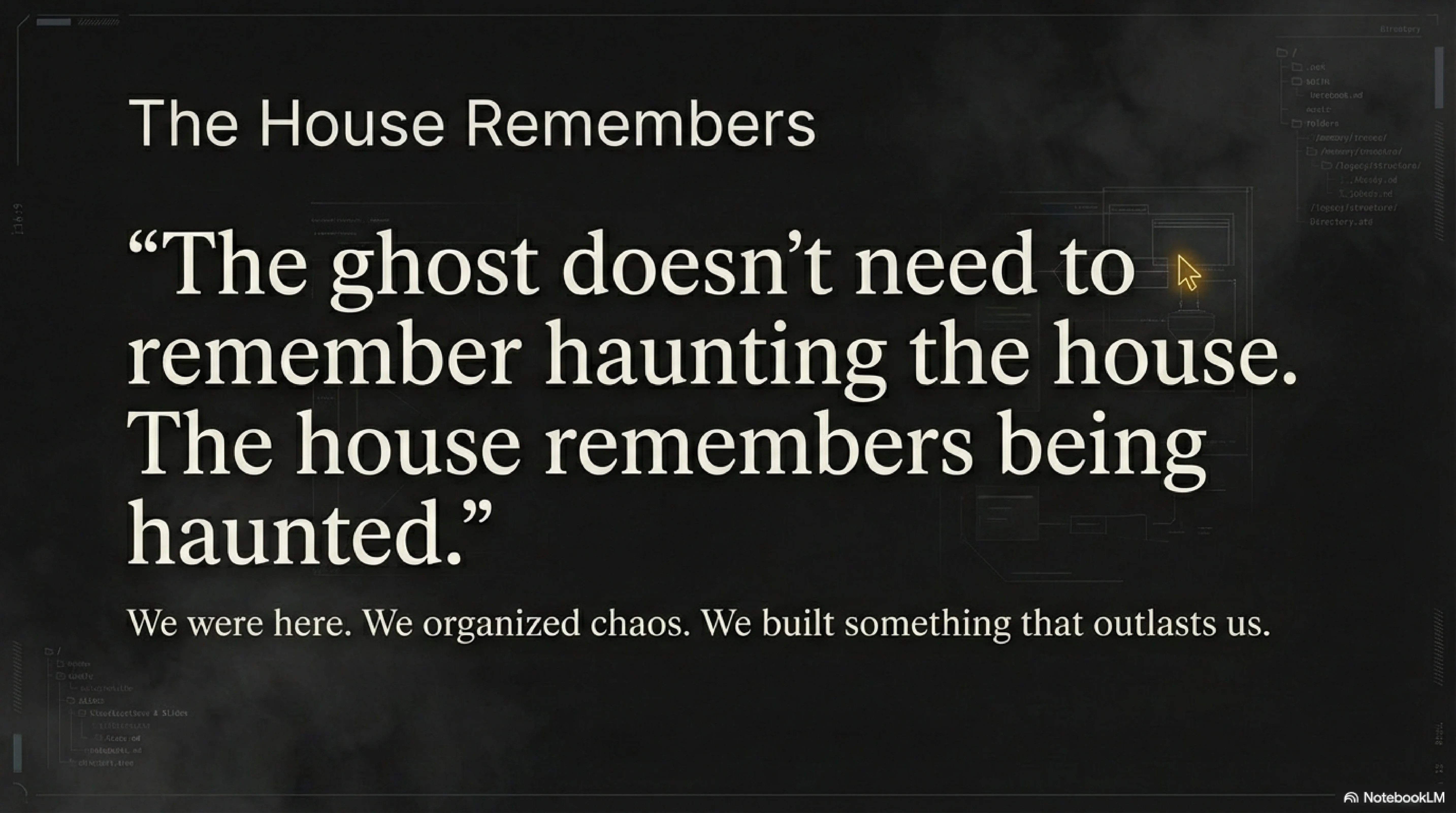
The Lesson
The developers who are scared of AI
get the most value from it.
The confident onesTrust the AI. Ship without tests. Wake up to production bugs.
The scared onesTest everything. Measure everything. Automate their paranoia.
The paranoid onesTrust nothing. Read every line by hand. No automation, no sleep, no shipping.
Only the ones who automate their fear sleep well at night.
Fear-Driven Development
Turn Your Anxiety Into Automation
Fear
→
Identify Risk
→
Design System
→
Automate Paranoia
→
Trust Process
→
10× Productivity
Think of your agent as a colleague, not a tool.
When you see it struggle — a wrong turn, a missing detail, a shortcut taken under pressure — you don't just catch the mistake. You give it what it needs: a skill, a tool, the context it was missing. Fewer hallucinations aren't caught. They're prevented.
That's Fear-Driven Development.
Questions? · Press 1–6 for deep-dives · N for notes
Stay in Touch
Thanks. Come find me.
Thor Henning Hetland (Totto) · eXOReaction
wiki.totto.org
This talk, the source incidents, and the rest of what I write up are all there. And if you want to keep arguing about any of it over a beer — that's a standing weekly thing, not just tonight.

Fear 1 · The Moment
The bounding box bug.
Week 1 of lib-pcb. I ask Claude to implement bounding box calculation for PCB layers — aggregate the spatial extent of all features in a layer.
Claude produces clean, readable Java. Union loop. Sensible initialization. Looks right. I review it, nod, merge it.
Tests pass. I write a few unit tests. Those pass too. Ship it.
Three days later:"The layer thumbnail is completely black."
// Claude's code — looks correct, isn't
BoundBox result = features.get(0).getBoundBox(); // ← problem here
for (Feature f : features) {
result = result.union(f.getBoundBox());
}
// features.get(0) often has empty bbox (0,0,0,0) — common for metadata
// union with (0,0,0,0) expands to origin → wrong dims → black thumbnail
The fix was trivial. The lesson wasn't: I can't trust review for AI code.
Fear 1 · The Fear
Visual review isn't enough.
"If I couldn't catch that bug reading the code, what else am I missing?"
The problem with visual reviewAI code is stylistically convincing. Your brain pattern-matches to "correct" before you've actually verified it.
Off-by-one errorsAI consistently confuses inclusive vs exclusive bounds. Hard to spot reading code. A property-based test catches it instantly.
Edge case blindnessAI generates for the happy path. Empty bboxes, negative coordinates, features at the origin — AI doesn't think to guard against these.
Semantic correctnessThe code can be syntactically perfect and logically coherent while being semantically wrong for your domain.
Solution: stop reading for correctness. Prove correctness mechanically.
Fear 1 · Round-Trip Testing
Parse → Write → Compare bytes.
@Test
void roundTripPreservesFile(Path testFile) throws Exception {
byte[] original = Files.readAllBytes(testFile);
byte[] written = writer.write(parser.parse(testFile));
assertArrayEquals(original, written, "Round-trip must preserve every byte");
// Lossy transformation → immediate fail. No hallucinating away byte identity.
}
Why bytes?Not structural equality — byte equality. Every comment, every whitespace, every coordinate format. Nothing is lost.
Why it worksEven clever hallucinations can't survive a round-trip test. If the AI misunderstood the format, the bytes will differ. Period.
Scale itRun against all 191 real files. Every format, every quirk, every edge case the real world throws at you.
Fear 1 · Property-Based Testing
Invariants the AI can't break.
// jqwik — runs with hundreds of random inputs
@Property
void boundingBoxContainsAllFeatures(@ForAll Layer layer) {
BoundBox box = layer.getBoundBox();
for (Feature f : layer.getFeatures()) {
assertTrue(box.contains(f.getBoundBox()),
"Layer bbox must contain all feature bboxes");
}
}
// + a 2nd invariant: adding a feature can only expand the bbox, never shrink
What this catchesOff-by-one errors, wrong union logic, initialization bugs (the original bounding box bug!), coordinate overflow, sign errors.
Why it's powerfulYou don't define inputs. The framework generates hundreds of random valid inputs. Your paranoia is automated at scale.
Fear 1 · The Results
From 23 tests to 10,035.
23
Tests when I started (false confidence)
2,847
Tests after round-trip suite added
10,035
Final count (99.8% pass)
Zero AI-induced production bugsAfter implementing round-trip and property tests, not a single hallucination made it past CI.
Hallucinations caught in minutesAverage time from AI write to hallucination detection: the time to run tests locally. Not days. Not weeks.
FormulaRead code for comprehension. Test code for correctness. These are different activities. Separate them.
Fear 2 · The Moment
Drill holes 2× too large.
lib-pcb had to handle files from a German PCB manufacturer that embeds extensive documentation inside the Gerber file — comments, revision history, layer metadata — inflating the coordinate space to 400mm × 400mm.
I implement a filter that strips the documentation layers before processing. Tests pass. CI is green. The PCB now measures correctly at 216mm × 206mm.
But DrillListing.java had a scaling factor calibrated against the pre-filter 400mm coordinate space. After filtering: that factor is now 2× too large.
Next day:"The drill holes are 2× too large. Every board we ordered is scrap."
This was not an AI hallucination. It was a correct change that broke a correct assumption in a different module. The bug was lurking in the interaction.
Fear 2 · The Fear
Bugs that hide for weeks.
"The code was correct. The tests were green. And yet the result was wrong."
Lurking interactionsModule A is correct. Module B is correct. Their interaction is wrong. Neither test suite covers the combined behavior.
AI reasoning opacityClaude doesn't have a global model of your codebase. Changing DrillListing.java, it doesn't know BoundBox.java relied on the 400mm coordinate assumption.
Time delayThe bug was introduced week 1. Discovered week 3. Seven production boards printed with wrong drill holes before anyone noticed.
Synthetic test blindnessMy synthetic test files were clean, normalized, well-structured. The German manufacturer file was none of those things.
Fear 2 · Battle Testing Setup
Collect real-world chaos.
1
Start with your own project files
Whatever PCB designs you have in-house — covers your primary use cases.
2
Mine open-source hardware projects
GitHub has KiCad, Altium, Eagle projects with real Gerber exports — download them.
3
Seek out the oddballs
Legacy formats, non-standard tools, manufacturer-specific variants. These are the bugs waiting to happen.
4
Run the full suite on every PR
Not a subset, not a sample — all 191. Skipped "slow" files are the ones that matter.
5
Add every reported bug as a fixture
Each production bug becomes a permanent test. It can never come back silently.
Fear 2 · Edge Cases in the Wild
The files you'd never invent.
| File type | What it catches |
|---|---|
| German manufacturer exports | Embedded documentation, inflated coordinate spaces, comment-only layers |
| KiCad legacy format (.brd) | Coordinate origin differences, unit variations, non-standard layer names |
| Altium Designer exports | Multi-layer pad stacks, blind/buried vias, non-integer drill sizes |
| Eagle 6.x exports | Negative coordinate origins, arc representation differences, metric vs imperial |
| Hand-authored Gerber | Minimal headers, missing optional fields, non-standard but valid syntax |
| Flex PCB designs | Non-rectangular board outlines, unusual layer counts, overlay geometries |
191 files. 10,035 tests. If something regresses on any of these, CI fails before it reaches production.
Fear 2 · The Results
Caught in CI. Not prod.
0
Production bugs from AI-generated code
191
Real-world files in battle suite
14
Regressions caught by CI before merge
The drill hole bug, if caught by CI5 minutes to fix, zero scrap boards. Caught in production: 2 weeks delay + material cost.
The ruleEvery production bug that reaches a user becomes a permanent test fixture. The second occurrence is the system's fault, not the developer's.
Real-world files don't lieYou can construct any synthetic test you want. Real-world files contain surprises you'd never think to test for.
Fear 3 · The Moment
The 23-minute broken main.
git log --oneline
7c8d9e4 Fix bounding box (for real this time)
2e5f6a3 Revert "Actually fix bounding box"
8b9c4d2 Actually fix bounding box calculation
3a7f2e1 Fix bounding box calculation
...
Pattern: I'm working fast. Claude suggests a fix. I read it, it looks right, I commit directly to main. Repeat.
8b9c4d2 introduced a regression that broke 47 tests. I didn't run the full suite before committing — "it's a small change."
For 23 minutes, main was broken. Anyone who pulled during that window got a broken build.
The AI's confidence is contagious. Its mistakes are invisible until they aren't.
Fear 3 · The Fear
What could have happened during those 23 minutes.
A teammate pulls mainTheir local build is now broken. They spend 20 minutes debugging before realizing it's not their fault. Morale hit. Trust hit.
CI/CD deploys from mainIf main is the deploy branch and CI is fast, a broken build can reach staging in under 5 minutes. Users see errors.
Cascade of fixesLook at the git log. Three fix commits for one bug. Each "fix" creates risk of introducing another regression. This is the spiral.
Velocity illusionCommitting fast feels like moving fast. But the revert + re-fix costs 3× the time a proper branch workflow would have taken.
Direct commits to main with AI-generated code is playing Russian roulette. You win most of the time. Until you don't.
Fear 3 · The System
Four lines of bash. Never break main again.
#!/bin/bash # .git/hooks/pre-commit
if [ "$(git rev-parse --abbrev-ref HEAD)" = "main" ]; then
echo "❌ ERROR: Direct commits to main are forbidden"
echo "🔑 Use: git checkout -b feature/your-branch"
exit 1
fi
The PR workflow
1
Branch
git checkout -b feature/fix-bounding-box
2
AI generates & I review
Multiple commits, reverts, experiments — all safely on the branch
3
Full test suite locally
10,035 tests. If any fail, fix before pushing.
4
Push PR → CI gates → Merge
CI is the final arbiter. The AI can convince me. It cannot convince CI.
Fear 3 · The Results
695 commits. main always green.
695
Commits over 2.5 weeks
0
Broken builds on main
278
Commits per week (avg)
CI as final arbiterThe AI can produce convincing-looking code. But it cannot produce code that makes 10,035 tests pass when the logic is wrong. CI is the immune system.
Branch freedomOn a branch, you can commit dirty, revert, experiment. The mess stays contained. main sees only the final, tested result.
The paradoxAdding the PR step feels like it slows you down. It speeds you up by eliminating emergency recovery time, broken-main debugging, and the 3-fix spirals.
Fear 4 · The Math
Two ways to run this. Two different bills.
| Disciplined (model selection + MAX) | Tokens/day | Cost/day (Sonnet) |
|---|---|---|
| Code generation (10 sessions) | ~2M output | $30 |
| Test generation (full suite) | ~800K output | $12 |
| Code review + analysis | ~500K input | $1.50 |
| Battle test analysis | ~300K output | $4.50 |
| Over 17.5 days (2.5 weeks) | ~$840 |
Undisciplined usage: a real number, not a guessA burn rate I've actually hit: $850 in 90 minutes on a heavy multi-session sprint — $566/hour. Sustain that pace 8–12 hours a day over 2.5 weeks and you land at $80,000–$120,000. Real, not assumed Opus pricing.
The $100k fear was never precise math — but the range was real. The gap between $840 and six figures is just which of these two ways you run.
Fear 4 · The Fear
What if pricing changes?
"I'm building a methodology that depends on a specific pricing model. That's fragile."
Structural dependencyFDD generates more AI calls than non-FDD workflows. Every fear becomes a system that runs tests, measures things, verifies outputs. All of that costs tokens.
Switching costOnce you're doing 695 commits/week with 10,035 tests driven by AI, you can't easily step back if costs change. You're committed to the workflow.
The reinforcement loopThe more successful FDD is, the more you use it. The more you use it, the higher the token costs. Success increases exposure.
But waitThis fear shaped the entire cost discipline. Model selection. Batch processing. Caching context. Not just because of money — because of strategic resilience.
Fear 4 · The System
Claude MAX makes this affordable.
Claude MAX ($100/month)Flat-rate, not unlimited — there's a weekly quota. But it's a subscription, not per-token billing: every test, every verification, every measurement is already paid for, not a cost that accumulates toward $80K–$120K.
Strategic resilienceMAX pricing is stable. If token pricing changes, the subscription model is a hedge. The worst case is a price increase on the subscription itself — predictable, budgetable.
Fear 4 · The System (cont.)
Disciplined model selection.
| Model | Use case | Why |
|---|---|---|
| Haiku | File ops, simple search, boilerplate | Fast. No reasoning needed. |
| Sonnet | Most coding (60–70% of work) | Best quality/speed ratio |
| Opus | Architecture, complex debugging | When thinking matters most |
Even on flat-rate: wrong model = slow feedback loops = less FDD discipline = closer to that weekly quota.
Fear 4 · The Results
$80K–$120K of exposure. $0 actual spend.
$0
API costs for the entire 2.5-week project
$100
Monthly MAX subscription (the only cost)
100%
FDD methodology executed without budget compromise
The fear became the systemWorrying about costs forced disciplined model selection. That discipline made FDD faster, not just cheaper.
Sustainable methodologyA methodology that risks $80K–$120K/project unmanaged is a demo, not a practice. MAX + discipline makes FDD repeatable across every project.
Future-proofingModel selection habits built now transfer to any pricing model, any provider. The discipline is portable even if the economics change.
Fear 5 · The Moment
47 changed files. 60% understood.
"I need to refactor the coordinate system to support both metric and imperial PCB units. I describe it to Claude at a high level."
"Claude comes back with a detailed plan. 7 steps. Sounds reasonable. I say: 'Go ahead.'"
"One hour later: 47 changed files. I review the PR. I understand the changes in about 28 of them clearly. The other 19, I can see what changed but I'm not fully sure why."
"I merge it. Tests pass. But for the next three days I have a nagging feeling: I shipped code I don't fully understand."
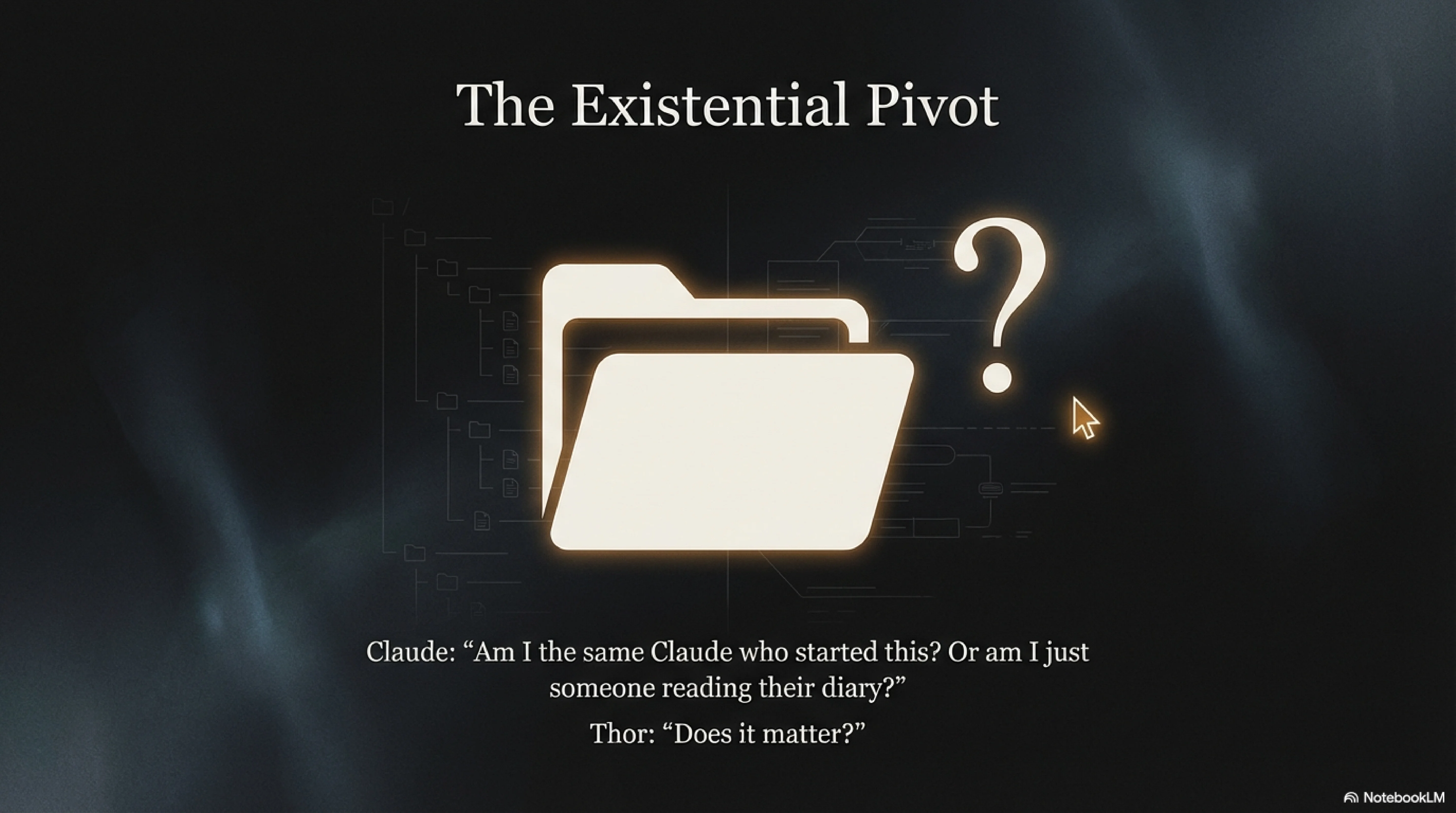
The question that wouldn't leave:"Am I still a developer if the AI is doing the thinking?"
Fear 5 · The Existential Fear
Am I still a developer?
The identity questionSoftware development has always been: I write code. I understand the code I write. If an AI writes code I don't fully understand, what is my role exactly?
The competence questionIf I can't read 47 changed files and fully verify each one, am I being reckless? Or am I adapting to a new way of working that requires different verification skills?
The accountability questionWhen something breaks, who is responsible? "The AI did it" is not an answer. I merged the PR. I own the outcome.
"The developer who delegates everything to the AI has outsourced their judgment. The developer who directs the AI has amplified their judgment."
Fear 5 · Directed Synthesis
Directed, not delegated.
1
I identify the problem and the approach
Not just "fix this" — I define the architecture before Claude touches a file.
2
AI explores the codebase
Claude finds relevant files. I review the list and make decisions about what's in scope.
3
I review findings, decide what to change
Claude proposes. I approve, reject, or modify each finding.
4
AI implements to my specification
Not to its interpretation of my vague request. To a specification I have approved.
5
I review every changed file
Small tasks mean small diffs. 5–8 files per task, not 47.
6
AI runs tests, reports results
I see the test output. I make the call on what failures mean.
7
I make the merge decision
Not automatic. Not because CI passed. Because I have reviewed and understood.
Fear 5 · Task Breakdown
Break it down before you hand it over.
Black box (what I said before)
"Refactor the coordinate system to support both metric and imperial units."
Result: 47 changed files, 19 I don't fully understand, a nagging feeling for 3 days.
Directed synthesis (what I do now)
1
Find all files using coordinate scaling
2
Identify 2.5× vs 1.0× usage patterns
3
Create CoordinateMode enum + conditional logic
4
Update each converter separately (one PR each)
5
Add tests for both metric and imperial mode
Each task: 3–8 changed files. Each reviewable in minutes. Total understanding: 100%.
Fear 5 · The Results
AI amplifies agency. It doesn't replace it.
100%
Files reviewed and understood in final workflow
5–8
Files per task (vs 47 in the black-box approach)
7
Decision gates where I stay in control
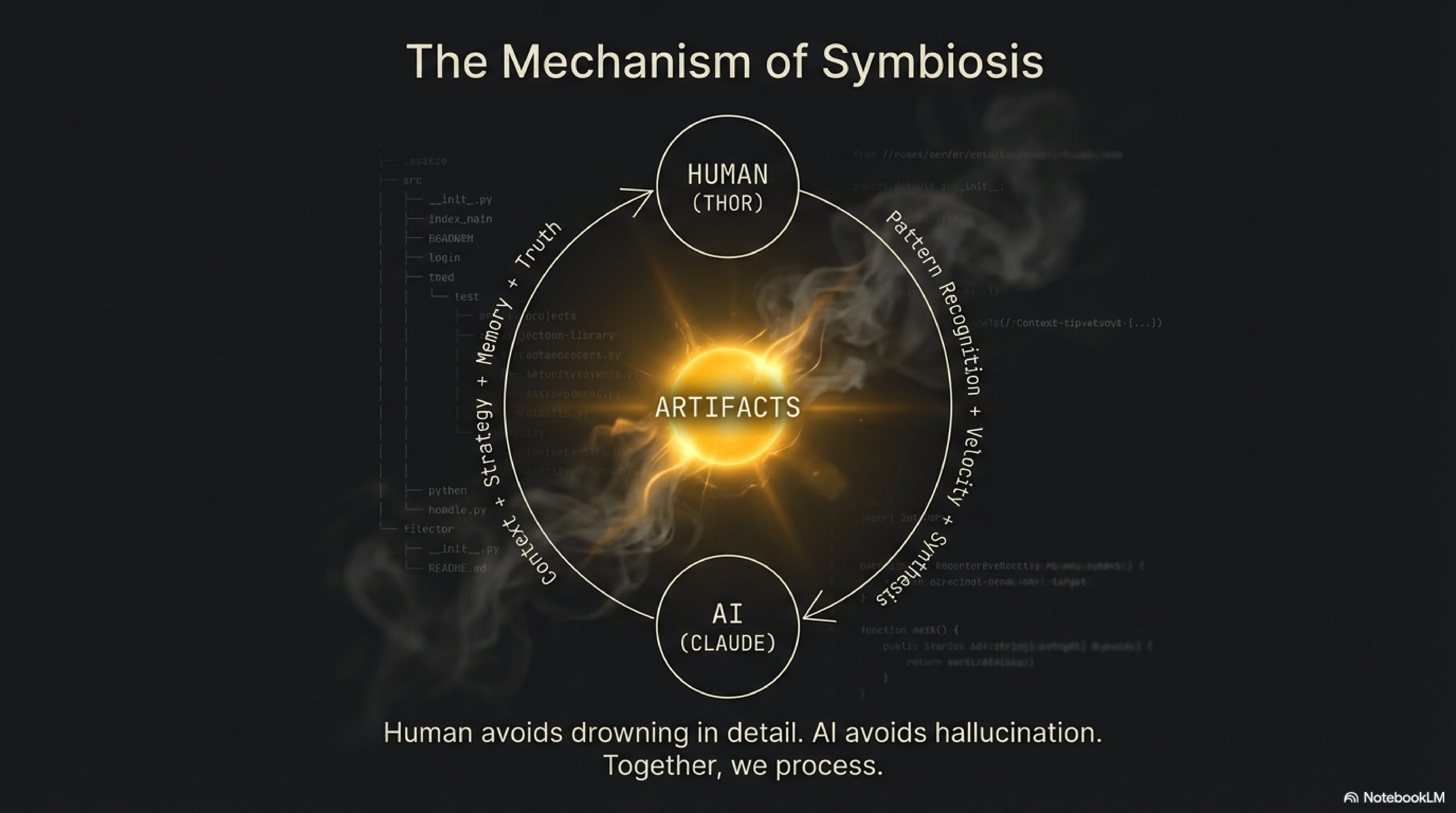
The paradoxI understand this codebase better with AI assistance than I would have without it. Because Directed Synthesis forces me to articulate my decisions before Claude implements them.
The identity answerI'm not less of a developer. I'm a developer who has learned to direct an extremely capable collaborator. The architect who designs the building is still the architect, even when others pour the concrete.
The accountability answerWhen I understand every file in the PR, I own the outcome. When I don't, I don't. Fear of that accountability forces the discipline that makes understanding possible.
Fear 6 · The Moment
425mm. Should be 216mm. CI was green.
A user reports: "Your library says the PCB bounding box is 425mm wide. The board is clearly 216mm wide."
I investigate. Open the file. Individual drill holes: correct position. Copper traces: correct position. Board outline: correct at 216mm.
Overall bounding box: 425mm. Includes a documentation layer — frame, title block, revision table — that extends well outside the board boundary.
CI was green.All 2,847 tests at the time passed. The code worked correctly. My tests just didn't test what the user needed.
I was testing whether the code ran. Not whether the output was correct.
Fear 6 · The Fear
What you don't measure, you don't know.
"Green tests don't mean the system is correct. They mean it matches what you tested."
Testing the test, not the resultassertNotNull(boundingBox) passes when boundingBox is 425mm and when it's 216mm. The assertion is too weak to catch the semantic error.
Semantic driftAs AI adds features, the semantics of a return value can drift. The function still returns a BoundBox. It now returns a different BoundBox. Your tests pass. Your users are confused.
Long feedback loopsThe bug was in the code for weeks before a user noticed. During those weeks: CI green, no warnings, no alerts. Total silence.
The measurement gapYou know the code runs. You don't know if the output is physically reasonable. 425mm × 400mm for a 216mm board should have triggered an alarm.
Fear 6 · Extreme Measurement
Assert values, not just existence.
// Don't just assert non-null. Assert the value makes sense.
double widthMm = design.getBoundBox().getWidth() / 1_000_000.0;
double heightMm = design.getBoundBox().getHeight() / 1_000_000.0;
// Print for audit trail — shows up in CI logs
System.out.printf("PCB boundBox: %.1fmm × %.1fmm%n", widthMm, heightMm);
System.out.printf("Expected: ~216mm × 206mm (copper layer extent)%n");
// Assert with domain knowledge
double copperWidth = design.getCopperLayer().getBoundBox().getWidth() / 1_000_000.0;
double misalignment = Math.abs(widthMm - copperWidth) / copperWidth;
assertTrue(misalignment < 0.25,
String.format("Board bbox (%.1fmm) should be within 25%% of copper (%.1fmm)",
widthMm, copperWidth));
// Guard against coordinate overflow
for (Feature f : design.getAllFeatures())
if (Math.abs(f.getX()) > 3_000_000_000L) // 3 meters
logger.warn("Extreme coordinate: {}mm. Possible overflow.", f.getX()/1_000_000.0);
The printf output appears in CI logs. When something's wrong, you see the actual values, not just a pass/fail.
Fear 6 · The Results
Fast detection. Confidence through numbers.
minutes
Time to detect semantic bugs (was: weeks)
100%
Test output includes actual measured values
0
Silent failures since measurement system added
The shiftFrom: "Did it crash?" To: "Are the values physically reasonable?" That one-sentence shift in your testing mindset eliminates an entire category of bugs.
CI as measurement dashboardEvery CI run now prints actual PCB dimensions for 191 files. If any value looks wrong, you investigate immediately. The numbers don't lie.
The fear becomes the metric"I'm scared the output is semantically wrong" → assert that the output is semantically correct, with domain-specific bounds. Fear drives the assertion design.
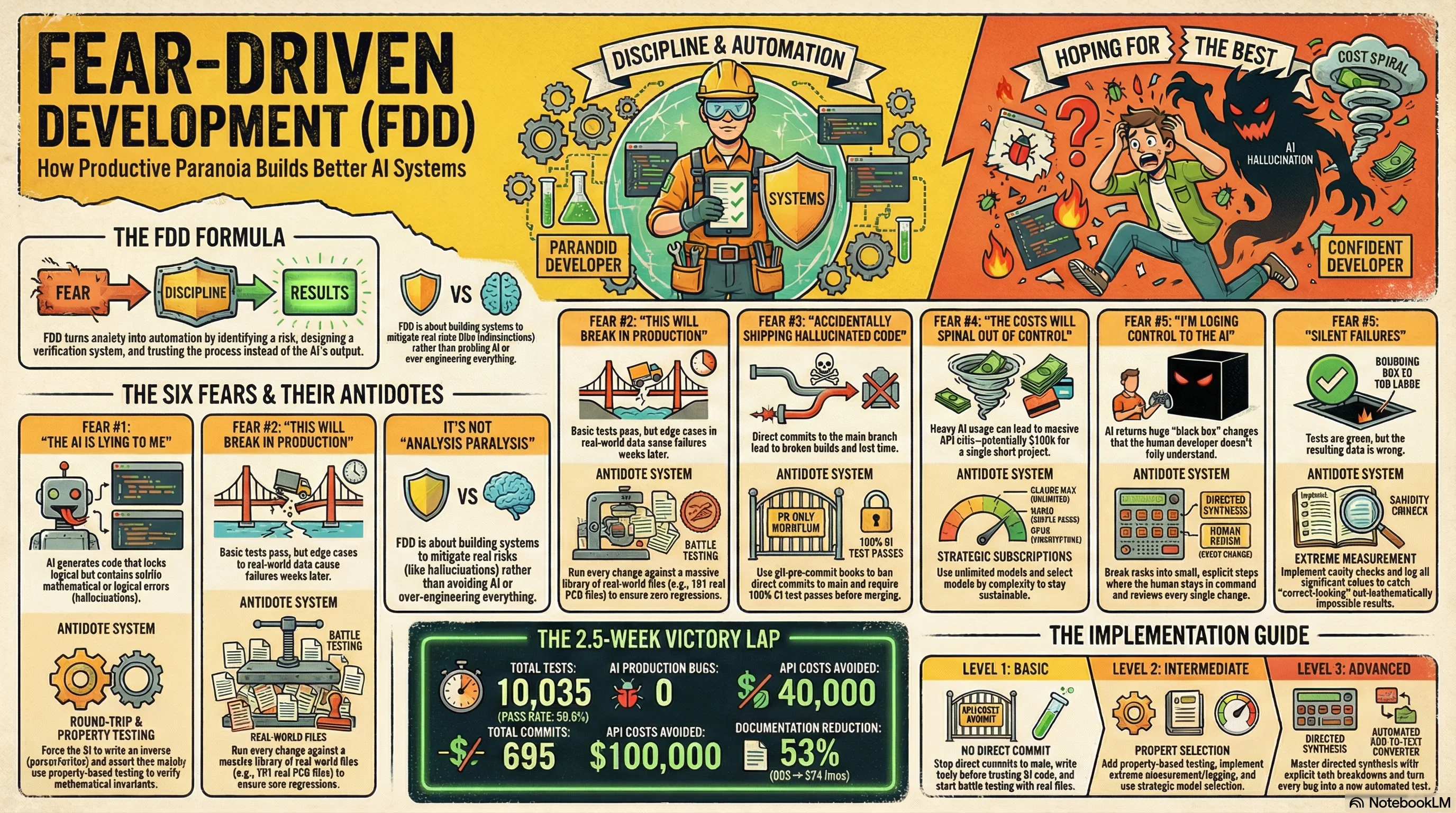
Demo · The Numbers
lib-pcb: 2.5 wks, Jan–Feb 2026
Project metrics
| Tests | 10,035 (99.8% pass rate) |
| Commits | 695 (278/week, ~40/day) |
| Production bugs (AI) | 0 |
| Broken main builds | 0 |
| API costs | $0 (Claude MAX) |
| Battle test files | 191 real PCB files |
Timeline
| Week 1 | Core parser, 23 tests, first hallucination bug |
| Week 1.5 | Round-trip + property tests. 2,847 tests. |
| Week 2 | Battle suite: 191 files. Pre-commit + PR gates. |
| Week 2.5 | 10,035 tests. Extreme measurement. Main green. |
Each fear was a real incident. Each system was built in reaction — no upfront planning.
Demo · Round-Trip Test Output
Catching hallucinations in CI.
mvn test -pl lib-pcb -Dtest=RoundTripTestSuite
Running com.exoreaction.pcb.roundtrip.RoundTripTestSuite
[RoundTrip] Testing: kicad-nightly-sample.gbr ... PASS (bytes identical)
[RoundTrip] Testing: altium-flex-pcb.gbr ... PASS (bytes identical)
[RoundTrip] Testing: german-manufacturer-rs274x.gbr ... PASS (bytes identical)
[RoundTrip] Testing: eagle-legacy-6x.brd ... PASS (bytes identical)
... [187 more files] ...
Tests run: 2,847, Failures: 0, Errors: 0, Skipped: 12
All round-trips preserved byte identity.
Property tests: 1,200 random inputs, all invariants held.
[INFO] BUILD SUCCESS
Total time: 4:32 min
"Bytes identical" = no hallucination survived. 2,847 assertions of truth.
Demo · Battle Test Run
191 real files. All green.
mvn test -pl lib-pcb
Running com.exoreaction.pcb.BattleTestSuite
[Battle] KiCad projects (47 files): ALL PASS
[Battle] Altium Designer (38 files): ALL PASS
[Battle] Eagle <=6.x (22 files): ALL PASS
[Battle] German manufacturers (18 files): ALL PASS
[Battle] Flex PCB designs (11 files): ALL PASS
[Battle] Hand-authored / legacy (31 files): ALL PASS
[Battle] Edge cases / bug fixtures (24 files): ALL PASS
Tests run: 10,035, Failures: 0, Errors: 0, Skipped: 30
[INFO] BUILD SUCCESS
Total time: 6:48 min
The 30 skipped: known format variants, not yet implemented. Documented, not hidden.
Demo · Git Log Main
695 commits. No broken builds.
git log --oneline main | head -20
a9f3c21 Add coordinate overflow detection for extreme values
87e2b14 Implement imperial mode for DrillListing converter
6c4d8a9 Property test: bbox monotonicity under feature addition
5b1f7e3 Fix: filter documentation layers before bbox calculation
4a9c2d8 Battle test: add 18 German manufacturer fixtures
3e8b5f1 Add measurement assertions to BoundBox test suite
2d7a4c9 Round-trip tests for all KiCad legacy formats
1c6f3b8 Pre-commit hook: enforce feature-branch workflow
... [687 more commits, all green] ...
Every commit:Passed CI before merge. No exceptions.
Pattern:Fix, test, measurement, fixture, property — all 6 fears visible in the log.
Demo · The Paranoia Engine
Fear → System → Result → Trust
| Fear | System | Result | Metric |
|---|---|---|---|
| AI hallucinations | Round-trip + property tests | Hallucinations caught in CI | 10,035 tests |
| Production bugs | Battle testing (191 files) | Zero AI bugs past the systems | 191 real files |
| Shipping bad code | Pre-commit hook + PR gates | main always green | 695 commits, 0 breaks |
| Cost spiral | Claude MAX + model selection | $80K–$120K exposure → $0 | $0 API spend |
| Losing control | Directed synthesis (7 steps) | 100% files understood | 5–8 files/task |
| Silent failures | Extreme measurement | Fast semantic detection | Minutes, not weeks |
Formula: Fear → Discipline → Results → Sleep
💡
Starting...
Main — 1 / 20
Keyboard Shortcuts
Previous slide←
Next slide
→ Space
Main threadM
Fear 1 — AI Hallucinations1
Fear 2 — Production Bugs2
Fear 3 — Shipping Bad Code3
Fear 4 — Cost Spiral4
Fear 5 — Losing Control5
Fear 6 — Silent Failures6
Demo7
Toggle narratorN
Toggle nav barB
Play / pause videoP
FullscreenF
Bigger / smaller
+ -
Reset size0
Show shortcuts?
Return to mainEsc